Austria continues to be viewed predominantly positively by Ukrainians: in August 2026, about 52.7% of respondents expressed a positive attitude toward the country, while only 2.7% expressed a negative one. At the same time, 41.7% of those surveyed hold a neutral position, which remains a distinctive feature of perceptions of Austria, according to the Experts Club Information and Analytical Center.
According to the results of the August survey, 15.3% of Ukrainians have a completely positive attitude toward Austria, and 37.4% have a mostly positive attitude. A neutral response was chosen by 41.7% of respondents. 2.3% view the country mostly negatively, only 0.4% view it entirely negatively, and another 2.9% were undecided.
Thus, the balance of positive and negative assessments, when rounded, stands at approximately plus 50 percentage points. There are nearly 20 times as many positive responses as negative ones; however, Austria differs from a number of other Western European countries in having a significantly higher proportion of neutral attitudes.
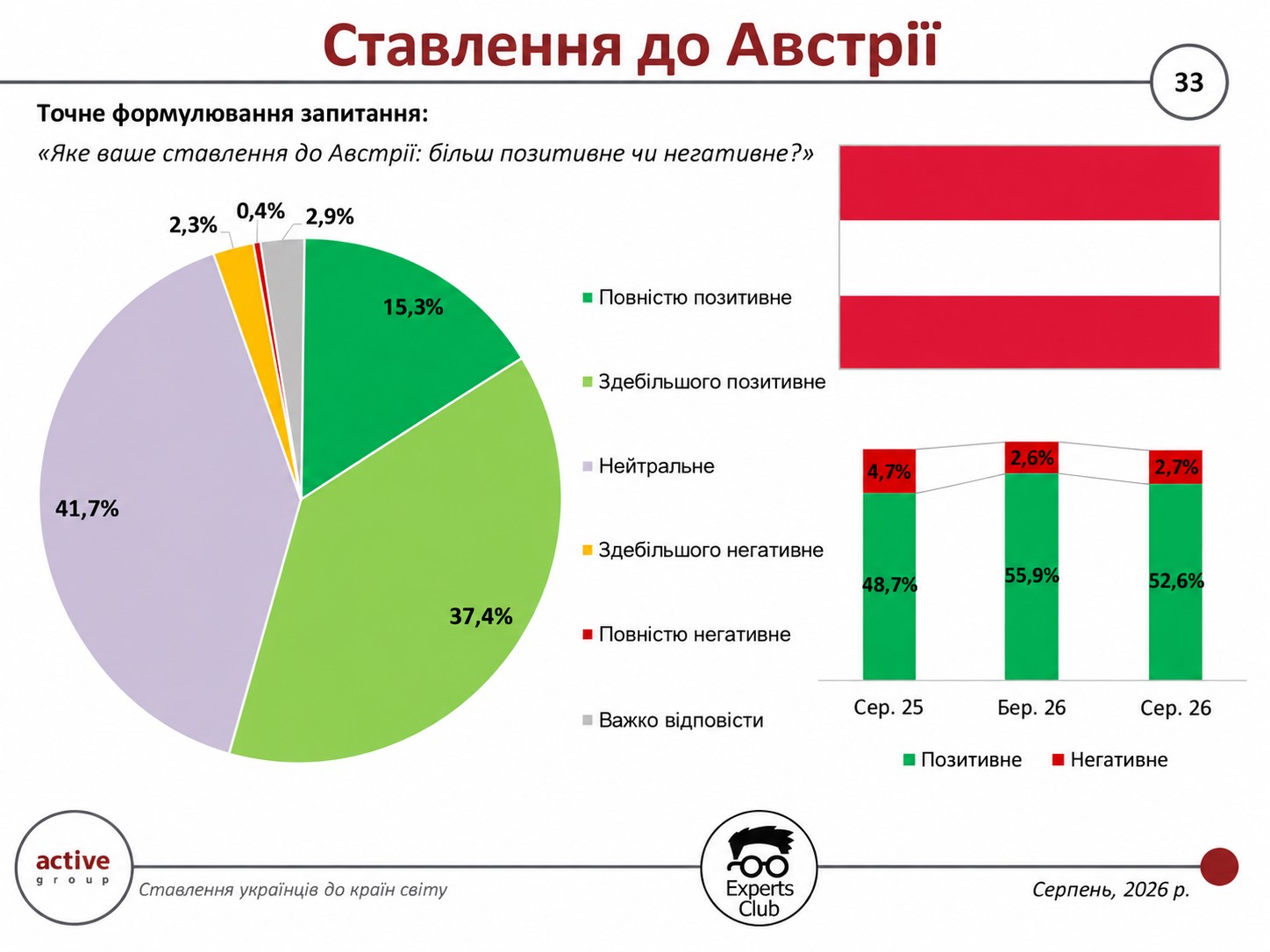
Compared to March 2026, the proportion of positive assessments has decreased slightly. In the previous survey wave, 17.5% of respondents had a completely positive attitude toward Austria, and 38.5% had a mostly positive attitude, meaning the combined positive rating was about 55.9%. A neutral stance was held by 40.3% of respondents, while about 2.6% expressed a negative attitude.
Thus, over the course of five months, the share of positive assessments decreased by approximately 3.2 percentage points—to 52.7%. The share of negative assessments remained virtually unchanged—about 2.6% in March compared to 2.7% in August—while the neutral segment increased by 1.4 percentage points. The most notable decline was in the share of entirely positive responses—from 17.5% to 15.3%.
This pattern indicates that the slight weakening of the positive rating is not accompanied by a shift toward a negative attitude among a significant portion of respondents. A neutral stance remains the primary alternative to a positive assessment of Austria.
Oleksandr Pozniy, director of the research company Active Group, when commenting on Ukrainians’ attitudes toward Austria, previously highlighted precisely this combination of a positive image of the country with a large neutral group.
“Austria is traditionally perceived by Ukrainians as a European country with high social standards, a rich cultural heritage, and a stable political system. Although Austria is not Ukraine’s main partner in foreign policy, the overall level of favorability remains positive,” Pozniy noted.
The current wave of the survey generally confirms this assessment: the negative segment remains very small, and changes are occurring primarily among positive and neutral responses. More than nine out of ten respondents view Austria positively or neutrally.
The survey was conducted in August 2026 using self-administered online questionnaires in the SunFlowerSociology panel among 800 Ukrainian citizens aged 18 and older. The previous survey wave in March also included 800 respondents; the sample was representative by age, gender, and region, with a maximum theoretical margin of error of ±3.5 percentage points for indicators at the 50% confidence level.
ACTIVE GROUP, AUSTRIA, EUROPEAN UNION, EXPERTS CLUB, international relations, Pozniy, PUBLIC OPINION, SOCIOLOGY, UKRAINE, WESTERN EUROPE