

Switzerland continues to enjoy a high level of positive perception among Ukrainians: in August 2026, 66.9% of respondents viewed the country positively, while only 1.4% viewed it negatively. Compared to March, the share of positive assessments has decreased slightly, but the overall structure of public opinion remains stable, according to the Experts Club Information and Analytical Center.
According to the results of the August survey, 28.2% of Ukrainians view Switzerland entirely positively, and 38.7% view it mostly positively. A neutral stance is held by 29.7% of respondents. 1.2% view the country mostly negatively, 0.2% view it entirely negatively, and another 2% were undecided.
The balance of positive and negative assessments stands at plus 65.5 percentage points. Thus, positive attitudes outnumber negative ones by nearly 48 to 1. Based on this indicator, Switzerland remains among the countries with the highest level of public favor among Ukrainians.
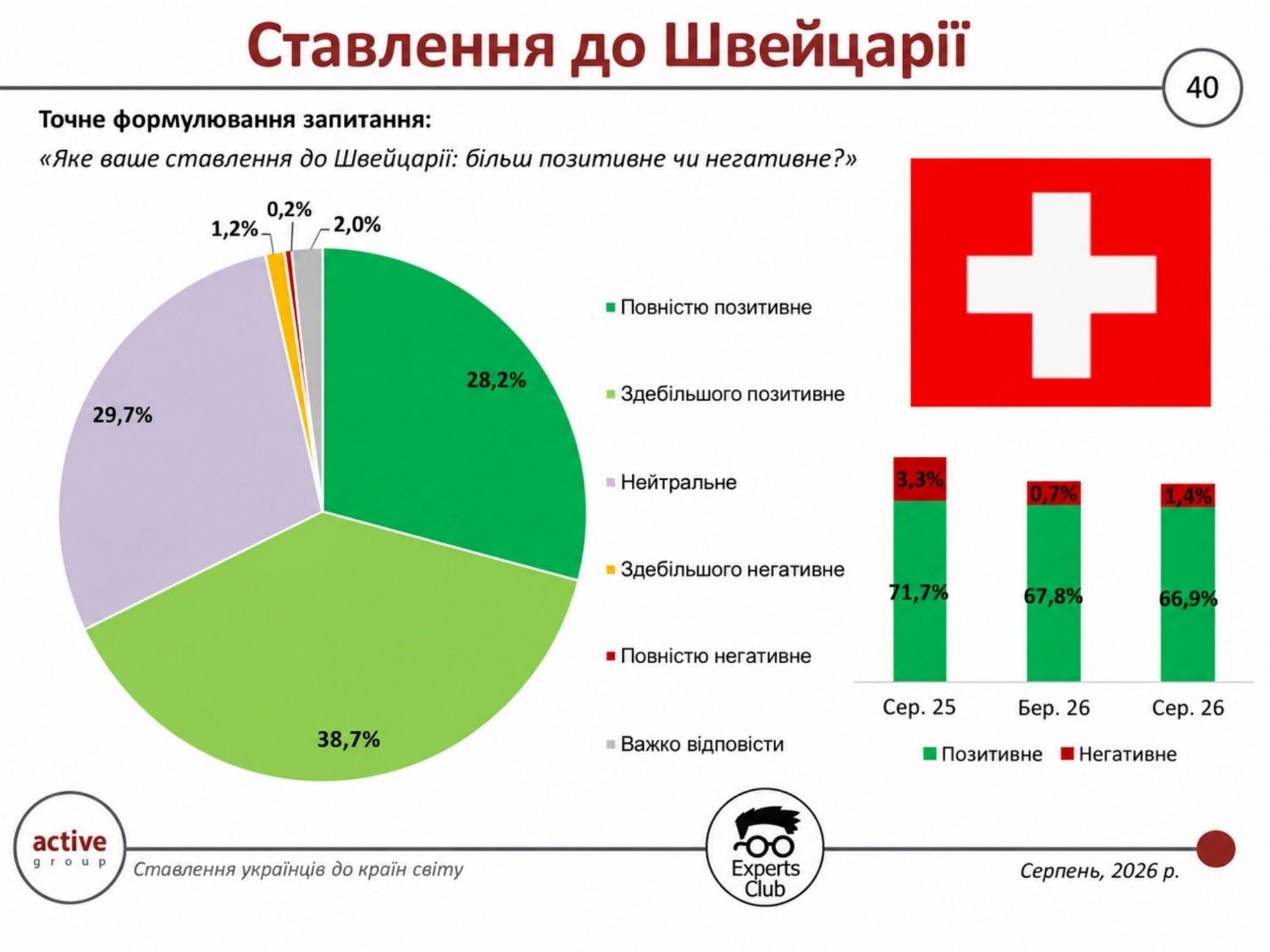
In March 2026, 67.8% of respondents viewed Switzerland positively: 29.6% viewed it entirely positively and 38.2% viewed it mostly positively. A neutral stance was held by 30.1% of respondents; only about 0.7% viewed the country negatively, while another 1.4% were undecided.
Thus, over the course of five months, the share of positive assessments decreased by only 0.9 percentage points—from 67.8% to 66.9%. Negative responses increased by 0.7 percentage points, while the neutral segment remained virtually unchanged—30.1% in March versus 29.7% in August. The balance between positive and negative attitudes decreased from approximately plus 67.1 to plus 65.5 percentage points.
The internal structure of positive responses also remains stable. The share of entirely positive assessments decreased from 29.6% to 28.2%, while the share of predominantly positive assessments even rose slightly—from 38.2% to 38.7%. This indicates minor fluctuations in public opinion rather than a significant change in perceptions of the country.
Alexander Pozniy, director of the research firm Active Group, commenting on the results of the previous wave of the survey, highlighted the enduring nature of Switzerland’s positive image.
“Switzerland is traditionally perceived by Ukrainians as a stable and neutral country with a high level of trust. At the same time, we see that some respondents are shifting to a neutral position, which may be linked to a lack of visibility regarding specific actions or projects. This does not mean a deterioration in Switzerland’s image, but rather points to the need for more active communication,” Pozniy noted.
The new round of the survey effectively confirms the stability of the ratings: the shares of positive and neutral responses changed by less than one percentage point. The negative segment, despite a slight increase, remains minimal—less than 2% of respondents view Switzerland negatively.
The previous phase of the study was conducted in March 2026 among 800 Ukrainian citizens aged 18 and older using self-administered online questionnaires on the SunFlowerSociology panel. The sample was representative by age, gender, and region; the maximum theoretical margin of error for indicators at the 50% confidence level was ±3.5 percentage points.
ACTIVE GROUP, EXPERTS CLUB, international relations, Pozniy, PUBLIC OPINION, SOCIOLOGY, SWITZERLAND, UKRAINE, WESTERN EUROPE
Austria continues to be viewed predominantly positively by Ukrainians: in August 2026, about 52.7% of respondents expressed a positive attitude toward the country, while only 2.7% expressed a negative one. At the same time, 41.7% of those surveyed hold a neutral position, which remains a distinctive feature of perceptions of Austria, according to the Experts Club Information and Analytical Center.
According to the results of the August survey, 15.3% of Ukrainians have a completely positive attitude toward Austria, and 37.4% have a mostly positive attitude. A neutral response was chosen by 41.7% of respondents. 2.3% view the country mostly negatively, only 0.4% view it entirely negatively, and another 2.9% were undecided.
Thus, the balance of positive and negative assessments, when rounded, stands at approximately plus 50 percentage points. There are nearly 20 times as many positive responses as negative ones; however, Austria differs from a number of other Western European countries in having a significantly higher proportion of neutral attitudes.
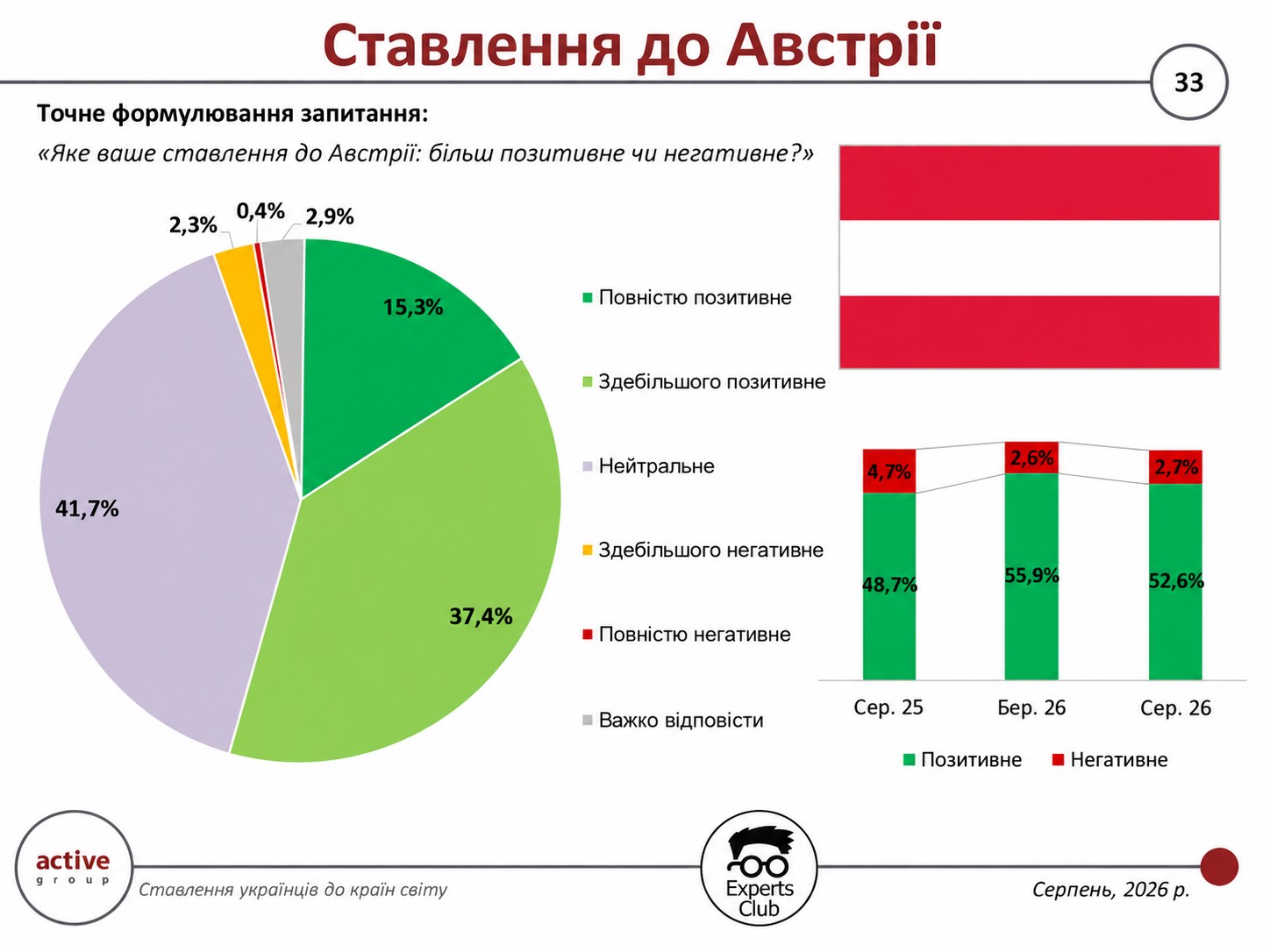
Compared to March 2026, the proportion of positive assessments has decreased slightly. In the previous survey wave, 17.5% of respondents had a completely positive attitude toward Austria, and 38.5% had a mostly positive attitude, meaning the combined positive rating was about 55.9%. A neutral stance was held by 40.3% of respondents, while about 2.6% expressed a negative attitude.
Thus, over the course of five months, the share of positive assessments decreased by approximately 3.2 percentage points—to 52.7%. The share of negative assessments remained virtually unchanged—about 2.6% in March compared to 2.7% in August—while the neutral segment increased by 1.4 percentage points. The most notable decline was in the share of entirely positive responses—from 17.5% to 15.3%.
This pattern indicates that the slight weakening of the positive rating is not accompanied by a shift toward a negative attitude among a significant portion of respondents. A neutral stance remains the primary alternative to a positive assessment of Austria.
Oleksandr Pozniy, director of the research company Active Group, when commenting on Ukrainians’ attitudes toward Austria, previously highlighted precisely this combination of a positive image of the country with a large neutral group.
“Austria is traditionally perceived by Ukrainians as a European country with high social standards, a rich cultural heritage, and a stable political system. Although Austria is not Ukraine’s main partner in foreign policy, the overall level of favorability remains positive,” Pozniy noted.
The current wave of the survey generally confirms this assessment: the negative segment remains very small, and changes are occurring primarily among positive and neutral responses. More than nine out of ten respondents view Austria positively or neutrally.
The survey was conducted in August 2026 using self-administered online questionnaires in the SunFlowerSociology panel among 800 Ukrainian citizens aged 18 and older. The previous survey wave in March also included 800 respondents; the sample was representative by age, gender, and region, with a maximum theoretical margin of error of ±3.5 percentage points for indicators at the 50% confidence level.
ACTIVE GROUP, AUSTRIA, EUROPEAN UNION, EXPERTS CLUB, international relations, Pozniy, PUBLIC OPINION, SOCIOLOGY, UKRAINE, WESTERN EUROPE
According to Experts Club, France and the Netherlands have the highest share of positive attitudes among Ukrainians among the Western European countries included in the study — 72.8% and 71.2%, respectively. Germany is viewed positively by 69.9% of respondents, and Switzerland by 66.9%. These findings come from the third wave of the study “Ukrainians’ Attitudes Toward Countries Around the World,” conducted by Active Group in collaboration with Experts Club, reports the Experts Club Information and Analytical Center.
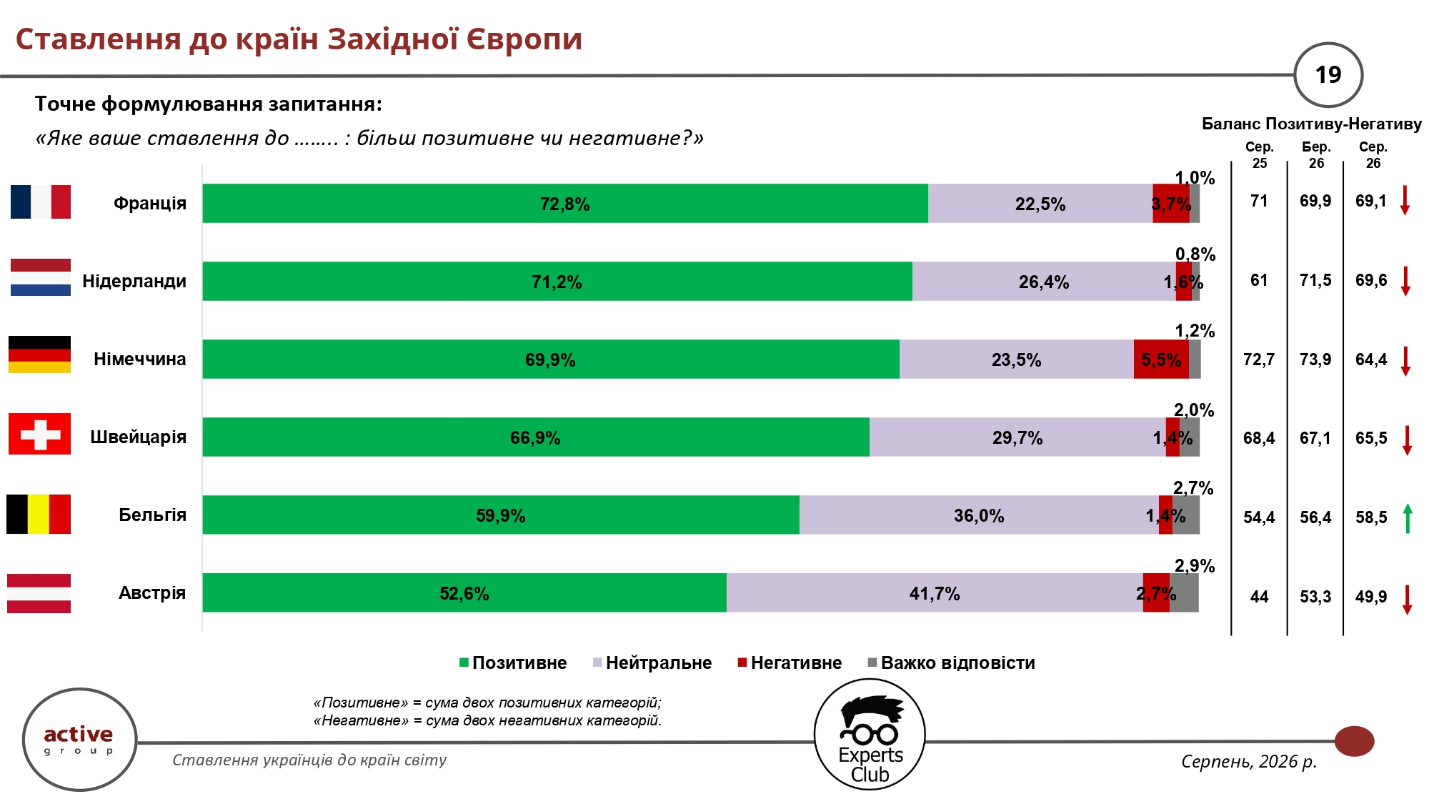
According to the results of the August survey, 22.5% of respondents have a neutral attitude toward France, 3.7% have a negative attitude, and another 1% were undecided. The balance of positive and negative assessments stands at 69.1 percentage points, compared to 69.9 percentage points in March 2026 and 71 percentage points in August 2025.
For the Netherlands, the balance of positive and negative attitudes stands at 69.6 percentage points. Specifically, 71.2% of respondents view the country positively, 26.4% neutrally, and only 1.6% negatively. In March 2026, the balance was slightly higher—71.5 percentage points—while in August 2025 it stood at 61 percentage points.
69.9% of Ukrainians view Germany positively, 23.5% neutrally, and 5.5% negatively. Its net balance fell to 64.4 percentage points, compared to 73.9 percentage points in March and 72.7 percentage points in August of last year. Thus, among the six Western European countries surveyed, Germany showed the most significant decline in this indicator between March and August 2026.
Switzerland is viewed positively by 66.9% of respondents, negatively by only 1.4%, and 29.7% hold a neutral view. The balance stands at 65.5 percentage points, compared to 67.1 percentage points in March.
Belgium is the only country in this group where the balance increased in August compared to March—from 56.4 to 58.5 percentage points. 59.9% of respondents view the country positively, 36% neutrally, and 1.4% negatively. In August 2025, the balance stood at 54.4 percentage points
Austria received the lowest share of positive responses among the Western European countries surveyed—52.6%. At the same time, only 2.7% of Ukrainians view it negatively, while 41.7% chose a neutral response. The balance stands at 49.9 percentage points, compared to 53.3 percentage points in March 2026 and 44 percentage points in August 2025. Overall, the data indicate that the lower levels of positive attitudes toward Belgium and Austria are primarily due to a higher proportion of neutral, rather than negative, assessments.
Maksym Urakin, founder of the Experts Club Information and Analytical Center, deputy director of the Interfax-Ukraine news agency, and candidate of economic sciences, emphasized the importance of systematic communication between foreign partners and Ukrainian society.
“The first recommendation is to regularly showcase concrete achievements and specific actions. The second is to be open to questions and inquiries from the media and the public,” Urakin noted.
Oleksandr Pozniy, director of the research company Active Group, for his part, drew attention to the link between public awareness and the practical development of bilateral cooperation.
“We should focus not only on raising general awareness. We need to expand cooperation with countries where we can achieve a positive balance,” Pozniy noted.
The survey was conducted in August 2026 using self-administered online questionnaires in the SunFlowerSociology panel among 800 Ukrainian citizens aged 18 and older. According to the organizers, the sample is representative in terms of age, gender, and region; the maximum theoretical statistical margin of error at a 95% confidence level is 3.5%. This is the third wave of the study, following surveys conducted in August 2025 and March 2026.
ACTIVE GROUP, AUSTRIA, BELGIUM, EXPERTS CLUB, FRANCE, GERMANY, SOCIOLOGY, SWITZERLAND, THE NETHERLANDS, UKRAINE, WESTERN EUROPE



