

For most people, the habit of sitting with their legs crossed does not in itself pose a serious health risk. This is the conclusion reached by the authors of an article published by ScienceAlert, citing The Conversation: according to their assessment, the available data does not confirm that this posture harms the back, “wears out” the hip or knee joints, or causes varicose veins.
As the authors note, the problem is more often related not to the posture itself, but to the fact that a person remains in one position for too long. It is prolonged immobility, rather than “incorrect” posture as such, that more often leads to stiffness, discomfort, and a feeling of numbness. The researchers emphasize that the modern view of posture is gradually moving away from the idea of a single “ideal” position for everyone.
The article specifically addresses the common belief that crossing one’s legs is harmful to the back. According to the data cited by the authors, studies on posture and back pain have not identified a single universal sitting position that reliably protects against problems, nor have they found evidence that ordinary everyday sitting positions in and of themselves cause damage.
A similar conclusion is drawn regarding the joints. The authors point out that the knees and hip joints endure much greater stress daily when walking up stairs, standing up from a chair, running, or carrying heavy objects than when sitting with crossed legs. Although this posture may temporarily alter the angle of the joints, there is no conclusive evidence that it leads to arthritis or long-term damage.
The popular claim linking this habit to varicose veins is also unsubstantiated. As the publication notes, the risk of varicose veins is much more strongly associated with age, heredity, pregnancy, obesity, and certain occupational factors—including prolonged standing—rather than sitting with crossed legs.
However, the authors note a caveat: in certain clinical situations, such as after some hip surgeries, doctors may temporarily recommend avoiding this position. But this does not mean it is harmful for everyone. The main practical conclusion of the review is that what matters more than “perfect posture” is regularly changing body position, moving around, and avoiding sitting in one position for too long.

According to Fixygen, Piraeus Bank ICB JSC plans to hold its annual general meeting of shareholders on April 29, 2026. The bank announced that the meeting will be held remotely. The agenda traditionally includes items related to the review of the bank’s performance and corporate governance. Piraeus Bank ICB is one of the banks with foreign capital operating in Ukraine and has been registered in the State Register of Banks since January 31, 1994.
Piraeus Bank ICB is part of the international financial group Piraeus. According to the bank’s ownership structure as of December 19, 2025, 99.991818% of the shares are owned by Piraeus Bank S.A. (Greece), with the remaining minor stakes distributed among individual minority shareholders.
Piraeus Bank MKB is a Ukrainian bank with Greek capital that serves retail and corporate clients. According to the bank, its profit for 2025 increased 8.97-fold to UAH 50.14 million, the customer loan portfolio grew by 57.14% to UAH 2.30 billion, and the share of non-performing loans stood at 3.35%.
https://www.fixygen.ua/news/20260414/aktsioneri-pireus-banku-mkb-zberutsya-29-kvitnya.html

According to Serbian Economist, the Hungarian opposition’s victory in the parliamentary elections and the upcoming change of government in Budapest have added uncertainty to the deal regarding the exit of Russian shareholders from NIS (Naftna industrija Srbije)—the company that operates Serbia’s only oil refinery in Pančevo and, according to estimates, supplies about 80% of the country’s fuel needs.
This refers to negotiations regarding the acquisition by Hungary’s MOL of a 56.15% stake in NIS, which is owned by Gazprom entities (44.9% by Gazprom Neft and 11.3% by Gazprom). In January, MOL announced the signing of a Heads of Agreement regarding this deal, as well as that it is considering the participation of ADNOC (UAE) as a minority partner.
A key factor is the deadlines set by the U.S. OFAC. In March, MOL reported that it had received an extension from OFAC on its license to negotiate until May 22, 2026. At the same time, MOL is seeking extensions of specific permits allowing it to continue operations and import raw materials during the negotiations.
The issue of price remains sensitive: the terms of the deal have not been officially disclosed. Serbian President Aleksandar Vučić previously mentioned a range of up to €1 billion for the 56.15% stake, while a number of media outlets and analytical publications cited higher estimates.
Why the Hungarian elections have become a risk factor
The deal itself is corporate in nature and requires regulatory approvals, specifically from OFAC and Serbia. However, the change in government in Hungary affects the political backdrop and the pace of decision-making. The new leader, Péter Magyar, has publicly stated his intention to form a government quickly (specifically citing May 5 as the start date), meaning just a few weeks before the May 22 deadline. In this scenario, any additional government-level reviews, disputes over the transparency of terms, or simply the restructuring of interagency coordination could cause delays.
The most likely baseline scenario is that the parties will try to meet the deadline or request an additional license extension from OFAC if they are close to the final closing. Market participants have already seen extensions in this situation.
The negative scenario is a protracted negotiation process without a clear resolution. In that case, the risks for NIS become not a legal abstraction but a matter of supply stability: the U.S. sanctions regime is specifically aimed at the exit of Russian majority owners, and any disruptions with licenses complicate the logistics and financing of raw material procurement and operations.
For Belgrade, this turns the issue into one of energy security. Serbian authorities have previously signaled their interest in increasing the state’s stake in NIS, and if the situation worsens, tougher decisions regarding the ownership structure may be necessary to remove the company from under sanctions pressure and prevent a shock to the fuel market.
https://t.me/relocationrs/2628

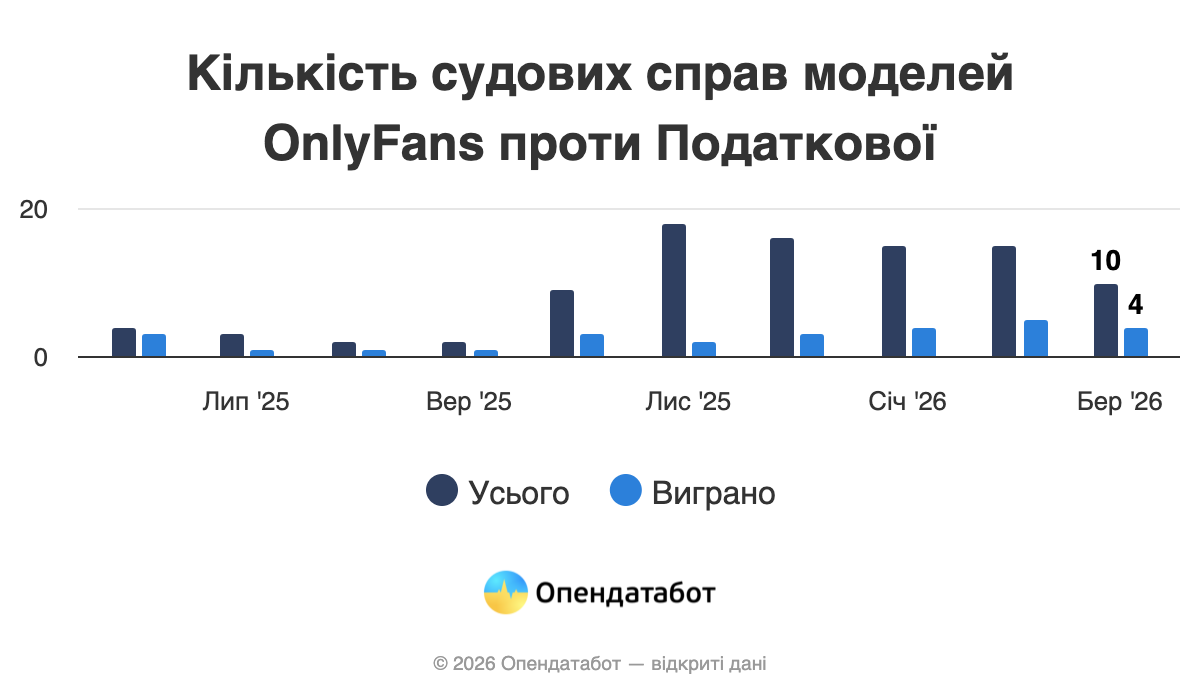
At least 27 court rulings in which OnlyFans content creators successfully challenged and partially or fully overturned fines imposed by the State Tax Service are currently listed in the Unified State Register of Court Decisions. In total, OnlyFans models have attempted to challenge the Tax Service’s actions in 94 cases. They have won nearly a third of them. In 92% of cases, procedural errors were the reason for the Tax Service’s defeats.
The number of court rulings in favor of OnlyFans content creators challenging fines and additional tax assessments from the Tax Service is rapidly increasing, according to the “Babusia” court decision search engine. At least 27 cases have been resolved fully or partially in favor of the plaintiffs. This is nearly a third of the 94 cases where models sought to defend their rights.
This year, courts have already issued 13 rulings in favor of content creators. February set a record with 5 rulings.
In 92% of cases, the courts sided with the plaintiffs due to procedural violations by the State Tax Service. Most often, the Tax Service sent documents to outdated addresses. The letters were returned, but the audits were conducted anyway. As a result, the courts ruled such audits unlawful, and along with them—all the assessments.
At the same time, the Tax Service often relied on letters from British tax authorities regarding payments from Fenix International Ltd, which operates OnlyFans. But the courts consistently emphasize: such letters are merely a pretext for an audit, not proof of income. Without bank statements, contracts, or other primary documents, the additional assessments are deemed unfounded.
One in three won cases was recorded in the Odesa region—8 court rulings. Dnipropetrovsk region follows with 5 cases. However, in some regions, particularly in the Zhytomyr and Rivne regions, despite ongoing proceedings, no cases have been won yet.
The largest fine that was successfully overturned was recorded in Kyiv—over 3 million UAH in taxes assessed on allegedly nearly 400,000 dollars in income. The plaintiff provided her own bank statements, which did not confirm these amounts—and the court ruled in her favor.
In Cherkasy Oblast, the court canceled over 1.3 million hryvnias in taxes and fines due to the complete absence of source documents. And in Odesa Oblast, the reason for canceling a fine of over half a million was a simple mistake with the address: the tax authority failed to properly notify the person of the audit, which the court deemed unlawful.
In Ivano-Frankivsk Oblast, the plaintiff independently contacted the British tax authority and received an official response: no information about her had been sent there. In fact, the State Tax Service was relying on data that did not exist. Accordingly, the court canceled all charges.
https://opendatabot.ua/analytics/onlyfance-courts

According to Serbian Economist, FAS/USDA forecasts corn production in Serbia for the 2025/2026 marketing year (beginning in October 2025) at 7.1 million tons, with a harvested area of 950,000 hectares.
Corn exports in the 2025/26 marketing year are estimated at 2.5 million tons, domestic consumption at 4.25 million tons, and ending stocks at 827,000 tons. The report notes that demand for Serbian corn on FOB terms from Danube ports is being held back by strong competition from Ukraine and Russia.
https://t.me/relocationrs/2622
In its April report, the U.S. Department of Agriculture (USDA) left its forecast for Ukraine’s corn harvest in the 2025–2026 marketing year (MY) unchanged at 30.7 million tons and exports at 22.0 million tons.
The estimate of Ukraine’s ending corn stocks also remained unchanged at 2.95 million tons.
Globally, the USDA raised its forecast for corn production in the 2025-2026 MY to 1,301.07 million tons, exports to 207.29 million tons, and ending stocks to 294.81 million tons. The agency attributes the adjustments in the corn segment in the April report mainly to South Africa, where harvest and export estimates have been raised, while figures for Argentina and Brazil remain unchanged.



