
According to Serbian Economist, the Office of Foreign Assets Control (OFAC) of the U.S. Department of the Treasury has extended the operating license of the Serbian oil company NIS until October 30, 2026, allowing the company to continue its current operations after the previous permit expires on September 30.
The license extension means that NIS will be able to continue its operations, including the purchase and refining of crude oil, the production of petroleum products, and their supply to the Serbian market.
NIS has been subject to U.S. sanctions due to the company’s ownership structure and the involvement of Russian capital. Gazprom and Gazprom Neft entities remain the key Russian shareholders, while the Serbian government holds a large minority stake.
For Serbia, the issue of NIS’s operations is of strategic importance. The company operates the country’s only oil refinery in Pančevo and the largest network of gas stations, and it also holds key positions in the supply of petroleum products to the domestic market.
Serbian President Aleksandar Vučić has previously stated on multiple occasions that Belgrade is negotiating with the U.S. side in an effort to ensure the uninterrupted operation of NIS while simultaneously finding a long-term solution to the issue of Russian ownership.
The one-month extension of the operating license eliminates the immediate risk of the company ceasing operations in early October, but it does not definitively resolve the issue of sanctions. In effect, Belgrade and NIS shareholders have been granted additional time to find a model for changing the ownership structure that is acceptable to OFAC.
Separately, negotiations are ongoing regarding the possible sale of the Russian stake. Throughout 2026, potential participants in the future deal included Hungary’s MOL and the UAE’s ADNOC, but the final structure of a possible deal has not yet been agreed upon.
https://t.me/relocationrs/3776
According to the Serbian business publication Parametar, the Serbian oil and gas company NIS has submitted a new request to the Office of Foreign Assets Control (OFAC) of the U.S. Department of the Treasury for a special license that would allow the company to continue its operations beyond September 30. The current license expires on that very day.
NIS emphasizes that the company’s uninterrupted operations, the stable operation of the oil refinery in Pančevo, and the regular supply of petroleum products to the Serbian market are crucial for the country’s energy stability.
U.S. sanctions against NIS were imposed in early 2025 due to Russian ownership stakes in the company. Since then, OFAC has repeatedly issued temporary licenses allowing NIS to continue its operations.
At the same time, the process of restructuring NIS’s ownership continues. Hungary’s MOL is in negotiations with Gazprom Neft regarding the acquisition of a 56.15% stake in NIS. In June, the Serbian government and MOL already signed a shareholders’ agreement outlining the future governance model for the company should the deal be finalized.
To finalize the deal, not only is a purchase and sale agreement between MOL and Gazprom Neft required, but also additional approvals from regulatory authorities, primarily OFAC. Serbia has also agreed to the possibility of increasing its stake in NIS by another 5 percentage points.
Serbian authorities had previously reported that a company from the UAE might also participate in the future structure of the deal. This refers to the possible entry of a Middle Eastern investor into NIS’s capital following the completion of the deal with MOL.
As of June 30, 2026, Gazprom Neft owned 44.85% of NIS, the Republic of Serbia owned 29.87%, and another 11.3% was held by JSC Intelligence. The remaining shares are held by minority investors.
NIS remains Serbia’s key oil company. It owns an oil refinery in Pančevo, and the company’s network of gas stations also operates in neighboring countries in the region.
Currently, the main question for the Serbian energy market is whether OFAC will extend the license before the current permit expires on September 30, while negotiations regarding the change in NIS ownership are still ongoing.
According to The Serbian Economist, the Office of Foreign Assets Control (OFAC) of the U.S. Department of the Treasury has extended a special license to the Croatian company JANAF, allowing it to continue transporting crude oil for the Serbian company NIS until September 30, 2026.
The company reported that it received the license extension with the assistance of the Croatian government and U.S. legal advisors. The authorization allows it to continue fulfilling its existing contract with NIS within the framework of the U.S. sanctions regime.
Thus, crude oil deliveries via the Adriatic Pipeline can continue for at least another month. The oil arrives by sea at the JANAF terminal in Omišalj on the island of Krk, after which it is transported via the pipeline system toward Serbia and used by the NIS refinery in Pančevo.
This decision is of critical importance for Serbia. The refinery in Pančevo is the country’s only large oil refinery and meets about 80% of the Serbian market’s demand for petroleum products. The facility’s design capacity is up to 4.8 million metric tons of crude processed per year.
NIS itself received a separate special license on August 28. It is also valid until September 30 and allows the company to continue oil refining, crude oil imports, financial transactions, technical maintenance, and other operations necessary to ensure a stable supply to the market.
The extension of the license is particularly important given the problems with alternative supply channels. Due to low water levels in the Danube, the capacity to import fuel by barge has been significantly reduced this summer. In July, fuel imports via this route amounted to only about a quarter of the planned volume, which has increased Serbia’s dependence on the Pančevo refinery and supplies via JANAF.
NIS and JANAF are bound by a three-year contract for the transportation of up to 10 million metric tons of crude oil, which remains in effect until December 2026. Actual supply volumes depend on the amount of oil that NIS purchases and delivers to the Omišalj terminal.
The main issue now concerns the change in NIS’s ownership structure. Hungary’s MOL is in talks with Gazprom Neft regarding the purchase of a 56.15% stake in the company. A potential deal is seen as a long-term way to remove NIS from U.S. sanctions. OFAC has also issued separate temporary licenses to facilitate the negotiations.
U.S. sanctions against NIS took full effect in October 2025 due to Russian control over the company. Since then, OFAC has repeatedly issued temporary licenses, allowing Serbia to maintain the refinery’s operations and oil shipments through Croatia for the duration of negotiations regarding the sale of the Russian stake.
https://t.me/relocationrs/3564
According to the “Serbian Economist,” Serbia’s economic ties with the European Union are now significantly more extensive than its trade with Russia, while Belgrade’s main dependence on Moscow remains primarily in the energy sector, said Andon Sapundži, Serbia’s ambassador to Ukraine.
According to him, about 70% of Serbia’s exports and imports go to European Union countries, with another approximately 15% going to countries in the region that are candidates or seeking to join the EU, including Bosnia and Herzegovina, Montenegro, North Macedonia, and Albania.
“The remaining countries account for the rest of Serbia’s foreign trade, including the United States, China, and Russia. Russia’s share is approximately 7–8%, and a significant portion of this trade consists of energy resources, primarily natural gas,” Sapundži said in an interview with “Apostrophe.”
According to him, dependence on Russian energy resources remains one of the most sensitive aspects of Serbian-Russian economic relations, which is why Belgrade is working to diversify its sources and supply routes.
Separately, the ambassador commented on the situation surrounding Serbia’s largest oil and gas company, NIS, which has come under U.S. sanctions due to Russian ownership stakes.
According to him, the process of changing NIS’s ownership structure is in full swing. Serbia is discussing the company’s future structure with Hungary’s MOL, while negotiations with Russia’s Gazprom Neft are ongoing. To finalize the deal, appropriate approvals under the U.S. sanctions regime are required, among other things.
Sapundži identified Serbia’s two main priorities as maintaining energy security and finding a long-term, sustainable ownership structure for NIS.
The company is of strategic importance to the country’s economy, as it operates Serbia’s only oil refinery in Pančevo.
At the same time, the diplomat emphasized that a change in trade structure does not mean Serbia is completely abandoning its economic relations with Russia.
Belgrade, meanwhile, continues to pursue EU accession. According to Sapundži, European integration remains a strategic priority for the country, although Serbia’s refusal to join sanctions against Russia is creating difficulties in negotiations with Brussels.
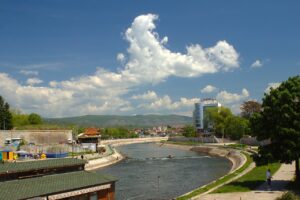
According to Serbian Economist, the authorities of the Serbian city of Niš have taken another step toward the construction of a new state-owned data center worth 50 million euros: the city council approved the transfer of a 37,400-square-meter plot of land near Niška Banja to the Republic of Serbia.
According to the city council’s decision, the undeveloped plot, covering 3.74 hectares, is to be transferred to the state free of charge. The final decision must be approved by the Niš City Assembly. The plot is located near the IMI industrial complex in the direction of Niška Bana.
The preliminary cost of the project is estimated at approximately 50 million euros. The exact technical specifications of the future data center have not yet been officially published, but earlier reports mentioned a capacity of several dozen megawatts and the facility’s use not only for storing government data but also as part of a broader digital infrastructure for southern Serbia.
One of the most interesting features of the project previously cited was the possibility of using the heat generated by the server equipment for Niš’s district heating system. Officials spoke of the potential to provide heat to up to 8,000 apartments.
The project is of strategic importance to Niš. The city is the main economic and transportation hub of southern Serbia, located on the routes to North Macedonia and Bulgaria, and already has a university, a Science and Technology Park, and a significant electronics and IT industry cluster.
Locating the national data center in Niš will also allow for the geographic distribution of the country’s critically important digital infrastructure. Currently, its main national hub is the data center in Kragujevac.
In April 2026, new 8 MW modules were commissioned at the Kragujevac National Data Center, bringing the complex’s total power capacity to 14 MW. A new supercomputer based on NVIDIA graphics processing units was also launched there.
https://t.me/relocationrs/3546
According to “Serbian Economist”, the Serbian company NIS has been granted another month to operate without restrictions from the U.S. OFAC has extended the company’s special license until July 31, said Serbia’s Minister of Mining and Energy Dubravka Jedović-Khandanović.
The previous license was valid until July 1. For Serbia, this means that the country’s key oil company will continue its normal operations for the time being, including the operation of the refinery in Pančevo and its network of gas stations.
At the same time, negotiations are ongoing between Hungary’s MOL and Gazprom Neft regarding the purchase of a stake in NIS. Earlier reports indicated that the deal involves a 56.15% stake. Additional regulatory approvals are required to finalize the deal, the most important of which remains approval from the U.S. Office of Foreign Assets Control (OFAC).
Serbia and MOL have already signed a shareholders’ agreement regarding the future management of NIS. The potential deal structure may also include the subsequent sale of a minority stake held by ADNOC of the UAE and the possibility for Serbia to increase its stake in the company by 5%.
Currently, Gazprom Neft remains NIS’s largest shareholder with 44.85%, while another 11.3% is held by an entity managed by Gazprom Capital. The Serbian government owns 29.87%.
NIS’s problems arose after the company, as a subsidiary of Gazprom Neft, was added to the U.S. SDN List in early 2025. President Aleksandar Vučić stated at the time that the U.S. was demanding the complete withdrawal of Russian capital from the company.
For Serbia, NIS is not just a major business but a strategic asset. The company is the only one in the country engaged in the exploration and production of hydrocarbons; it owns an oil refinery in Pančevo with a capacity of 4.8 million metric tons per year and dominates the petroleum products market. Its network includes more than 400 gas stations in Serbia and neighboring countries.
The extension of the license until July 31 eliminates the short-term risk to the fuel market, but does not resolve the main issue—who will control NIS after Russian capital withdraws, and under what conditions Serbia will retain influence over the country’s key energy company.



