

At least 132 cases of traffic accidents involving electric scooters have been recorded over the past year and a half in Ukraine, according to the Babusia court registry search engine. 79% of these accidents were caused by the electric scooter riders. The highest number of such accidents over the past 1.5 years occurred in the Odesa, Lviv, and Vinnytsia regions. Most often, scooter riders are prosecuted for hitting pedestrians, colliding with cars, or driving under the influence. Teenagers are involved in 29% of these cases.
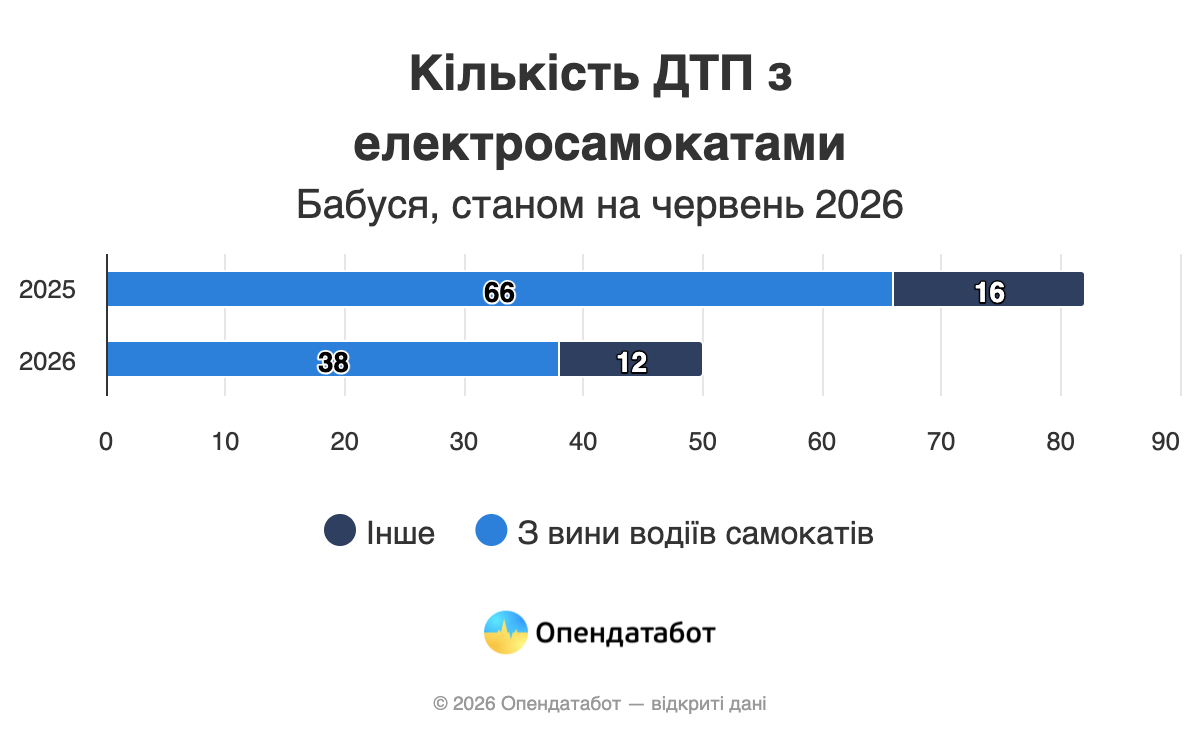
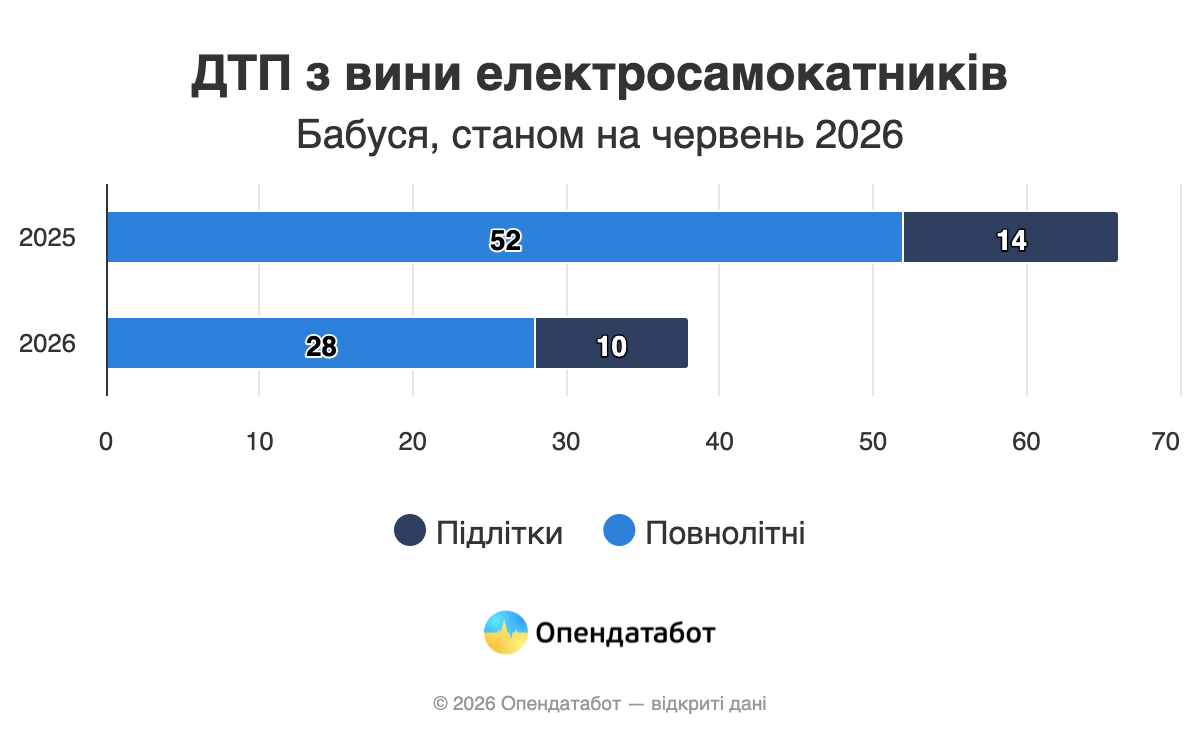
At least 132 cases involving accidents with electric scooters have been heard by courts over the past year and a half, according to data from the Babusia court registry search engine. In 79% of these accidents, the drivers of electric scooters were at fault—104 cases. In nearly one in three such cases, minors were involved in the accident: 38 accidents, or 29% of the cases that went to court.
In 66 court cases last year and 38 this year, electric scooter riders were found at fault for the accidents.
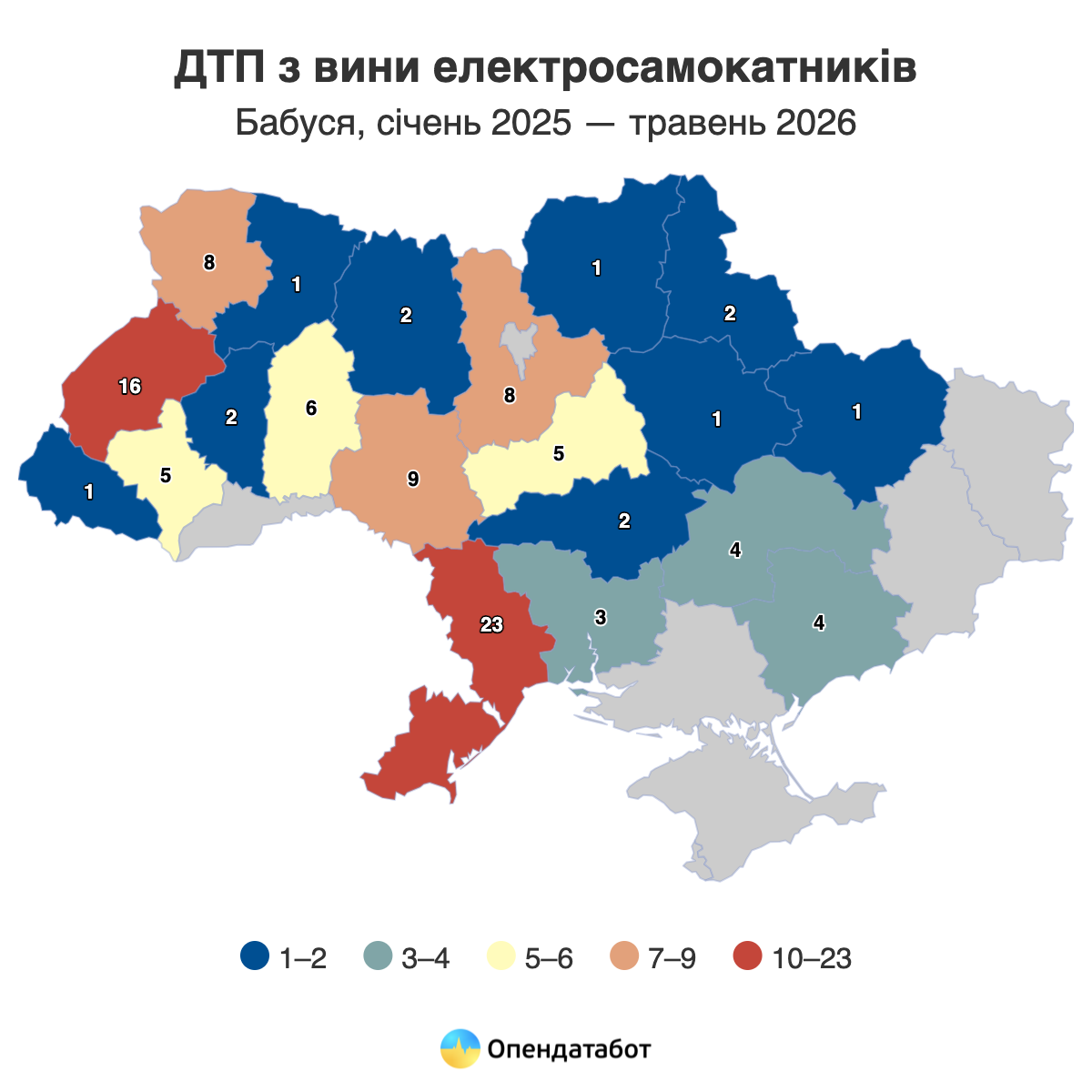
The highest number of traffic accidents caused by electric scooter riders was recorded in the Odesa region—11 in 2025 and 12 in the first five months of this year. Next are Lviv Oblast (11 and 5 cases, respectively) and Vinnytsia Oblast (5 and 4). The top five also include Volyn Oblast (5 and 3 cases) and Kyiv Oblast (7 and 1 case).
It is worth noting that, apart from regions with active hostilities, Chernivtsi Oblast is the only region where no court cases involving traffic accidents caused by electric scooter drivers have been recorded over the past 1.5 years.
Mostly, courts hear cases involving traffic violations that led to accidents (Article 124 of the Code of Administrative Offenses)—57 cases over the past 1.5 years.
Typical cases include collisions with cars, hitting pedestrians, and fleeing the scene of an accident. For example, in Lviv, a user of a rented JET scooter damaged two parked cars at once—an Audi and a Mazda—and left the scene of the accident. The court fined him 3,400 UAH.
In Dnipro, a driver of a Magura electric scooter ran a red light and struck a boy at a crosswalk. In court, the man explained that the scooter’s brakes had failed in the winter. Ultimately, the court fined him as much as 850 UAH.
The second most common category involves cases of driving a vehicle while under the influence of alcohol or drugs (Article 130 of the Code of Administrative Offenses)—47 cases during the period under review. The penalty in most cases is standard—a fine of 17,000 hryvnias. For example, in Odesa, police stopped an electric scooter rider whose blood tested positive for 0.65 �
It should be noted that the law also provides for the revocation of a driver’s license and restrictions on driving privileges for drivers; however, this sanction cannot always be applied to scooter riders—after all, a driver’s license is not required to operate a scooter.
For example, this also happened in another case—also in Odesa. There, the court not only fined the intoxicated driver 17
thousand UAH but also revoked his right to operate vehicles for one year. This decision is currently being appealed.
However, if the violation is repeated within a year, the punishment becomes significantly harsher. For instance, in Odesa, patrol officers stopped a driver of a JET electric scooter who showed clear signs of intoxication. During the check, the man refused to undergo a breathalyzer test and later fled the scene. In court, it was revealed that less than a year prior, he had already been punished for a similar violation. The court found the driver guilty and imposed a fine of 34,000 UAH and revoked his license for three years.
There are also cases where intoxicated drivers caused traffic accidents resulting in injuries. In Kyiv, a user of a Bikenow rental scooter with a blood alcohol level of 0.56 �
If the violation results in the victims sustaining moderate bodily injuries, the case may be elevated to a criminal matter. This is exactly what happened in Vinnytsia, where an intoxicated driver of a Bolt electric scooter was riding on the sidewalk and struck an elderly woman. She suffered a broken shoulder. The court found the man guilty and imposed a fine of 34,000 UAH. Additionally, he had to pay over 6,000 UAH in expert examination fees. In doing so, the court took into account that the defendant admitted guilt, expressed remorse, and compensated the victim for material and moral damages.
In total, minors were involved in 38 out of 132 cases—nearly a third of the cases heard by the courts. Looking specifically at traffic accidents caused by scooter riders, teenagers were involved in 24 cases—about a quarter of such proceedings. The highest number of such cases over the past 1.5 years was recorded in Vinnytsia (4), Lviv (3), and Cherkasy (3) regions.
It is worth noting that individuals under the age of 16 are not subject to administrative liability; reports are filed against parents for improper fulfillment of parental duties (Article 184 of the Code of Administrative Offenses).
For example, in Ivano-Frankivsk, a 15-year-old electric scooter rider drove onto a crosswalk, where she collided with a car. The girl’s mother was held liable and fined 850 UAH. At the same time, not all cases result in punishment: in Khmelnytskyi, a 12-year-old driver of a VEVI rental scooter was riding across a crosswalk when he collided with a Toyota Yaris. The young driver did not admit guilt, but the court ruled that the electric scooter driver’s guilt had been proven, although the case was closed due to the statute of limitations.
In many rulings, courts specifically emphasize that electric scooter drivers are road users and must comply with traffic rules. In particular, they must cross pedestrian crossings on foot.
It should be noted that the amount of fines in cases involving electric scooters varies significantly depending on the violation. For certain administrative offenses and cases involving the parents of minors, courts impose a fine of 850 hryvnias. For driving under the influence—from 17,000 hryvnias. In addition, violators pay a court fee—about 665 hryvnias in 2026—and may also be required to compensate the owners of damaged property or the victims.
https://opendatabot.ua/analytics/scooter-dtp-2026

Cherkasy Bus JSC may supply 27 school buses to the Ivano-Frankivsk Regional State Administration (RSA) for 113.45 million UAH, including 17 units with two seats for students with limited mobility for nearly 73.7 million UAH.
According to information on Prozorro, the plant was the sole participant in two relevant tenders held by the Ivano-Frankivsk Regional State Administration. It offered 17 buses for 73.7 million UAH against an expected amount of 73.909 million UAH, and in the second tender—10 standard school buses for 39.75 million UAH against an expected purchase amount of 40 million UAH.
The delivery deadline for the buses is September 30, 2026.
The Euro 5-compliant buses were manufactured this year, with a localization rate of over 68–70%.
As noted in the announcement, a state budget subsidy of 67.173 million UAH is allocated for the purchase of 17 buses, with co-financing from the local budget amounting to 6.736 million UAH. Accordingly, UAH 35.92 million and UAH 4.08 million have been allocated for the purchase of 10 buses.
As previously reported, starting in 2024, the “School Bus” program is being implemented thanks to financial cooperation between the EU and Ukraine as part of the Ukraine Facility.
For the program’s implementation, the state budget subsidy for the current year amounts to 2 billion UAH, with plans to purchase over 540 buses. The Ivano-Frankivsk region has been allocated 103.09 million UAH in state subsidies.
Founded in 1994, the “Cherkasy Bus” plant manufactures Ataman small-class buses (including city, suburban, school, and specialized models), as well as other wheeled vehicles based on Japanese Isuzu components.
The plant ended 2025 with a net profit of nearly 83 million UAH—32% less than in 2024—amid a slight decline in net revenue to 1.733 billion UAH.
Cherkasy Bus, Ivano-Frankivsk region, Prozorro, school buses, Ukraine Facility

Cypriot banks and financial institutions have begun conducting enhanced due diligence on clients who have obtained citizenship or a residence permit through investment programs, including the former Cypriot “golden passport” program and current investment-based residency schemes.
On June 5, the Tax Department of the Republic of Cyprus published a notice regarding the strengthening of due diligence procedures under DAC2/CRS standards. The measures are aimed at determining clients’ actual tax residency and preventing the use of investment passports and residence permits to conceal assets or evade tax reporting.
The new requirements primarily apply to clients who indicate tax residency in countries with high-risk investment programs. Banks must more carefully verify whether the declared jurisdiction actually corresponds to the client’s real “center of vital and economic interests.”
As part of the verification process, financial institutions may request additional information from clients: whether citizenship or a residence permit was obtained through an investment program, whether the client has the right of residence in other countries, whether they have stayed in other jurisdictions for more than 90 days in the past year, and where they actually filed tax returns.
For new clients, the enhanced procedures apply from the date of publication of the notice—June 5, 2026. For existing clients, financial institutions have up to six months to conduct the additional verification.
If a bank determines that a client’s actual situation does not match their declared tax residency, information about their accounts may be shared with the tax authorities of the relevant country through the CRS automatic exchange system.
The OECD has previously noted that citizenship and residency-by-investment programs can be used to circumvent tax transparency rules if a client obtains formal status in one country but actually lives and conducts economic activities in another.
The list of jurisdictions whose programs the OECD considers potentially risky for the CRS includes, in particular, Cyprus, the UAE, Bahrain, Antigua and Barbuda, Dominica, Grenada, St. Kitts and Nevis, St. Lucia, the Bahamas, Barbados, the Seychelles, Vanuatu, and the Turks and Caicos Islands.
This is an important signal for the Cyprus real estate market, as investment residency remains one of the factors driving demand for housing from foreign buyers. The current permanent residency-by-investment program requires an investment of at least €300,000, particularly in real estate; however, investors must now be prepared for a more thorough review of their sources of funds, tax history, and actual place of residence.
Cyprus’s citizenship-by-investment program, known as the “golden passport” program, was shut down in 2020 following a corruption scandal and pressure from the EU. However, some investors who obtained citizenship earlier still hold Cypriot documents and bank accounts, making them a group of heightened interest for tax and financial authorities.
Tighter controls may complicate account management for some foreign investors, especially those who hold multiple residencies, do not maintain transparent tax records, or cannot verify the source of their funds. That said, for real estate buyers with documented income and a clear tax history, the new rules do not mean automatic denial of service, but they do raise compliance requirements.
Cyprus remains one of the prominent real estate and tax planning markets in the Eastern Mediterranean. The country is an EU member, has a developed banking sector, a low corporate tax rate, and continues to attract interest from foreign homebuyers, primarily in Limassol, Paphos, Larnaca, and Nicosia. However, following the closure of the “golden passport” program and the strengthening of international tax information exchange, the market is gradually shifting from a model of quick investment statuses to stricter compliance and transparency regarding the origin of capital.

Viking Park LLC (Lviv) raised UAH 3.6 million from the placement of its debut bonds, the company reported in its issuance results report.
According to information published in the disclosure system of the National Securities and Stock Market Commission, the bond offering via a public offering took place from April 16 to April 30, 2026. The face value of the bonds is UAH 1,000, with a total value of UAH 100 million.
The total number of bonds actually placed was 3,627.
According to the company’s website, Viking Park LLC conducts development activities under the Viking Development brand. Its portfolio includes over 30,000 square meters of completed residential space in Lviv. Among its projects are the Viking Park, Viking Hills, Viking Gardens, and Helga residential complexes. According to information on the “LUN” real estate portal, since 2019 the developer has commissioned 13 buildings comprising two complexes, while another nine buildings in three residential complexes are currently under construction.
According to data from the YouControl analytical system, the owners of Viking Park LLC are listed as Teplokom LLC (88%) and ZNVKIF “Mira-Capital” JSC (12%). The ultimate beneficiary is Ernest Ishchuk.
As of the end of 2025, the company increased its net profit by 4.4% to UAH 4.8 million, while net revenue decreased by 18.4% to UAH 168.7 million. Assets nearly doubled to UAH 1.8 billion.

On Thursday, June 11, the western and southeastern parts of the country will see brief showers and thunderstorms in some areas; in Zakarpattia and Prykarpattia, there will be moderate rain, with heavy rain in some places; the rest of the country will remain dry, according to the Ukrainian Hydrometeorological Center.
Winds will be predominantly southerly, 5-10 m/s. Nighttime temperatures will range from 13-18°; daytime temperatures from 23-28°, and in the far west of the country from 18-23°.
In Kyiv on June 11, no precipitation is expected. Winds will be southerly, 5-10 m/s. Temperatures at night will be 16-18°C, and during the day 26-28°C.
According to data from the Boris Sreznevsky Central Geophysical Observatory in Kyiv, on June 11, the highest daytime temperature was 33.7°C in 2010, and the lowest nighttime temperature was 6.3°C in 1952.
On Friday, June 12, across Ukraine—except for the far west—there will be brief showers and thunderstorms in some areas; in Khmelnytskyi, as well as during the day in most northern, central, Mykolaiv, and Odesa regions, there will be moderate rain, with heavy rain in some areas.
Winds will be predominantly southerly, northwesterly in the west of the country, 5–10 m/s. Temperatures at night will be 13–18°, during the day 23–28°; in the western, Vinnytsia, and Zhytomyr regions, temperatures at night will be 9–14°, during the day 15–20°.
Weather forecast for Kyiv on June 12 – light rain at night, moderate rain during the day, with thunderstorms. Wind from the south, 5-10 m/s. Nighttime temperatures 16-18°, daytime temperatures 23-25°.
RAIN, THUNDERSTORMS, UKRAINE, Ukrainian Hydrometeorological Center, WEATHER

PJSC “Tovkachivsky Mining and Processing Plant” (TGZK, Pershotravneve, Zhytomyr Oblast) reported a net loss of UAH 2.806 million in January-March of this year, compared to a net profit of UAH 4.885 million in the same period last year.
According to the company’s interim report, which is available to the agency “Interfax-Ukraine,” revenue from ordinary activities for this period decreased to UAH 6.307 million from UAH 18.790 million in the first quarter of 2025.
Retained earnings as of the end of March amounted to UAH 463.231 million.
According to the annual report, the company reported a net profit of UAH 6.336 million in 2025, compared to a profit of UAH 1.260 million in 2024, while revenue from ordinary activities amounted to UAH 80.377 million (UAH 91.104 million in 2024).
The average number of full-time employees on the payroll was 110. Compared to the previous year, the payroll fund for 2025 increased by 1,758,500 UAH and amounted to 24,479,300 UAH. Due to the armed aggression of the Russian Federation, there was an exodus of qualified personnel throughout 2025; from November 2024 through May 2025 inclusive, and from October 2025 onward, the enterprise was idle.
As reported, TGZK earned a profit of 78,175,767 thousand UAH in 2020, 44,223,637 thousand UAH in 2021, and 14,659,029 thousand UAH in 2022. The company ended 2023 with a net loss of UAH 794,133 thousand.
TGZK is a company engaged in the extraction, processing, and enrichment of quartzite. It is the main supplier of raw materials for the production of ferroalloys, refractories, and dinas in Ukraine. TGZK operates the Tovkachivska section of the Ovruch quartzite deposit, located in the town of Pershotravneve, using open-pit mining methods.
According to the National Securities and Stock Market Commission’s data for the first quarter of 2026, Navaro Development Limited owns 5.1898% of the company’s shares, Lucrino Investments Limited – 9%, Mantara Holdings Limited – 72.0629%, and Duxton Holdings Limited (all based in Cyprus) – 12.1891%.
According to the report, the ultimate beneficial owners (controllers) of the company are Ihor Kolomoyskyi and Hennadiy Boholyubov, against whom sanctions have been imposed.
The company’s authorized capital is UAH 1.588 million, and the par value of a share is UAH 2.25.



