

Oil prices rise on Friday, but end the week with a significant decline amid a general decline in risk appetite in global markets due to the situation in the U.S. banking sector.
May Brent crude futures on London’s ICE Futures exchange are at $75.5 a barrel by 7:05 a.m. Q, up $0.8 (1.07%) from the previous session’s closing price. Those contracts rose $1.01 (1.4%) to $74.7 a barrel on Thursday.
The price of WTI crude futures for April at electronic trades of the New York Mercantile Exchange (NYMEX) rose by $0.75 (1.1%) by that time to $69.1 per barrel. The contract value grew by $0.74 (1.1%) to $68.35 per barrel at the end of previous session.
Both Brent and WTI have fallen more than 10% since the beginning of this week, which is the worst weekly dynamics for the market since the beginning of this year.
Traders are keeping a close eye on OPEC+, believing the cartel countries may take action in response to the market drop, Bloomberg noted.
“External factors continue to dictate conditions to the oil market,” said Warren Patterson, who is responsible for strategy in commodity markets at ING Groep NV. – The downturn in the market is probably a concern for OPEC+, but it is unlikely to act quickly. OPEC+ is more likely to wait for the situation to calm down.”
Saudi Arabia’s Energy Minister Prince Abdulaziz bin Salman and Russian Deputy Prime Minister Alexander Novak on Thursday affirmed their countries’ commitment to the October 2022 OPEC+ decision to cut oil production by 2 million bpd by the end of 2023.
A day earlier, the Saudi prince told Energy Intelligence that the oil market is subject to very high uncertainty, so OPEC+ does not intend to change the parameters of the deal adopted last October.
Structure of approved Ukrainian state budget expenditures for 2023
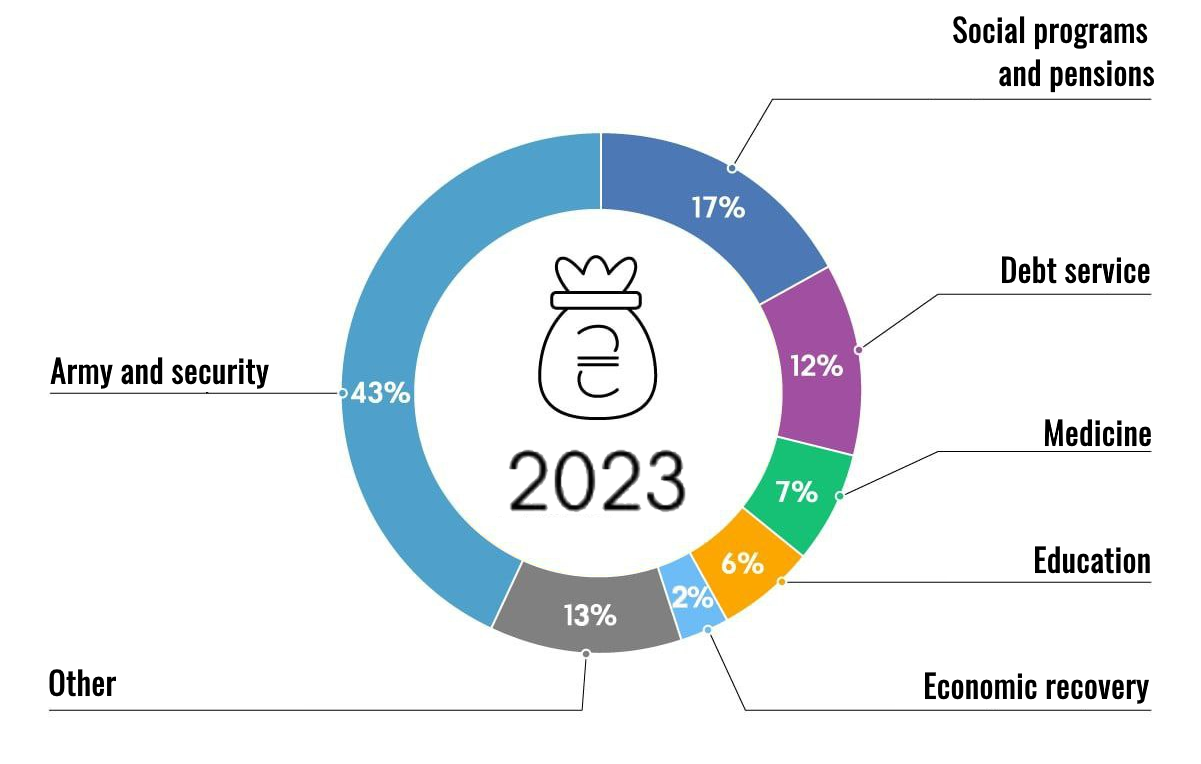
Source: Open4Business.com.ua and experts.news
Ruslan Gashev, Head of the Export Credit Agency (ECA), announced at the Summit of Exporters held by Forbes Ukraine in Kyiv that in 2022 it supported 35 exporters for UAH 3.18 billion and is ready to increase export support up to UAH 18 billion this year.
He pointed out that the agency is capable of such volume of activities without increasing the nominal capital.
Gashev also announced that in the nearest future the number of Ukrainian banks-partners to ECA under the program of portfolio credit insurance will increase from six to seven.
According to the head of the agency, the ECA may also become a tool of activity in Ukraine for the Multilateral Investment Guarantee Agency (MIGA) from the World Bank Group and the U.S. Corporation for International Development Finance (DFC), which do not have their own representative offices in Ukraine.
“Even in those projects where MIGA and DFC risk insurance will be involved, we can be their ‘hands’ because they do not have their own offices in Ukraine,” Gashev explained.
He clarified that this issue has already been discussed with the DFC, and the ECA has sent its proposal, while the Ministry of Economy is still working with MIGA without the agency’s participation.
The head of ECA also supported the initiative contained in the draft law “On Amendments to the Law on Financial Mechanisms to Encourage Export Activities in relation to Investment Insurance against Military Risks in Ukraine” (#9015) to expand the ECA’s mandate to insure investments in Ukraine.
“When we approach our foreign partners, especially such structures as MIGA and DFC, to insure Ukrainian and foreign investments in Ukraine, we also have to think about how to use the tools we have in the country,” Gashev said.
He stressed that we are talking about insurance not only of foreign investments, but also domestic ones. According to him, the document has not been introduced at the meeting of the Profile Committee, but it is being worked on.
Since the beginning of the year (as of March 13) ECA has supported export from Ukraine in the amount of 242.35 million UAH (11 agreements). Banks financed UAH 43.5 million. Exports were made to France, Germany, Latvia, Poland, Switzerland, and the USA. The leaders among the branches according to the results of two months of 2023 are furniture industry, the second place is taken by toys and further by rubber, rubber and rubber goods.

Ukrainian winemaking needs state support to restore the industry that suffered from war and to promote it on international markets, says Volodymyr Pechko, head of the public union “Ukrsadvinprom”.
“Ukrainian winemaking has been on the verge of survival because of the war. A significant number of territories of Ukrainian vineyards, which are in the south of Ukraine, are mined by the aggressor, their restoration will require significant resources and time. We propose to work out a strategy of development of the winemaking industry and recognize viticulture as a priority branch of development,” he said in his opinion to the Interfax-Ukraine news agency.
Pechko noted that currently the winemaking industry, which suffered from the actions of the aggressor, is not included in any of the state support programs. Also, the industry does not have an approved development strategy and certain mechanisms of compensation for losses incurred.
However, according to the head of Ukrsadvinprom Ukrainian winemaking has a rather high export potential. His products are in demand on international markets, including due to the unprecedented support of Ukraine in the confrontation with the aggressor.
“We saw that the interest in Ukrainian wine is very high. We are a household name today and we need to win our “place on the shelf”. They want to see and buy Ukrainian wine in Europe, Asia and Africa. To have an effective breakthrough on international markets we need government participation in the promotion of Ukrainian wine,” Pechko said.
The head of “Ukrsadvynprom” reminded that Ukraine has restored the membership in the International Organization of Vine and Wine (OIV, OIV), which it had been a part of from 1997 to 2008, that opens new prospects for the Ukrainian wine-makers.
OIVW was founded in 2001. The organization became the successor of the International Grape and Wine Bureau, which existed since 1924. Its aims are protection of interests of the wine making industry and creation of favorable market conditions, harmonization and correspondence of analysis methods, struggle against fraud and unfair competition on the market. Ukraine became the 49th member state of IGOV.
Currently, Ukrainian scientists, including representatives of the scientific center “Tairiv Institute of Viticulture and Winemaking” actively work in the IGOV committees. NAAS of Ukraine.
As of February 1, 2022, the total area of vine plantations in Ukraine on all categories of farms amounted to 34.0 thousand hectares, the gross harvest of grapes – 257.5 thousand tons. However, because of the Russian aggression, almost 25% of the area under vineyards are temporarily occupied or are in the war zone.
Total in Ukraine there are 144 wineries, including 29 small producers of wine products.
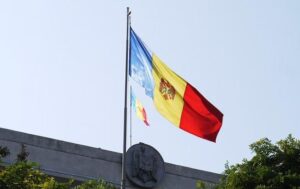
The phrase “Moldovan language” will be replaced with “Romanian language” in the texts of all Moldovan laws and regulations, including the Moldovan Constitution. The relevant law “On the implementation of certain decisions of the Constitutional Court (CC)” was adopted Thursday in its second and final reading by the Moldovan Parliament.
The authors refer to three rulings of the CC, including one from December 5, 2013. Given that “acts of the CC, which interpret constitutional texts, have the force of law and are binding,” the authors propose to replace “Moldovan language” with “Romanian language” in the text of the laws.
“In order to implement this law, the Legal Information Resources Agency shall, within 30 days from the date of enactment of this law, ensure the amendment of all legislation of the Republic of Moldova, including the Constitution, in the State Register of Legal Acts,” the document reads.
The law was voted for by deputies from the parliamentary majority of the Action and Solidarity Party (PAS), as well as independent deputy Gaic Vartanyan, who left the Socialist Party and joined the National Alternative Movement (MAN) headed by Chisinau Mayor Ion Ceban.
The bill drew criticism from the opposition Bloc of Communists and Socialists. Deputies of the BCS hung several banners on their rostrum during the voting in Parliament. Earlier they said that they would appeal to the Constitutional Court to challenge the law if it is adopted.
According to the Constitution, amendments to the Main Law may be approved by “two-thirds of votes of deputies” “not earlier than six months after the registration of the corresponding draft law and only with a positive conclusion of the CC.” Also, according to the Constitution, “the Constitution can not be reviewed during a state of emergency, siege and martial law.
In turn, the authors of the bill, represented by a group of PAS deputies, believe that it is a “technical execution” of the decisions of the Constitutional Court, and not an amendment to the Constitution.
Till now, according to article 13 of the Constitution of Moldova, the state language of the Republic of Moldova is “the Moldovan language functioning on the basis of Latin script”. Meanwhile, the Academy of Sciences of Moldova admitted that the correct name of the language is “Romanian”. Romanian language is taught in all schools and educational institutions of Moldova since 1992.
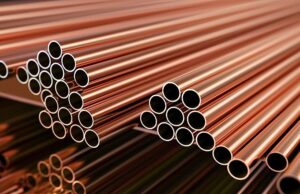
Ukrainian companies in January-February this year, imports of copper and copper products in value terms decreased by 3.8% compared to the same period last year – up to $ 17.466 million.
According to customs statistics, released by the State Customs Service of Ukraine on Thursday, the export of copper and copper products for the period decreased by 39.7% – to $ 14.150 million.
In February, imported copper at $ 11.096 million, exported – to $ 7.743 million.
In addition, Ukraine in January-February 2023, imports of nickel and its products decreased by 95.3% compared to the same period in 2022 – to $ 1.156 million (in February – $ 844 thousand), aluminum and aluminum products – by 81.6%, to $ 14.373 million (in February – 7.596 million). At the same time, the imports of lead and lead products decreased by 89.9% to $204 thousand (in February – $173 thousand), while imports of tin and tin products dropped by 8.5% to $544 thousand (in February – $371 thousand) and zinc and zinc products – by 72.6% to $4.117 million (in February – $1.879 million).
Exports of aluminum and its products for the first two months of 2023 increased by 2.4 times to $53.512 million (in February – $26.983 million) compared to the same period last year, lead and lead products decreased by 50.4% – to $3.023 million (in February – $1.391 million) and nickel and products – $92 thousand (in February – $89 thousand), whereas in January-February 2022 it was $875 thousand.
Zinc exports during two months of the current year amounted $24 thsd. (in February – $23 thsd.), while in January-February 2022 it was $402 thsd. Tin exports and products totaled $18 thsd. (in February – $1 thsd.) against $33 thsd. in the same period last year.
As reported, the Ukrainian enterprises in 2022, imports of copper and copper products in value terms reduced by 64.3% compared to the previous year – up to $ 65.370 million, their exports decreased by 56.3% – to $ 90.245 million.
In addition, Ukraine has reduced imports of nickel and its products in 2022 by 49.9% compared to 2021 – up to $59.754 million, aluminum and its products – by 33.4% to $ 340.398 million, while the imports of lead and its products decreased by 66.6% – to $ 2.839 million.
Imports of tin and tin products fell by 33.5% to $3.312 million, while imports of zinc and zinc products decreased by 58.7% to $38.690 million.
Exports of aluminum and aluminum products for 2022 were down 42.7% from 2021, to $96.972 million, lead and lead products were down 68.7%, to $11.970 million, and nickel and nickel products were down 73.9%, to $1.268 million.
Zinc exports for 2022 were $1.331 million, up from $550,000 in 2021. Tin and products exports for 2022 were $424,000, up from $346,000 the previous year.



