

The European Commission is launching a new European Bauhaus capacity building program to assist municipalities in the reconstruction and rehabilitation of Ukraine.
The European Commission said Thursday that the decision follows several events, including a meeting between Commission members and the Ukrainian government in Kiev on February 2, the EU-Ukraine summit on February 3, and the visit of European Commissioner Virginius Sinkevicius to Kiev on February 16-17.
“The program will be launched in the afternoon during a high-level meeting with Commissioner Virginijus Sinkevičius. The capacity building initiative aims to inspire and provide practical assistance to municipalities involved in the reconstruction and rehabilitation of Ukraine,” the European Commission explained the essence of the initiative.
It is also reported that the program is organized by and with Ukrainian partners, such as Ro3kvit, ReThink, Covenant of Mayors East and the Council of Architects Europe. The president of the European Commission, Ursula von der Leyen, and commissioners Maria Gabriel and Elisa Ferreira will take part in the event through a video address.
Commenting on the event, European Commission President Ursula von der Leyen said: “We will rebuild Ukraine. We must, and we will. The reconstruction that Ukraine deserves should be done in the spirit of the New European Bauhaus (NEB). Urban planners, architects, engineers are involved in the project, and the concept of the NEB will inspire them. Our vision is to turn the destruction of war into opportunities to build a beautiful and healthy future for Ukraine.
Changes in consolidated budget expenditures in 2021-2022 (%)
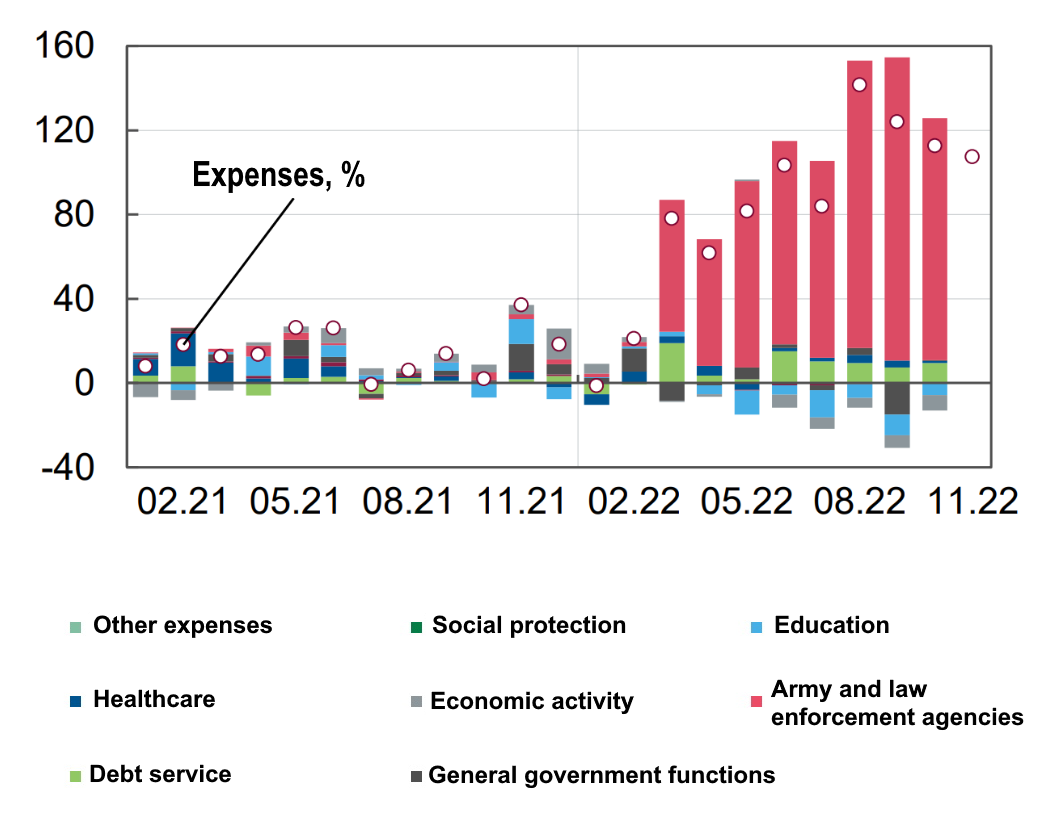
Source: Open4Business.com.ua and experts.news

The US dollar is moderately weakening in pairs with the euro and the pound sterling Thursday morning after a strong growth at the end of last session.
The index calculated by ICE which shows the US dollar dynamics against six currencies (euro, Swiss franc, yen, Canadian dollar, pound sterling and the Swedish krona), declined by 0.15% during the morning session. The day before, the indicator jumped 1 percent due to demand for defensive assets.
The euro/dollar pair was trading at $1.0601 as of 8:26 a.m. CC versus $1.0578 at the close of Wednesday’s session, with the euro adding about 0.2%.
The pound sterling is up 0.1% and is trading at $1.2070 versus $1.2057 at the close of last session.
The dollar-yen exchange rate is declining by 0.4% and is trading at 132.92 yen against 133.43 yen the day before.
Investors are waiting for the outcome of the March meeting of the European Central Bank, which will end on Thursday. Most analysts expect key interest rates to rise by 50 basis points.
Also, market participants continue to evaluate the data published a day earlier that retail sales in the USA declined 0.4% versus the previous month in February. At the same time, according to revised data, sales jumped 3.2% in January, the fastest pace since March 2021.
U.S. producer prices (PPI) rose 4.6% in February relative to the same month last year after jumping 5.7% in the first month of the year, the Labor Department said. On a month-over-month basis, the indicator declined 0.1% after rising 0.3% in January.
Many analysts now expect the Federal Reserve may leave interest rates unchanged at the end of its March meeting, although the consensus forecast still calls for a 25 basis point increase. At the same time, last week the markets allowed for a hike of 50 bps.

Oil prices are rising on Thursday morning, rising from the previous day’s lows since December 2021.
The value of May futures for Brent on London’s ICE Futures exchange is $74.63 a barrel by 7:18 a.m., up $0.94 (1.28%) from the close of the previous session. Those contracts fell by $3.76 (4.9%) to $73.69 per barrel at the close of trading on Wednesday.
The price of WTI futures for April at electronic trades of the New York Mercantile Exchange (NYMEX) is $68.42 per barrel by that time, which is $0.81 (1.2%) above the final value of the previous session. The contract fell by $3.72 (5.2%) to $67.61 per barrel on Wednesday.
The fall of oil quotations was caused by concerns that the problems of the banking sector amid rising interest rates might lead to a global recession, writes MarketWatch.
In addition, released the day before, the U.S. Energy Department data showed an increase in oil reserves over the past week by 1.55 million barrels. The increase was recorded at the end of the 11th week of the last 12 weeks.
Gasoline reserves decreased by 2.06 million barrels and distillates by 2.54 million barrels.
Experts were expecting oil reserves to grow by 1.5 million barrels, gasoline reserves to decrease by 1.62 million barrels and distillates reserves to drop by 1.4 million barrels.

IAEA inspectors found that about 2.5 tons of unenriched uranium stored at a site in Sebha, 660 kilometers southeast of the Libyan capital Tripoli, has disappeared, the Associated Press (AP) reported Thursday, citing the agency.
“Security inspectors found last Tuesday that 10 barrels containing approximately 2.5 tons of natural uranium in the form of uranium ore concentrate were no longer at the declared site in Libya. The agency will take action to clarify the circumstances surrounding the removal of nuclear material from the site,” the AP cited excerpts from an IAEA statement.
The day before IAEA Director General Raphael Grossi informed member countries about the situation in Libya.
According to AP, each ton of these substances, given the appropriate technology, can be processed into 5.6 kilograms of weapons-grade material needed to build an atomic bomb.
Since the overthrow and assassination of Libyan leader Moammar Gadhafi in 2011, Sebha has been in a state of powerlessness, with an illegal migration route through the city and, according to the UN, cases of slave trade recorded in Sebha. In recent years, the city has been largely controlled by the Libyan National Army of Field Marshal Khalifa Haftar, with rebels from neighboring Chad also present.
Altogether, according to various estimates, Libyan authorities accumulated about 1,000 tons of uranium concentrate during the Gadhafi rule (1969 – 2011). In 2003, after the U.S. invasion of Iraq, he disclosed to the international community the workings of Libya’s nuclear program, and in 2009 international inspectors removed the last stocks of enriched uranium from the country. However, according to the UN, in 2013 Sebha stored about 6,400 barrels of uranium concentrate.

President of Ukraine Volodymyr Zelensky, volunteer Serhiy Prytula and advisor to the head of the presidential office Mykhaylo Podolyak top the list of politicians and public figures trusted by Ukrainians, according to results of a poll conducted by the Razumkov Center polling service from 22 February to 1 March 2023 as part of the MATRA program financed by the Dutch Embassy in Ukraine.
According to a press release with the results of the survey, which was released on Wednesday, 85% of respondents trust V. Zelensky, S. Pritula – 65% and M. Podolyak – 59.5%.
More than half of Ukrainians trust also Kiev mayor Vitaliy Klitschko (58% of respondents), the Secretary of the National Security and Defense Council of Ukraine Oleksiy Danilov (55%), Prime Minister Denis Shmygal (52%), and Defense Minister Oleksiy Reznikov (51%).
More often trust than distrust were expressed by the Head of the President’s Office Andriy Ermak (41% and 36% respectively), the Speaker of the Verkhovna Rada Ruslan Stefanchuk (35% and 27% respectively), activist and volunteer Sergei Sternenko (29% and 18% respectively), the Minister of Internal Affairs Igor Klimenko (27% and 17% respectively).
The majority of respondents do not trust MPs Yuri Boiko (82%) and Yulia Tymoshenko (76%), the fifth President of Ukraine, MP Petro Poroshenko (65%), former presidential advisor Oleksiy Arestovych (59%). The head of the parliamentary faction “Servant of the People” David Arahamia is also expressed more often in distrust than trust (39% and 27% respectively).
“Compared to 2021, the share of those who trust V. Zelenski (from 33% to 85%), S. Pritula (from 22% to 65%), V. Klitschko (from 26% to 58%), A. Danilov (from 12% to 55%), D. Shmygal (from 11% to 52%), A. Yermak (from 10% to 41%), S. Sternenko (from 15% to 29%) and P. Poroshenko (from 18% to 24%) increased. During the same period the percentage of those who trust Y. Boiko (from 18% to 6%) and Y. Tymoshenko (from 20% to 13%) decreased,” sociologists concluded.
The survey was conducted by the sociological service of the Razumkov Center from February 22 to March 1, 2023 in the framework of the MATRA program, funded by the Dutch Embassy in Ukraine in 22 regions of Ukraine and in Kyiv (the survey was not conducted in Lugansk and Donetsk regions, in the ARC and Sevastopol, and in Zaporozhye, Nikolayev, Kharkiv and Kherson regions – the study was conducted only on the territories controlled by the government of Ukraine and on which no military operations are conducted).
As part of the face-to-face survey, 2,020 respondents aged 18 years and older were interviewed. The theoretical sampling error does not exceed 2.3%.



