

Foreign aid as of February 15 accounted for 68.8% of sources of financing of the state budget deficit since the beginning of this year, Roksolana Pidlasa, head of the Verkhovna Rada Budget Committee, told Interfax-Ukraine news agency on Friday.
“If we compare with last year, we see an increase in the share of foreign aid in the sources of financing. This is primarily due to the fact that, unlike last year, the National Bank does not redeem government bonds, therefore, emission funds are not attracted to cover the state budget deficit, “- said the head of the Committee.
Pidlasa specified that the state budget has already received UAH 171.9 billion from international partners. The biggest share is constituted by the macro-financial credit aid from the EU (EUR 3 billion) and grant aid from the USA ($1 billion).
“At the same time, the government continues to issue war bonds – debt obligations, which constitute about 31% of all sources of budget financing,” the MP added.
As reported, the state budget deficit of Ukraine in January 2023 due to a significant reduction in spending decreased to 72.3 billion UAH from 99 billion UAH in December, including for the general fund – to 78.9 billion UAH from 101.3 billion UAH.
Cash expenditures of state budget, according to operational data of State Treasury, in January fell to 193.7 billion UAH, including the general fund – to 183.6 billion UAH, or 80.6% of the estimates, while the general fund revenues amounted to 104.4 billion UAH, of which 36.6 billion UAH – grant international aid.
According to the Ministry of Finance, the actual state borrowings to the general fund of the state budget in January 2023 amounted to UAH 160.1 billion, or 54.7% of the plan, including UAH 41.4 billion from placement of government bonds, of which UAH 2.6 billion in foreign currency ($40.2 million and EUR29.4 million).
EUR 3 bln were financed from external sources due to the EU tranche of macrofinancial aid.
The state budget of Ukraine for 2023 was approved with a marginal deficit of UAH 1296.5 billion, including the general fund deficit of UAH 1124.6 billion.

Never before has the work of two famous Catalans, the painter Salvador Dali and the architect Antoni Gaudi, appeared before the audience in such a stunning way as it has been presented by the French operator of immersive exhibitions for historical monuments, museums and art centers Culturespaces.
“Dali, the Infinite Enigma” and “Gaudi, Architect of the Imaginary” are two new immersive exhibitions that run from February 2023 to January 2024 in Bordeaux at the unique Pools of Light exhibition space.
The exhibition about Dali presents more than 60 years of work by the epathetic Catalan master, one of the most enigmatic painters in history, graphic artist, sculptor, filmmaker and writer. Developed under the influence of Cubism and Futurism, who became an iconic figure in Surrealism, Dali came to a carefully executed realism on canvas, about which it was said that the real was nevertheless muddled with mysteries of the mind, fantasies and allusions of memories.
While exploring the exhibition, the viewer walks in digital visions as an accomplice among the metaphysical landscapes and images of an artist with an inimitable imagination. Paintings, drawings, photographs, installations, film footage, details of works, coming alive on the walls, reflected in the water of “Pools of Light”, of course, do not solve the mystery, but still bring us closer to the mysteries of the personality of the artist with the original mustache, to his obsession with the strange, and to the passion that his muse and wife, Gala, inspired him.
Everything takes place to the music of the legendary British band Pink Floyd, offering a timeless journey that awakens the subconscious.
One of Dali’s important sources of inspiration was the work of the architect Gaudi, whose early twentieth-century works were considered provocative and often criticized. Dali was a staunch defender of the visionary Gaudí. A second fascinating exhibition at Pools of Light pays tribute to this architectural genius and his famous buildings, which have now been classified as UNESCO World Heritage Sites.
The visitor of the exhibition is immersed in another journey in which it is difficult to distinguish between the imaginary and reality. He walks through Barcelona from Park Güell to the Casa Batlló, entering the Casa Milà and visiting the inimitable wonder of the Sagrada Familia. The faceless construction of the Pools of Light suddenly takes on the outlines of hyperbolic vaults, fanciful columns, wavy facades, covered with ornaments and Gaudi’s invariably pleasing glass and ceramic mosaics.
Culturespaces was created in 1990 by Bruno Monnier. In 2020, Culturespaces opened a “digital art center” in Bordeaux, considered to be the largest in the world. It is housed in the hulks of a former Italian and German submarine base built in 1941-1943 in France occupied during World War II.
It is another story under the slogan “from the atrocities of war to the pinnacles of art.
After the war there was the question of what to do with this gigantic bunker of 600,000 cubic meters of concrete. For decades it stood abandoned. In 1990 a failed attempt was made to convert it into an international museum for pleasure boats, which were placed inside the base. But the public was not interested. And the concrete structures once again fell into oblivion. Until 2020.
Then Culturespaces people showed up at the former military base, and it became known as Pools of Light. The Digital Art Center took over four of the existing eleven pools. Immersive exhibitions are projected on 12,000 square meters of the base. Since the Pools of Light opened, it has already hosted digital exhibitions by artists Gustav Klimt, Claude Monet, Auguste Renoir, and Venetian art, and a number of other exciting educational projects have taken place within the walls built for mass murder techniques.
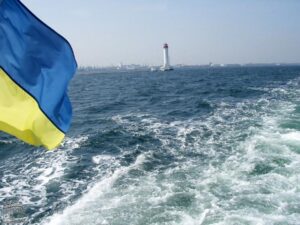
The Ukrainian Grain Association (UZA) called on the world community, Turkey and the UN to oppose the Russian seizure of the Black Sea and the establishment of restrictions on navigation for other countries.
“UZA considers it necessary to note that the Black Sea is not an internal sea of Russia, where it can dictate to other countries requirements to navigation. Russia’s purposeful actions to delay inspections of ships bound for Ukrainian ports to load grain and other food products under the Black Sea Grain Initiative demonstrate Russia’s real intentions to continue destabilizing global food security and turning food into weapons,” according to the organization’s website.
UZA stressed that because of Russia’s deliberate delay in inspecting ships, a queue of more than 140 ships has formed in the Bosphorus, with the vast majority waiting their turn for more than a month. Thus, the food security of the countries that depend on the export of Ukrainian food products was threatened.
In addition, the Russian Federation, despite military aggression, attacks on Ukrainian ports and restriction of navigation in Ukrainian seaports, continues to enjoy unimpeded commercial passage of its vessels from Russian Black Sea ports.
“The involvement of the Russian side in the inspection of vessels going to Ukrainian ports (which it deliberately and intentionally delays) and at the same time the absence of inspections of vessels sailing from Russian ports in the Azov-Black Sea basin is nothing but rewarding the aggressor and restricting navigation in international waters of the Black Sea in its favor,” – stated in a statement of the association.
“Moreover, the inspection of Russian vessels in the Bosphorus is not carried out, which makes it possible for it to use merchant ships to transport military cargo to continue the war against Ukraine and blackmail other states,” UZA added.
As a result, the association calls on the world community, the UN and Turkey not only to encourage Russia to stop delaying the movement of ships under the Istanbul grain initiative and stop using food as weapons, but also to begin work to restore free navigation in the Black Sea for all countries, in particular free commercial shipping to Ukrainian ports of the Black Sea.
As reported, on February 15, the Minister of Foreign Affairs of Ukraine Dmytro Kuleby and Deputy Prime Minister for Reconstruction of Ukraine – Minister of Development of Communities, Territories and Infrastructure Oleksandr Kubrakov called on the international community, in particular the UN and Turkey as guarantors of the Black Sea grain initiative to demand the Russian Federation to immediately stop artificial delays in the grain corridor and unblock commercial shipping to Ukrainian ports of the Black Sea.
The Ukrainian side notes that Russian representatives in the inspection teams under the Joint Coordination Centre in Istanbul have been systematically delaying for several months in a row the inspection of vessels passing through the Bosporus Strait to/from Ukrainian ports.
In particular, Russian inspectors are slowing down inspections, regularly demanding unregulated documentation, refusing to work during working hours, and looking for other unreasonable reasons to stop inspections. Typically, fewer than half of the 10 inspections scheduled each day occur.
It is emphasized that such destructive policy of Russia has led to a systematic reduction of cargo turnover in the framework of the Black Sea Grain Initiative. In the past three months alone, the world has under-received 10 million tons of Ukrainian food.
Number of unemployed in Ukraine and job opportunities, Sep 21 – Nov 22
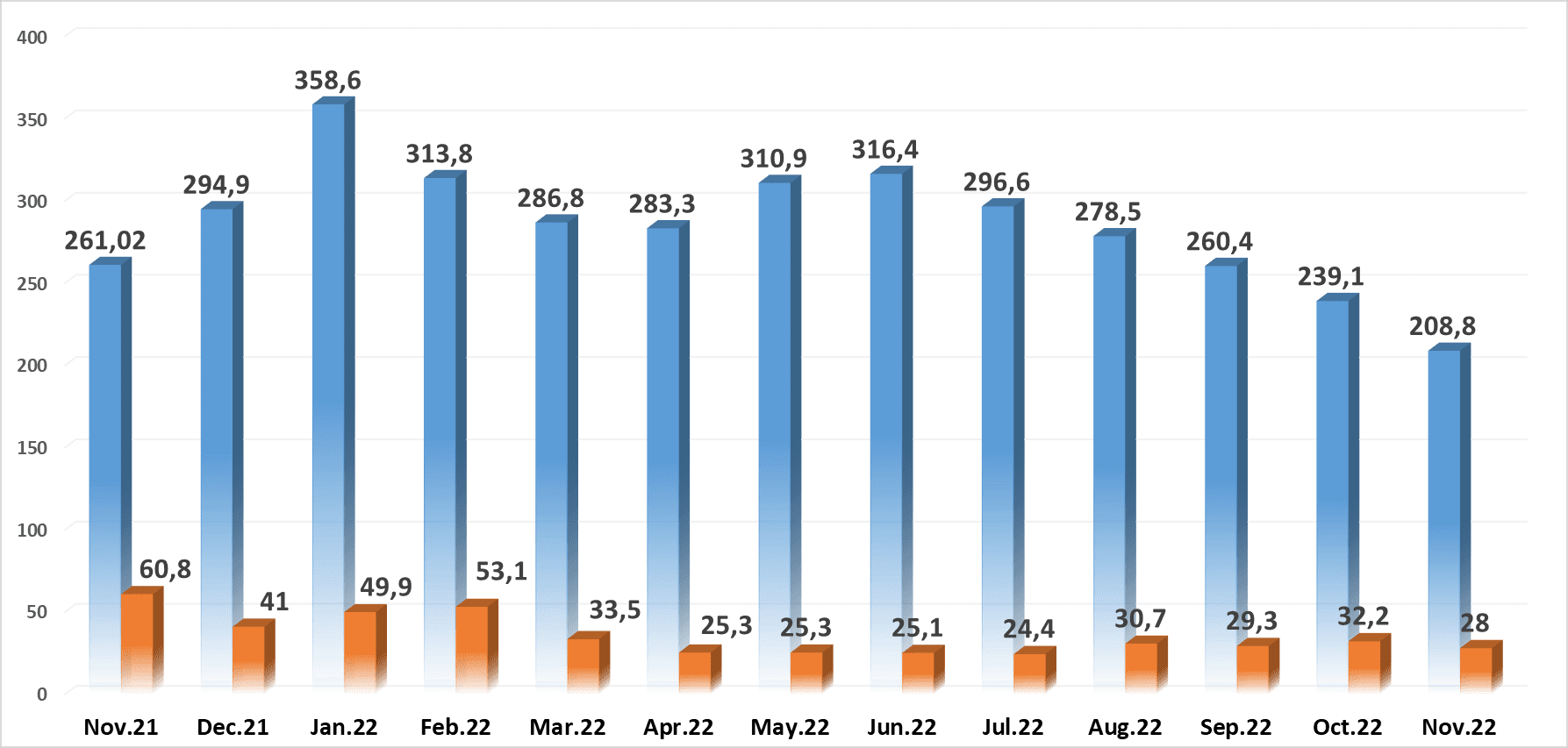
Source: Open4Business.com.ua and experts.news

Oil prices are falling on Friday as signals of crude glut in the U.S. outweigh expectations of demand growth in China, Bloomberg writes.
The cost of April futures for Brent crude oil on London’s ICE Futures exchange is $84.27 a barrel by 7:15 a.m. on Friday, down $0.87 (1.02%) from the previous session’s closing price. Those contracts fell $0.24 (0.3%) to $85.14 a barrel on Thursday.
March futures on WTI crude oil at electronic trades of NYMEX fell by that time by $0.85, to $77.64 per barrel. The previous session’s contract value was down $0.1 (0.1%) to $78.49 a barrel.
“Investors are trying to assess which of the major oil market drivers will prove the most influential in the next few months,” said CIBC Private Wealth senior trader Rebecca Babin.
Major Chinese air carriers announced a significant increase in flight loadings, indicating an upturn in tourist activity, Bloomberg notes.
Meanwhile, oil refining companies in China are increasing their purchases of raw materials. According to the agency’s sources, the trading “subsidiary” Sinopec bought 10 million barrels of oil in the UAE with delivery in April. A number of other Chinese refiners, including China National Chemical Corp. and Rongsheng Petrochemical Co. are also increasing their oil purchases, including from the United States.
At the same time, the U.S. Energy Department said Wednesday that the country’s oil inventories jumped 16.28 million barrels last week. Experts predicted an average increase of 2 million barrels.
U.S. Energy Department data this year “consistently give bearish signals to the market, pointing to weak consumer demand, low refinery activity and rising oil inventories,” analysts say Sevens Report Research.
The U.S. dollar goes up against the euro, yen and pound sterling in trading on Friday on hawkish statements of Federal Reserve (Fed) executives, which strengthened traders’ opinion that the U.S. Central Bank is not going to stop the rate hike cycle yet.
Federal Reserve Bank (FRB) Cleveland President Loretta Mester said the day before that she had seen a “compelling case” for a 50 basis points (bps) rate hike at the January 31-February 1 Fed meeting.
The Federal Open Market Committee (FOMC) unanimously decided at that meeting to raise the rate by 25 bps, to 4.5-4.75% per year.
Mester still believes the Fed needs to raise the benchmark rate to more than 5% and keep it above that mark for a while to get inflation back under control.
St. Louis Fed Chairman James Ballard said Thursday that, like Mester, he supported a 50-bp rate hike at the last meeting. Neither Ballard nor Mester have a vote on the FOMC this year.
Ballard said he thinks the Fed should raise the rate to 5.25-5.5% and do it “as soon as possible. Thus, Ballard believes it is necessary to raise the rate by 75 bps from current levels, Market Watch notes.
“A further rate hike could help solidify the disinflationary trend in 2023 even as the economy continues to grow and the labor market is strong,” Ballard said.
The ICE-calculated index, which shows the dollar’s performance against six currencies (euro, Swiss franc, yen, Canadian dollar, pound sterling and Swedish krona), added 0.53% Friday, while the broader WSJ Dollar Index gained 0.38%.
The euro/dollar pair was trading at $1.0638 as of 7:45 a.m., compared with $1.0672 at market close Thursday.
The pound was down to $1.1948 from $1.1988 the day before.
The value of the American currency against the yen rose to 134.71 yen against 133.94 yen by the previous trading results.
The dollar/yuan pair is trading at 6.8755 yuan, compared to 6.8607 yuan on the previous day.
EURO, pound, U.S. dollar, yen



