

The Ukrainian Grain Association (UZA) called on the world community, Turkey and the UN to oppose the Russian seizure of the Black Sea and the establishment of restrictions on navigation for other countries.
“UZA considers it necessary to note that the Black Sea is not an internal sea of Russia, where it can dictate to other countries requirements to navigation. Russia’s purposeful actions to delay inspections of ships bound for Ukrainian ports to load grain and other food products under the Black Sea Grain Initiative demonstrate Russia’s real intentions to continue destabilizing global food security and turning food into weapons,” according to the organization’s website.
UZA stressed that because of Russia’s deliberate delay in inspecting ships, a queue of more than 140 ships has formed in the Bosphorus, with the vast majority waiting their turn for more than a month. Thus, the food security of the countries that depend on the export of Ukrainian food products was threatened.
In addition, the Russian Federation, despite military aggression, attacks on Ukrainian ports and restriction of navigation in Ukrainian seaports, continues to enjoy unimpeded commercial passage of its vessels from Russian Black Sea ports.
“The involvement of the Russian side in the inspection of vessels going to Ukrainian ports (which it deliberately and intentionally delays) and at the same time the absence of inspections of vessels sailing from Russian ports in the Azov-Black Sea basin is nothing but rewarding the aggressor and restricting navigation in international waters of the Black Sea in its favor,” – stated in a statement of the association.
“Moreover, the inspection of Russian vessels in the Bosphorus is not carried out, which makes it possible for it to use merchant ships to transport military cargo to continue the war against Ukraine and blackmail other states,” UZA added.
As a result, the association calls on the world community, the UN and Turkey not only to encourage Russia to stop delaying the movement of ships under the Istanbul grain initiative and stop using food as weapons, but also to begin work to restore free navigation in the Black Sea for all countries, in particular free commercial shipping to Ukrainian ports of the Black Sea.
As reported, on February 15, the Minister of Foreign Affairs of Ukraine Dmytro Kuleby and Deputy Prime Minister for Reconstruction of Ukraine – Minister of Development of Communities, Territories and Infrastructure Oleksandr Kubrakov called on the international community, in particular the UN and Turkey as guarantors of the Black Sea grain initiative to demand the Russian Federation to immediately stop artificial delays in the grain corridor and unblock commercial shipping to Ukrainian ports of the Black Sea.
The Ukrainian side notes that Russian representatives in the inspection teams under the Joint Coordination Centre in Istanbul have been systematically delaying for several months in a row the inspection of vessels passing through the Bosporus Strait to/from Ukrainian ports.
In particular, Russian inspectors are slowing down inspections, regularly demanding unregulated documentation, refusing to work during working hours, and looking for other unreasonable reasons to stop inspections. Typically, fewer than half of the 10 inspections scheduled each day occur.
It is emphasized that such destructive policy of Russia has led to a systematic reduction of cargo turnover in the framework of the Black Sea Grain Initiative. In the past three months alone, the world has under-received 10 million tons of Ukrainian food.
Number of unemployed in Ukraine and job opportunities, Sep 21 – Nov 22
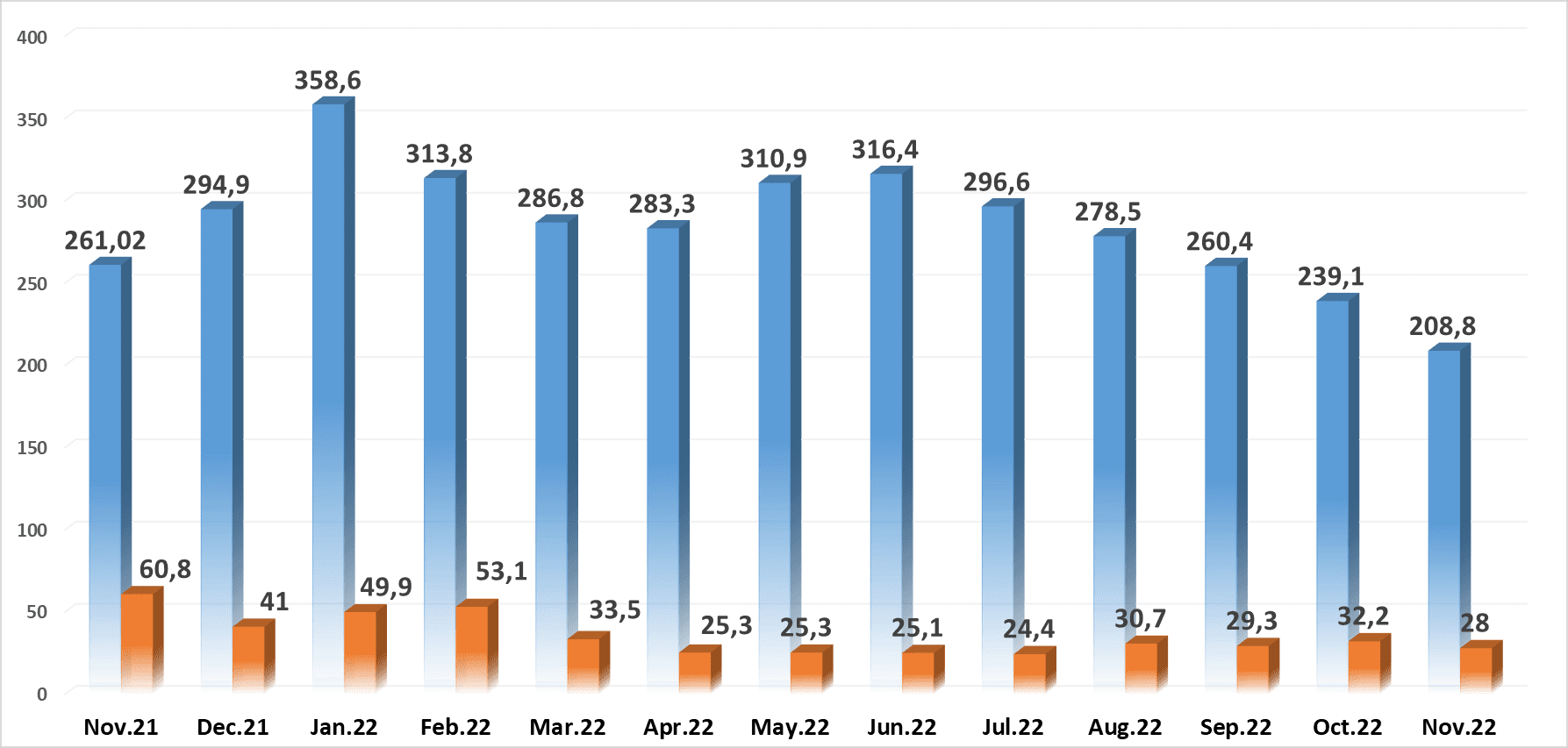
Source: Open4Business.com.ua and experts.news

Oil prices are falling on Friday as signals of crude glut in the U.S. outweigh expectations of demand growth in China, Bloomberg writes.
The cost of April futures for Brent crude oil on London’s ICE Futures exchange is $84.27 a barrel by 7:15 a.m. on Friday, down $0.87 (1.02%) from the previous session’s closing price. Those contracts fell $0.24 (0.3%) to $85.14 a barrel on Thursday.
March futures on WTI crude oil at electronic trades of NYMEX fell by that time by $0.85, to $77.64 per barrel. The previous session’s contract value was down $0.1 (0.1%) to $78.49 a barrel.
“Investors are trying to assess which of the major oil market drivers will prove the most influential in the next few months,” said CIBC Private Wealth senior trader Rebecca Babin.
Major Chinese air carriers announced a significant increase in flight loadings, indicating an upturn in tourist activity, Bloomberg notes.
Meanwhile, oil refining companies in China are increasing their purchases of raw materials. According to the agency’s sources, the trading “subsidiary” Sinopec bought 10 million barrels of oil in the UAE with delivery in April. A number of other Chinese refiners, including China National Chemical Corp. and Rongsheng Petrochemical Co. are also increasing their oil purchases, including from the United States.
At the same time, the U.S. Energy Department said Wednesday that the country’s oil inventories jumped 16.28 million barrels last week. Experts predicted an average increase of 2 million barrels.
U.S. Energy Department data this year “consistently give bearish signals to the market, pointing to weak consumer demand, low refinery activity and rising oil inventories,” analysts say Sevens Report Research.
The U.S. dollar goes up against the euro, yen and pound sterling in trading on Friday on hawkish statements of Federal Reserve (Fed) executives, which strengthened traders’ opinion that the U.S. Central Bank is not going to stop the rate hike cycle yet.
Federal Reserve Bank (FRB) Cleveland President Loretta Mester said the day before that she had seen a “compelling case” for a 50 basis points (bps) rate hike at the January 31-February 1 Fed meeting.
The Federal Open Market Committee (FOMC) unanimously decided at that meeting to raise the rate by 25 bps, to 4.5-4.75% per year.
Mester still believes the Fed needs to raise the benchmark rate to more than 5% and keep it above that mark for a while to get inflation back under control.
St. Louis Fed Chairman James Ballard said Thursday that, like Mester, he supported a 50-bp rate hike at the last meeting. Neither Ballard nor Mester have a vote on the FOMC this year.
Ballard said he thinks the Fed should raise the rate to 5.25-5.5% and do it “as soon as possible. Thus, Ballard believes it is necessary to raise the rate by 75 bps from current levels, Market Watch notes.
“A further rate hike could help solidify the disinflationary trend in 2023 even as the economy continues to grow and the labor market is strong,” Ballard said.
The ICE-calculated index, which shows the dollar’s performance against six currencies (euro, Swiss franc, yen, Canadian dollar, pound sterling and Swedish krona), added 0.53% Friday, while the broader WSJ Dollar Index gained 0.38%.
The euro/dollar pair was trading at $1.0638 as of 7:45 a.m., compared with $1.0672 at market close Thursday.
The pound was down to $1.1948 from $1.1988 the day before.
The value of the American currency against the yen rose to 134.71 yen against 133.94 yen by the previous trading results.
The dollar/yuan pair is trading at 6.8755 yuan, compared to 6.8607 yuan on the previous day.
EURO, pound, U.S. dollar, yen

Stock indices of the largest countries in the Asia-Pacific Region (APR) are down in trading on Friday, following the U.S. stock market.
The pressure on stock markets is being put by renewed fears over further interest rate hikes amid a resilient U.S. economy, which was indicated by fresh statistical data, and hawkish comments from U.S. Federal Reserve (Fed) management.
Federal Reserve Bank of Cleveland (FRB) President Loretta Mester said she thought it was premature to conclude that US inflation was on a steady path toward the US central bank’s 2% target.
Although inflation has slowed somewhat since last summer, it is still too high, Mester said during an event at the University of South Florida on Thursday. Last week’s January Consumer Price Report showed that core inflation is slowing little, she said.
St. Louis Fed Chairman James Ballard said during a speech in Tennessee that he called for a sharper rate hike at the last Fed meeting and did not rule out a sweeping move further down the road.
Japan’s Nikkei 225 Index was down 0.7 percent by 7:13 a.m.
Shares of Internet company Rakuten Group Inc. (-5.5%), Recruit Holdings Co. Ltd., which owns job search sites, (-3.9%) and industrial equipment manufacturer Keyence Corp. (-2.6%).
In addition, investment technology stocks of SoftBank Group (-2.1%), consumer electronics maker Sony (-2.3%) and Asia’s largest clothing retailer Fast Retailing (-0.7%) were getting cheaper.
China’s Shanghai Composite Index was down 0.1% by 7:23 a.m. Hong Kong’s Hang Seng lost 0.7%.
Shares of computer maker Lenovo Group Ltd. were down the most on the Hong Kong Stock Exchange. – by 4 percent, jewelry company Chow Tai Fook Jewellery Group Ltd. – by 3.8 percent and Internet company Baidu Inc. – Ltd. by 2.8 percent.
Shares of Internet giant Alibaba dropped 1.4 percent and consumer electronics maker Xiaomi Corp. – 2.4% and Internet company Meituan – 2.6%.
South Korea’s Kospi was down 0.9% by 7:23 a.m.
One of the world’s biggest chip and electronics maker Samsung Electronics Co. was down 1.7%, automaker Hyundai Motor down 0.5%.
The Australian S&P/ASX 200 index fell 0.86% in trading.
The capitalization of the world’s largest mining companies BHP and Rio Tinto decreased by 0.25% and increased by 0.5% respectively.

Dubai authorities are again talking about launching a flying cab service. It is expected that such transport will work by 2026.
Talks about flying cabs have been going on in the UAE commercial capital famous for its architectural wonders since 2017, a number of companies intend to participate in the implementation of the project.
The head of Dubai, Sheikh Mohammed bin Rashid Al Maktoum, recently announced the relaunch of a program to develop flying cabs. This time, in a commercial, Dubai introduced an electric flying cab created by Joby Aviation of Santa Cruz, California.
Previously, the EHang 184 and XPeng X2 made in China, as well as an electric Volocopter from Germany, were also shown in Dubai.
According to Ahmed Bahrozian of the emirate’s Roads and Transportation Authority, implementation of the plan “is still just beginning.” “We have not yet signed a contract with any partner,” he specified.
According to the published program, the city plans to create four “vertiports”: near Dubai International Airport, the world’s busiest, near downtown Dubai, the Palm Jumeirah Archipelago and Dubai Marina. These points will include two launch pads and four charging points for flying cabs.
“We believe that these are attractive areas with business and tourist price-tracks that can be in demand,” Bahrozian noted.
According to him, the prices for flying cabs “will be the same as limousines in Dubai, maybe a little higher. Right now, limousines cost about 30 percent more than a regular cab, with a minimum cost of about $3.25 or $0.50 per kilometer.
According to the plan, manned flying cabs would be used first, rather than autonomous cabs as previously discussed. However, Bahrozian clarified that testing will continue with autonomous flying cabs as well.
Joby’s manned prototype with four passenger seats can fly more than 240 kilometers without recharging, making Abu Dhabi and other parts of the country within reach. It takes off and lands vertically, and its rotors tilt forward in flight. The machine has a top speed of 320 km/h.
The advent of flying cabs is expected to ease the traffic situation in the nearly 3.5 million-strong city, which has more than 1.8 million registered cars sharing the highway with cars from the other six UAE emirates.



