

Ukrzaliznytsia reported delays of four trains due to enemy shelling near Nikopol and damage to the contact network.
At the same time, according to the railway company’s Telegram channel on Wednesday, Ukrzaliznytsia deployed reserve diesel locomotives to safely pull out of the region.
At the moment, such flights are delayed:
No. 62 Odessa-Kharkov – delayed by 4 hours;
#276 Kyiv-Zaporizhzhia – delayed for 4 h 30 min;
#119 Lviv-Zaporizhzhya – for 2 hours;
#120 Zaporizhzhya-Lviv – by 30 min.
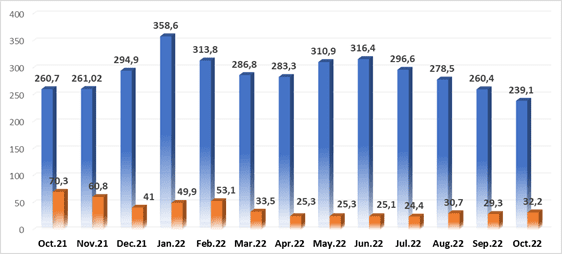
Number of unemployed in Ukraine and job opportunities, Sep 21 – Sep 22
State employment center

Willis Towers Watson (WTW), a leading global advisory and brokerage firm, expects deal-making to remain active in 2023 despite continued uncertainty and major obstacles, and recession fears will cause a “small object effect” as larger deals lose popularity, the WTW website notes.
It also notes that the global M&A market remains remarkably resilient during a year of unprecedented uncertainty. Mergers and acquisitions in 2022 have been affected by a host of factors – geopolitical turmoil, soaring inflation, rising interest rates and fears of a global recession – that will continue into next year. In such a difficult economic environment, it’s harder for buyers, especially those who go beyond their borders, to confidently predict the profitability of potential targets.
“An unprecedented number of disruptive forces have created barriers to deals, but they also create opportunities. The fundamentals behind deal making are still in place, and with valuations dropping after the historic levels reached in 2021, both strategic and financial buyers will take advantage of better growth opportunities,” notes Duncan Smithson, senior director of mergers and acquisitions, WTW.
WTW has identified five major M&A trends for 2023. The first trend is the return of the “small item effect,” which will result in buyers increasingly focusing on smaller deals.
The second is opportunities in distressed M&A, as a challenging operating environment will lead to more companies getting rid of non-core assets in pursuit of long-term value creation. Some deals will be strategic – energy companies, for example, will continue to get rid of carbon-intensive assets – while continued economic uncertainty will force other companies to sell assets – the retail and leisure sectors often have higher operating leverage. This can create opportunities for buyers to expand product lines, services or supply chains at a reduced cost.
The third is technological mergers and acquisitions: from defense to offense. The need for the speed of digital transformation across all industries, accelerated by an era of volatility, will keep deal-making in the spotlight, and a wave of acquisitions in the artificial intelligence and machine learning markets is expected in 2023. Whether it’s introducing new technology and talent or reaching new markets, mergers and acquisitions continue to be the fastest way to transform businesses to remain relevant and sustainable in today’s fast-changing world.
The fourth is geopolitical impact. Because of the many supply chain disruptions during the pandemic, which is expected to continue into 2023, companies will consider M&A deals to improve their operational resilience. The vulnerabilities that continue to lead to problematic deal flows in the hardest-hit sectors will also be catalysts for companies to reinvent their own supply chain networks. By attracting or locating suppliers closer to production, businesses will seek greater security and resiliency.
Fifth, the focus will remain on environmental, social and governance (ESG) issues. As more investors view ESG as fundamental to financial success, businesses will face increasing scrutiny and pressure on climate risk transparency, social justice, sustainability and corporate governance. “Green” due diligence is undoubtedly on the rise.
“As we approach 2023, economic uncertainty will continue to define and challenge mergers and acquisitions, but there will also be opportunities. That same volatility will provide its own incentive for deals, as strategic buyers look to capitalize on lower-priced deals to confront current market challenges and realize transformational growth,” Smithson notes.

Because of the snowfall that began on Thursday, the movement of transport to the state border checkpoints in several regions has slowed down, the press service of the State Border Guard Service of Ukraine reported.
“The longest queues were formed on the border with Poland at the entrance to the checkpoints “Shehyni”, “Krakivets”, “Rava-Russkaya” in Lviv region, as well as before the checkpoints “Yagodin” and “Ustilug” in Volyn,” – said in the message.
It specifies that at the same time checkpoints in Transcarpathian and Chernivtsi regions are not overloaded.
“Take this information into account when crossing (the border – IF-U). In the meantime, border guards together with employees of the National Police, if necessary, carry out reverse traffic to pass cars and try to clear passengers and vehicles as quickly as possible”, – summarized in the State Border Guard Service.

The cost of February futures for Brent at London’s ICE Futures Exchange is $82.09 per barrel by 7:20 a.m. (KSC), down $0.61 (0.74%) from the close of the previous session. At the close of trading on Wednesday these contracts rose by $2.02 (2.6%) to $82.7 a barrel.
The price of WTI futures for January at electronic trades of the New York Mercantile Exchange (NYMEX) makes $76.52 per barrel by that time, which is $0.76 (0.98%) lower than the final value of the previous session. The contract rose by $1.89 (2.5%) to $77.28 per barrel at the end of last session.
On Wednesday, the International Energy Agency raised its estimate for oil demand growth in 2022 by 140,000 barrels per day (bpd) to 2.3 million bpd. The 2023 demand growth forecast was also raised by 100k bpd to 1.7 million bpd. This gave a boost to the market, writes Bloomberg.
The agency also noted that oil demand remains relatively robust, especially in non-OECD countries.
Meanwhile, the Federal Reserve expectedly raised interest rates by 50 basis points to 4.25-4.5% per year. Meanwhile, the U.S. central bank said in a statement that it plans to keep raising rates so that monetary policy becomes restrictive enough to return inflation to the 2% target. Investors are concerned that tight monetary policy could cause an economic slowdown and, as a result, a drop in demand for oil.
U.S. oil inventories rose 10.23 million barrels to 424.13 million barrels last week, according to a weekly report from the U.S. Energy Department. Experts polled by Bloomberg expected a 3.5 million barrel drop in oil reserves.

LLC “Carton and Paper Company” (Lviv), a major Ukrainian manufacturer of cardboard sleeves and sanitary products in January-November 2022 increased production volume by 50.2% compared to the same period of 2021 – up to 1 billion 076 million UAH.
According to the statistical data of “UkrPapir” association, provided to “Interfax-Ukraine” agency, thus, the company has slightly increased the growth rate of this indicator compared to the same period of the last year (according to 10 months, the increase was 49.4%).
In physical terms, the company has kept the output of base paper for sanitary products almost at last year’s level – 6.42 thousand tons, while increasing the output of toilet paper in rolls by 41% – to 3.7 million pieces.
Production of cardboard products increased insignificantly – to 24.2 thousand tons.
As reported with reference to “UkrPapir” statistics, the mill has continued to work all months from the beginning of this year, reducing the output of paper and paperboard in March (to March 2021), but in April has already gone to a positive trend, which remained in subsequent months.
“Carton and Paper Company” (until 2011 – “Lvivkartonoplast”) produces products and semi-finished products from waste paperboard (cardboard sheets, corners, sleeves), cellulose and recycled waste paper (toilet paper, towels, napkins TM Papero).
In 2021 the company produced UAH 782.7 mln worth of products – 47% more than the year before.



