OTP Bank (Kyiv) has begun providing online acquiring services for businesses that sell online, the financial institution announced on Tuesday.
“The online acquiring service has been operational since the first days of 2026. Before the launch, the bank studied competitors’ offers and user needs, and the decision to launch was made taking into account customer requests,” said Serhiy Sereda, director of the corporate products and services department at OTP Bank.
According to the bank’s statement, the service features include connection within two days and crediting of funds from sales twice a day: at the beginning and end of the working day.
According to the bank, the service provides customers with various e-commerce tools, including accepting payments via QR codes and payment links, setting up a payment button on the website, including Apple Pay and Google Pay, as well as automated solutions for integrating payment instruments into customers’ mobile applications.
As Sereda noted, the bank is guided by market rates, and the main users of the service are currently existing customers of the bank. The rate for internet acquiring is 1.5% for Ukrainian bank cards and 2.3% for foreign bank cards. There is a possibility of applying individual rates as the volume of transactions increases.
The bank announced plans to scale up its online acquiring business in 2026 and launch merchant acquiring in the second quarter.
“The project’s benchmarks are customer satisfaction with product quality and service profitability, and the bank expects to reach profitability as soon as possible,” Sereda added.
According to the National Bank, OTP Bank ranked 10th among the country’s 60 banks in terms of total assets as of January 1, 2026, with UAH 135.99 billion. Its net profit for 2025 amounted to UAH 5.45 billion.
The Norwegian government has approved a decision to allocate 85 billion Norwegian kroner (1 krone = $0.1) to support Ukraine in 2026, of which 70 billion kroner will go to military aid and 15 billion kroner to support civil society, the government press service reported on Tuesday.
“In close dialogue with the Ukrainian authorities, the government has now determined the main direction of military support for Ukraine in 2026. We will use the funds where they will have the greatest effect for Ukrainians,” said Prime Minister Jonas Gahr Støre.
Priority attention in the field of military support will be given to drones, air defense, artillery ammunition, and the training and equipping of Ukrainian military personnel, the statement said.
Thus, more than 12 billion kroner will be allocated for drones and their autonomy (equipment capable of operating independently), about 9 billion kroner for air defense and F-16 fighter jets, about 6 billion kroner for maritime security, more than 8 billion kroner for international cooperation mechanisms and strategic projects, etc.
In addition, 11.5 billion kroner allocated in 2025 will be spent on military needs in 2026.
As the prime minister noted, if during the year it becomes necessary to change the areas of support, “they will be carried out in close cooperation with the Ukrainians.”
One of Ukraine’s largest grain market operators, Nibulon, has launched a new phase of its humanitarian demining initiative and signed an agreement with German organization DEG Impulse gGmbH for €7.8 million in funding, the company announced on Facebook.
According to the report, the funds under the develoPPP program will be used for maritime and inland water demining in southern Ukraine. The project involves the construction of a 90-meter marine platform equipped with modern unmanned underwater systems (ROV, AUV, and UUS) for clearing waterways at Nibulon’s own shipyard.
According to the company’s estimates, the implementation of the project will make it possible to clear more than 10 square kilometers of water areas in the Mykolaiv and Kherson regions and additionally clean up more than 13,600 hectares of agricultural land. This will allow more than 200 farms to resume safe operations and ensure an annual production of more than 70,000 tons of grain.
In addition, the initiative includes the creation of a technical service center, the deployment of a mobile rapid response infrastructure, and the training of more than 60 specialists (sappers, operators, and divers). The project’s coastal base will be certified according to IMAS international standards.
“This new stage not only strengthens our technical capabilities, but also demonstrates how Ukrainian business can take the lead in overcoming the consequences of war,” emphasized Oleksandra Dolzhenkova, Nibulon’s director of government relations.
As reported, Nibulon is actively developing its own humanitarian demining unit to restore security on leased land and assist Ukraine’s agricultural sector. The company is a certified mine action operator. In February 2026, Vsevolod Petrovsky, an expert on international missions in Somalia and Libya, headed Nibulon’s demining division.
Before the war, Nibulon cultivated 82,000 hectares of land in 12 regions of Ukraine and exported agricultural products to more than 70 countries around the world. In 2021, the grain trader exported a record 5.64 million tons of agricultural products. After the war began, the company was forced to move its central office from Mykolaiv to Kyiv. In addition to 23 elevator complexes, Nibulon has its own road and rail transport facilities, as well as a fleet built at its own shipyard. Even during wartime, this fleet continues to operate river transport on the Dnipro, Danube, and Southern Bug rivers.
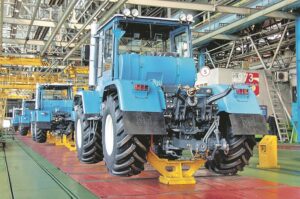
According to Fixygen, Kharkiv Tractor Plant (HTZ), part of businessman Oleksandr Yaroslavskyi’s DCH group, has announced a general shareholders’ meeting to review its performance in 2022-2024, with plans to approve a procedure for covering losses incurred.
According to the announcement of the meeting on March 27, it is planned, in particular, to approve the reports of the CEO and the supervisory board (SB) on the company’s activities in 2022-2024, approve the audit reports, and terminate the powers and elect a new composition of the SB.
The draft decision of the meeting states that the losses incurred during these years are planned to be covered by profits from economic activities in future periods.
The report does not provide financial performance indicators for KhTZ in 2022-2024. According to YouControl, in 2022, the plant incurred losses of UAH 50 million and net income of UAH 123 million (compared to UAH 138.3 million and UAH 476 million, respectively, a year earlier), in 2023 – UAH 14.6 million in net profit and UAH 199.2 million in net income, and in 2024 – UAH 359 million in losses and UAH 300 million in net income.
As reported, on July 23, 2025, the Commercial Court of Kharkiv Region opened a preventive restructuring procedure for the private joint-stock company Kharkiv Tractor Plant (PJSC HTZ).
The company requested the opening of the procedure due to financial difficulties. HTZ has total creditor debt of UAH 2.29 billion, which it is unable to repay, indicating an unstable financial situation.
In December of the same year, a preventive restructuring plan was approved, which provides for the repayment of debts within three years and three months (until March 17, 2029).
Kharkiv Tractor Plant has been manufacturing tractors since 1931 and was acquired by Alexander Yaroslavsky’s DCH group in 2016. In 2023, with the support of the UN World Food Programme and the Swiss Foundation for Mine Action (FSD Ukraine), HTZ developed, certified, and launched the production of a demining machine based on the T-150 crawler tractor.
On February 21, 2026, JSC NAEK Energoatom joined the balancing group of EA Trade LLC, whose sole founder and participant is NAEK, the company announced on its Telegram channel on Monday.
“To this end, the parties have entered into an agreement on participation in the balancing group of EA Trade LLC in accordance with the Market Rules (…) and, in accordance with the established procedure, agreed with NPC Ukrenergo on a change in the party responsible for the balance,” the statement said.
Energoatom explained that participation in the balancing group will reduce the company’s costs for settling electricity imbalances and significantly speed up the receipt of funds for imbalances, which are currently paid by the transmission system operator Ukrenergo with a delay of several months.
According to the Market Rules, all market participants, except consumers, are responsible for their electricity imbalances. Each market participant is required to become a BSO or transfer its financial responsibility for imbalances to another BSO.
According to information from Opendatabot, EA Trade LLC was founded on September 23, 2025, with a registered capital of UAH 50 million. 100% of the company’s shares are owned by NAEK Energoatom.
The director of EA Trade is Viktor Kachurenko, who previously headed Shell Oil Products Ukraine LLC and Shell Energy Ukraine, which specialize in trading various types of fuel. Currently, both companies are in the process of being dissolved.
As stated on the website, EA Trade is a modern company specializing in trade in the energy sector. Its goal is to ensure efficient, transparent, and competitive trade in electricity, contributing to the stability of the energy system. The website does not mention the likely participants in the balancing group and the company’s customers.