
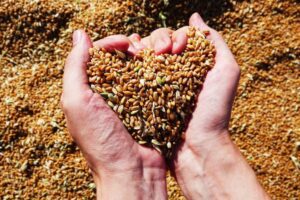
Federal Minister of Foreign Affairs of Germany Annalena Berbock said that she supports the proposal of the European Commission to appoint a central coordinator represented by the EU, who will buy grain in Ukraine and rationally distribute its exports through existing logistics channels.
She made the corresponding statement on July 18 after visiting the Romanian port of Constanta, which transships significant volumes of agricultural raw materials from Ukraine under the blockade of Ukrainian seaports, according to the Spiegel website.
“We should think about whether to buy up all (Ukrainian – IF-U) grain, so that later we can distribute it logistically much faster,” the German minister was quoted as saying.
Burbock recalled that due to the Russian blockade of Ukrainian ports, Ukraine has accumulated 18 million tons of agricultural products ready for export. After four-party talks between Ukraine, the OO, Turkey and the Russian Federation, there is hope for the deblockade of Ukrainian export infrastructure in the Black Sea, but it is still important to look for alternative grain routes, for example, through Constanta.
As reported, on June 28, the Cabinet of Ministers of Ukraine approved a draft agreement with the UN World Food Program (WFP) on the resumption of its office in the country, which will allow the organization, among other things, to purchase agricultural products from Ukrainian companies to carry out international humanitarian programs.
WFP is expected to participate in the purchase of agricultural and food products from Ukrainian companies for the needs of UN international humanitarian projects.
People’s Deputy Dmitry Solomchuk wrote in June that the uncertainty with the export of Ukrainian grain, leading to a global food crisis and rising food prices, can be resolved by buying last year’s and this year’s crops from Ukraine for a total of $30-35 billion through a specially created fund. This will contribute to the development of exports from the country and its internal processing in the agro-industrial complex, as well as provide the Ukrainian agricultural sector with working capital and the opportunity to continue working in the conditions of the military invasion of the Russian Federation.
Hungary is working on expanding the border checkpoints with Ukraine Chop-Zahony and Luzhanka-Beregshurani in order to equip corridors for the export of agricultural products bypassing Ukrainian seaports blocked by the Russian Federation.
This was announced by the Parliamentary State Secretary of Hungary Levente Madyar during a meeting with the head of the Transcarpathian Regional Council Volodymyr Chubirko, organized to address issues of current and future humanitarian support for Ukraine by Hungary.
For his part, the head of the Transcarpathian Regional Council promised, as far as possible, to assist in the implementation of all projects planned by Hungary for implementation in Ukraine, and presented the Hungarian official with world-famous stamps and a postcard on the theme of the Russian ship.
As reported, Ukraine, together with Hungary, intends to apply to the European Union to increase the throughput capacity of checkpoints on the Ukrainian-Hungarian border.
“We will apply together to the EU so that we can develop the capacity of transit corridors from both the Ukrainian and Hungarian sides. We are concerned about what the food supply of the world will be like as a result of the war … We are interested in the movement of goods to accelerate. This is not only the Hungarian , Ukrainian or European interest. This is a global interest,” Hungarian Agriculture Minister Ivstan Nadia said last week.
According to the Minister of Agrarian Policy of Ukraine Mykola Solsky, Slovakia and Hungary are logistics corridors in the European market that have not been developed, because Ukraine exported agricultural products mainly through the sea.
“We have fewer checkpoints on the border with Hungary than with Romania or Poland, so we plan to increase it and are already working on it,” the Ukrainian minister stressed.
Consumer prices in the euro area in June increased by 8.6% in annual terms, according to the final data of the Statistical Office of the European Union.
The indicator is the maximum since the beginning of the data calculation.
Thus, inflation in the region accelerated compared to 8.1% in May.
The final data coincided with the preliminary ones. Analysts polled by Trading Economics also did not expect a revision in the preliminary estimate.
The growth of consumer prices compared to the previous month amounted to 0.8%, as in May.
Inflation is over four times the European Central Bank’s (ECB’s) target of 2%. The next meeting of the ECB will take place on Thursday, and it is likely that as a result of it, key interest rates will be raised immediately by 50 basis points, and not by the expected 25 bp.
According to Eurostat, energy resources jumped in price by 42% compared to June last year. Food, alcohol and tobacco increased in price by 3.7%, manufactured goods – by 4.3%, services – by 3.4%.
Consumer prices excluding food and energy rose 3.7% year-on-year last month from 3.8% in May.
In the European Union, inflation in June accelerated to 9.6% in annual terms from 8.8% in May.
The lowest inflation in the EU was recorded in Malta (6.1%), France (6.5%) and Finland (8.1%), the highest – in Estonia (22%), Lithuania (20.5%). ) and Latvia (19.2%).

The Ministry of Digital Transformation of Ukraine is working on the translation of a foreign passport, driver’s license and technical passport into English, Deputy Prime Minister – Minister of Digital Transformation Mikhail Fedorov said.
“Some digital documents in Die will have an English version. Today, the team reviewed specific examples of this. We will translate the international passport, driver’s license and registration certificate. It is important that the license and registration certificate receive international coding used in the EU, USA and Canada,” – he wrote on the Telegram channel on Monday evening, emphasizing that this is another step towards the international integration of Diya.
“We are already completing the technical details of the development and will soon come out with a beta test,” the minister said.
As reported, the Ministry of Justice of Ukraine, together with the State Enterprise “National Information Systems” and the Ministry of Digital Development, developed a procedure for registering a limited liability company in automatic mode without the participation of a state registrar.
driving license, English version, international passport, registration certificate

Ukraine in January-June of this year reduced the export of ferroalloys in quantity terms by 27.2% compared to the same period last year, to 232,596 tonnes.
According to statistics published by the State Customs Service, in monetary terms, exports of ferroalloys increased by 2%, to $420.518 million.
At the same time, the main export was to Poland (55.83% of supplies in monetary terms), the Netherlands (9.72%) and Romania (7.05%).
In addition, during this period, Ukraine imported 14,941 tonnes of these products, which is 45.7% less compared to January-June 2021. In monetary terms, imports decreased by 26.1% to $54.361 million.
Import was carried out mainly from Norway (30.23%), China (16.77%) and Brazil (16.24%).
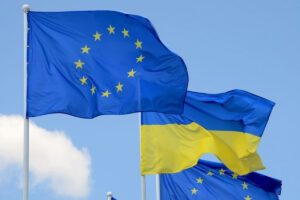
The EU-Ukraine Association Council is scheduled for September 5, said Josep Borrell, High Representative of the European Union for Foreign and Security Policy.
“We will continue to support Ukraine in advancing the reform agenda of its European perspective after Ukraine has been granted candidate status. We will hold an Association Council on September 5 after the summer break and we are working to ensure that this Council advances the European perspective for Ukraine through implementation of the necessary reforms,” he announced on Monday in Brussels at a press conference following the meeting of the EU Council at the level of foreign ministers.
Borrell confirmed that the ministers had unanimously approved his proposal for the next tranche from the European Peace Fund in the amount of 500 million euros, which will be formally decided in the coming days.
The High Representative stated that the EU is “terrified of the brutality of Russian aggression against the civilian population in Ukraine, the use of sexual violence as a weapon of war”, the Russians are “burning fields with grain”, “blocking food supplies” and “are responsible for world hunger” . “Russia is trying to destroy Ukraine and the Ukrainian nation, while at the same time unleashing the global food and energy crisis. Ministers agreed that we must continue to stand by Ukraine in its struggle for independence. Ukraine needs more weapons and we will supply them. We We will continue to support Ukraine,” he assured.
Borrell also said that work continues on sanctions for the Russian Federation. He also refuted claims that energy price increases were driven up by the EU’s ban on Russian oil. “Many say that the EU, by imposing sanctions, provoked a rise in prices. This is not true. The price of oil rose one month before the war, and after we banned the export of oil from Russia, the price of oil fell,” the High Representative stated. .



