The Council of the European Union (EU) has adopted a regulation allowing for temporary trade liberalisation and other trade concessions with regard to certain Ukrainian products.
“We proposed it as a temporary measure, and it will make it easier for Ukraine to continue trading in the face of Russia’s aggression and will provide overall support to the Ukrainian economy,” Executive Deputy Chairman of the European Commission Valdis Dombrovskis said, commenting on the decision adopted by the EU Council on Tuesday.
The decision will suspend tariffs, which are still in place under the 2017 the Association Agreement between the EU and Ukraine establishing a deep and comprehensive free trade area (DCFTA), which liberalized much of the trade.
The suspension covers notably: industrial products subject to duty phase out by the end of 2022, fruits and vegetables subject to the entry-price system, and agricultural products and processed agricultural products subject to tariff-rate quotas, the collection of anti-dumping duties on imports originating in Ukraine, and the application of the common rules for imports with respect of imports originating in Ukraine.
The European Commission’sproposal has already been approved by the European Parliament, the law will enter into force after publication in the Official Journal of the EU.
Dombrovskis also said that the ministers of economy and finance of the EU countries discussed the European Commission’s proposal for short-term relief and long-term reconstruction, and more specifically, our proposal for an exceptional macro-financial assistance programme of EUR 9 billion. He said that “there was broad – in fact unanimous – support for a continued need to provide necessary support to Ukraine to face this aggression.”
Projects of modernization to the European standard of the track from the border to Lviv and Kovel are described in the National Transport Strategy and require more than $ 75 million investment, said former Deputy Minister of Infrastructure of Ukraine for European Integration Viktor Dovgan to Interfax-Ukraine.
As reported, Prime Minister Denis Shmygal at a government meeting on Tuesday said that Ukraine will begin to gradually move to the European track to connect the Ukrainian railway with the EU, first connecting large hubs and large cities, and then gradually expanding across the country .
“Investments in such a large-scale project are unlikely, because 1 km of the European road – 1 million euros plus rolling stock. It is necessary to make short connections Lviv, Mukachevo, Chernivtsi and transfer. It is important to take an action plan of the National Transport Strategy. it is unrealistic to make a European track to Kyiv or Odessa at this stage, “Dovgan commented.
It will be recalled that in the Investment Atlas published by the Cabinet of Ministers at the end of 2020, two potential sections with the European standard of 1435 mm gauge were presented: Sknilov-Mostiska and Kovel-Yagodin-State Border.
The estimated cost of the Sknilov-Mostiska modernization project is $ 20.8 million, Kovel – Yagodin – State Border – $ 54.2 million.
In February 2022, Lviv OVA announced that within the framework of the presidential program “Big Construction” this year work will begin on the restoration of the 8-km Goskolitsa-Rava-Russkaya Eurorail, which they intend to implement within two years.
BORDER, EUROPEAN RAILWAY TRACK, INVESTMENT, LVIV, MODERNIZATION, КОВЕЛЬ
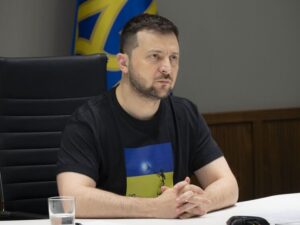
President of Ukraine Volodymyr Zelensky said that the main task of the international advisory group of specialists on security guarantees for Ukraine will be the development of such guarantees that will work throughout the life of many generations of Ukrainians.
According to him, the President’s Office and diplomats continue to work to ensure that Ukraine receives reliable guarantees of its own security after the end of the war.
“In particular, the international advisory group headed by Yermak and ex-NATO Secretary General Rasmussen was established. The group will include leading experts in the field of security and defense, diplomacy. Their task is to develop a format of guarantees that will really work, moreover, work not for several months or a year, but throughout the life of many generations of Ukrainians,” Zelensky said in an evening video message on Tuesday.
As reported, on Tuesday, May 24, head of the Office of the President of Ukraine Andriy Yermak announced the creation of an international advisory group that will provide proposals on security guarantees for Ukraine.
It will be headed by Andriy Yermak and ex-NATO Secretary General Anders Fogh Rasmussen.
Prime Minister Denis Shmygal says that by the end of the year Ukraine plans to expand the capabilities of Ukrainian energy companies, and will be able to export to the European Union about 800 MW of electricity per day.
“In mid-March, Ukraine joined the European network ENTSO-E ahead of schedule… Ukraine is already exporting its electricity to Europe,” Shmygal told a government meeting on Tuesday.
According to the Prime Minister, in April, electricity exports to Poland increased by 35% compared to pre-war January.
“By the end of the year, we plan to expand the capabilities of Ukrainian energy companies, and will be able to export to the EU about 800 MW of electricity per day. This will help Europe to abandon the consumption of Russian coal and reduce the consumption of Russian gas, “he said.
The World Trade Organization (WTO) will consider unblocking Ukrainian ports for food security at the 12th Ministerial Conference on June 12-15 in Geneva.
“We are grateful for the personal efforts of the Director General of the WTO to find a solution to the logistics of Ukrainian grain, so important for Ukraine, Africa and the world. Free and fair trade will save the world from hunger and poverty,” the press service quoted the First Deputy Prime Minister as saying. Minister of Economy Yulia Sviridenko following her meeting with WTO Director-General Ngozi Okondji-Ivela at the World Economic Forum.
During the meeting, the parties also agreed on cooperation on the eve of the 12th Ministerial Conference.
Ovostar Union agro-industrial group of companies, one of the leading producers of eggs and egg products in Ukraine, in January-March 2022 received $ 16.44 million in net loss against the Russian military invasion against $ 4.72 million in net profit in the first quarter of 2021, according to the message of the agrarian group on the Warsaw Stock Exchange on Tuesday.
“The egg processing plant in Makarov (Bucha district, Kyiv region) was temporarily shut down until the city was deoccupied by Ukrainian troops in late March. A subsequent inspection of the plant revealed signs of uncritical damage to administrative and industrial buildings … Management expects to resume the operation of the plant after the completion of repair work in the premises, “the company said in a report on the consequences of the Russian invasion.
Ovostar’s revenue in the first quarter of 2022 decreased by 13.7% compared to January-March 2021 – to $ 27.71 million. The gross loss of the group of companies in the first quarter of this year amounted to $ 13.38 million against $ 6.91 million gross profit in January-March 2021, also for this period it received $ 15.67 million in operating loss against $ 4.37 in operating profit last year.
In the structure of Ovostar’s revenue, 75% was accounted for by egg sales ($ 20.8 million), of which 87% ($ 18.1 million) accounted for sales in Ukraine. The egg products segment generated 25% of the agroholding’s revenue ($ 6.8 million), with 58% of its sales ($ 3.93 million) in the domestic market.
“The main sales channel of the egg segment is large national retail chains. Geographically, sales are concentrated in the central part of the country, and the share of sales in the most affected regions does not exceed 10%. Market losses in the east and south where a large number of internally displaced persons temporarily reside, “the Ovostar report said.
The document states that the assets of the agricultural holding as of March 31, 2022 decreased compared to December 31, 2012 by 18.3% to $ 115.3 million, its long-term debt decreased by 1.8 times to $ 5.8 million, and current growth – by 1% to $ 14.5 million
“Since the beginning of the Russian military campaign, the group has faced significant obstacles to export activities due to serious logistics disruptions. In particular, the blockade of the port of Odessa blocked access to Middle Eastern markets, where goods were shipped by sea. after the company was issued a special license, “the egg producer said in a statement.
Ovostar also noted its dependence on imports of certain feed additives, vaccines and spare parts for equipment, which are included in the list of critical imports and are imported into Ukraine without restrictions. The management is also looking for adequate substitutes for imported supplies on the Ukrainian market.
According to the report, as of March 31, 2022, Ovostar Union shares were owned by: Prime One Capital Limited (67.93%), controlled by Ovostar CEO Boris Belikov and Chairman of the Board Vitaly Veresenko; Generali Open Funds Emergency Fund (10.39%), Fairfax Financial Holdings Limited (10.39%), Aviva Open Funds Emergency Fund (5.02%).
Ovostar Union Group is a vertically integrated public holding company, one of the leading producers of chicken eggs and egg products in Europe. The manufacturer is a certified exporter to EU countries since 2015.
The group’s holding company is Ovostar Union N.V. in mid-June 2011 held an IPO of 25% of the shares on the Warsaw Stock Exchange and raised $ 33.2 million. The majority stake in the company is owned by Prime One Capital Limited, which is controlled by its CEO Boris Belikov and Chairman of the Board Vitaly Veresenko.