

Nearly four out of ten apartments in London that were resold within 12 months as of August 2026, after five to ten years of ownership, were sold for less than their original purchase price. This is according to an analysis by e.surv Chartered Surveyors.
The share of loss-making apartment resales in the British capital reached 39.5%, the highest rate among regions in the United Kingdom. By comparison, among homes owned for the same period, the share of sales below the original purchase price was less than 4%.
In Southeast and East England, approximately one-third of apartments that owners had held for five to ten years were also sold for less than their purchase price. In central and northern England, such transactions accounted for about 20%, while the UK-wide average was slightly more than a quarter. In Scotland, the figure remained below 10%.
According to e.surv’s assessment, price trends for apartments and single-family homes began to diverge noticeably around 2017. Among the factors holding back apartment prices, analysts cite leasehold issues, high service charges, safety concerns regarding buildings, the cost of replacing cladding following the cladding crisis, and rising mortgage costs.
Additional pressure is coming from the general weakening of the London real estate market. According to the e.surv index, the average housing price in the United Kingdom in September 2026 was approximately £328,900, which is 1.5% higher than a year ago. However, London was the only major region to see a year-over-year decline in prices—by approximately 2.3%, to 594,200 pounds
A separate analysis by ValuQ also shows an increase in the number of loss-making transactions in England and Wales. In the first half of 2026, 16.3% of residential properties resold less than five years after purchase were sold for less than their original price. Among apartments, this figure reached 29.5%. The total difference between the purchase price and the resale price of such properties was estimated at approximately £210 million.
It is important to note that this is strictly a nominal comparison of purchase and sale prices. The calculation does not include stamp duty, mortgage interest, real estate agent commissions, renovation costs, maintenance fees, or other owner expenses. Therefore, the actual financial outcome for some sellers may be even worse.
Experts attribute the weak performance of the apartment market primarily to the fact that buyers are increasingly carefully evaluating the ongoing maintenance costs of apartment buildings and potential legal and technical risks. At the same time, demand for single-family homes and townhouses remains relatively more stable.
According to Experts Club, the United Kingdom continues to enjoy one of the highest levels of positive perception among Ukrainians: in August 2026, 72.6% of respondents viewed the country positively, while 7.1% viewed it negatively. Compared to March, the share of positive assessments has decreased slightly, but the overall attitude remains consistently favorable, reports the Experts Club Information and Analytical Center.
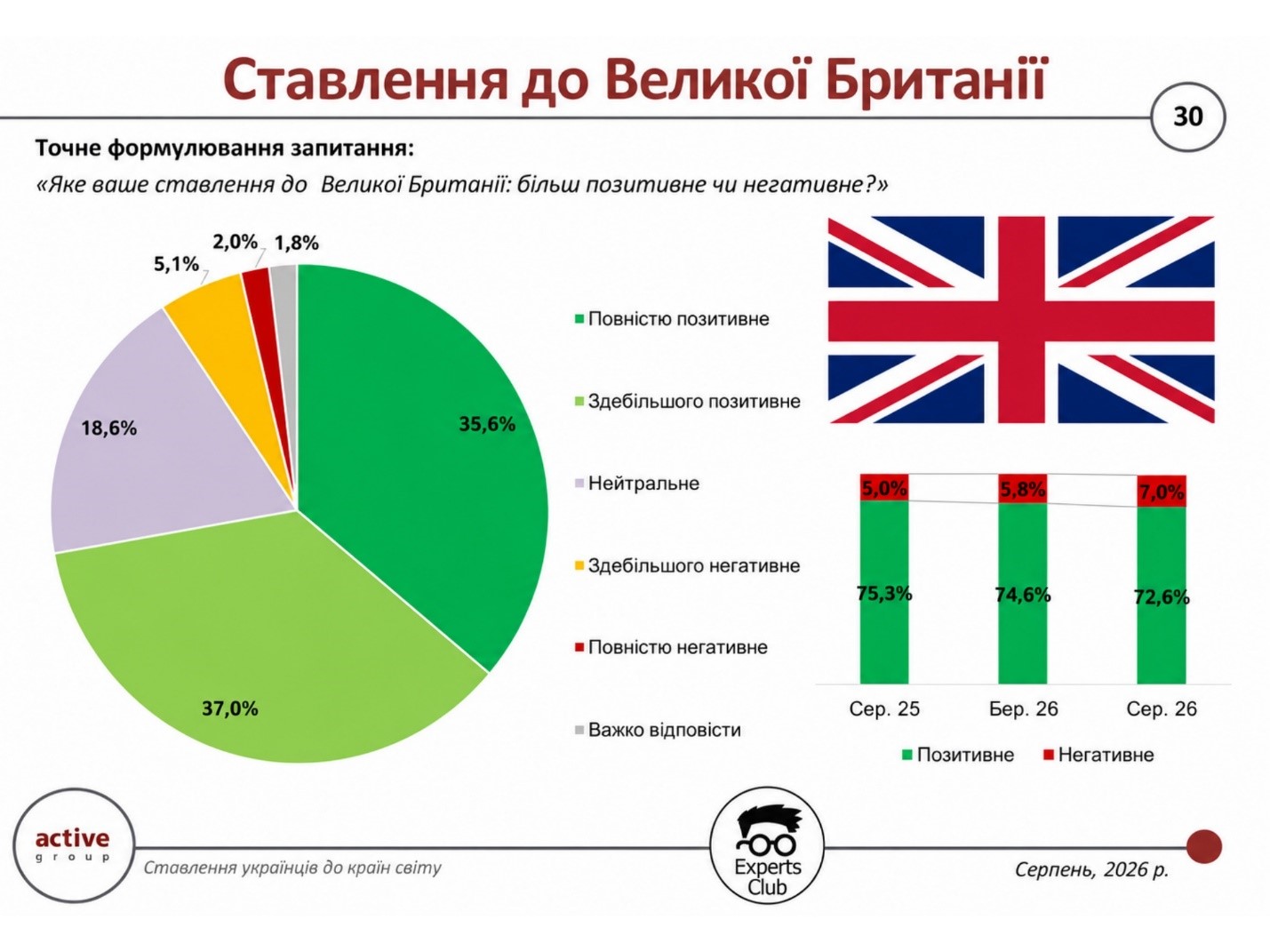
According to the results of the August survey, 35.6% of Ukrainians have a completely positive view of the United Kingdom, and 37% have a mostly positive view. 18.6% of respondents hold a neutral position. 5.1% view the country mostly negatively, 2% view it entirely negatively, and another 1.8% were undecided.
Based on the rounded figures in the table, the balance between positive and negative assessments stands at approximately plus 65.5 percentage points. Thus, positive attitudes outweigh negative ones by more than ten times, and the United Kingdom remains among the countries with the highest level of public favor among Ukrainians.
In March 2026, the overall share of positive assessments of the United Kingdom stood at 74.6%. At that time, 40.3% of respondents described their attitude as entirely positive, while another 34.3% described it as mostly positive. A neutral response was chosen by 18.2% of those surveyed, and negative assessments accounted for about 5.8%.
Thus, over the course of five months, the share of positive responses decreased by approximately 2 percentage points—from 74.6% to 72.6%—while negative responses increased by approximately 1.3 percentage points. The share of neutral responses remained virtually unchanged—18.2% in March versus 18.6% in August.
At the same time, a noticeable shift has occurred in the structure of the positive segment. The share of entirely positive assessments fell from 40.3% to 35.6%, while the share of mostly positive assessments rose from 34.3% to 37%. This suggests a certain softening in the intensity of positive attitudes rather than a fundamental change.
Oleksandr Pozniy, director of the research firm Active Group, had previously linked the high ratings for the United Kingdom to the nature of its relationship with Ukraine.
“Support from London during the war—both political and military—was highly valued by Ukrainian society. The United Kingdom is perceived as a reliable ally,” Pozniy noted.
At the same time, commenting on the trends in subsequent waves of the survey, he emphasized that the ratings for certain countries had deteriorated somewhat compared to the previous survey.
The current results confirm that a high level of positive attitude toward the United Kingdom remains, although it has weakened somewhat compared to March. At the same time, the country remains in the top group of nations in terms of the balance of positive and negative assessments by Ukrainians.
The survey was conducted in August 2026 using self-administered online questionnaires in the SunFlowerSociology panel among 800 Ukrainian citizens aged 18 and older. In the previous survey wave in March, 800 respondents were also surveyed; the sample was representative by age, gender, and region, with a maximum theoretical margin of error of ±3.5 percentage points for indicators at the 50% confidence level.
ACTIVE GROUP, EUROPE, EXPERTS CLUB, international relations, PUBLIC OPINION, SOCIOLOGY, UKRAINE, UNITED KINGDOM
According to Experts Club, Ukrainians’ attitudes toward the United Kingdom, the Scandinavian countries, and the Baltic states remain predominantly positive: in August 2026, the share of positive assessments for the countries included in the study ranged from 66.9% to 72.6%. At the same time, the balance between positive and negative attitudes toward all countries in this group has declined slightly compared to the previous survey wave in March 2026. This is evidenced by the results of a study conducted by Active Group and the Experts Club Information and Analytical Center, reports the Experts Club Information and Analytical Center.
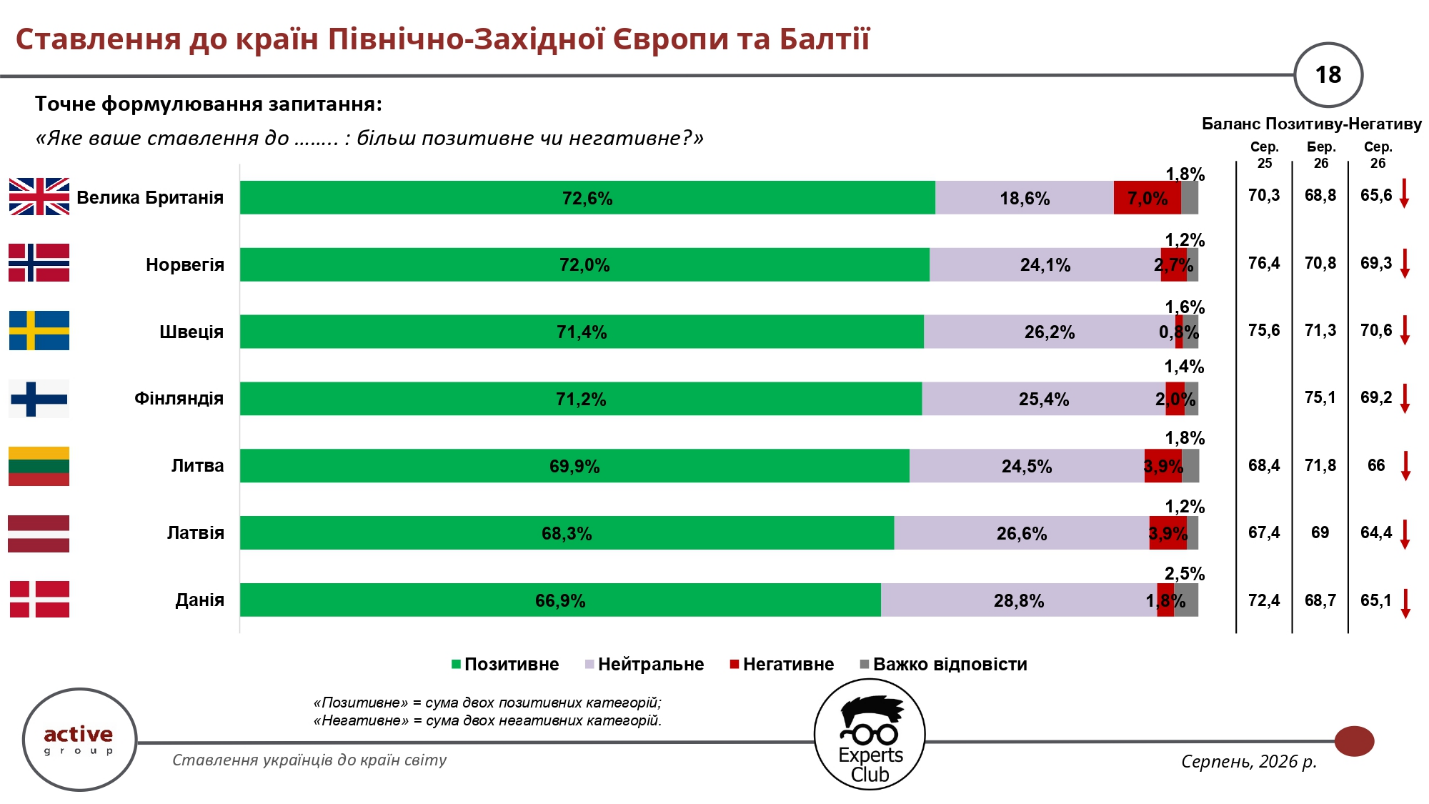
The United Kingdom received the highest share of positive assessments in the group—72.6%. 18.6% of respondents had a neutral attitude toward it, 7% had a negative attitude, and another 1.8% were undecided. The balance of positive and negative assessments stands at 65.6 percentage points, compared to 68.8 percentage points in March 2026 and 70.3 percentage points in August 2025.
Seventy-two percent of Ukrainians view Norway positively, while only 2.7% view it negatively, resulting in a balance of 69.3 percentage points. In March, this balance stood at 70.8 percentage points, and in August of last year, at 76.4 percentage points. Sweden has 71.4% positive and only 0.8% negative assessments—its balance stands at 70.6 percentage points and is the highest among the countries presented on the slide. Overall, the study records approximately 67–73% positive ratings for the countries of Northwestern Europe and the Baltic states.
71.2% of respondents view Finland positively, 25.4% neutrally, and 2% negatively. The balance stands at 69.2 percentage points, down from 75.1 percentage points in March. Lithuania is viewed positively by 69.9% of respondents and negatively by 3.9%; the balance fell from 71.8 percentage points in March to 66 percentage points in August.
A positive attitude toward Latvia was expressed by 68.3% of respondents, a neutral one by 26.6%, and a negative one by 3.9%. Its balance stands at 64.4 percentage points, compared to 69 percentage points in March. For Denmark, the corresponding figures are 66.9% positive, 28.8% neutral, and 1.8% negative assessments, with a balance of 65.1 percentage points, compared to 68.7 percentage points in the previous survey wave.
Maksym Urakin, founder of the Experts Club Information and Analytical Center, deputy director of the Interfax-Ukraine news agency, and candidate of economic sciences, emphasized the importance of constant communication between foreign partners and Ukrainian society.
“The first recommendation is to regularly showcase concrete achievements and concrete actions. Second, be open to questions and inquiries from the media and the public,” Urakin noted. According to him, the results of sociological surveys can be used to strengthen bilateral relations, particularly trade relations.
Alexander Pozniy, director of the research company Active Group, also drew attention to the need to combine public perceptions of countries with the development of practical economic cooperation.
“We should do more than just raise general awareness. We need to expand cooperation with countries where we can maintain a positive balance,” Pozniy noted. He also emphasized the role of business associations and government agencies in developing bilateral economic ties.
Overall, the results show that Northern and Northwestern Europe, along with the Baltic states, continue to enjoy a high level of positive perception among Ukrainians. At the same time, the decline in the balance compared to March 2026 indicates that even regarding countries with traditionally high ratings, public opinion is not static. In the overall ranking, Sweden, Finland, Norway, Lithuania, and the United Kingdom were among the top ten countries with the highest net sentiment.
The survey was conducted in August 2026 using self-administered online questionnaires via the SunFlowerSociology panel. It included 800 Ukrainian citizens aged 18 and older. The sample is representative by age, gender, and region; the stated maximum theoretical margin of error is ±3.5 percentage points. This is the third wave of the study, following surveys conducted in August 2025 and March 2026.
ACTIVE GROUP, DENMARK, EXPERTS CLUB, FINLAND, LATVIA, LITHUANIA, NORWAY, SOCIOLOGY, SWEDEN, UKRAINE, UNITED KINGDOM
European Union countries and the United Kingdom remain the top foreign economic priority for Ukrainians: in August 2026, 69.9% of respondents noted the need to prioritize the development of trade and economic relations with these countries. This is evidenced by the results of the third wave of the study “Ukrainians’ Attitudes Toward Countries Around the World,” conducted by Active Group in collaboration with the Experts Club Information and Analytical Center, according to the Experts Club Information and Analytical Center.
At the same time, support for the European direction has declined compared to previous waves of the study. In August 2025, 82.8% of respondents cited EU countries and the United Kingdom; in March 2026, 81.1%; and in August, 69.9%. Thus, over the course of a year, the figure decreased by 12.9 percentage points.
The trend regarding the United States is even more pronounced. In August 2025, 58.8% of respondents supported prioritizing the development of trade and economic relations with the United States; in March 2026, this figure was 59.2%, while in August it stood at 11.9%.
In August 2026, 8.4% of respondents named China as a priority, compared to 35.4% in March and 26.7% in August of the previous year. At the same time, China remains one of Ukraine’s most important trading partners, highlighting the discrepancy between the actual structure of foreign trade and public perceptions of the desired directions for its development.
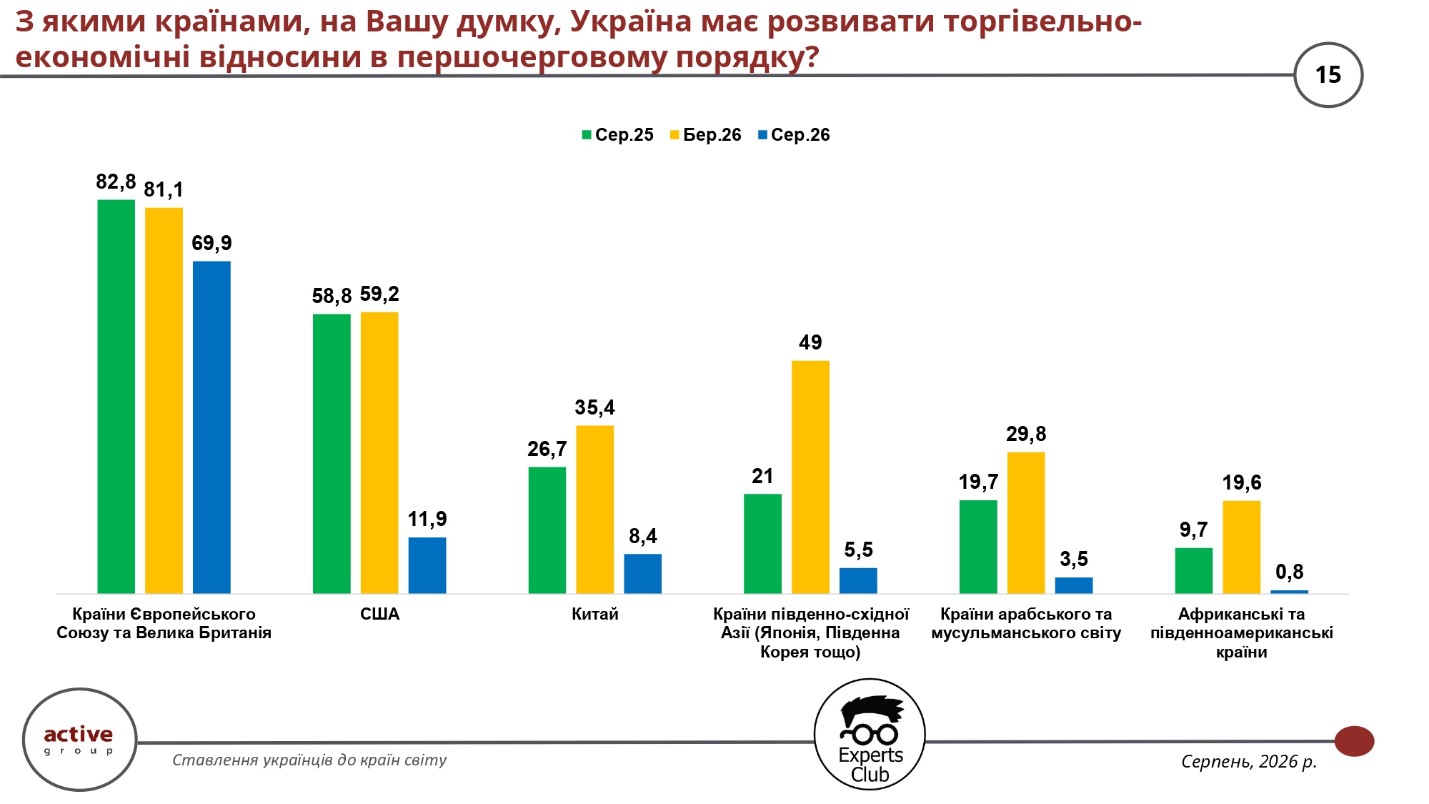
Another 5.5% of those surveyed in August advocated for prioritizing the deepening of economic relations with countries in Southeast Asia—Japan, South Korea, and other nations in the region. In March, this figure stood at 49%, and a year earlier—at 21%. Countries in the Arab and Muslim world were cited by 3.5% of respondents, compared to 29.8% in March, while African and South American countries were cited by 0.8%, compared to 19.6%.
Maksym Urakin, founder of the Experts Club information and analytical center, emphasized the need for more active communication between international partners and Ukrainian society.
“We need to regularly showcase concrete achievements and specific actions. Openness toward the media and the public helps strengthen relations, particularly trade relations,” Urakin noted.
According to him, sociological surveys can serve as a practical tool for government agencies, diplomatic missions, and the business community in determining the direction of bilateral relations.
Oleksandr Pozniy, director of the research firm Active Group, also highlighted the need to strengthen the economic component of international cooperation.
“We need to do more than just raise general awareness. Businesses and government agencies need to work more actively on developing bilateral relations,” Pozniy noted.
The survey was conducted in August 2026 using self-administered online questionnaires via the SunFlowerSociology panel. A total of 800 Ukrainian citizens aged 18 and older were surveyed. The sample is representative by age, gender, and region; the stated maximum theoretical margin of error is ±3.5 percentage points. Previous waves of the survey were conducted in August 2025 and March 2026.
ACTIVE GROUP, CHINA, EUROPEAN UNION, EXPERTS CLUB, FOREIGN TRADE, international relations, SOCIOLOGY, UKRAINE, UNITED KINGDOM, UNITED STATES
European Union countries remain in first place in terms of the share of responses from Ukrainians to the question of who contributes most to achieving peace in Ukraine. In August 2026, 44.6% of respondents named EU countries, 25.2% named the U.S., and 23.3% named the United Kingdom. This is evidenced by the results of the third wave of a survey on Ukrainians’ attitudes toward countries around the world, conducted by Active Group in collaboration with Experts Club, according to the Experts Club Information and Analytical Center.
Compared to March 2026, the ratings have changed significantly. In the spring, 63.4% of respondents named EU countries in this context, 53.8% named the United Kingdom, and 29.6% named the United States. In August, the figures for the EU and the United Kingdom fell by 18.8 and 30.5 percentage points, respectively, while the figure for the United States changed much less—by 4.4 percentage points.
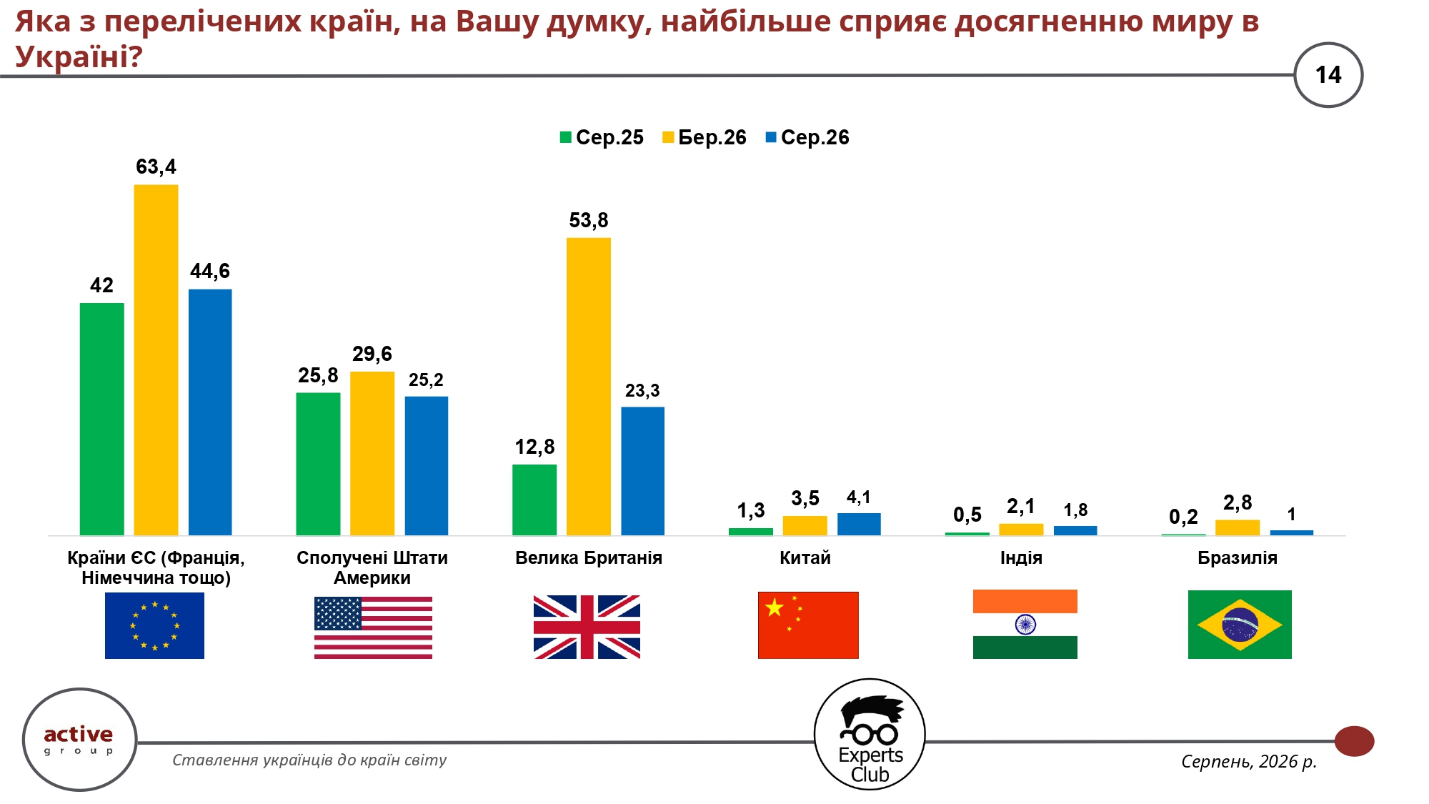
At the same time, compared to August 2025, the share of respondents who named EU countries increased slightly—from 42% to 44.6%. The figure for the U.S. was 25.8% at that time, and for the UK, 12.8%. Thus, the trend in assessments of the UK remains the most dramatic: 12.8% in August 2025, 53.8% in March 2026, and 23.3% in August of this year.
Perceptions of the role of other major powers remain significantly lower. In August 2026, 4.1% of respondents cited China, compared to 3.5% in March and 1.3% a year earlier. The figure for India was 1.8%, and for Brazil, 1%.
Oleksandr Pozniy, director of the research firm Active Group, emphasized that public perceptions of countries should be considered alongside the level of awareness and the actual development of bilateral relations.
“We need to do more than just raise general awareness. First and foremost, business associations, the Ministry of Economy, and the Ministry of Foreign Affairs must work to develop bilateral relations and improve the balance. Given that Ukraine already lacks funding and we are essentially living off foreign loans, we need to expand cooperation with countries where we can achieve a positive balance,” Pozniy noted.
The survey was conducted in August 2026 using self-administered online questionnaires on the SunFlowerSociology panel. It involved 800 Ukrainian citizens aged 18 and older. According to the organizers, the sample is representative in terms of age, gender, and region, and the stated maximum theoretical statistical margin of error is ±3.5 percentage points. This is the third wave of the study, following surveys conducted in August 2025 and March 2026.
ACTIVE GROUP, EUROPEAN UNION, EXPERTS CLUB, international relations, SOCIOLOGY, UKRAINE, UNITED KINGDOM, UNITED STATES, WORLD

The Kyiv Business Center has begun operations in the Ukrainian capital, with the aim of ensuring a permanent presence of British companies in the country and deepening industrial ties between the two nations, according to the UK government’s press service.
The hub was established through close collaboration between the National Armaments Director (NAD) Group, industrial partners, and the UK financial sector as part of the “100-Year Partnership” initiative.
“The KBC provides British companies, particularly small and medium-sized enterprises (SMEs), with a base from which they can build trusting relationships with Ukrainian partners, obtain information on the situation on the battlefield, and pursue opportunities for joint development, co-production, and investment,” the statement reads.
It is noted that, until now, the cost, security requirements, and administrative complexity of doing business in Ukraine have made it difficult for small firms to establish a presence in the country.
Luke Pollard, Minister for Defense Readiness and Industry, commenting on the center’s opening, stated that KBC will help unlock new opportunities for investment, growth, and long-term recovery.
“By supporting British companies in Kyiv, we are deepening our ‘100-year partnership’ and turning our shared determination into shared innovation,” he emphasized.
The KBC’s operating model is based on three principles: industry, innovation, and investment, providing members with access to a networking platform that helps forge partnerships, attract investment, and expand production and capacity.
National Director of Armaments Rupert Pierce met with leading industry representatives and small and medium-sized businesses to mark the launch of the center, which brings together British and Ukrainian industry.
“This new facility is not just a center; it is a permanent channel that transforms the UK’s ability to collaborate fruitfully with our Ukrainian partners, both now and in the long term. Until now, costs, security concerns, and other restrictions caused by Russia’s full-scale invasion have made it difficult for companies—especially small ones—to operate in Ukraine. Our previous trade missions successfully addressed some of these challenges—this center removes these barriers by providing British companies with a permanent presence in Kyiv, opening up real opportunities for innovation, investment, and exports,” he emphasized.
The center’s operating model builds on more than 40 existing major industrial partnerships between the United Kingdom and Ukraine, as well as on the success of the UK Ministry of Defense’s trade missions to Ukraine. KBC also supports Ukrainian companies seeking British industrial partners or establishing subsidiaries in the United Kingdom.



