

Ukraine from the beginning of 2022/2023 marketing year (July-June) to January 27, 2012 and January 27, 2012 exported 25.99 million tons of cereals, including 14.69 million tons of corn (56.5% of total shipments), 9.4 million tons of wheat (36.2%) and 1.8 million tons of barley (6.9%).
According to the website of the Ministry of Agrarian Policy and Food on Friday, the rate of grain exports since the beginning of the current MY is 30.86% lower than the same period of the previous MY, as 37.6 million tons were delivered abroad from July 1, 2021 to January 27, 2022. At the same time, the previous maximum rate of exports was achieved on January 9, 2023, when the lag from last year’s values was the lowest for the entire MY, 29.61%.
According to the agency, this week corn exports began to lag behind last MY for the first time since the start of the 2022/2023 MY, with 14.69 million tons delivered to foreign markets by January 27, 2023, compared to 14.95 million tons on January 27, 2022. In addition, Ukraine exported 9.4 million tons of wheat (1.78 times less than the same period last year), 1.8 million tons of barley (3.02 times less), 12.5 thousand tons of rye (12.2 times less) and 80.8 tons of flour (+28%) from the beginning of 2022/2023 MY.
It is specified that Ukraine exported 3.24 million tons of cereals, including 2.07 million tons of corn, 990 tons of wheat, 173 tons of barley and 11.8 thousand tons of flour since early January.
As follows from the Ministry data, during the period of January 20-27, 121.1 thousand tons of cereals per day were supplied to the foreign markets, whereas during the preceding period of January 9-20 – 140 thousand tons/day, January 2-9 – 121.7 thousand tons/day, December 21 – January 2 – 196.4 thousand tons/day on average, and December 14-21 – 134.3 thousand tons/day. Thus, the average daily rate of exports during the reporting period January 20-27, decreased by 13.5% compared to the previous period January 9-20.
As reported, Ukraine exported 48.51 million tons of grain and leguminous crops in 2021/2022 MY, which is 8.4% higher than in the previous MY, despite the full-scale invasion of Russia and the difficulties with the export of agricultural products due to the blockade of Ukrainian sea ports. 18.74 million tons of wheat (12.6% more than in 2020/2021MY), 23.54 million tons of corn (+1.9%), 5.75 million tons of barley (+35.9%), 70.9 thousand tons of flour (-44.1%) were supplied to foreign markets.
Ukraine in 2020/2021 MY exported 44.72 million tons of grain and leguminous crops: 16.64 million tons of wheat, 23.08 million tons of corn, 4.23 million tons of barley, 126.9 thousand tons of flour and 18.4 thousand tons of rye.
In 2019/2020, Ukraine exported 56.72 million tons of grain and leguminous crops.

Canadian Defense Minister Anita Anand announced Thursday that Ottawa will deliver four Leopard 2 tanks to Ukraine.
“Defense Minister Anita Anand said Canada will transfer four German-made Leopard 2 tanks to Ukraine in the coming weeks,” the Toronto Star reports.
Canada will transfer spare parts and ammunition along with the equipment, as well as train the Ukrainian military in the use of the tanks. The paper said that Anand allowed for the possibility of additional deliveries of Leopard 2 tanks to Ukraine.
Canada has a total of 112 tanks of this model.
The German authorities decided the previous day to transfer the first batch of 14 Leopard 2 tanks to Ukraine. Berlin will also give its allies permission to deliver Leopard 2 tanks to Ukraine. In addition, on Wednesday, US President Joe Biden announced his decision to send Ukraine 31 M1 Abrams tanks.
2022-2024 goods trade balance forecast (USD bln)
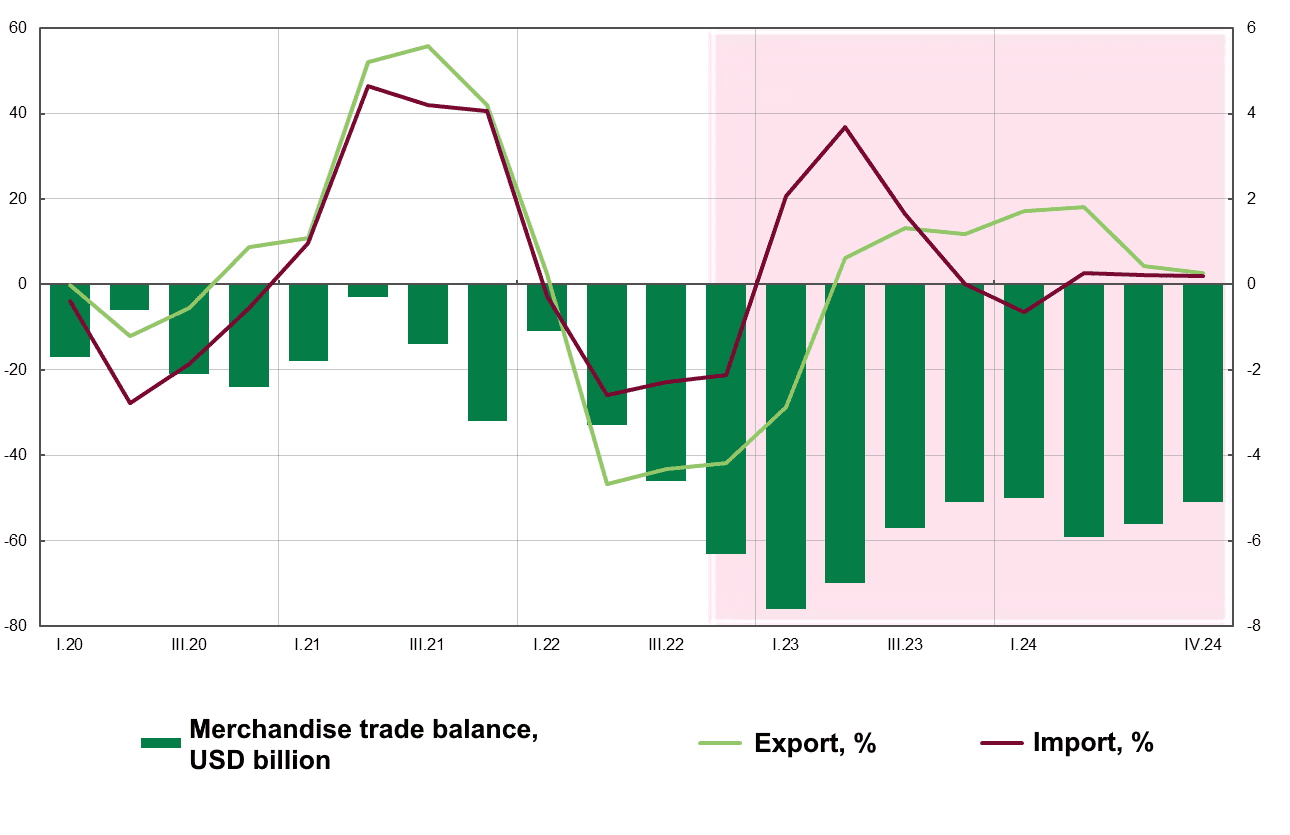
Source: Open4Business.com.ua and experts.news

Stock indices of the largest Asia-Pacific countries are mainly gaining on Friday following the U.S. stock market dynamics.
The stock exchanges in Mainland China continue to remain closed on the Spring Festival (the beginning of the new year according to the lunar calendar).
The growth of optimism in Asian markets was also supported by the U.S. statistics published the day before, which showed that the economy remains flexible, despite a significant tightening of monetary policy by the Federal Reserve (FRS).
According to preliminary data from the U.S. Commerce Department, the country’s GDP rose 2.9% year-over-year in the fourth quarter after climbing 3.2% in the previous quarter. The consensus forecast by analysts, cited by Trading Economics, suggested economic growth had weakened to 2.6%.
The Nikkei 225 Index was up 0.05% by 7:09 a.m.
The leaders of the price growth are the securities of the chemical company Shin-Etsu Chemical Co. Ltd. (+4.2%), industrial robotics manufacturer Yaskawa Electric Corp. (+3.7%) and Chiba Bank Ltd. (+3.6%).
Shares of carmaker Toyota Motor rose 0.4% and consumer electronics maker Sony gained 1%.
Hong Kong’s Hang Seng index was down 0.01% by 7:16 a.m.
Shares of solar panel maker Xinyi Solar Holdings Ltd. (-3.5%), computer maker Lenovo Group Ltd. (-3%) and home appliances and electronics maker Haier Smart Home Co. Ltd. (-2.3%).
Shares of retailer Alibaba Group Holding Ltd. fell 1.3% while JD.com Inc. rose 1.8%.
South Korea’s Kospi was up 0.7% by 7:14 a.m.
The stock price of one of the world’s largest chip and electronics maker Samsung Electronics Co. is up 1.1%, the share price of automaker Hyundai Motor is down 0.6%.
Australia’s S&P/ASX 200 index added 0.3% for the day.
Australia’s producer price index rose 0.7% quarter-over-quarter in the fourth quarter of 2022, compared with a 1.9% increase in the third quarter. The index was up for the tenth consecutive quarter, but the rate of increase was the slowest since the second quarter of 2021, Trading Economics wrote.
BHP and Rio Tinto, the world’s largest mining companies, rose 0.6% and 0.4%, respectively.
Fortescue Metals Group Ltd. shares gained 0.04%. The company said it shipped a record volume of iron ore in the fourth quarter while cutting production costs compared with the previous three months.

The U.S. dollar is getting stronger against the euro and the pound sterling in trading on Friday, getting cheaper against the yen.
The ICE-calculated index showing the dollar’s performance against six currencies (euro, Swiss franc, yen, Canadian dollar, pound sterling and Swedish krona) gained 0.11%, while the broader WSJ Dollar Index gained 0.07%.
The euro/dollar pair was trading at $1.0871 as of 8:20 a.m., up from $1.0892 at the close of the previous session.
The pound was down to $1.2380 from $1.2410 the day before.
Statistical data published on Thursday showed that the U.S. economy remains resilient despite a significant tightening of monetary policy by the Federal Reserve (Fed).
According to preliminary data from the U.S. Commerce Department, the nation’s GDP rose 2.9% on an annualized basis in the fourth quarter after climbing 3.2% in the previous quarter. The consensus analyst forecast cited by Trading Economics suggested economic growth weakened to 2.6%.
“The Commerce Department report suggests that the U.S. economy remains relatively strong despite aggressive measures by the Federal Reserve trying to slow inflation,” notes BMO Family Office chief investment officer Carol Schleif, quoted by Market Watch.
A less-than-expected slowdown in U.S. GDP growth last quarter somewhat dampened investor optimism that signals of deterioration in the U.S. economy would prompt the Federal Reserve (Fed) to further slow the pace of base interest rate increases.
The first Federal Open Market Committee (FOMC) meeting of the year will be held next week. The U.S. Central Bank raised the rate by 50 basis points (bps) in December after increasing it by 75 bps at the end of the previous four meetings.
On Friday, the market will follow the Commerce Department’s report on Americans’ income and spending for December, which includes data on consumer price movements.
According to a consensus forecast by experts quoted by Trading Economics, the PCE Core Consumer Price Index, which excludes food and energy costs, rose 0.3% in December after rising 0.2% a month earlier.
The dollar/yen dropped to 129.91 yen against 130.22 yen in previous trading.
The International Monetary Fund (IMF) recommended the Bank of Japan to consider taking measures to increase the flexibility of long-term government bond yields, noting that rising inflation risks in the country require additional room for maneuver in monetary policy.
In particular, the Japanese Central Bank could increase the target yield on 10-year government bonds, expand the range of fluctuations in the interest rates of these securities, as well as return to the quantitative target in the bond buyback program and switch to the purchase of more “short” securities, says the IMF report, published Thursday.

Oil prices rose on Friday on optimism about demand prospects thanks to signals of increased energy consumption in China and data on a weaker-than-expected slowdown in U.S. GDP growth.
Trafigura Group, one of the biggest commodity traders in the world, sees “great upside” for the oil market, noting the release of pent-up demand following the lifting of quarantine restrictions in China.
The price of March futures for Brent on London’s ICE Futures Exchange stood at $87.83 a barrel by 7:15 a.m. Friday, up $0.36 (0.41%) from the previous session’s close. Those contracts rose $1.35 (1.6%) to $87.47 a barrel at the close of trading on Thursday.
The price of WTI futures for March increased by $0.33 (0.41%) to $81.34 per barrel at electronic auctions of New York Mercantile Exchange (NYMEX). By the close of previous trading the cost of those contracts rose by $0.86 (1.1%) to $81.01 a barrel.
U.S. statistics released Thursday showed that the U.S. economy remains accommodative despite a significant tightening of monetary policy by the Federal Reserve (Fed).
According to preliminary data from the Commerce Department, fourth-quarter GDP rose 2.9 percent on an annualized basis after climbing 3.2 percent in the previous quarter. The consensus analyst forecast cited by Trading Economics suggested that economic growth had weakened to 2.6%.



