
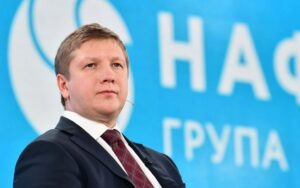
The Supreme Anti-Corruption Court (HACC) has denied the prosecutor’s request for a preventive measure in the form of detention with an alternative to a 365 million UAH bail for the former head of Naftogaz of Ukraine, Andrey Kobolev.
The court made a decision to that effect on Monday night.
“The petition for a measure of restraint in the form of detention against the suspect Kobolev to leave without satisfaction … The decision can be appealed in the appeal chamber of the SACC within five days from the moment of the announcement,” the judge announced.
As reported, a prosecutor of the Specialized Anti-Corruption Prosecutor’s Office and detectives of the National Anticorruption Bureau of Ukraine last week notified the former head of Naftogaz Andriy Kobolev of suspicion of abusing his official position while ensuring himself a 229m hryvnia bonus payment for the company’s victory in the Stockholm arbitration with Russia’s Gazprom.
According to the investigation, this amount considerably exceeds the normative amounts of such payments (37.48 mln hryvnyas).
The Stockholm arbitration in 2018-19 as a result of two disputes between the companies on the supply and transit of gas ruled that Gazprom had to pay additional $2.56 billion to NAC.
At the same time, the arbitration fully rejected Gazprom’s claims to Naftogaz on the “take or pay” condition for the period 2012-2017 in the amount of $56 billion.
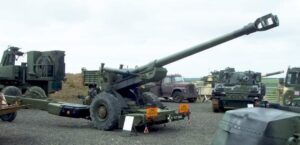
The Republic of Estonia has handed over to the Ukrainian Armed Forces all of its 155 mm howitzers, the General Staff of the Armed Forces of Ukraine said on Monday.
According to the General Staff, dozens of 155 mm FH-70 and 122 mm D-30 howitzers, thousands of 155 mm artillery shells, hundreds of M2 Karl-Gustaf anti-tank grenade launchers with ammunition, support equipment for artillery units were also transferred to Ukraine.
In addition, Estonia will continue to provide both basic and specialized training to the Ukrainian Armed Forces.
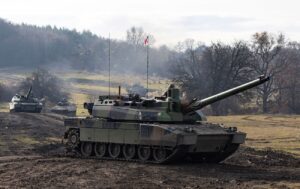
France does not rule out supplying Leclerc heavy combat tanks to Ukraine for support in the war against Russia, French President Emmanuel Macron said at a press conference with German Chancellor Olaf Scholz in Paris, Le Figaro reported.
“Regarding Leclerc, I asked the minister of the armed forces to work on this. Nothing is ruled out, and it is really being evaluated collectively,” the French president said.
For his part, Scholz, responding to a question about German Leopard tanks, said: “The way we have acted in the past is always closely coordinated with our friends and allies, and we will continue to act according to the specific situation.”
Kernel, one of the largest Ukrainian agro-industrial groups, in the second quarter of fiscal 2023 (FY, Q2 – September-December 2022) decreased its sales of vegetable oils (sunflower and rapeseed) by 17% as compared to the same period of the previous FY – from 416,500 tons to 344,700 tons.
According to the report published on the company’s website, the total processing of oilseeds in the specified period decreased by 34%, from 985.4 thousand tons to 653.2 thousand tons.
The holding explained the decrease of production and sales volumes by the stoppage of three of its nine oil extraction plants (IEP) in Kharkiv region, caused by the military risks from the Russian Federation. In addition, the group’s production performance was affected by Russian rocket attacks on Ukrainian critical infrastructure, which led to power outages across the country, the report said.
“Due to regular power outages, Kernel had to temporarily suspend processing operations at two of its oilseed processing plants during November-December 2022, while the remaining four oil extraction plants (OEPs) operated relatively steadily thanks to cogeneration thermal power plants,” the holding explained in the report.
According to the report for the first half of FY 2023 (July – December 2022) Kernel sold 546.8 thousand tons of sunflower and rapeseed oil (-14% compared to the same period of 2022) and processed 1.11 million tons of oilseeds (-24%).
The Group halved the volume of crops supplied to its elevators in the second quarter of FY 2023 as compared to the second quarter of FY 2022 to 1.51 million tons. The company delivered 2.0 million tons of raw agricultural products to elevators in 6 months of FY 2023 – by similar 50% less than in 6 months of FY 2022.
“Kernel” also noted that because of the military aggression of the Russian Federation in Ukraine, 18 of its employees were killed and 61 employees were injured. A total of 1,333 employees of the group participated in the war, of which 532 were demobilized and returned to work.
“In December 2022, one of the group’s MEZs in the Kharkiv region came under missile fire from Russia. Due to its location in a high-risk area and constant shelling in the region, it is not possible at this time to properly assess and evaluate the damage to the facility. No other Kernel infrastructure was damaged during the reporting period,” the report states.
Kernel’s total exports of crops in the second quarter of FY 2023 decreased by 56% compared to the same period last fiscal year – to 1.52 million tons, and in the first half of the year – by 61%, to 2.25 million tons. Export was carried out mainly within the framework of Istanbul grain deal, while negligible volume of agricultural products was exported through alternative channels (railroad, river, automobile transport).
The holding said in a report that in December 2022 it successfully completed the acquisition of a 100% stake in the Pivdennyi oil transshipment terminal (Odessa region, Black Sea) for $19.8 mln.
“Kernel is the world’s largest producer and seller of bottled sunflower oil in Ukraine, accounting for 7% of world production and 12% of exports. In addition, the company was involved in other agricultural products cultivation and sales.
The largest co-owner of Kernel, through Namsen Ltd. is Ukrainian businessman Andrei Verevskyi, with a 39.3% stake.
In FY2022 (July-2021 – June-2022), the holding posted net loss of $41 mln against $506 mln net profit in the previous FY. Its revenue decreased by 5% – to $5.332 bln, while EBITDA decreased 3.7 times – to $220 mln.
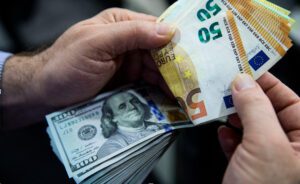
The euro, which fell below parity with the U.S. dollar in September 2022, is recovering thanks to a cooling energy market, reduced fears of recession and a hawkish stance of the European Central Bank (ECB).
The euro, which has gained almost 13% in the last 3.5 months, was also helped by a general weakening of the U.S. currency: the dollar ICE index, which rose to a 20-year high in September, has since lost about 10%.
As of 11:15 a.m. on Monday, the euro/dollar pair was trading at $1.0895, up from $1.0857 at the close of the previous session.
The Federal Reserve (Fed) raised its benchmark rate by 425 basis points last year, the fastest rate hike for a single year in four decades, the Financial Times noted. The widening of the spread between U.S. and other interest rates triggered an influx of investor funds into U.S. assets, which provided strong support for the U.S. dollar. This put additional pressure on the euro, already weakened by the rise in energy prices due to the full-scale war unleashed by Russia against Ukraine and fears of a downturn in the region’s economy.
Recently, however, trends have changed somewhat.
“For several years, there were virtually no alternatives to the dollar,” says Andreas König, head of currency markets at Amundi. – Now the capital returns to the economy outside the U.S., as there are other attractive options for investment.
In particular, the expert notes the increase of foreign capital inflow to China after the lifting of quarantine restrictions by the authorities of the country. China’s decision to abandon its policy of zero tolerance for COVID-19 provoked higher forecasts for the global economy by leading experts. This also puts pressure on the dollar, which usually strengthens in periods of macroeconomic stress.
At the same time, the outlook for Europe has recently improved, notes the FT. Gas prices have fallen due to a mild winter in the region, allowing the economy to avoid the expected deep recession.
Emerging signals of weakening inflation in the U.S. means that the U.S. Central Bank could continue to slow the pace of rate hikes. In December, the Fed increased the rate by 50 bps. – up to 4,25-4,5% per annum after its rise by 75 bp following the results of the previous four meetings.
The market expects further reduction in the Fed’s policy tightening and believes that the central bank may begin to reduce the rate in the second half of this year.
The ECB raised key interest rates by a total of 250 bps last year.
“Lower rates will eliminate a major advantage the dollar has,” said MUFG currency analyst Lee Hardman, who expects the ECB’s deposit rate to rise to 3.25 percent from 2 percent by the middle of this year. – Last year, the Fed was the leader among other global central banks in raising rates, but now the ECB has become more hawkish.
Strengthening the divergence in policy between the Fed and the ECB could lead to a rise in the euro to $ 1.12 by early 2024, said Hardman.
The expert, however, cautions against excessive optimism about the euro exchange rate against the dollar, given the continuing threat of rising energy prices that could affect the volume of European trade.
Economic results of KSG Agro holding for 2021 were confirmed by international audit company Crowe which is one of the top 10 world audit networks, the holding press-release said on Monday.
According to the report, the agrarian group has significant biological assets through its agricultural operations, which reached $39.4 million at the end of 2021, and net income from biological transformation for that year was $7.3 million.
“The pre-war year was one of the best in the history of our holding company, as witnessed by international auditors. Thanks to the successful choice of technology and weather conditions, our crop yields were the highest in the last 10 years, and in the pig segment we had a good update of the herd with Canadian Genesus genetics and achieved high dynamics of piglet litter,” – quotes the head of the holding Sergei Kasyanov.
KSG Agro noted that Polish investors are very closely monitoring the state and development of the Ukrainian companies which are listed on the Warsaw Stock Exchange. They understand that Ukraine will win the war with Russia, and therefore they pay attention to the professional evaluation of the financial and production situation of Ukrainian assets by international auditing companies, said the holding
KSG Agro reminded that according to the results of 2021, KSG Agro S.A. (Luxemburg) increased gross income by 44% compared to 2020 – from $21.3 million to $30.7 million, EBITDA by 2 times – from $6.02 million to $12.27 million, its operating profit increased by 2.5 times – from $4.3 million to $10.7 million. The profit of KSG Agro S.A. (Luxemburg), which includes all the group companies, was $20.2 million before taxes.
The vertically integrated holding KSG Agro is engaged in pig breeding as well as the production, storage, processing and sale of grain and oilseeds. Its land bank is about 21,000 hectares.
According to the agricultural holding, it is one of the top five pork producers in Ukraine.
KSG Agro in the first half of 2022 increased normalized profit by 43% compared with January-June 2021 – to $1.21 million, while its revenue decreased by 12%, to $6.02 million, and EBITDA by 17%, to $2.22 million.



