
Ukraine will be fully integrated into the EU energy market in 2027, even if we are not yet formally a member of the Union, said Deputy Prime Minister for European and Euro-Atlantic Integration of Ukraine Taras Kachka, according to a correspondent from Interfax-Ukraine.
“There is currently a large bill in parliament—several hundred pages on the final integration of Ukraine’s energy market with the EU. It is ready for its second reading, and I think we will be able to adopt it in February,” he said at the Ukrainian Breakfast in Davos on the sidelines of the World Economic Forum on Thursday, organized by the Victor Pinchuk Foundation.
According to Kachka, the document consists of hundreds of pages of technical assessments that experts have been working on for years.
“It is thanks to this work that in 2027 we will be fully integrated into the EU energy market, even if we are not yet formally a member of the Union,” the Deputy Prime Minister emphasized.
As reported, on July 22, the Verkhovna Rada adopted draft law No. 12087-d “On Amendments to Certain Laws of Ukraine Regarding the Implementation of European Law on Energy Market Integration, Improving Security of Supply and Competitiveness in the Energy Sector.” According to the Ministry of Energy, the relevant legislative proposal was developed on the basis of nine EU energy legislation acts and aims to create the necessary legislative framework for the full integration of Ukraine’s electricity market into the single European market on the principle of reciprocity.
The document provides, in particular, for the integration of the short-term (spot) electricity markets of Ukraine and the EU (market coupling) and balancing markets, which means increasing market liquidity, simplifying the conditions for trading electricity with the EU, making effective use of the transmission capacity of interconnections between countries, increasing the flexibility of the energy system, and providing access to EU reserves.
The draft law also provides for additional mechanisms to protect consumer rights and strengthen their role in the market by increasing the transparency of supply conditions and introducing tools for comparing suppliers’ offers, as well as creating conditions for consumers to participate in other market segments, in particular the ancillary services market.
The ministry noted that the adoption of the document as a whole will ensure the synchronization of electricity markets in early 2027.
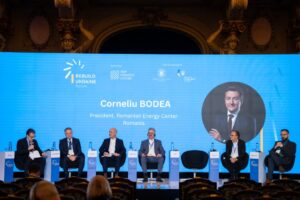
Participants in the Green Reconstruction and Green Energy panel at the Rebuilding Ukraine: Security, Opportunities, Investments forum in the Romanian capital concluded that the modernization and decarbonization of Ukraine’s energy infrastructure must go hand in hand with digitalization, the development of smart cities, and deeper integration into the EU energy space.
The panel was moderated by Corneliu Bodea, president of the Romanian Energy Center, who outlined the need for profound transformations of energy systems to transition to a low-carbon model. The key speaker was Bogdan-Gruia Ivan, Romania’s Minister of Energy, who set the strategic guidelines for the discussion. The discussion was also joined by George Agafitei, Head of Sustainable Development and Institutional Relations at PPC Group; Vitaly Radchenko, Head of Energy and Climate Change Practice at CMS Ukraine; Nicolas Richard, CEO of Engie Romania; Gheorghe Chubotar, President of Electroalfa International; and Eduard Dumitrascu, President of the Romanian Smart City Association.
The speakers noted that urban digitalization and energy modernization projects, in particular smart city initiatives, have become important catalysts for the renewal of local energy systems and municipal infrastructure. They emphasized that Ukraine should not be underestimated in terms of technological solutions: businesses and government agencies are highly receptive to the implementation of digital tools, from artificial intelligence to network infrastructure optimization. “Ukraine has already demonstrated its ability to quickly transition to new digital platforms. This makes it possible to build a modern energy sector rather than a ‘patched-up’ one,” Radchenko noted.
Participants emphasized that Ukraine is undergoing an intensive phase of legislative reforms and convergence with European standards in the fields of energy, ecology, and market regulation. This creates conditions for more effective coordination between central authorities and local levels, as well as for the implementation of joint projects with EU countries, with an emphasis on inter-state interconnectors, network balancing, and strengthening regional energy security. “Aligning rules with European ones is not only a requirement for integration, but also a prerequisite for attracting investors to long-term ‘green’ projects,” Ivan emphasized.
A separate part of the discussion was devoted to rethinking the architecture of energy networks in the direction of decentralization, flexibility, and increasing opportunities for electricity flows between countries. Participants recalled that Ukraine is already working in sync with the European energy system and is increasing the volume of electricity and gas exchanges with EU countries. In their opinion, Ukraine’s “green” transformation requires not only the physical reconstruction of generation and network assets, but also the formation of a new culture of innovation capable of attracting strategic investments and the most advanced technologies.
In this context, cooperation between European and Ukrainian energy and technology ecosystems was described as a fundamental element of regional energy sustainability. Participants called green reconstruction a historic opportunity to form a more sustainable, digitized, and EU-integrated Ukrainian economy. The panel concluded that, despite the challenges, close cooperation and coordinated investment by the state, business, and international partners is the only realistic path to an effective, future-oriented reconstruction of the energy sector.
The forum “Rebuilding Ukraine: Security, Opportunities, Investments” is being held on December 11-12 in Bucharest under the auspices of the Romanian Ministry of Foreign Affairs and the Ukrainian Ministry of Foreign Affairs and is organized by the New Strategy Center. According to the organizers, more than 30 panel discussions and parallel sessions are planned over two days with the participation of representatives of governments, international organizations, the private sector, financial institutions, and experts from Europe, North America, and Asia. The topics of the panels cover security and defense, infrastructure, financing and investment, green energy, digitalization, human capital, and cross-border cooperation.
DIGITALIZATION, energy market, EU, INTEGRATION, RECONSTRUCTION
The euro, which fell below parity with the U.S. dollar in September 2022, is recovering thanks to a cooling energy market, reduced fears of recession and a hawkish stance of the European Central Bank (ECB).
The euro, which has gained almost 13% in the last 3.5 months, was also helped by a general weakening of the U.S. currency: the dollar ICE index, which rose to a 20-year high in September, has since lost about 10%.
As of 11:15 a.m. on Monday, the euro/dollar pair was trading at $1.0895, up from $1.0857 at the close of the previous session.
The Federal Reserve (Fed) raised its benchmark rate by 425 basis points last year, the fastest rate hike for a single year in four decades, the Financial Times noted. The widening of the spread between U.S. and other interest rates triggered an influx of investor funds into U.S. assets, which provided strong support for the U.S. dollar. This put additional pressure on the euro, already weakened by the rise in energy prices due to the full-scale war unleashed by Russia against Ukraine and fears of a downturn in the region’s economy.
Recently, however, trends have changed somewhat.
“For several years, there were virtually no alternatives to the dollar,” says Andreas König, head of currency markets at Amundi. – Now the capital returns to the economy outside the U.S., as there are other attractive options for investment.
In particular, the expert notes the increase of foreign capital inflow to China after the lifting of quarantine restrictions by the authorities of the country. China’s decision to abandon its policy of zero tolerance for COVID-19 provoked higher forecasts for the global economy by leading experts. This also puts pressure on the dollar, which usually strengthens in periods of macroeconomic stress.
At the same time, the outlook for Europe has recently improved, notes the FT. Gas prices have fallen due to a mild winter in the region, allowing the economy to avoid the expected deep recession.
Emerging signals of weakening inflation in the U.S. means that the U.S. Central Bank could continue to slow the pace of rate hikes. In December, the Fed increased the rate by 50 bps. – up to 4,25-4,5% per annum after its rise by 75 bp following the results of the previous four meetings.
The market expects further reduction in the Fed’s policy tightening and believes that the central bank may begin to reduce the rate in the second half of this year.
The ECB raised key interest rates by a total of 250 bps last year.
“Lower rates will eliminate a major advantage the dollar has,” said MUFG currency analyst Lee Hardman, who expects the ECB’s deposit rate to rise to 3.25 percent from 2 percent by the middle of this year. – Last year, the Fed was the leader among other global central banks in raising rates, but now the ECB has become more hawkish.
Strengthening the divergence in policy between the Fed and the ECB could lead to a rise in the euro to $ 1.12 by early 2024, said Hardman.
The expert, however, cautions against excessive optimism about the euro exchange rate against the dollar, given the continuing threat of rising energy prices that could affect the volume of European trade.



