
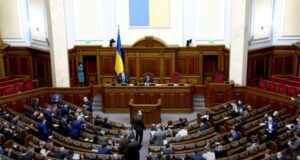
The Parliamentary Committee on Finance, Tax and Customs Policy on Tuesday recommended that draft laws No. 8298 and No. 8299, which exempt the import of equipment and components for own production from VAT and duties until the end of martial law (MP), be passed as a basis, the committee head Daniil Hetmantsev said in a telegram.
“The Ministry of Finance did not support almost the entire law … During the committee noted that without the agreement of the IMF this bill will not be adopted. Negotiations with the IMF on this law have not yet been held,” the deputy head of the committee Yaroslav Zheleznyak indicated in Telegram.
As specified Getmantsev, the bills also include preferential rent for iron ore and water for the period of the EaP, as well as single tax benefits for the taxpayers of Group 4.
In addition, it is planned to extend the life of the registered EDR, which had such a term expired during the EaP, as well as the abolition of taxation for electronic stamps and digital postage stamp and services for the demonstration and demonstration of films with Ukrainian dubbing.
“My prediction is that we will never accept it as a whole in this volume, precisely because of the IMF position,” Zheleznyak said.

Some 1,092 Starlink terminals have been delivered to Ukrainian medical institutions, the Ministry of Health told Interfax-Ukraine, citing deputy minister Maria Karchevych.
“We understand that there are power outages now, and we provide our medical institutions with alternative opportunities. For example, over the past few months, 1,092 Starlink terminals have been delivered to medical institutions so that clinics can connect to the Internet,” the ministry said.
Karchevych also said that despite the challenges of wartime, the digitalization of the healthcare system and the introduction of electronic tools continue in Ukraine. In particular, in 2022, more than 10 million prescriptions worth UAH 2.2 billion were issued under the Affordable Medicines program. Also, according to the ministry, more than 1 billion records have been entered into the e-health system, while 35 million Ukrainians have declarations with their family doctor.

Cumulative damage to the world economy from natural disasters in 2022 decreased by about 15% compared with 2021 and amounted to about $270 billion against $320 billion, according to preliminary data from Germany’s Munich Re, the largest reinsurance company in the world.
The volume of insured losses, meanwhile, remained virtually unchanged at $120 billion.
Economic losses last year were in line with the average of the previous five years, while insured losses were well above average ($97 billion in 2017-21).
“It is alarming that natural disasters particularly affect citizens in the poorest countries. That’s why preventive measures and financial protection, such as insurance, are especially important,” said Thomas Blunk, a member of Munich Re’s board of directors.
The most devastating event of the past year was Hurricane Ian, which struck the Florida coast in September, bringing wind gusts of nearly 250 kilometers per hour. It caused an economic loss of $100 billion, with insured losses of $60 billion. In terms of damages when adjusted for inflation, Ian is second only to Hurricane Katrina in 2005.
In second place is the flooding in Pakistan, caused by a record monsoon in terms of rainfall. Some 1,700 people were victims of the flooding, and the direct damage was at least $15 billion, virtually all of it uninsured.
“When analyzing the data for 2022, there are two key factors to keep in mind. First, the La Niña phenomenon is in its third consecutive year, increasing the likelihood of hurricanes in North America, flooding in Australia, drought and heat waves in China, and heavy monsoons in parts of South Asia. In addition, extreme weather events have become more frequent due to climate change. Sometimes these factors overlap,” wrote Ernst Rauch, chief climate scientist at Munich Re.
Dynamics of changes in population of Ukraine from 1991-2022
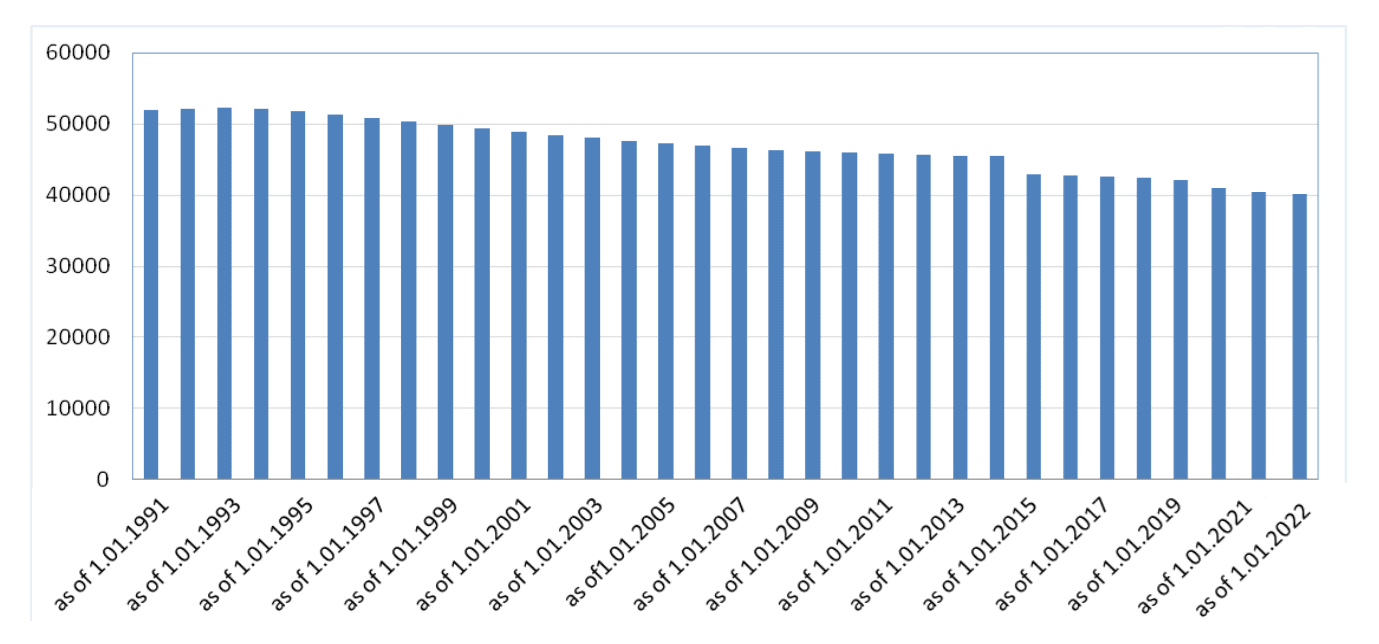
Source: Open4Business.com.ua and experts.news

Chair of the State Nuclear Regulatory Inspectorate of Ukraine (SNRIU) Oleh Korikov confirmed the arrival of an International Atomic Energy Agency (IAEA) mission to all three nuclear power plants in Ukraine-controlled territory in the near future.
“The IAEA agreed to organize a mission to all our other nuclear power plants at the invitation of Ukraine. The key goal is to monitor nuclear safety in military conditions. The IAEA will witness in real time what happens when all power units are turned off by emergency protection, as happened on November 23 in Russian shelling,” he said during a briefing at the Media Center in Kyiv on Tuesday.
“In the near future, the mission will arrive and will be more widely represented at all nuclear power plants,” Korikov said.
He also said the IAEA continues negotiations with Russia on the creation of a security zone initiated by the agency around the seized Zaporizhia nuclear power plant, based on the Ukrainian position of complete demilitarization and de-occupation of the plant.
“Negotiations are being held, meetings are taking place in Moscow. We proceed from the proposal that the security zone should be created on the terms of complete demilitarization, de-occupation of ZNPP, including the town of Energodar, and returning it under the control of the Ukrainian authorities. We make our proposals to Grossi [IAEA Head Rafael Grossi] was handed over, and in his negotiations he proceeds from the Ukrainian position,” the SNRIU’s chair said.
At the same time, he said as a result of the occupation of Zaporizhia NPP by the Russians, “there has been a significant degradation of nuclear and radiation safety at Zaporizhia NPP,” and the presence of the Russian military has nothing to do with these concepts.
“In fact, the invaders have turned ZNPP into a military and repair base where their equipment is being repaired. These actions are unacceptable,” Korikov said, adding that these actions at ZNPP are taking place in frontline of the permanent IAEA mission, and even it cannot decisively influence the behavior of the invaders.
Korikov said ZNPP is connected to the energy system of Ukraine and consumes Ukrainian electricity, but, despite the ability to issue a resource, its launch is blocked by the occupiers.
He also said as a result of the creation by the Russian invaders of dangerous working conditions at ZNPP, the number of its personnel has significantly decreased, but enough to ensure safe operation under such conditions.
The Russians, including representatives of Rosatom, who are at the plant, according to the SNRIU’s chair, will fall under personal sanctions, their list is established by the relevant services of Ukraine.
He also said Ukraine is doing everything possible to ensure that international sanctions are applied to the state-owned concern Rosatom.
“We are also working towards sanctions on international projects of Rosatom, on Rosatom itself and on the regulatory agency. It is difficult to predict what the tenth package of sanctions will represent, but we are actively doing the relevant work,” the nuclear regulator’s head said.
Korikov said that eight out of nine power units that are located in the territory controlled by Ukraine are currently operating in the energy system, one is under scheduled repairs. According to him, nuclear power plants provide a little more than half of electricity consumption.
“All possible nuclear capacities are used to the maximum,” the SNRIU’s chair said.

Consumer price growth in Ukraine in December 2022 remained at the level of November – 0.7%, compared to 2.5% in October, 1.9% – in September and 1.1% – in August, returning to the level of July, the State Statistics Service (Gosstat) said on Tuesday.
Last December, there was a 0.6% inflation rate, so in annual terms it was 26.6% for the year as a whole, compared to 26.5% in November.
Core inflation fell to 0.8% last month from 1.3% in November and 1.9% in October, 2.4% in September and 2.1% in August.
Overall for the year, core inflation was 22.6%, the Gosstat said.
In mid-October, the National Bank kept the inflation forecast for 2022 at 30%, while the government improved it from 30.1% to 29.3% in late October.
The prices of food and non-alcoholic beverages in the consumer market rose by 0.7% in December. Oil, milk and dairy products, bread, fruit, vegetables, soft drinks, fish and fish products rose by 2.5-0.9%. At the same time, processed cereal products, eggs, sugar, poultry, bacon, pork and rice went down in price by 2.7-0.1%.
Prices for alcoholic beverages and tobacco products increased by 0.7%, which is associated with an increase in the price of tobacco products by 1.7%.
Clothing and footwear became cheaper by 2.6%, including clothing by 3.0% and footwear by 2.4%.
A 0.9% increase in health care prices was primarily due to a 1.3% increase in the price of outpatient services and a 1.0% increase in the price of pharmaceutical products.
Transportation prices rose 1.6% primarily due to a 3.1% increase in the price of fuel and lubricating oils.
As reported, Ukraine’s inflation rate in 2021 rose to 10% from 5% in 2020 and 4.1% in 2019, and the base rate rose to 7.9% from 4.5% a year earlier.



