
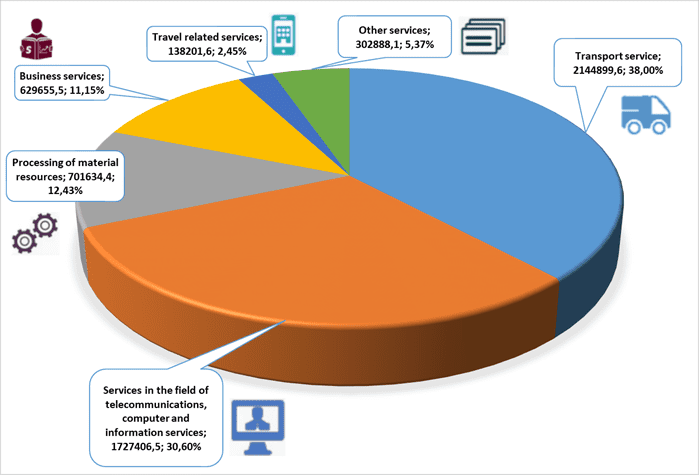
Structure of export of services in Jan-june 2021 (graphically)
SSC of Ukraine
The European Union has invited the Ukrainian government to determine specific targets for achieving climate neutrality by 2050, 10 years ahead of schedule.
“The EU welcomes the submission of an updated NDC with increased ambition and encouraged Ukraine to continue developing concrete milestones to achieve Ukraine’s climate neutrality by 2050 and to align its sectoral strategies with that objective,” a press release by the EU Delegation to Ukraine, following the second meeting of the working group within the framework of the dialogue on Green Deal between Ukraine and the EU, reads.
The EU reiterated the need for Ukraine to pursue reforms, and strengthen administrative capacities to implement the commitments of enhanced NDC and possibly achieve additional emission reductions.
“The EU underlined the need for rapid adoption, implementation and enforcement of Ukraine’s key environmental legislation (Waste management, Industrial Emissions, Environmental Control, Emerald network) and of the National Forest management Strategy,” the message says.
Deputy Director General NEAR and Head of the Support Group for Ukraine (SGUA) Katarína Mathernová signalled EU’s readiness to support further Ukrainian efforts, including through financial assistance, for setting up a robust Ukrainian climate governance based on long-term climate neutrality objectives which would guide policies and the “whole-of-the-economy” green transition.
As reported, in accordance with NDC, Ukraine should reduce greenhouse gas emissions by 65% of the 1990 level by 2030, and achieve climate neutrality by 2060. Such goals were set and approved by the Cabinet of Ministers decree of July 30, 2021.
Ukraine’s accession to the European Convention on a Common Transit Procedure is expected at the end of the second quarter of 2022, already in the third quarter Ukrainian enterprises will be able to go in transit through 35 countries on the principle of one vehicle – one transit declaration – one guarantor’s undertaking, Director of the Department for the Implementation of the International Transit System of the State Customs Service Serhiy Demchenko has said.
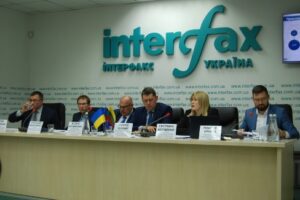
During a roundtable entitled “Implementation of customs procedures in accordance with EU practice: what changes may Ukrainian business expect? Practical aspects” held at Interfax-Ukraine, he said that these are all EU countries, the European Free Trade Association (EFTA) countries, Turkey, Serbia, North Macedonia and the U.K.
The expert recalled that joining the Convention is stipulated by the Ukraine-EU Association Agreement and shall intensify international trade due to the establishment of joint transit procedures by Ukraine with the countries-members of the Convention and their use of a single technology – the New Computerised Transit System (NCTS) system. This system allows the member countries to exchange customs data in real time and monitor goods at every stage of transportation.

“The common transit system provides for four main special transit simplifications for enterprises: the authorized consignor, the authorized consignee, special sealing and a guarantee,” Demchenko said. He added that new approaches are being applied to the standard guarantee amount, which will reduce the amount when it is used by 50%, 70% or 100%.
To obtain simplifications in NCTS, the legislation provides for a special procedure. The guarantee can be provided by companies that have received the financial guarantor status. To submit a transit declaration to NCTS, a company needs to register on the Trader’s Portal in the “personal account” on the “Single Window for International Trade” portal.
“Ukrainian legislation on common transit has already been generally shaped and is in line with the best European practices,” International Key Expert on Customs reform of the EU4PFM Programme to improve Public Financial Management (PFM) in Ukraine, former Deputy Chairman of the Lithuanian Customs Service Vytenis Ališauskas said during the roundtable.

To date, more than 3,000 customs officials are registered in the system, more than 180 companies have access to the Trader’s Portal, about 300 T1UA declarations have been submitted, three companies have received the financial guarantor status, and the Helpdesk operates.
As reported, NCTS is still used in Ukraine on a national scale. However, as a representative of the State Customs Service said, “enterprises that use NCTS (have submitted 50 or more declarations) can submit documents to the State Customs Service for simplifications, which will be valid even after Ukraine joins the Convention, that is, with the international application of the system.”
ANISCHENKO, CUSTOMS, EXPORTERS_CLUB_OF_UKRAINE, LITVINOVA, UKRAINIAN_CHAMBER_OF_COMMERCE_AND_INDUSTRY, URAKIN, ДЕМЧЕНКО, МОСКАЛЕНКО, ЧИЖИКОВ
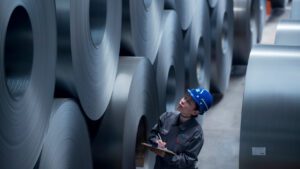
Ukraine, following the results of work of metallurgical enterprises in August 2021, increased steel production by 1.7% compared to the same period in 2020 – up to 1.858 million tonnes, having risen from the 14th to 13th place in the ranking of 64 countries – the world’s major manufacturers of these products, compiled by the World Steel Association (Worldsteel).
In August, an increase in steel production from August 2020 was recorded in all countries of the top ten, except for China.
The top ten steel producing countries in August 2021 are as follows: China (83.239 million tonnes, a drop of 13.2% versus August 2020), India (9.850 million tonnes, an increase of 8.2%), Japan (7.924 million tonnes, an increase of 22.9%), the United States (7.521 million tonnes, an increase of 26.8%), Russia (6.290 million tonnes, an increase of 4.4%), South Korea (6.130 million tonnes, plus 6.2%), Turkey (3.501 million tonnes, an increase of 7.1%), Brazil (3.149 million tonnes, an increase of 14.1%), Germany (3.020 million tonnes, an increase of 6.7%) and Iran (2.540 million tonnes, an increase of 8.7%).
This is followed by Vietnam (2.250 million tonnes, an increase of 48%), Taiwan (China, 1.950 million tonnes, an increase of 21.9%), Ukraine (1.858 million tonnes, an increase of 1.7%), Mexico (1.540 million tonnes, plus 6.6%) and Italy (1.358 million tonnes, an increase of 44.3%).
In general, in August of this year, steel production decreased by 1.4% compared to the same period last year – to 156.806 million tonnes.
For the eight months of this year, the top ten steel producing countries looks like this: China (733.015 million tonnes, an increase of 5.3%), India (77.739 million tonnes, an increase of 25.6%), Japan (63.988 million tonnes, an increase of 17%), the United States (57.065 million tonnes, plus 19.5%), Russia (50.758 million tonnes, an increase of 7.7%), South Korea (47.455 million tonnes, an increase of 8.4%), Germany (26.662 million tonnes, an increase of 17.4%), Turkey (26.565 million tonnes, an increase of 16.7%), Brazil (24.119 million tonnes, an increase of 20.9%) and Iran (20.371 million tonnes, an increase of 9.7%).
This is followed by Vietnam (17.370 million tonnes, an increase of 65.5%), Italy (16.299 million tonnes, an increase of 27.4%), Taiwan (15.402 million tonnes, an increase of 9.8%), Ukraine (14.590 million tonnes, 6.6%) and Mexico (12.541 million tonnes, plus 15.9%).
In general, in the eight months of 2021, some 64 countries produced 1.322 billion tonnes of steel, which is 10.6% more than in the same period last year.
Ukraine is carrying out customs reform, one of the directions of which is the introduction of principles and instruments used in the EU countries. The EU, in turn, assists Ukraine in the development and implementation of such customs instruments. This was emphasized by the participants in the round table “Implementation of customs procedures in accordance with European practice: what changes should Ukrainian business expect? Practical aspects,” which took place at the press center of the Interfax-Ukraine news agency on September 21, 2021.
The event was attended by President of the Exporters’ Club of Ukraine Yevhenia Litvinova, President of the Ukrainian Chamber of Commerce and Industry Hennadiy Chizhikov, representatives of business associations, Director of the Customs Policy Department of the Finance Ministry of Ukraine Oleksandr Moskalenko, Director of the International Transit System Implementation Department of the State Customs Service of Ukraine Serhiy Demchenko, Director of the Department for Customs Audit and Registration of Persons of the State Customs Service Svitlana Anischenko, Head of the AEO Support Department of the Customs Control and Customs Clearance Organization Department of the State Customs Service Andriy Teply, the EU4PFM international expert on customs issues, ex-deputy head of customs of the Republic of Lithuania Vytenis Alisauskas.
Organizer and moderator of the round table Maksim Urakin noted that now the State Customs Service provides 35-40% of revenues to the state budget, and these figures have remained stable over the past years.
“In general, in January-August 2021, the State Customs Service fulfilled the revenue plan by 107% and transferred UAH 291 billion to the state budget (against the planned figure of UAH 272 billion). At the same time, in the eight months of this year, compared to the same period last year, receipts from customs payments increased by UAH 76 billion, or 36%,” Urakin emphasized.
In addition, the organizer noted that, based on the monitoring of data of Ukraine’s foreign economic activity in 2021, conducted by the Experts Club analytical center, the state budget revenues will continue to grow, as the country continues to increase the volume of international trade.
“Thus, exports to the EU countries in the first half of 2021 grew by 43.9% compared to the same period last year, imports – by 26.3%. The total volume of trade with the EU countries for the six months amounted to almost $ 25 billion, with China – about $ 9 billion. These data indicate that the stimulation of foreign trade through the harmonization of customs legislation is a key factor in the financial stability of the state, ensures budget replenishment and economic growth,” the speaker said.
The speakers provided an overview of the principles laid down in the EU Customs Code and the instruments used by EU countries to implement these principles; what of them should be expected in Ukraine (including thanks to the support of European partners), and which of these customs instruments are already being introduced or are close to being introduced in Ukraine – in particular, the common transit regime (NCTS), the Authorized Economic Operator Program (AEO) and customs audit.
Of particular interest to business representatives was the system of customs simplifications, which is used in the EU countries and is now being implemented in Ukraine – in particular, as part of implementation of the Association Agreement between Ukraine and the EU.
Yevhenia Litvinova, the President of the Exporters Club of Ukraine, in turn, emphasized that it is important for business to know what changes await us.
“Do opportunities or additional costs await us? The round table will give an impetus to better understand the expected changes, to prepare for them, so that our exports after 2022 are painless, efficient and active,” she stressed.
“We want everything to be good at once, but the customs reform is not an easy process. But what we see now gives a large share of positive. And above all, we are moving towards the EU, including mentally,” Hennadiy Chizhikov, the President of the Ukrainian Chamber of Commerce and Industry, said.
According to Vytenis Alisauskas, the EU4PFM international expert on customs issues, the ex-deputy head of the customs of the Republic of Lithuania, the changes to the EU Customs Code fixed the new mission of the European customs. If earlier the customs had to protect the local market and collect customs duties, now it is becoming part of the international trade chain. And the competitiveness of local exporters depends on how it works.
The international expert focused on the tasks that must be solved with the help of the EU Customs Code – so that it would be profitable for an entrepreneur to be honest, so that a conscientious business could save his time and money, so that some of the processes that are (as a rule) performed at customs could be carried out by such a business on its own.

“An authorized economic operator (AEO) is a symbol of a conscientious entrepreneur who is trusted by customs and who has significant advantages in customs clearance,” he said.
Alisauskas highlighted the key tools used by European customs to save time for fair business – in addition to the simplification system (the AEO program and simplification in the general transit regime), this is a customs audit system (post-audit) and a customs risk management system.
International partners help create and implement these principles and tools in Ukraine.
Oleksandr Moskalenko, the Director of the Customs Policy Department of the Finance Ministry of Ukraine, stressed that the country is now working in the vector defined by the Constitution – European integration. Europe is our largest trading partner, and therefore, it is important to approximate, introduce the best European practices – so that European and Ukrainian customs work according to the same rules.
“We have completed a large layer of legislative changes. Now both the customs and the business must deploy all this. We need training, enlightenment, promotion. Therefore, I would like international partners to help us also conduct business training. So that all participants in the process not only have the rights, but also know how to use them,” he said.
In his opinion, the acceleration of customs clearance should be achieved not at the expense of a command to customs officers to “work quickly,” but at the expense of an efficiently built system.
“We are moving towards building partnerships between business and customs. It will take some time,” he concluded.

Serhiy Demchenko, the Director of the Department for the Implementation of the International Transit System of the State Customs Service, said that in the second quarter of 2022 Ukraine is expected to join the Convention on the Common Transit Procedure, and already in the third quarter of 2022 – the stage of Ukraine’s international application of the NCTS system.
“In a year, Ukrainian enterprises will be able to transit with 35 countries (including all EU countries, EFTA, Turkey, Great Britain) on the principle of “one vehicle – one transit declaration, one financial guarantee”,” Demchenko said.
He also informed about the main four special transit simplifications that the general transit system provides: an authorized consignor, an authorized consignee, self-sealing of a special type, a common financial guarantee. Regarding the guarantee, the Customs Service representative emphasized that new approaches are being applied that make it possible to reduce the amount of security for the base amount of the guarantee when it is used – by 50%, 70%, or 100%.
“As you know, now NCTS is used on a national scale, however, enterprises using this system (having issued 50 declarations or more) can apply for simplifications, which will also be valid for the international application of the system. Currently, the system has registered more than 3,000 officials of customs authorities, more than 180 companies gained access to the Trader Portal, about 300 T1UA declarations were submitted, three companies received the status of a financial guarantor, Helpdesk works, seven seminars were held with subjects of foreign economic activity,” the expert summed up.
According to Andriy Teply, the head of the AEO support department of Customs Control and Customs Clearance Organization at the State Customs Service, the full implementation of the functioning of the Authorized Economic Operator (AEO) Program is a priority of the State Customs Service for the next 2-3 years. Among the main challenges, he named the transformation of customs-business relations: such relations today are built on the distrust of business in customs, but should be open and partnership.
As you know, the Authorized Economic Operator Program has been operating in Ukraine since August 2020. Its implementation is stipulated by the Association Agreement between Ukraine and the EU. It provides a number of simplifications and advantages in customs clearance. To obtain the status, it is necessary to go through a rather difficult and lengthy authorization procedure.
“As of September 2021, the State Customs Service received five applications for authorization of the AEO. Of these, one enterprise was granted authorization as the AEO, two were denied an assessment, while two applications are under preliminary consideration,” the expert said.
Svitlana Anischenko, the Director of the Department for Customs Audit and Personnel Registration of the State Customs Service, stressed that customs audit in Europe is more focused on foreign economic activity and acts as a system that allows speeding up the process of customs clearance.
“We feel the need to create a high-quality IT tool – with the support of European partners, the first version of the Customs Audit information system was created, in August-September it is tested by customs. A month ago, an agreement was reached with European partners to support the creation of the second version. Also, the development of a risk management system for the selection of enterprises for customs audit has begun,” she said.
The event record can be viewed here: https://www.youtube.com/watch?v=4VBpReShdr8.
The organizers of the event are the European Union Project EU4PFM “Public Finance Management Support Program in Ukraine,” the Ukrainian Chamber of Commerce and Industry, the Exporters’ Club of Ukraine, and the Interfax-Ukraine news agency.
ANISCHENKO, CUSTOMS, EXPORTERS_CLUB_OF_UKRAINE, LITVINOVA, UKRAINIAN_CHAMBER_OF_COMMERCE_AND_INDUSTRY, URAKIN, ДЕМЧЕНКО, МОСКАЛЕНКО, ЧИЖИКОВ
National bank of Ukraine’s official rates as of 23/09/21
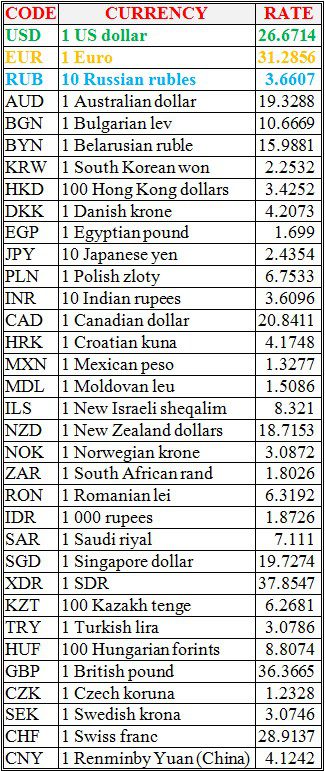
Source: National Bank of Ukraine



