
First Ukrainian International Bank (FUIB, Kyiv) from March 2 reduces the rates on deposits of individuals in hryvnias by 0.5-1.5 percentage points (p.p.), to 8-12% per annum, depending on the type and term of the deposit.
According to the report on the bank’s website, FUIB will also reduce rates on deposits of individuals in U.S. dollars by 0.2-0.5 p.p. (to 0.3-1.1% per annum) and in euros by 0.1-0.5 p.p. (to 0.2-0.3% per annum).
“The revision of deposit rates is mainly related to the planned reduction in the refinancing rate of the National Bank of Ukraine (NBU), which is now 11% per annum, and should be reduced to 7% by the end of the year,” the bank explains.
It is specified that interest rates on deposits signed before March 2 will remain unchanged.
FUIB was founded in 1991. The owner of a substantial stake in the bank is Rinat Akhmetov (indirect participation of 100%).
As of January 1, 2020 FUIB ranked seventh in terms of total assets (UAH 63.16 billion) among 75 banks operating in the country, according to the National Bank of Ukraine.
Sales of spirit by state-owned enterprise (SOE) Ukrspyrt in January 2020 grew by 62% compared with the same period in 2019, to 412,000 decaliters.
“This is the result of the preparation of SOE Ukrspyrt for privatization and our common struggle with the Ministry of Economic Development, Trade and Agriculture, the State Tax Service and law enforcement authorities against the illegal spirit,” acting Director of Ukrspyrt Serhiy Bleskun said.
Last month, 11 Ukrspyrt distilleries were operating. “Last year, seven distilleries were operating at the same period, and sales amounted to 255,000 decaliters of ethyl spirit,” the enterprise said.
According to the company, in January 2019, the loss-making performance of Ukrspyrt amounted to UAH 5.5 million. In turn, the net profit of SOE in January 2020 reached UAH 2.6 million.

The Interdepartmental Commission on International Trade (ICIT) has decided to introduce anti-dumping duties on the import into Ukraine of aerated concrete blocks originating from Belarus.
“The final anti-dumping measures are applied for a period of five years by introducing the charging of the final anti-dumping duty at a rate of 34.19%,” the commission said in the Uriadovy Kurier newspaper on February 25, 2020, which the agency received yesterday.
The decision concerns building blocks from porous structural and heat-insulating concrete according to tariff heading 6810 11 originating from Belarus.
The final anti-dumping duty is charged as a percentage of the customs value of goods.
The Commission’s decision shall enter into force in 30 days from the date of its publication.
According to the State Statistics Service, in 2019, imports of building blocks for the specified tariff heading from Belarus amounted to 338,400 tonnes for $13.9 million, while exports to the country amounted to 858 tonnes for $273,000.
In general, Ukraine imported of such goods for $14.6 million and exported for $2.3 million in 2019.

The Cabinet of Ministers of Ukraine has approved a list of 402 investment programs and regional development projects that will be financed from the State Regional Development Fund in 2020.
“We have taken another step to launch the Big Construction project as early as March 1. We approved a list of programs and projects funded by the State Regional Development Fund. These are 402 projects, 206 of which are facilities of the Big Construction program,” Ukrainian Prime Minister Oleksiy Honcharuk said on his Telegram channel on Wednesday.
Thus, UAH 5.2 billion out of UAH 7.5 billion envisaged by the State Regional Development Fund in 2020 was allocated to regional development projects.
In addition, the procedure for using funds for the construction and reconstruction of the Zaporizhia Bridge, the Odesa-Melitopol-Novoazovsk highway on the Odesa-Mykolaiv-Kherson section and the Kyiv-Sumy-Kharkiv highway within the borders of Chernihiv and Sumy regions was approved, the prime minister added.
PJSC Ukrtelecom cut its net income by 1.4%, to UAH 6.357 billion in 2019, the company’s CEO Yuriy Kurmaz said at a press conference in Kyiv.
According to him, the revenue is expected at the level of 2019 amounting to about half a million hryvnia, but this figure will be announced only after the financial audit of the company.
At the same time, EBITDA increased by 9.4%, to UAH 1.766 million, EBITDA margin – by 2.8 percentage points (p.p.), to 27.8% compared to 2018.
The company’s capital investments grew by 14.6%, to UAH 692 million.
In the total amount of income, revenues from telecoms services amounted to UAH 5.288 billion (a decrease of 4.1% from 2018), while total revenues from providing Internet access and data transmission services continue growing – by 6.2%, to UAH 1.949 billion, revenues from telephony continue declining – by 9.1%, to UAH 2.56 billion.
In 2019, Ukrtelecom served 2.3 million fixed-line subscribers, 1.04 million Internet access subscribers, and 78,000 television subscribers in the B2C segment. Revenues from telephony in this segment decreased by 10.9%, to UAH 1.865 billion, those from Internet access services grew by 6.2%, to UAH 1.372 billion.
According to the results of 2019, the operator in the B2B segment serviced 790,000 fixed-line telephony subscribers with an average revenue per user (ARPU) of UAH 70 without VAT (UAH 68 in 2018), and 150,000 subscribers of the Internet access service with an average ARPU of UAH 198 (UAH 175 in 2018).
National bank of Ukraine’s official rates as of 27/02/20
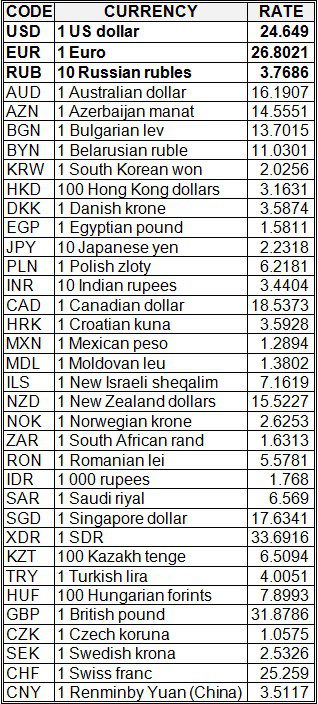
Source: National Bank of Ukraine



