

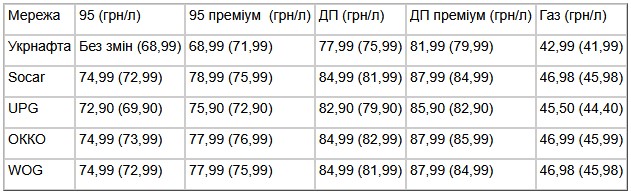
Prices for all types of fuel rose by 1–3 UAH/liter on Friday compared to Thursday; against this backdrop, PJSC “Ukrnafta” lowered the price of A-95+ by 3 UAH/liter, bringing it in line with A-95, according to data monitoring on websites and in network apps conducted by the “Energoreforma” internet portal.
According to the data, three of the surveyed gas station chains raised diesel fuel prices by 3 UAH/liter: Socar, WOG, and UPG, with the first two currently selling diesel at 84.99 UAH/liter and diesel+ at 87.99 UAH/liter. The same price applies at OKKO, which brought its prices in line with this level by raising them by 2 UAH/liter. UPG lists prices of 82.9 UAH/liter and 85.9 UAH/liter, respectively.
State-owned “Ukrnafta,” following a 2 UAH/liter increase in diesel prices, has a diesel price of 77.99 UAH/liter and diesel+ at 81.99 UAH/liter, which is the lowest among the surveyed networks.
The price of gasoline increased by 1 UAH/liter at OKKO, by 2 UAH/liter at WOG, and by 3 UAH/liter at Socar and UPG, but UPG’s price remains the lowest among private chains. Meanwhile, the state-owned “Ukrnafta” left the price of A-95 unchanged and reduced the price of A-95+ by 3 UAH/liter. For both types of fuel, it stands at 68.99 UAH/L.
Fuel prices (averages) as of March 20 compared to March 19 (based on monitoring by “Energoreforma” of network websites and apps*).
*Not all gas stations provide up-to-date prices on their websites and in their apps
As reported, at the beginning of last month, Serhiy Kuyun, director of the consulting firm A-95, predicted that diesel fuel prices would rise to 80 UAH/liter by the end of the month and noted the conditions for a further increase to 90 UAH/liter. At the same time, he indicated that he does not believe diesel fuel will reach 100 UAH/liter. According to him, since price spikes have affected many countries, the global economy cannot sustain such prices, and every effort will be made to offset the increase. He added that gasoline prices will rise only slightly.
The real estate markets of Vietnam, Thailand, Cambodia, and Bali will be in different phases of the cycle by 2026, but they share one common factor—the significant role of foreign demand. That said, the degree of dependence on foreign buyers, the supply structure, and price levels vary significantly across these markets.
Vietnam currently appears to be the most balanced of these markets. Here, the recovery is driven primarily by domestic demand, while foreigners play an important but not dominant role. In Hanoi, the average price of new apartments has already reached about $3,800 per square meter, while in the coastal city of Da Nang, the primary market stands at $2,200–2,300 per square meter. Foreigners can only purchase housing in approved commercial projects, cannot directly own land, and their share is limited by quotas, specifically to 30% of the apartments in a single condominium.
This is precisely why Vietnam remains largely a market for local buyers, while foreign demand is concentrated in the premium segment and in the largest cities. Among the key foreign groups in the market, citizens of South Korea, China, Singapore, Japan, and some overseas Vietnamese are typically cited. Russians are present mainly in resort locations, primarily in Nha Trang, while Ukrainians are also found among renters and individual buyers, but their share in publicly available statistics is not disclosed and remains niche.
Thailand, on the other hand, is much more dependent on external demand, especially in the condominium segment. According to REIC, in 2025, foreigners completed 14,899 condominium transactions, which is 2.2% more than the previous year. They accounted for 14.7% of all property transfers by volume and 25% by value. Chinese buyers retained the top spot among foreign buyers, Myanmar moved up to second place, and Russia remained among the largest groups.
In terms of prices, Thailand is significantly more expensive than Vietnam, especially in the capital and major resort areas. In Bangkok, the average price of condominiums in early 2026 was estimated at approximately $4,200–4,300 per square meter, and in central districts, the price was even higher. In Phuket, the median price of condominiums as of 2025 was about 144,000 baht per square meter, which corresponds to approximately $4,000 per square meter at the current exchange rate. The law allows foreigners to own units in condominiums but not the land, with the foreign quota in a project limited to 49% of the total area.
In Thailand, the role of foreigners is already directly influencing market dynamics in Bangkok, Pattaya, and especially Phuket. Russians remain one of the most prominent groups of buyers in resort regions, while Ukrainians, although not officially in the top 10, are considered by market estimates to be among the most active second-tier buyers and are primarily active in resort real estate.
Cambodia appears to be a riskier market, but also one more dependent on foreign capital. Following a boom and subsequent downturn, the market in Phnom Penh and Sihanoukville is recovering more slowly than in Thailand or Vietnam. In Phnom Penh, prices for condominiums in the business district are around $2,746 per square meter, and the market as a whole remains under pressure due to a high supply base and slower absorption.
The Cambodian market has historically been closely tied to Chinese capital, especially in Sihanoukville, and this dependence persists. Foreigners can purchase apartments but not land, making condominiums the primary vehicle for foreign investors. At the same time, there is virtually no comprehensive, up-to-date official breakdown of homebuyers by nationality available to the public. According to market reviews, the largest foreign groups remain the Chinese, as well as investors from South Korea, Singapore, and Malaysia. The presence of Russians and Ukrainians in this market remains limited and has no significant impact on the overall demand structure.
Bali occupies a special place among this quartet, as it is not a separate country but Indonesia’s most internationalized resort market. The driver here is not so much local demand as it is tourism, short-term rentals, digital nomads, and relocation. In 2025, Bali welcomed 6.33 million foreign tourists, a 9.7% increase from 2024, with Australia remaining the largest source market by visitor numbers.
Prices in Bali depend heavily on the property type and location. According to market surveys, the average selling price in 2025 was approximately $1,970 per square meter, and by early 2026, the average price in the villa market had risen to about $2,210 per square meter. At the same time, in the central areas of Badung, prices often exceeded $3,000 per square meter, and the average cost of villas, according to some surveys, rose from approximately $321,000 to $484,000 per property over 12 months. For foreigners, the primary option remains long-term leasehold, as direct land ownership is restricted.
Foreigners play a key role in Bali, but statistics on the nationalities of homebuyers here are less transparent than in Thailand. Based on tourism and market trends, Australians, British, Americans, and Russians are the most prominent. Since 2022, the market has also seen growing interest from Ukrainian citizens, primarily in the rental, relocation, and some investment purchase segments. However, as in Cambodia, there is no complete official breakdown by buyer nationality available to the public.
If we compare these four markets based on their market models, Vietnam currently appears to be the most internally stable and less dependent on foreigners. Thailand is the most transparent and institutionally developed market for foreign buyers, where the influence of foreign capital is already well-documented by statistics. Cambodia remains a more speculative market dependent on specific external groups. Bali, on the other hand, is a story of global mobility, tourism, and rental yields, where foreign demand effectively drives a significant portion of price dynamics.
In terms of price levels, capital cities and resorts also fall into different tiers. Bangkok and select projects in Phuket remain the most expensive in this group, followed by Hanoi. Da Nang and Phnom Penh fall within the mid-range price bracket, while in Bali the spread is particularly wide: from relatively affordable properties outside premium zones to expensive villas in Chang, Seminyak, and Bukit.
For an investor from Ukraine, this quartet looks like this: Thailand and Bali are the most straightforward markets for a resort strategy and rental income, but also the most dependent on external market conditions; Vietnam is more complex from a legal standpoint but has a strong domestic market; Cambodia is a potentially more profitable but also riskier market. At the same time, Ukrainians are already present in the Thai and Balinese markets, while in Vietnam they primarily operate as a niche group in resort locations.
Source: https://expertsclub.eu

The Bali real estate market is experiencing robust growth in 2026, driven by the recovery of tourism and an increase in the number of foreign residents, particularly digital nomads and investors. The main areas of demand are concentrated in Canggu, Seminyak, Ubud, and Uluwatu. These are the areas that form the premium segment of the market and attract international capital.
Prices for real estate in Bali vary significantly depending on the property type. In the villa segment, prices average between $1,500 and $3,500 per square meter, and higher in premium projects. Ready-to-rent villas are sold in the range of $150,000–500,000 per property and above.
Indonesian law restricts foreign ownership of real estate, so the primary model remains a long-term leasehold for 25–30 years with the option to renew.
Foreigners play a key role in the Bali market. In some locations, they account for 60–70% of all transactions, particularly in the rental villa segment.
The main buyer groups are citizens of Australia, the UK, the US, and European countries. In recent years, the presence of investors from Russia and Ukraine has grown significantly, especially after 2022.
Russians have become one of the most prominent groups in the Bali market, actively investing in villas and the rental business. Ukrainians are also present among investors and renters, driving part of the demand in the remote work and relocation segment.
Thus, Bali is one of the real estate markets in the world most dependent on foreign capital, where price dynamics are directly linked to global population mobility and the trend toward remote work.

The Romanian authorities have extended the transition period for submitting applications to regain Romanian citizenship without the mandatory B1-level Romanian language certificate by one more year.
The transition period itself has been moved from March 15, 2026, to March 15, 2027. Thus, over the next 12 months, applicants under this procedure will still be able to begin the process without providing a language certificate at the application stage.
The requirement to demonstrate proficiency in Romanian at the B1 level was introduced by Law No. 14 of March 12, 2025, and the agency’s leadership initiated steps to postpone its practical implementation.
This does not mean the cancellation of the language requirement itself, but rather an extension of the transition period for another year.
Source: https://relocation.com.ua

According to Fixygen, PJSC “Sambir Instrument-Making Plant ‘Omega’” will hold a general meeting of shareholders on April 6, 2026. The company remains an active industrial enterprise in the Lviv region and continues to operate in the instrument-making and electrical equipment sector.
According to Opendatabot, the plant was registered in November 1995 in Sambir; its director is Petro Moshumansky, and its primary activity is the production of electrical distribution and control equipment. “Omega” manufactures measuring and control instruments for the nuclear power, metallurgy, gas, oil production, and chemical industries.
OMEGA, Sambir Instrument-Making Plant, shareholders' meeting

The Antimonopoly Committee of Ukraine (AMCU) has granted permission to Agroton Public Limited (Nicosia, Cyprus) to acquire control over the agricultural limited liability company (LLC) “Mriya.”
According to the AMCU’s announcement, control will be established through the direct acquisition of shares, ensuring a majority of more than 50% of the votes in the company’s highest governing body. The decision was made following the review of an application dated February 2, 2026 (No. 15-01/215-EKk).
Agroton Public Limited is the holding company of the “Agroton” group—a large, diversified, vertically integrated agricultural producer. The group’s primary beneficiary is Yuriy Zhuravlev.
As reported, in March 2026, the AMCU also granted Agroton Public Limited permission to acquire control over PAOP “Zorya” (Berestynsky District, Kharkiv Region), which previously belonged to American businessman George Ror through LLC “Charivny Svitanok (Agro).” The enterprise specializes in crop farming and dairy farming.
“Agroton” has been operating in the Ukrainian market since 1992 and, prior to the full-scale Russian military invasion, specialized in growing grain and oilseed crops, as well as the production and sale of livestock products. Before the war, Agrotone’s land bank consisted of approximately 110,000 hectares in the Luhansk and Kharkiv regions. The group also owned two poultry farms in the Luhansk region. However, according to the report for the first half of 2024, the area of land leased by the company from private individuals was zero.
In 2022, Agroton reported that representatives of the so-called “LPR” and JSC “Agrokompleks named after M.I. Tkachev” (Russian Federation) “seized” all assets of its parent company, Agroton Public Limited, in the Luhansk region on May 21, 2022. According to the Luhansk Regional Military Administration (RMA), Russian occupiers, with the participation of collaborators, stole 20,000 tons of grain from Agroton’s elevators, harvested 200,000 tons of the 2022 crop from its fields, and transported it to the Russian Federation. In addition, the invaders stole 40 vehicles and transported them to Russia.
Yuriy Zhuravlev, the majority owner and CEO of the Agroton agricultural group, who owned 85.4% of the shares in the parent company Agroton Public Limited (Cyprus) as of mid-2024, purchased an additional 2.09% (453,024 shares of the company) in November 2024, increasing his stake to 87.49%. As the company reported to the Warsaw Stock Exchange, the purchase took place on the over-the-counter market.



