

According to Fixygen, JSC “Kharkiv Electrical Installation Products Plant” will hold a general meeting of shareholders on April 9, 2026. Information about the meeting on this date has been published on the issuer’s corporate website.
JSC “Kharkiv Electrical Installation Products Plant” was registered in January 1994. According to the registry, the company is located in Kharkiv, and its director is Anatoliy Konik.

Construction has begun on a plant for processing basalt and manufacturing finished basalt products by BF “Zavod” within the “BF Terminal” industrial park in Zakarpattia.
“As part of the ”BF Terminal” industrial park, a plant with an area of over 37,000 square meters will be built, equipped with modern machinery and utilizing innovative technologies, which will provide over 120 guaranteed jobs with high salaries. This investment of over 30 million euros will ensure a stable annual inflow of up to 10 million hryvnias into the local budget and strengthen the community’s capacity for sustainable development. At the same time, the state will receive a strategic product for domestic use and export,” Deputy Head of the Presidential Office Viktor Mykyta reported on Telegram.
According to Vitaliy Kindrativ, Deputy Minister of Economy, Environment, and Agriculture of Ukraine, the development of “BF Terminal” in Zakarpattia is an example of how the development of industrial parks is shaping a new economic reality, in which state incentives help launch modern production facilities. “Thanks to government incentives, the Berehove district is gradually transforming into a powerful industrial hub working toward the recovery of Ukraine’s economy,” he emphasized.
He noted that government funds are being directed toward key infrastructure, primarily the construction of a new railway access track at the Batyevo station. “This is essentially a transport artery that will connect the industrial facilities of the park to the Ukrzaliznytsia network and open direct access to European markets. Additionally, major repairs are being carried out on the exit ramp from the highway,” he said.
In addition, state funding covers the full cycle of energy supply, specifically the construction of a new 110 kV high-voltage power line, the construction of a modern “BF Terminal” substation, and the reconstruction of the existing outdoor switchgear. “This creates a reserve of energy stability not only for the industrial park but also for the entire regional power grid,” says Kindrativ.
According to Mikita, railway tracks and electrical infrastructure have already been built at a total cost of 316.6 million UAH. Approximately 148 million UAH of this amount was financed from the state budget.
As reported, at the end of 2025, “BF Terminal” in Zakarpattia Oblast, among others, received state funding for infrastructure development, specifically 11.908 million UAH for the major repair of the exit ramp from the highway.

Over the next two days, March 17 and 18, traffic on several bridges and overpasses in Kyiv will be partially restricted. During this time, specialists from the Kyivavtoputemost municipal enterprise will be repairing sections of the road surface, according to the Kyiv City State Administration.
According to the report, on Tuesday, March 17, repair work will be carried out on the Vozduhoflootsky overpass crossing the railroad tracks on Air Force Avenue, the bridge over the on Povitryanikh Sil Avenue, the overpass on Zhylianska Street, the Northern Bridge, and the overpass at the intersection of Dehtiarivska Street and Mykola Vasylenka Street with Beresteisky Avenue near the “Beresteiska” metro station.
On Wednesday, March 18, traffic will be restricted on the Vozduhoflootsky overpass over the railroad tracks on Povitryanikh Sil Avenue, the bridge over the Lybid River on Povitryanikh Sil Avenue, the overpass on Zhylianska Street, the Northern Bridge, and the overpass over the railroad tracks on Mykoly Vasylenka Street.
“During the work, traffic will be restricted partially and in stages. In the event of deteriorating weather conditions, the schedule for the work may be changed,” the Kyiv City State Administration emphasized.

According to the Interfax-Ukraine Culture project, the novel “Null” (“Zero”) by Polish writer Szczepan Twardoch, dedicated to the war in Ukraine, won in the “Fiction” category of the Książka Roku 2025 reader poll on the Polish platform Lubimyczytać, as reported on the platform’s website .
“The novel ‘Null’ is a story about war, memory, and what war does to a person,” note the organizers of the Książka Roku poll on the Lubimyczytać platform
The Lubimyczytać announcement notes that this year, readers cast 277,259 votes across 16 categories, and the winners were announced during a ceremony at the International Book Fair in Poznań.
In the fiction category, Twardoch’s novel beat out Valérie Perrin’s “Colette” and Jakub Malecki’s “Obiekty głębokiego nieba.” The “Null” platform describes it as a painfully contemporary story about the war in Ukraine, which was initially conceived as an essay for a German publisher but later evolved into a full-fledged novel.
As the poll organizers note, the book combines themes of war, historical memory, and the human experience of history, and raises questions about what war does to a person. This is not Twardoch’s first such recognition: last year, his novel “Korowód” won in this same category. In addition, “Null” previously also received an award as an Empik network bestseller.
The novel was published in February 2025 by Marginesy. Translations into German, Slovak, and Belarusian have since appeared, and the Ukrainian translation is being prepared by the publishing house “Fabula.”
Szczepan Twardoch is one of the most famous contemporary Polish writers, and his books have already been published in Ukrainian in Ukraine. In 2024, the writer was honored with the Stand with Ukraine Award for his support of Ukraine: following the start of Russia’s full-scale invasion, he has been involved in humanitarian and volunteer aid, and he refused permission to publish his novel *The King* in Russia until the war ends.
As reported, on March 16, the DTEK photo exhibition “Do Svitla / Into the Light” will open at the “Sens” bookstore on Khreshchatyk in Kyiv. The exhibition is dedicated to one of the harshest winters Ukraine has endured during the war, as well as to the people who helped the country survive, according to the bookstore’s press service.
https://interfax.com.ua/news/culture/1151986.html

According to the Interfax-Ukraine Culture project, photos of the Dolby Theatre in Los Angeles after the conclusion of the 98th Academy Awards ceremony have been shared on social media, showing a large amount of trash, film journalist and editor of the Next Best Picture website Matt Neglia reported on social media platform X.
“Clean up on aisle ALL,” Neglia wrote, posting a photo of the auditorium after the ceremony.
The photo quickly went viral and sparked a wave of discussion. Users noted the contrast between the glamorous atmosphere of the Oscars, the red carpet, and the guests’ evening attire—and what the auditorium looked like after the event ended.
The photo shows snack wrappers, cups, bottles, and other trash scattered on the floor and between the rows of seats. In the comments, some users criticized this scene, noting that public talk about the environment and responsible consumption seems contradictory against the backdrop of such images.
The 98th Academy Awards ceremony took place on the night of March 16 at the Dolby Theatre in Hollywood.
As reported, Sean Penn missed the 2026 Oscars: his absence is linked to a trip to Ukraine. The host of the 2026 Oscars, Conan O’Brien, opened the ceremony with a series of sharp jokes about Hollywood, politics, and streaming platforms. The documentary film “Mr. Nobody Against Putin”, which explores Russian propaganda regarding the war against Ukraine and its impact on schoolchildren, won the Academy Award in the category of “Best Documentary Feature.”
https://interfax.com.ua/news/culture/1152008.html

On March 14, a grand opera concert took place at the National Palace of Arts of Ukraine, featuring the world-renowned Ukrainian soprano Lyudmila Monastyrska, accompanied by the symphony orchestra and choir of the T. G. Shevchenko National Opera of Ukraine under the baton of conductor Mykola Dyadyura.
According to reporters from the “Culture” section of the “Interfax-Ukraine” agency reporting from the scene, the palace hall was completely full that evening. The concert drew a large audience of classical music enthusiasts, members of the diplomatic corps, the cultural community, journalists, and distinguished guests.
Among those present were Ukrainian Minister of Culture Tetiana Berezhna, Deputy Minister of Culture of Ukraine for Digital Development, Digital Transformation, and Digitalization Anastasia Bondar, People’s Deputy from the “Servant of the People” faction Yulia Hryshyna, Deputy Head of the Office of the President Ihor Zhovkva, as well as representatives of the diplomatic corps, international organizations, the media, and public figures.
“Culture is one of the languages through which Ukraine speaks to the world. We invited heads of diplomatic missions and representatives of international organizations accredited in Ukraine to the concert at the National Palace of Arts ‘Ukraine,’” wrote Ukrainian Minister of Culture Tetiana Berezhna on her Facebook page.
According to her, on the eve of her performances at the world’s leading opera stages—the Metropolitan Opera in New York and the Teatro Colón in Buenos Aires—the prima donna presented an evening of world opera classics in Kyiv. Such events, Berezhna emphasized, are of particular importance for cultural diplomacy, as it is through music, art, and shared cultural experiences that Ukraine communicates its history, values, and strength to the world.
The minister also emphasized that the Ukrainian opera school has a rich tradition that has developed over the centuries—from composer Semen Hulak-Artemovsky and the legendary Solomiya Krushelnytska to the outstanding voices of the 20th century. Today, this tradition is carried on by contemporary Ukrainian artists who successfully represent Ukrainian culture on the world’s most prestigious stages.
Yulia Hryshyna, a member of the Ukrainian Parliament, who was also among the evening’s guests, shared her impressions of the concert.
“When music plays, the soul sings. And it is in moments like these that inspiration to move forward emerges,” she wrote on her Facebook page.
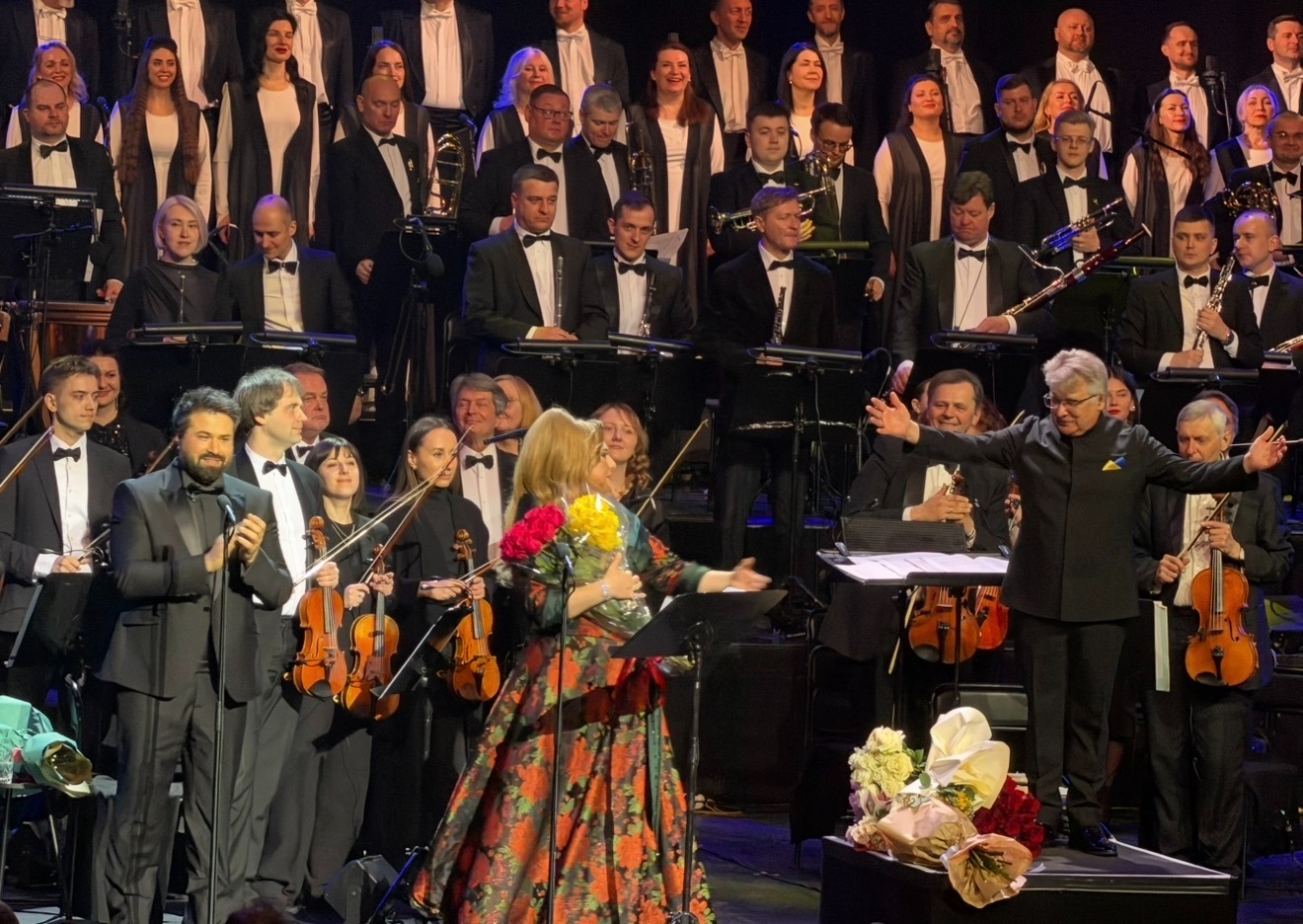
According to Hryshyna, the concert was a truly special evening that combined majestic music, flawless vocals, and the magic of the live sound of the National Opera of Ukraine’s symphony orchestra.
Opera singers David Axelrod, Vitaliy Bilyi, and Vlad Sitnik performed alongside Lyudmila Monastyrska. The evening concluded with a performance of Igor Shamo’s iconic song for the capital, “How Can I Not Love You, My Kyiv!”, which the artists performed together with the choir of the National Opera of Ukraine. The audience greeted the final composition with a standing ovation.
Serhiy Perman served as the project’s creator and artistic director, Dmytro Saratsky as music producer, Anastasia Buzhanska as production director, Anton Kyrychuk as technical director, and Oleg Yakovlev as executive producer. Sound for the concert was provided by “Terminal,” and lighting by “Feeria.” The organizers also expressed their gratitude to Petro Chupryna, General Director of the National Opera of Ukraine, for his support of the project.
Lyudmila Monastyrska is one of the most famous Ukrainian opera singers in the world. Her voice can be heard on the world’s leading opera stages, as well as in European opera houses. The artist’s performances have become an important part of Ukraine’s cultural presence in the world, as through music she represents Ukrainian art to an international audience.



