
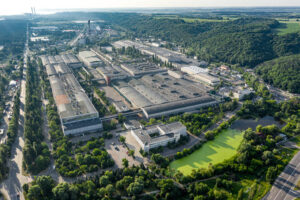
The Kyiv Cardboard and Paper Mill (KKPK, Obukhiv, Kyiv Oblast) suffered a large-scale missile attack by the enemy on March 14, resulting in damage to industrial and administrative buildings, production facilities, and utility infrastructure, the mill reported on its website.
“Thanks to the effective and timely safety measures in place at the plant, all employees remained alive and unharmed,” the statement from Monday reads.
The plant reports that its emergency response headquarters is currently operating around the clock, and all necessary measures are being taken to address the damage, assess the destruction, and evaluate the losses incurred.
“Recognizing our high degree of social responsibility toward our employees, customers, and partners, Heinz Zinner, the owner of the Kyiv Cardboard and Paper Mill, has decided to immediately allocate the additional funding necessary to carry out all restoration work,” the statement notes.
The plant also added that it would be grateful to everyone who supports it as a Ukrainian manufacturer by purchasing its products, which will allow production activities to resume more quickly.
Kyiv Cardboard and Paper Mill is the flagship enterprise of the group of companies of the same name, one of Europe’s largest manufacturers of cardboard and paper products with a workforce of over 2,500 people.
In particular, the plant has a cardboard production capacity of 240,000 tons per year and a corrugated packaging plant with a capacity of 355 million square meters, as well as a production facility for base paper and finished products with an annual capacity of 70,000 tons of base paper.
As reported, in 2025 the plant increased its production volume by 5% compared to 2024, reaching 8.4 billion UAH.
The plant is wholly owned by the Austrian company Pulp Mill Holding GMBH, whose ultimate beneficiary is Heinz Zinner.

According to Fixygen, PJSC “Rodos” has scheduled a general meeting of shareholders for April 6, 2026. Against the backdrop of the traditional spring season of corporate procedures, this meeting will be a key step for the company in approving annual resolutions based on the results of 2025.
PJSC “Rodos” was registered in Kyiv in January 1995. According to Opendatabot, the company operates at an address on Yulia Zdanovska Street, its authorized capital is 418,500 UAH, and its primary activity is the manufacture of lifting and loading/unloading equipment.

A turnkey seed processing line for legumes and grain crops with a capacity of 6 tons per hour has been installed at one of the agricultural enterprises in Latvia, according to a press release from the Ukrainian manufacturer OLIS LLC.
“OLIS equipment is well known in the Baltic market: in particular, several comprehensive projects have already been implemented in Latvia with our participation. The launch of this seed processing line is further confirmation that OLIS’s technological solutions meet the high quality standards in effect in the EU market,” commented Vladimir Cheglatonev, the company’s acting CEO, on the launch.
The project involved a full cycle of work: engineering, equipment supply, installation, automation, staff training, and a test run. The line includes equipment manufactured by OLIS, specifically PSO-100 grain cleaning separators with a KAO-1.0 aspiration column, an OMP-6 stone remover, trier blocks, and SPS-3.5 pneumatic sorting tables.
The technological solution was designed for cleaning and preparing wheat, pea, and bean seeds. The quality of seed preparation on the new line has already been confirmed by the relevant regulatory authority in Latvia.
The company emphasized that implementing the project on a turnkey basis allowed the customer to receive a comprehensive solution with coordinated components and to shorten the time required to commission the facility.
As reported, “Olis” resumed operations at its plant in the Odesa region in March 2022.
Olis LLC (Odesa) was founded in April 2005. The company manufactures approximately 200 types of equipment for the grain processing industry. The enterprise is capable of producing grain cleaning complexes, mills, and cereal processing plants from the technology development stage through to commissioning. Additional areas of activity include the installation, repair, and maintenance of industrial machinery, as well as the wholesale trade of equipment. The company’s products are exported to more than 25 countries worldwide.
According to Opendatabot, the company’s revenue in 2025 increased by 2.13%—to 238.95 million UAH compared to 233.97 million UAH in 2024. Net profit for the past year amounted to 2.69 million UAH, compared to 10.42 million UAH a year earlier. The company’s assets are valued at 216.52 million UAH, and its liabilities at 169.7 million UAH. The authorized capital is 60,000 UAH. The founders and beneficiaries of the company are Oleg Vasilyev (35%), Larisa Ostapenko (35%), and Alexander Vereshchinsky (30%).
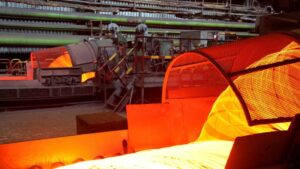
The Kametstal plant, part of Metinvest’s mining and metallurgical group and established at the Dniprovsky Metallurgical Plant (Kamenskoye, Dnipropetrovsk Oblast), has mastered the technology for refurbishing cast iron ladles for metallurgical enterprises.
According to a press release, Kametstal’s metallurgical equipment repair shop has mastered a new area of expertise: the repair of pig iron ladles. This decision is aimed at supporting the smooth operation of the blast furnace shop and will help effectively restore critical equipment in-house.
It is noted that this year’s launch of new services at the Central Repair and Maintenance Unit began with mastering the repair of cast iron ladles. This is a strategic move: the stable operation of the blast furnace shop directly depends on the number of ladles “in service.” Since the need to repair such equipment has grown, while personnel resources remain limited, the repair team has taken proactive measures. The team’s initiative, supported by the plant’s management, will address the shortage of operational equipment and ensure the stability and productivity of pig iron production.
According to the repair technology, restoration work is carried out based on the results of defect detection, which is conducted jointly with specialists from the blast furnace shop. This allows for the precise identification of weak spots and the scope of necessary repairs.
The main repair operations include sealing cracks on the vertical walls of the ladles, as well as eliminating through-wall damage in the bottom section. Such burn-throughs occur due to the aggressive action of molten iron in areas where the refractory lining is most worn. Repair crews cut out the damaged sections and replace them with new steel “patches.” Special attention is paid to the upper part of the ladle—the neck—where worn-out metal structures are replaced. The entire process involves a full cycle of technical work: dismantling damaged elements, manufacturing replacement parts, and their subsequent installation.
Dmytro Lubenets, head of the metallurgical equipment repair shop, explained that they approach the repair of each pig iron ladle individually: from defect detection and drawing development to in-house manufacturing of parts.
“The first restored unit has already returned to the blast furnace shop; we are currently restoring the second one. Since the results of the pilot repair are quite satisfactory, we decided, together with the blast furnace operators, to systematize this process: ladles that go out of service will be sent directly to the Central Repair and Maintenance Unit. This will allow us to quickly return them to service after repair and, thus, maintain the stability of the production process. In these difficult wartime conditions, such cooperation is crucial—it is our way of overcoming staff shortages and maintaining production momentum,” said the shop foreman.
It should be noted that CMU specialists have mastered the technology for repairing slag ladles with significant wear and defects. Previously, such ladles were written off for disposal and replaced with expensive new ones. In 2025, 15 ladles were repaired and returned to the blast furnace shop for further operation.
“Kametstal” was established on the basis of PJSC “Dniprovsky Coke Chemical Plant” (DKHP) and PJSC “Dniprovsky Metallurgical Plant” (DMP).
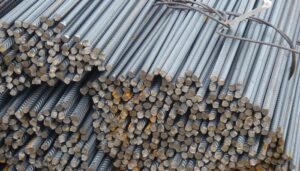
PJSC Slavgorod Reinforcing Bar Plant (SAZ, Dnipropetrovsk region) reported a net profit of UAH 1.132 million for 2025, compared to UAH 7.497 million in 2024.
According to the company’s announcement in the disclosure system of the National Securities and Stock Market Commission (NSSMC) regarding the remote general meeting of shareholders to be held on April 17, six items are scheduled for consideration, including approval of the results of financial and operational activities for 2025 and a decision on the profit distribution procedure.
In addition, it is proposed to preliminarily grant consent for the execution of significant transactions and to approve the procedure for the mandatory buyback of shares from shareholders who voted against the decision to execute significant transactions.
The draft resolutions, copies of which are available to the Interfax-Ukraine agency, propose that the net profit earned in 2025, amounting to UAH 1.132 million, be retained by the company to fulfill its statutory tasks and objectives. No annual dividends are to be accrued or paid based on the results of operations in 2025.
As of the end of 2024, SAZ’s retained earnings amounted to UAH 27.848 million.
As reported, in 2023, SAZ increased its net profit to UAH 18.93 million, which exceeded the 2022 figure by more than four times.
The Slavgorod Valve Plant was founded in 1926 as a manufacturer of cast iron valves. It currently specializes in the production of steel pipeline equipment (shut-off, control, and steam traps) and the assembly of flanges for such equipment. It also manufactures devices for securing mine workings in coal mines, as well as forgings and stampings for automotive and agricultural machinery parts.
According to the State Registration Service data for the fourth quarter of 2025, PJSC “Promarmatura” (Dnipro) owns 53.5661% of PJSC “SAZ,” and PJSC “Inter-Industry Assembly Base ”Zagallomashkontrakt” owns 22.0307%.
The authorized capital of PJSC “SAZ” is UAH 0.045 million, and the par value of a share is UAH 0.25.
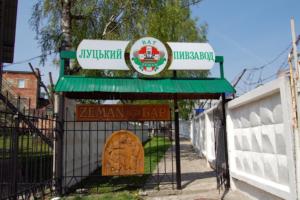
According to Fixygen, PJSC “Lutsk Brewery” will hold its annual general meeting of shareholders on April 15, 2026, in a virtual format. The relevant announcement was published in the information disclosure system, and the company has posted materials for shareholders on its website.
The company is registered in Lutsk and has been operating since the 1990s.



