

According to the project Relocation.com.ua, citing data from idealista with reference to Banco de Portugal, foreigners invested €3.905 billion in Portuguese real estate in 2025, setting a new record and exceeding the 2024 level by 10.4%. Against this backdrop, the total inflow of foreign direct investment (FDI) into Portugal, conversely, fell by 34.9% to €8.51 billion, while the share of real estate in total FDI rose to 45.9%, or nearly half of all foreign capital.
The geography of this capital remains fairly predictable. The largest volume of accumulated foreign investment in Portugal is concentrated in Greater Lisbon—€113.2 billion, followed by the North of the country—€37.2 billion, and the Algarve—€21.7 billion; together, these three regions account for 80.5% of the total foreign investment stock.
Among the countries from which capital flowed in 2025, Luxembourg stood out—€1.1 billion, the United Kingdom—about €900 million, and Germany—€800 million. At the same time, Banco de Portugal itself notes that jurisdictions such as Luxembourg, the Netherlands, and Spain often serve as intermediary platforms, so the ultimate sources of funds may differ from the country of the direct counterparty.
But if we look not at investment capital but at actual real estate transactions, the picture becomes clearer. The latest detailed official breakdown from INE shows that in 2024, foreign families purchased 38,552 houses and apartments in Portugal, which is 6.7% more than in 2023 and 19.2% higher than the 2019 level. That said, foreigners still remained a minority in the market: in total, families purchased 134,540 properties, of which 95,988 were bought by buyers of Portuguese origin. Among foreign buyers, Brazilians led the way with 7,694 transactions, followed by Angolans with 4,054 and the French with 4,016. Separately, INE noted a rapid increase in the number of Americans: the number of their purchases rose from 537 in 2019 to 1,707 in 2024.
If we broaden the picture and look at all major foreign groups residing in Portugal, it becomes clear that the market demand is much broader than just traditional buyers from Brazil, France, or the United Kingdom. According to AIMA, 1,543,697 foreigners were residing in Portugal as of the end of 2024.
The largest community was Brazilians—484,596 people, followed by Indians—98,616, Ukrainians—79,232, Nepalese—58,086, and British—48,238.
The mortgage market adds a distinct dimension to this picture. According to Banco de Portugal, in 2024, 10.1% of people who took out a mortgage for their primary residence were foreigners. Brazilians again led the way, accounting for 38% of all foreign borrowers; they were followed by Angolans and British nationals. In terms of loan amounts, Brazilians accounted for 30% of foreign mortgage volume, the British for 7%, Americans for 6%, and the French and Italians for 5% each. This shows that in Portugal, foreign demand has long been driven not only by purchases with personal funds but also by full-scale lending.
That is precisely why the Portuguese market should now be viewed from two perspectives. In the first, foreign capital has indeed set a record and continues to fuel the real estate market even after the abolition of “golden visas” for housing. Second, the composition of actual foreign demand is becoming increasingly diverse: as before, Brazilians, Angolans, French, British, and Americans are the most active buyers, but within the country’s demographic structure, the role of Ukrainians, Indians, Nepalese, and other new communities is becoming increasingly prominent. For the market, this means one thing: the foreign presence in the Portuguese housing market is not weakening, but changing form.
https://relocation.com.ua/foreigners-break-record-in-portugals-housing-market/

According to The Serbian Economist, Serbia’s Elixir Group and Germany’s K+S have launched production of a new water-soluble fertilizer for agriculture at the Prahovo ChemPark site in Serbia. The product will be marketed in Europe under the brand name soluMAP®.
Simply put, production has begun in Prahovo of a fertilizer that dissolves quickly in water and is used in modern plant nutrition systems—primarily in drip irrigation and other precision application methods. This is important for the European market, as such supplies will be geographically closer and delivery times shorter. K+S explicitly states that the project is intended to strengthen the reliability of supply for European customers.
The site is located in Prahovo on the Danube, near the borders with Romania and Bulgaria. K+S notes that this simplifies logistics across Europe and to Turkey, while the proximity to Elixir’s phosphoric acid production facilities provides the project with a local raw material supply.
The Elixir and K+S project was announced back in 2023. At that time, it was reported that the investment would amount to €35 million, and the capacity of the new plant in Prahovo would be 50,000 tons per year. Production was planned to begin in 2026.
For Elixir, this launch also reinforces the role of Prahovo ChemPark as a major industrial and chemical hub. The group describes itself as the leading producer of phosphoric acid in the region and the largest producer of compound mineral fertilizers in Southeast Europe, with over 70% of its output exported to more than 85 countries.
The tMAP 12-61 product is a fertilizer with a high phosphorus and nitrogen content. The numbers 12-61 indicate the proportion of the main nutrients: 12% nitrogen and 61% phosphorus.
It is used in drip irrigation, fertigation, and foliar feeding, especially during the early stages of plant growth when crops need phosphorus for root system development.
https://t.me/relocationrs/2448

Ukrzaliznytsia is organizing the first spring retro tour along Europe’s longest narrow-gauge railway—the Haivoron Railway—which will take place on March 21, according to the press service.
Ukrzaliznytsia invites outdoor enthusiasts and railway fans to welcome spring aboard the “Haivoron Express,” which will be pulled by Ukraine’s oldest operating steam locomotive, built in 1938.
The tour program includes a ride on a retro train, picturesque views of the Podillia region, traditional Ukrainian cuisine, and a cultural and artistic program. Charity fairs in support of the Armed Forces of Ukraine, featuring local delicacies and handmade goods, are also planned. In total, three tourist routes are planned as part of the retro tour, including narrow-gauge trips from “Haivoron to Khashchuvate” and “Haivoron to Peredbuzhzhia,” as well as a standard-gauge trip to Henrikhivka.
For passengers’ convenience, direct trailer cars have been designated for the “Kyiv–Haivoron,” “Lviv–Haivoron,” and “Odesa–Haivoron” routes.
Tickets are already available via the “Ukrzaliznytsia” mobile app, on the official website, and at station ticket offices. The average one-way fare is approximately 145 UAH for adults and 110 UAH for children under 14
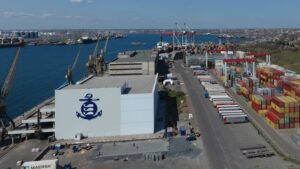
Odessa Port Cold Storage PJSC will hold its annual general meeting of shareholders on April 21, 2026, via remote participation. According to the published notice, shareholders are invited to review the supervisory board’s report, approve the financial and operational results for 2025, and cover the loss of UAH 197,000 using retained earnings.
The company is registered in Odesa. According to Opendatabot, the company’s director is Ihor Khmelevskyi, and the issuer itself operates in the city’s port infrastructure.

Centravis Production Ukraine, a leading manufacturer of seamless stainless steel pipes and a subsidiary of the Centravis holding company, has been forced to change its product supply routes due to the situation in the Middle East.
According to Centravis Sales Director Artem Atanasov, the company continues to closely monitor the development of the geopolitical situation in the Middle East and its potential impact on regional logistics and supply chains.
“Over the past weekend, the situation has changed, and new developments have affected previously available logistics options,” Atanasov stated.
According to him, as of March 16, several shipping lines have temporarily suspended new bookings to and from a number of destinations in the Persian Gulf region, including the UAE, Iraq, Kuwait, Qatar, Saudi Arabia (Dammam & Al Jubail), Oman (Sohar), and Bahrain.
The sales director of Centravis noted that the situation remains fluid. Shipping lines are currently working on possible solutions to ensure transportation and minimize operational risks.
Centravis was founded in 2000 and ranks among the top ten largest manufacturers of seamless stainless steel pipes in the world. Its main production facilities are located in Nikopol (Dnipropetrovsk region). In 2023, the company opened a branch in Uzhhorod.
Centravis Ltd. was established on the basis of CJSC “Nikopol Stainless Steel Pipe Plant” and the service and trading companies LLC “Production and Commercial Enterprise ”YUVIS.” Its shareholders are members of the Atanasov family. Centravis Ltd. owns 100% of the shares in Centravis Production Ukraine PJSC.

In February 2026, the Export Credit Agency (ECA) supported exports by Ukrainian companies worth 670.8 million UAH, according to the agency’s website.
Oschadbank provided the largest volume of support in cooperation with partner banks—UAH 552.48 million in supported exports, while Creditvest Bank supported UAH 51.01 million.
The largest volume of supported exports came from enterprises in Lviv (501.88 million UAH), Poltava (51.01 million UAH), Chernihiv (43.03 million UAH), and Zaporizhzhia (35.32 million UAH) regions.
The main importing countries of Ukrainian products in February were Germany (UAH 501.88 million), Poland (UAH 86.69 million), Kazakhstan (UAH 43.03 million), Lithuania (UAH 22.91 million), and Romania (UAH 14.90 million).
In terms of sectoral structure, the largest shares were held by printed matter and periodicals, nuclear reactors, boilers, machinery and mechanical appliances, paper and paperboard, ferrous metal products, as well as plastics and polymer materials.



