

In January-February of this year, Ukrainian enterprises reduced their consumption of rolled metal products by 11.01% compared to the same period last year, to 495,500 tons.
According to a press release from the Ukrmetallurgprom association on Thursday, 246,900 tons, or 49.83% of the domestic market for rolled metal consumption, were imported during this period.
According to Ukrmetallurgprom, in January-February 2026, metallurgical enterprises produced 796.7 thousand tons of rolled metal (83.2% compared to the same period in 2025), of which, according to the State Customs Service of Ukraine, about 548.1 thousand tons, or 68.8%, were exported. In January-February 2025, the share of exports was 63.5% (607.6 thousand tons with a total production of rolled metal products of 957.0 thousand tons).
The share of semi-finished products in export deliveries in January-February 2026 is 33.90%, which coincides with the indicator for the two months of 2025 (33.21%). The share of flat products in export deliveries in January-February 2026 significantly exceeds the figure for January-February 2025 (58.58% and 47.78%, respectively). The share of long products is significantly lower than in January-February 2025 (7.52% in 2026 versus 19.01% in 2025).
The structure of imports in January-February 2026 is characterized by a noticeable dominance of flat products over long products (53.54% and 30.21%, respectively), However, in January-February 2025, the dominance of flat rolled products over long products was significantly greater (82.55% and 14.42%, respectively).
In January-February 2026, the domestic market capacity was 495.5 thousand tons of rolled metal, of which 246.9 thousand tons, or 49.83%, were imports. In January-February 2025, the domestic market capacity was 556.8 thousand tons, of which 207.4 thousand tons, or 37.25%, were imported. Thus, in January-February 2026, there was an 11.01% decrease in the capacity of the domestic market compared to January 2025, with a simultaneous 12.58% increase in the share of imports,” the press release states.
According to the State Customs Service, the main export markets for Ukrainian rolled metal in January-February 2026 are the countries of the European Union (75.8%), other European countries (12.7%), and the CIS (6.4%).
Among metallurgical importers in January-February 2026, other European countries ranked first (44.9%), followed by Asian countries (24.6%) and the EU-27 countries (17.3%).
As reported, Ukraine’s rolled metal market in 2025 increased by 21.73% compared to the previous year, to 4 million 1.6 thousand tons. During this period, 1 million 603.6 thousand tons were imported, or 40.07% of the domestic rolled metal consumption market.
In 2024, Ukraine’s rolled metal market decreased by 6.26% compared to the previous year, to 3 million 288.4 thousand tons, while in 2023 it increased 2.19 times compared to 2022, to 3 million 505.6 thousand tons.
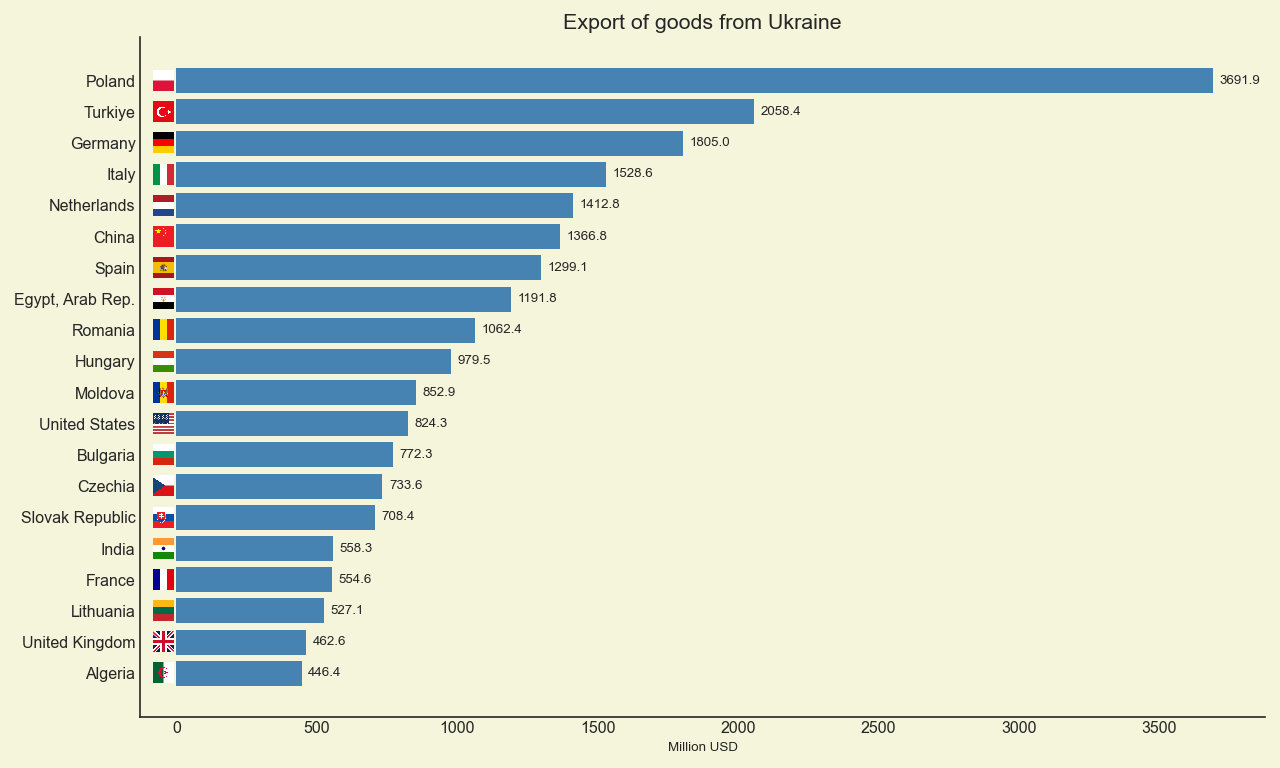
Geographical structure of Ukraine’s foreign trade (exports) in January-September 2025, million usd

Cashback on fuel of 5-15% will be valid until May 1 at all gas stations that join the program, Prime Minister Yulia Svyrydenko announced.
“Cashback on fuel. When purchasing at a gas station, citizens will be able to receive from the state: 15% cashback on diesel fuel, 10% cashback on gasoline, and 5% cashback on autogas,” Svyrydenko wrote on Telegram following the results of a government meeting on Thursday.
According to her, cashback on fuel will be valid until May 1 at all gas stations that join the program, and payments will be made on the basis of the National Cashback program, which is already used by 9.4 million citizens.

Ukraine will participate in the Leipzig Book Fair, which will take place from March 19 to 22, according to the Ukrainian Book Institute (UBI).
“On March 19-22, 2026, Ukraine will participate in the Leipzig Book Fair, one of the most important European events in the field of book publishing. The Ukrainian program will be held under the slogan “Filling in,” which reflects the desire to fill in the historical and cultural gaps in the perception of Ukraine in the world,” according to a statement from the UIC.
It is noted that today Ukraine is actively working to restore its visibility, return its voice to the European dialogue, and restore historical justice.
“Ukrainian literature, art, and philosophy are not only becoming more visible in the world—they are complementing the European cultural discourse with new stories, perspectives, and meanings,” the Institute emphasized.
According to the report, Ukraine will be represented at the fair by the national stand D311, where Ukrainian publishers will present their publications: “My Bookshelf,” “Time of Masters,” “Old Lion Publishing House,” Chas Zmin Inform, Bilka, the publishing house of the magazine Pam’yatky Ukrainy, as well as the Ukrainian-German magazines Dach Magazine and Gel[:b]lau, and Mystetskyi Arsenal will present its own selection of book publications.
There will also be readings, panel discussions, and presentations on the Ukrainian stage. Participants include writer and military officer Pavlo Matyusha, poet and paramedic of the volunteer medical battalion “Hospitaliers” Olena Herasyuk, writer Yevheniya Kuznetsova, literary scholar Tamara Gundorova, historian Serhiy Yekelchik, writers Kateryna Mikhalitsyna, Iryna Fingera, Ulrike Almuth Sandig, Michal Gworetsky, Asya Bazdyreva, Kateryna Botanova, Adrian Ivakhiv, Daria Tsymbaliuk, Svitlana Oslavska, and other authors and researchers.
Key events of the program on the stages of the Leipzig Book Fair include: Opening of the Ukrainian stand “Ukraine. Fillin In“ (March 19, 3:15 p.m.), with the participation of representatives of the Leipzig Book Fair, the German federal government, the city of Leipzig, and cultural institutions; Discussion ”Culture Despite Everything” with philosopher and publicist Volodymyr Yermolenko on the role of culture in times of war; Conversation “When Everyday Life Becomes History” with Ostap Slyvynsky, Olesia Ostrovska-Lyuta, and Georgiy Gospodinov on literature, memory, and oblivion; Panel “Ukrainian Feminist Literature: Voices, Texts, and Trends” with Tamara Hundrova, Roksolana Sviato, Natalkia Sniadanko, and Gaike Winkel; Events on language and identity, including a public conversation “Common Myths about Languages in Ukraine” with writer Yevgenia Kuznetsova; Discussions on ecology and culture, including the panel “When the Earth Is Destroyed: Stories, Images, and Practices of Ecological Testimony”; Discussions on historical memory, including the presentation of Anatoliy Kuznetsov’s documentary novel Babyn Yar with the participation of Kateryna Mishchenko, Christiane Körner, and Serhiy Yekelchik; Literary performance Echoes by Olena Herasyuk and Pavlo Matyusha, combining poetry and staged readings.
As reported, Ukraine is participating in The London Book Fair, which takes place from March 10 to 12. Twelve publishers and a literary agency are presenting their books at the national stand.
In 2025, the Ukrainian national stand at the London Book Fair was represented by 14 Ukrainian publishers and literary agencies, with 199 Ukrainian publications.

In 2025, the Spanish housing market reached its highest level since 2007: according to data from the Spanish Ministry of Housing and Urban Agenda, 752,098 home sales were completed in the country, which is 5% more than in 2024.
Foreign demand remains one of the key drivers of this growth. According to preliminary data from Spanish registrars, foreigners bought almost 97,300 houses and apartments in Spain in 2025, which was a new high and accounted for 13.8% of all transactions in the housing market. At the same time, according to notarial statistics for the first half of 2025, foreigners accounted for 71,155 transactions, or 19.3% of the total number of home sales during this period. Notaries separately note that the growth in 2025 was mainly driven by foreign residents, while purchases by non-residents declined slightly.
The main groups of foreign buyers in Spain are now primarily Europeans and people from countries with high migration to Spain itself. According to registrars’ data for the fourth quarter of 2025, the largest shares among foreign buyers were British (8.57%), German (6.67%), Dutch (5.91%), Moroccans (5.30%), French (5.28%), Romanians (5.17%), and Italians (4.76%). Notarial statistics for the first half of 2025 also show the UK leading the way with 5,731 transactions, followed by Morocco with 5,654 and Germany with 4,756.
Ukrainians also occupy a prominent place in this structure. According to data based on Spanish notarial statistics, in January-June 2025, Ukrainian citizens made 2,165 home purchases in Spain, which was a record for the entire series of observations. In the official Notariado review, Ukraine is also named among the countries that showed growth in the first half of 2025: the number of purchases by Ukrainians increased by 5% year-on-year. The average price paid by Ukrainian buyers was around EUR 1,832 per square meter.
Russians, on the contrary, are losing weight in the Spanish market. According to notaries, in the first half of 2025, home purchases by Russian citizens decreased by 17.4% compared to the same period in 2024, and Russians are no longer among the largest foreign groups in terms of the number of transactions. At the same time, Russians are still among the buyers with above-average purchase prices for foreigners.
Geographically, foreign demand is most noticeable on the coast and islands. According to registrars, the share of foreign buyers is particularly high in the Balearic Islands (32.8%), the Valencian Community (29.6%), the Canary Islands (24.5%), Murcia (22.8%), Catalonia (16.5%), and Andalusia (14%). Notaries also highlight Alicante, the Balearic Islands, Malaga, and Santa Cruz de Tenerife as the main areas of concentration for transactions with foreigners.
Thus, the Spanish housing market is currently being fuelled by two foreign flows: non-resident buyers, especially from Northern and Western Europe, and migrants who already live and work in Spain. According to notarial statistics, it is the second group that will be the main factor in maintaining record demand for housing in 2025.

The Academy of Motion Picture Arts and Sciences has announced the full list of nominees for the 98th Academy Awards, the world’s most prestigious film industry awards. The ceremony will take place on the night of March 15-16, Kyiv time, at the Dolby Theatre in Los Angeles.
“This year’s nominations demonstrate the extraordinary diversity of contemporary cinema, from large-scale studio projects to auteur films that are shaping the new language of world cinema,” the academy said in a statement.
In Ukraine, the ceremony will be commented on by theater and film actor and director Oleksiy Hnatkovsky, who will also host a special pre-show before the awards ceremony begins.
The broadcast schedule in Kyiv time is as follows:
At the same time, the streaming platform Netflix has released a special selection of films related to this year’s Oscars, so viewers can watch some of the films in advance and prepare for the main cinema event of the year.
Ten films of various genres are nominated in the Best Picture category this year , ranging from historical dramas to big Hollywood productions.
One Battle After Another is a new film by director Paul Thomas Anderson that tells the story of a group of people caught up in political conflicts and social transformations. The film explores how personal decisions can change the course of history.
The Secret Agent is a dramatic thriller by Brazilian director Kleber Mendonça Filho, based on the classic novel by Joseph Conrad. The film tells a story of espionage, political intrigue, and moral dilemmas in the world of covert operations.
Sentimental Value is an auteur family drama by Norwegian director Joachim Trier that explores the complex relationships between generations, memory, and the emotional legacy that people pass on to one another.
Sinners is a dramatic story by director Ryan Kugler about the struggle with inner demons, guilt, and attempts at redemption in modern American society.
Train Dreams is a poetic adaptation of the novel of the same name by Denis Johnson. The film takes the viewer back to the early 20th century and tells the story of a simple worker whose life unfolds against the backdrop of changes in nature and society.
Bugonia is a fantasy comedy-drama by director Yorgos Lanthimos that explores the boundary between reality and absurdity through a story of conspiracy and bizarre theories about the extraterrestrial origins of humanity.
Frankenstein is a new gothic adaptation of Mary Shelley’s classic novel by director Guillermo del Toro, which reimagines the legendary story of the creation of life and man’s moral responsibility for his creation.
F1: The Movie is a large-scale sports drama about the world of Formula 1, which tells the story of a legendary racer who returns to the sport and becomes a mentor to a young driver.
Hamnet is a historical drama by director Chloé Zhao, based on the novel by Maggie O’Farrell, which tells the story of William Shakespeare’s family and the tragedy of the loss of his son, which influenced the creation of the play Hamlet.
Marty Supreme is a sports drama about a legendary table tennis player who overcomes personal and professional challenges to return to the top of world sport.
This year’s Best Actor category features five global film stars who have created some of the most memorable male roles of the year, from psychological dramas to large-scale Hollywood productions. The list includes both legends of modern cinema and representatives of the new generation of actors who are shaping the face of Hollywood today.
Leonardo DiCaprio — One Battle After Another — in the new film by director Paul Thomas Anderson, the actor plays a hero caught up in complex political events. DiCaprio has long been one of the most influential actors in modern Hollywood and has dozens of iconic roles to his credit.
Timothée Chalamet — Marty Supreme — The actor plays a charismatic table tennis champion who is trying to return to the top of the sport. Chalamet has been considered one of the brightest representatives of the new generation of Hollywood actors for several years and regularly appears in large-scale international projects.
Ethan Hawke — Blue Moon — in this film, the actor creates a deep psychological portrait of a man who is going through a crisis and rethinking his life. Hawke is known for his roles in auteur and intellectual cinema.
Michael B. Jordan — Sinners — The actor plays a complex character who struggles with his past and tries to find a path to inner purification.
Wagner Moura — The Secret Agent ” (The Secret Agent) — a Brazilian actor known to a wide audience for his role as Pablo Escobar in the series Narcos, in the new film he plays a character involved in a dangerous game of espionage and political intrigue.
This year’s Best Actress category features five actresses who have created some of the strongest female characters in contemporary cinema, from historical dramas to psychological stories about human emotions and inner experiences. The list includes both Hollywood stars and actresses from European arthouse cinema, who are increasingly finding themselves in the spotlight at international film awards.
Emma Stone — “Bugonia” (Bugonia) — the Oscar-winning actress played one of the central roles in the new film by director Yorgos Lanthimos. Stone has been one of Hollywood’s most successful actresses for many years, known for her roles in La La Land, The Favourite, and other high-profile projects.
Jessie Buckley — Hamnet — The Irish actress played the lead role in a historical drama about William Shakespeare’s family and the tragedy of losing his son. Buckley is known for her powerful dramatic roles in theater and film and is considered one of the most outstanding actresses in contemporary British cinema.
Kate Hudson — Song of Love — The American actress starred in an emotional story about the power of feelings, creativity, and self-discovery. Hudson, who gained worldwide fame thanks to romantic comedies, demonstrates a more dramatic side of her acting talent in this new film.
Rose Byrne — If I Had Legs I’d Kick You — The Australian actress created a complex psychological image of a woman experiencing a deep personal crisis. Byrne is known as an actress who is equally confident in both comedy and drama genres.
Renate Reinsve — Sentimental Value — The Norwegian actress played one of the key roles in Joachim Trier’s film. Reinsve became famous after the success of The Worst Person in the World at the Cannes Film Festival and is now considered one of the leading stars of contemporary European cinema.
This year’s Best Supporting Actor category features five renowned actors whose roles were instrumental in developing the plot and atmosphere of the nominated films. The list includes both legends of world cinema and actors of the new generation who are increasingly making their mark in international cinema.
Sean Penn — One Battle After Another — The two-time Oscar winner appears in Paul Thomas Anderson’s film as an experienced politician. His character adds tension and ideological depth to the film, as it is through him that the key conflicts of the story are revealed.
Jacob Elordi — Frankenstein — the Australian actor, who gained worldwide fame after the series Euphoria, appears in the new film adaptation of Mary Shelley’s classic novel by director Guillermo del Toro. In the film, he plays one of the important roles, helping to reveal the dramatic story of the creation of life and man’s moral responsibility for his own experiments.
Benicio del Toro — One Battle After Another — The Oscar-winning actor plays one of the key roles in the new film by director Paul Thomas Anderson. Del Toro, known for his roles in Traffic, Sicario, and The Usual Suspects, creates a complex character in the film who influences the development of the political intrigue and the fate of the main characters.
Delroy Lindo — Sinners — The British-American actor, known for his powerful acting charisma, created a deep and multi-layered character in the film, who plays an important role in the dramatic story of guilt, atonement, and the dark side of human nature.
Stellan Skarsgård — Sentimental Value — a Swedish actor known for his roles in the films Dune, Good Will Hunting, and the series Chernobyl, played an important role in the new film by Norwegian director Joachim Trier. His character becomes one of the central elements of a family drama that explores the themes of memory, loss, and complex family relationships.
This year’s Best Supporting Actress category features five actresses whose roles have become an important part of the dramaturgy of the nominated films. Although their characters are not always at the center of the plot, they play a key role in the development of the story and the creation of the emotional depth of the films.
Inga Ibsdottir Lilleas — Sentimental Value — The Norwegian actress was another important discovery in the film. In the film, she plays a character who helps reveal the theme of family memory and emotional heritage between generations.
Elle Fanning — Sentimental Value — The American actress plays one of the central roles in the new drama by Norwegian director Joachim Trier. Fanning, known for her roles in Maleficent and The Great, plays a heroine who tries to make sense of complex family relationships and her own past.
Amy Madigan — Weapons — An American actress with a long career in film and television, Madigan creates a powerful dramatic image of a woman caught up in complex and dangerous events in the new film.
Teyana Taylor — One Battle After Another — An American singer and actress appears in Paul Thomas Anderson’s film, where her character plays an important role in the development of the political and personal history of the film’s heroes. Her appearance in the film became one of the most talked-about performances of the year.
Wunmi Mosaku — Sinners — The British actress played one of the key roles in this dramatic story of guilt and redemption. Mosaku is known for her ability to create emotionally rich and profound characters on screen.
Teyana Taylor — One Battle After Another — American singer and actress appears in Paul Thomas Anderson’s film, where her character plays an important role in the development of the political and personal stories of the film’s protagonists. Her appearance in the film became one of the most talked-about performances of the year.
Five directors whose works have become some of the most notable in world cinema will compete in the Best Director category this year. The list includes both authors of large-scale Hollywood projects and representatives of European auteur cinema, who offer new artistic approaches to storytelling on the big screen.
Josh Safdie — Marty Supreme — a director known for his dynamic style and tense plots, tells the story of a legendary table tennis player who strives to return to the top of world sport in his new sports drama.
Paul Thomas Anderson — One Battle After Another — one of the most famous American directors of our time, author of the films There Will Be Blood, Phantom Thread, and Licorice Pizza. In his new film, he explores complex political processes and the personal dramas of his characters against the backdrop of large-scale social change.
Ryan Coogler — Sinners — a director who gained worldwide fame thanks to the films Black Panther and Creed, in his new work turns to a more dramatic and atmospheric story that combines social themes with elements of Southern Gothic.
Joachim Trier — Sentimental Value — The Norwegian director, who became internationally known after the success of The Worst Person in the World, returns to the themes of family ties, memory, and personal loss in his new drama.
Chloe Zhao — Hamnet — The Oscar winner for Nomadland turns to the life of William Shakespeare’s family in her new historical drama, telling the story of the tragedy of his son’s death and the impact of this event on the great playwright’s work.
This year’s Best Original Screenplay category features films whose writers created entirely new stories specifically for the big screen. The list includes both psychological dramas and large-scale film projects that combine social themes, personal stories, and the author’s narrative style.
It Was Just an Accident is an ironic and at the same time tense story that begins with a seemingly random event that triggers a series of unpredictable consequences. The film combines elements of black comedy and dramatic thriller.
Blue Moon is an intimate dramatic story about a man going through a difficult period in his life and trying to rethink his mistakes, past, and future. The film’s script is distinguished by its deep psychological insight and attention to the inner world of the protagonist.
Marty Supreme is a sports drama about a legendary table tennis player who is trying to make a comeback in the big leagues. The script combines the story of athletic competition with a deep personal portrait of the protagonist.
Sentimental Value — Norwegian director Joachim Trier’s original screenplay tells the story of complex family relationships, memory, and emotional inheritance between generations.
Sinners is a dramatic screenplay that explores themes of guilt, moral choice, and redemption. The film is set in the American South, which adds a special atmosphere and social context to the story.
The Best Adapted Screenplay category features films based on literary works, historical sources, or existing stories. The screenwriters of these films reinterpret well-known plots for modern audiences, preserving the spirit of the original while offering a new take on familiar stories.
Frankenstein (Frankenstein) is a large-scale adaptation of Mary Shelley’s classic novel by director Guillermo del Toro. The film offers a new interpretation of the legendary story of the creation of life, raising themes of responsibility, loneliness, and the limits of human experimentation.
Bugonia is the new work by director Yorgos Lanthimos, based on the Korean film Save the Green Planet! The film combines elements of satire, science fiction, and black comedy, telling the story of people who are convinced of an alien conspiracy.
Hamnet is a historical drama based on the novel of the same name by Maggie O’Farrell. The film tells the story of William Shakespeare’s family and the tragedy of the loss of his son, which, according to one version, may have influenced the creation of the play Hamlet.
One Battle After Another is a film by director Paul Thomas Anderson, based on a literary work that explores political conflicts and the complex moral choices of characters against the backdrop of social upheaval.
Train Dreams (Train Dreams) is a film adaptation of the famous novella by American writer Denis Johnson. The film takes the viewer back to the beginning of the 20th century and tells the story of an ordinary man’s life against the backdrop of changes taking place in American society.
This year’s Best Original Song category features compositions created specifically for films. These songs not only accompany the events on screen, but also help to reveal the emotions of the characters and the atmosphere of the films more deeply — from dramatic stories to musical and animated projects.
“I Lied to You” — Sinners — a dramatic song that enhances the emotional tone of the film and conveys the inner experiences of characters who are faced with feelings of guilt and the search for redemption.
“Dear Me” — Diane Warren: Relentless — an emotional composition from a documentary film about the legendary American songwriter Diane Warren. The song reflects her life journey, creative pursuits, and long career in the music industry.
“Golden” — K-Pop Demon Hunters — a vibrant pop composition from an animated film that combines the world of popular Korean music with a fantastic story about a team of demon hunters.
“Sweet Dreams of Joy” — “Viva Verdi!” — a composition from a musical film dedicated to the legacy of the great Italian composer Giuseppe Verdi. The song combines a modern sound with motifs from the classical opera tradition.
“Train Dreams” is a lyrical composition that plays in the final scenes of the film and emphasizes its atmosphere of memories, loneliness, and reflections on the transience of time.
In the category “Best Original Soundtrack “” honors composers whose musical works have become an important part of the atmosphere of films. It is music that helps create the emotional mood of a film, enhances dramatic moments, and shapes the unique style of a picture.
Sinners — the soundtrack combines elements of blues, gospel, and contemporary film music, creating the atmosphere of the American South and enhancing the dramatic story of guilt, atonement, and the inner struggles of the characters.
Frankenstein — The soundtrack to the new film adaptation of Mary Shelley’s classic novel is distinguished by its gothic atmosphere. The orchestral music creates a dark and dramatic mood that enhances the story of the creation of life and the moral dilemmas of the protagonist.
Bugonia — the music for Yorgos Lanthimos’s fantastical satirical film combines disturbing electronic motifs with minimalist orchestral compositions that emphasize the absurdity and tension of the plot.
Hamnet — In this historical drama, the music plays a special role in conveying the atmosphere of 16th-century England. The soundtrack combines elements of classical orchestral music with traditional motifs of the era.
One Battle After Another — the music for Paul Thomas Anderson’s film creates a tense and dynamic rhythm that emphasizes the political intrigue and dramatic events unfolding in the film.
The Best International Feature Film category features films from around the world that were created outside of English-language cinema. These films reflect the cultural, political, and social realities of different regions and are often among the most striking discoveries at international film festivals.
The Secret Agent ” (The Secret Agent) is a political thriller set during the military dictatorship in Brazil. The film depicts the atmosphere of fear and political intrigue that affects the lives of the characters.
It Was Just an Accident is a dramatic story about an event that seems accidental but triggers a series of complex and unpredictable consequences for the characters. The film explores the themes of responsibility, moral choice, and human relationships.
Sentimental Value is a Norwegian family drama by director Joachim Trier that tells the story of the complex relationships between generations and how the past affects the lives of a modern family.
Sirat is an atmospheric film by director Oliver Lasch that combines elements of drama and philosophical cinema. The film explores a person’s spiritual quest and their place in the world. Special attention is paid to the musical accompaniment created by composer David Letellier.
The Secret Agent is a political thriller set during the military dictatorship in Brazil. The film depicts the atmosphere of fear and political intrigue that affects the lives of the characters.
The Voice of Hind Rajab is a drama inspired by real events that tells of the power of the human voice and the struggle for justice in difficult historical circumstances.
This year’s Best Documentary category features five films that explore real events, social conflicts, and human stories from around the world. Documentary cinema traditionally draws attention to complex contemporary issues, from politics and social transformations to personal dramas and the struggle for justice.
The Perfect Neighbor is a psychologically tense documentary about how ordinary neighborly relations can turn into a dramatic story of conflict, mistrust, and unexpected discoveries.
Look at Me in the Good Light is a documentary about people who want to be heard and seen beyond stereotypes. The film explores the themes of self-identity, acceptance, and the power of the human voice.
Cutting Through Rocks is a film that tells the stories of people who live in difficult natural conditions and are forced to overcome obstacles every day in order to survive. The film combines social observation with stunning natural landscapes.
Mr. Nobody Against Putin is a political documentary about a man who found himself in confrontation with the Russian authorities. The film explores the theme of civil courage and resistance to authoritarianism.
The Alabama Solution is a documentary that explores the controversial policies and social consequences of decisions made by the Alabama state government. The film raises questions about human rights and systemic problems in society.
This year’s Best Animated Feature category features films that combine modern animation technology with original stories and colorful characters. The nominees include both large-scale studio projects and independent animated works that have received critical and audience acclaim in various countries around the world.
Zootopia 2 is the sequel to Disney’s popular animated film about a city where different species of animals live side by side. In the new installment, viewers will once again meet detectives Judy Hopps and Nick Wilde, who take on a new complicated investigation.
Arco is an animated story about the adventures of an unusual hero who sets off on a journey to find his place in the world. The film stands out for its vivid visual style and philosophical story about friendship, courage, and self-discovery.
Elio is a new animated project from Pixar that tells the story of a boy who accidentally becomes Earth’s representative in an intergalactic community. The film combines humor, science fiction, and the theme of searching for one’s identity.
K-Pop Demon Hunters is a dynamic animated film that combines the world of popular Korean music with a fantastic story about a team of demon hunters. The film gained popularity thanks to its vibrant music, stylized animation, and energetic plot.
Little Amélie or the Character of Rain is an animated adaptation of a novel by Belgian writer Amélie Nothomb, which tells the story of a little girl’s childhood in Japan. The film is distinguished by its poetic atmosphere and subtle humor.
The Best Costume Design category recognizes artists who create the visual image of characters and help convey the atmosphere of the era, genre, and mood of the film. Costumes play an important role in shaping the style of a film, from historical dramas to large-scale fantasy productions.
Sinners — the costumes in the film help convey the atmosphere of the American South, combining classic style with elements of the region’s culture. The characters’ social status, character, and internal conflicts are revealed through their clothing.
Avatar: Fire and Ash — in the new installment of James Cameron’s epic saga, the costumes and visual images of the characters once again create the unique world of the planet Pandora. The artists combined elements of fantasy, natural motifs, and high technology to convey the culture and way of life of the various Na’vi tribes.
Frankenstein — In this gothic adaptation of Mary Shelley’s novel, the costumes help recreate the atmosphere of the 19th century. The dark color palette and classic silhouettes emphasize the drama of the story about a scientific experiment and its consequences.
Hamnet is a historical drama set in 16th-century England. The costumes in the film recreate the style of the Elizabethan era and help convey the atmosphere of William Shakespeare’s family life.
Marty Supreme is a sports drama in which the costume design combines the retro aesthetics of sports fashion with modern elements, reflecting the evolution of the hero and his path to sporting glory.
The Best Makeup and Hairstyling category recognizes the work of makeup artists who help create convincing images of characters on screen. It is thanks to makeup and hairstyling that actors can transform themselves into characters from different eras, cultures, and even fantasy worlds, and sometimes change beyond recognition.
Sinners — in this film, makeup and hairstyles help convey the atmosphere of the American South, emphasizing the characters’ personalities and the social environment in which they live.
Frankenstein — In this new adaptation of Mary Shelley’s classic novel, the makeup team created dark and atmospheric images that enhance the film’s gothic aesthetic. Particular attention was paid to creating the image of Frankenstein’s creature, which combines elements of traditional makeup with modern special effects.
Kokuho — a historical drama inspired by Japanese culture and kabuki theater traditions. In the film, makeup and hairstyles recreate the complex stage images characteristic of classical Japanese theater.
The Smashing Machine is a biographical sports drama about the world of mixed martial arts. Makeup artists worked to create realistic images of athletes, recreating the effects of grueling training and fights.
The Ugly Stepsister — in this film, makeup plays an important role in creating grotesque and at the same time comical images of characters inspired by classic fairy tale motifs.
The Best Production Designer category recognizes artists who are responsible for the visual world of a film — the sets, the architecture of the space, the atmosphere of the locations, and the overall style of the film. It is the production designers who create the environment in which the story unfolds, transforming the script into a compelling cinematic reality.
Sinners — the production designers in the film recreate the atmosphere of the American South with its characteristic towns, interiors, and natural landscapes, which adds a special authenticity to the story.
Frankenstein — this gothic adaptation of Mary Shelley’s classic novel is distinguished by its dark and atmospheric visual style. The sets of laboratories, ancient cities, and gloomy landscapes create a distinctive gothic world that enhances the drama of the story.
Hamnet — in this historical drama, the production designers recreated the atmosphere of 16th-century England. The interiors of houses, market squares, and rural landscapes help convey the era in which William Shakespeare’s family lived.
Marty Supreme — This sports drama uses stylized interiors of sports arenas, training halls, and urban spaces that reflect the era and atmosphere of professional sports.
One Battle After Another — in Paul Thomas Anderson’s film, the art direction helps to create a large-scale political atmosphere, where each location — from offices to urban spaces — emphasizes the tension and drama of the events.
The Best Sound category recognizes the work of sound engineers who create the film’s full soundscape. It is through the combination of dialogue, music, sound effects, and the atmosphere of the environment that the viewer can fully immerse themselves in the world of the film — from quiet emotional scenes to large-scale action episodes.
Sinners — the film’s sound combines music characteristic of the American South with atmospheric effects that help emphasize the dramatic story and emotional experiences of the characters.
Frankenstein — In this gothic adaptation of Mary Shelley’s classic novel, the sound helps create a tense and gloomy atmosphere. The effects of thunderstorms, laboratory experiments, and dark interiors enhance the drama of the story about the creation of life.
F1: The Movie — this sports drama about the world of Formula 1 stands out for its powerful sound design. The roar of engines, the speed of the cars, and the noise of the race tracks create the most realistic effect of presence for the viewer.
One Battle After Another — in this political drama, sound is used to convey the tension and atmosphere of large-scale events, combining intimate character dialogues with the dynamics of social conflicts.
Sirat — in this film, sound plays a special role in creating a meditative atmosphere. Minimalist sound solutions and musical motifs help convey the inner world of the characters and the philosophical mood of the film.
The Best Editing category recognizes the work of editors who shape the rhythm and structure of a film. It is the editing that determines the pace of the narrative, combines individual scenes into a coherent story, and helps create tension, emotional climaxes, and dramatic transitions between events.
Marty Supreme — in this sports story, the editing emphasizes the tension of the matches and the hero’s inner struggle. The rhythm of the film is built on a combination of sports scenes and personal moments in the character’s life.
F1: The Movie — in this sports drama, editing plays a key role in conveying the speed and dynamics of racing. Quick transitions between cameras and a combination of close-ups and wide shots of the track create the effect of being present at the race track.
One Battle After Another — this political drama uses a complex editing structure that intertwines several storylines. This approach helps to show the scale of events and the relationships between the characters.
Sentimental Value — in this intimate drama, the editing is more delicate, emphasizing emotional pauses, dialogues, and the atmosphere of a family story.
Sinners — the editing of the film combines slow, atmospheric scenes with tense dramatic episodes, creating a contrasting rhythm that reinforces the themes of guilt, conflict, and atonement.
The Best Cinematography category recognizes the skill of cinematographers who create the visual language of a film. Cinematographers are responsible for the composition of the frame, lighting, camera movement, and atmosphere of the film, transforming the story into an expressive and memorable cinematic image.
One Battle After Another (One Battle After Another) — the cinematography in Paul Thomas Anderson’s film creates a large-scale yet intimate atmosphere. The camera closely follows the characters, combining wide panoramic shots with emotional scenes.
” Frankenstein — In this gothic adaptation of Mary Shelley’s classic novel, the cinematography emphasizes the dark and mysterious atmosphere of the story. Contrasting lighting, foggy landscapes, and detailed close-ups create a sense of tension and mystery.
Marty Supreme. Marty Supreme — In this sports drama, the camera actively moves with the characters, conveying the dynamics of the matches and the emotions of the athletes. The combination of fast shots and close-ups helps the viewer feel the tension of the competition.
Sinners — the visual style of the film conveys the atmosphere of the American South. Warm colors, natural lighting, and long shots enhance the dramatic story and help reveal the inner world of the characters.
Train Dreams — the cinematography in the film is distinguished by its poetic nature and attention to natural landscapes. The camera shows the grandeur of nature and the loneliness of the protagonist, transforming the film into a visually meditative story.
The category “Best Visual Effects features films in which modern digital technologies help create large-scale cinematic worlds and spectacular scenes. It is the work of the visual effects team that allows real footage to be combined with computer graphics, making fantastic stories as convincing as possible for the viewer.
Sinners (Sinners) — although the film is primarily a dramatic story, visual effects are used to create atmospheric scenes and enhance the style of the film, helping to convey the inner state of the characters more deeply.
“Avatar: Fire and Ash” (Avatar: Fire and Ash) — the new installment of James Cameron’s epic franchise continues to explore the world of Pandora. The film features sophisticated digital motion capture technology and large-scale computer-generated scenes, creating one of the most detailed fantasy worlds in modern cinema.
F1: The Movie — In this sports drama, visual effects help convey the speed and danger of Formula 1 racing. The combination of real footage on the tracks with digital effects creates the most realistic racing experience possible.
Jurassic World Rebirth — the film continues the popular dinosaur franchise. Thanks to modern computer graphics technology, realistic prehistoric creatures and large-scale scenes of human interaction with them appear on screen.
The Lost Bus — in this film, digital effects are used to recreate dangerous situations and large-scale disaster scenes, creating tension and momentum in the story.
The Best Short Film category features films that prove that even in a short time, it is possible to tell a powerful and emotional story. Short films often become a platform for creative experimentation and the discovery of new directors who offer unconventional approaches to storytelling and contemporary social issues.
Jane Austen’s Historical Drama is an ironic film inspired by the style of English writer Jane Austen. The film combines the classic atmosphere of historical novels with a modern view of relationships and social roles.
Dorothy’s Friend is an intimate dramatic story about friendship and support in difficult moments of life. The film explores the theme of human intimacy and how chance encounters can change destiny.
The Butcher’s Stain is a tense short drama in which a single event triggers a chain of moral dilemmas for the characters. The film explores themes of guilt, choice, and responsibility.
The Singers is a musical short story about people for whom singing becomes a way of self-expression and overcoming life’s difficulties.
Two People Exchanging Saliva is an experimental short film that explores the themes of closeness, intimacy, and boundaries between people through an unusual cinematic form.
The Best Animated Short Film category features works that demonstrate the diversity of styles in contemporary animation — from poetic stories to social and philosophical plots. The short format allows authors to experiment with form, visual style, and themes, creating vivid and emotional stories.
Butterfly is a lyrical animated story about transformation, hope, and inner change. The film’s visual language is based on the symbolism of nature and metamorphosis.
Evergreen is an animated work that explores the themes of memory, time, and resilience in the face of life’s challenges. The film is distinguished by its minimalist style and atmospheric music.
Retirement Plan is an ironic story about a person trying to imagine their life after retirement. The film combines humor with reflections on the future and the meaning of life.
The Girl Who Cried Pearls is a poetic animated fairy tale about a girl whose tears turn into pearls. The film combines elements of myth and metaphorical storytelling about emotions and human vulnerability.
Three Sisters is an animated story about family ties and the different life paths of three heroines. The film explores the themes of choice, growing up, and mutual support.
The Best Short Documentary category features films that explore complex social, political, and personal issues of our time. The short format allows authors to focus on a single event or character, creating a strong emotional effect and drawing attention to issues that often remain outside the focus of big cinema.
All the Empty Rooms is a documentary story about memory, loss, and people who are left alone with their past. The film explores how personal tragedies affect lives and change perceptions of the world.
Armed Only with a Camera: The Life and Death of Brent Renaud is a film about American journalist and documentary filmmaker Brent Renaud, who was killed while covering the war in Ukraine. The film tells the story of his professional career, his work in hot spots, and the power of documentary film as a testimony to historical events.
Children No Longer Exist: They Were Here and They’re Gone is a painful documentary story about the fate of children who have fallen victim to war. The film shows the human dimension of the tragedy and reminds us of the price of armed conflict.
The Devil Is Busy is a documentary that explores the dark side of modern society, showing how moral dilemmas and human weaknesses can lead to dramatic consequences.
The Perfect Weirdness is an ironic yet profound story about people who are not afraid to be different. The film explores the themes of self-expression, creativity, and finding one’s place in the world.
The Best Casting category recognizes the work of casting directors who assemble the cast of a film. The credibility of the story on screen often depends on the right choice of actors, because a harmonious ensemble of actors helps to reveal the characters’ personalities and make the plot as emotional and authentic as possible.
Marty Supreme — in this sports drama, the casting combines modern movie stars and young actors, creating a compelling story about an athlete’s path to success.
Hamnet — a historical drama about William Shakespeare’s family, distinguished by a carefully selected cast that helps convey the atmosphere of 16th-century England and the complex personal experiences of the characters.
Marty Supreme — in this sports drama, the cast combines modern movie stars and young actors, creating a compelling story about an athlete’s path to success.
One Battle After Another — this film by director Paul Thomas Anderson features a strong ensemble cast, including famous Hollywood stars and experienced dramatic performers.
Sinners — the film’s cast brings together actors from different generations, allowing for the creation of multi-layered characters and the exploration of complex social themes raised by the film.
The Secret Agent — in this political thriller, an international cast helps to uncover a story of espionage and political intrigue against the backdrop of historical events.
As reported, “Oscar 2026”: where and when Ukrainians can watch the awards ceremony.
Oleksiy Hnatkovsky will host the Oscar 2026 pre-show. About 7,000 glasses of champagne and over 600 pizzas will be prepared for guests at the traditional Governors Ball reception, which will take place after the Oscar 2026 awards ceremony.



