
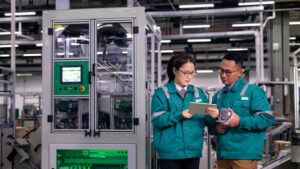
Schneider Electric, the global leader in energy technologies, today announced that its plant in Wuhan (China) has been recognized by the World Economic Forum (WEF) as a Global Lighthouse for Talent—one of only three sites worldwide to receive this designation.
The Global Lighthouse Network is a World Economic Forum initiative that recognizes advanced manufacturing sites and value chains that have achieved exceptional results in productivity, supply chain resilience, customer centricity, sustainability, and talent development. The initiative was co-founded with McKinsey & Company and is supported by an advisory board of industry leaders who collectively shape the future of global manufacturing.
A new award category—Talent Lighthouse—identifies manufacturing sites that achieve a transformational impact on the workforce through advanced solutions in work process and safety design, talent planning, engagement and onboarding, development, and workforce effectiveness.
The Wuhan plant became Schneider Electric’s ninth Lighthouse site globally and the first recognized for talent development, complementing the company’s eight other Lighthouse factories and distribution centers, including five Sustainability Lighthouses.
As Schneider Electric’s strategic supply chain hub in China and a model of digital manufacturing transformation, the Wuhan plant faced significant workforce challenges driven by rapid automation and a 239% expansion of its product portfolio. Initially, only 20% of employees had automation skills, onboarding new employees took 75 days, and technical staff turnover reached 48%.
Over the past five years, the plant increased its automation level by 55% and expanded its product portfolio by 239%, creating a critical shortage of qualified personnel. To address these challenges, Schneider Electric implemented a people-centered “workforce of the future” model that combines technology, partnerships, and continuous learning.
“The Fourth Industrial Revolution is as much about people as it is about technology,” said Mourad Tamoud, Chief Supply Chain Officer at Schneider Electric. “With our Wuhan plant, we have demonstrated that when AI and human potential work together, organizations can build resilient, agile, and future-ready teams—while ensuring that technology serves its ultimate purpose: delivering more value to customers.”
“Today, competitiveness is no longer determined solely by efficiency, but by the ability to sense, adapt, and respond quickly,” said Kiva Allgood, Managing Director at the World Economic Forum. “This year’s industrial transformation examples show how intelligently driven operations scale, placing resilience and sustainability at the heart of manufacturing companies’ activities.”
This achievement underscores Schneider Electric’s commitment to developing future-ready talent, building an agile organization, and fostering a culture that unlocks people’s potential and drives innovation.
Related resources:
About Schneider Electric
Schneider Electric is a global leader in energy technologies that delivers efficiency and sustainability through electrification, automation, and digitalization of industry, business, and homes. The company’s technologies enable buildings, data centers, factories, infrastructure, and power grids to operate as open, interconnected ecosystems, improving productivity, resilience, and environmental performance. Schneider Electric’s portfolio includes smart devices, software-oriented architectures, AI-based systems, digital services, and expert consulting. With 160,000 employees and 1 million partners in more than 100 countries, Schneider Electric consistently ranks among the world’s most sustainable companies.
Discover the latest energy technology insights on Schneider Electric Insights

Olevsk Bread Factory PJSC (Olevsk, Zhytomyr region) will hold its annual general meeting of shareholders on March 5, 2026, in a remote format, according to the company’s announcement in the SMIDA information disclosure system.
According to the announcement, the date for compiling the list of shareholders eligible to participate in the meeting has been set for March 2, 2026. Ballots for voting (on issues other than the election of bodies) must be submitted no later than 11:00 a.m. on February 23, 2026, and the depositary institution will continue to accept ballots until 6:00 p.m. on March 5.
The agenda includes, in particular, consideration of the supervisory board’s report for 2025, approval of the results of financial and economic activities for 2025, and distribution of profits (it is proposed to allocate 5% of net profit to reserve capital, with the remainder going toward development and strengthening of the material and technical base). Shareholders are also invited to decide on the extension of the lease agreement for one calendar year and the lease of premises, fixed assets, and transport of Olevsk-Khleb LLC (code 39508687).
Oleksky Bread Factory PJSC (EGRPOU code 00375964) was registered on December 25, 1996, and is located in Oleksky (13 Kooperativna Street). Its main activity is the production of bread and bakery products (KVED 10.71). . According to Opendatabot, the company’s revenue for 2024 amounted to UAH 1.667 million, net profit – UAH 156 thousand, asset value – UAH 4.864 million; director – Oleg Nechiporuk.

In 2025, Ukraine imported 93.2% more cabbage than a year earlier, amounting to 48.41 thousand tons, while procurement costs increased by 86.1% to $44.90 million, according to the State Customs Service.
The main suppliers of cabbage were North Macedonia (31.29%), Poland (24.05%), and the Netherlands (13.79%).

In 2025, Ukraine imported 123,600 tons of potatoes, which is 2.4 times more than in 2024; the cost of purchasing them increased 2.5 times to $66.29 million, according to the State Customs Service.
Poland (37.1%), Egypt (13.56%), and the Netherlands (11.58%) became the leaders in potato supplies to Ukraine.

As of 3:50 PM, border crossings between Ukraine and the Republic of Moldova were operating normally, according to the State Border Service of Ukraine’s Telegram channel.
Border crossing restrictions for trucks have also been lifted.

February looks like a month of “macro + flows,” where the direction will be determined not so much by individual crypto news as by a combination of factors: expectations regarding interest rates, risk appetite, ETF behavior, and derivatives volatility.
Fixygen offers several scenarios for how the situation could unfold.
Base scenario (most likely)
Sideways market with increased volatility: Bitcoin is trying to recover after January’s sell-off, but is facing selling pressure as it approaches strong levels (including around $90,000). In this scenario, the “swings” will continue until there is a clear signal regarding liquidity — either through macro data or a sustained reversal of ETF flows.
Positive scenario
The market will get a “window” for growth if two conditions are met simultaneously:
sustainable net inflows into Bitcoin ETFs return (this reduces dependence on derivative demand);
macro policy becomes less tight, real yields fall, the dollar weakens, and the risk premium declines.
Then crypto could quickly recover from its late January slump, and altcoins could temporarily revive following BTC.
Negative scenario
If outflows from ETFs continue and macro expectations remain hawkish, pressure may return: the January episode showed how quickly the market unpacks when volatility and liquidations increase. In this case, February will be marked by the defense of support levels and investors’ flight to cash/safe-haven assets.
Markers we recommend watching in February:
1) daily statistics on spot Bitcoin ETF flows (inflows/outflows);
2) the state of derivatives: open interest, funding rates, liquidation “flashes”;
3) the tone of the macro agenda and the reaction of yields/the dollar to key data for the month;
4) the stability of BTC after the sharp movements at the end of January (the market is testing whether “demand on dips” is ready to be systemic).
Source: https://www.fixygen.ua/news/20260131/prognozi-na-lyutiy-dlya-rinku-kriptovalyut-vid-fixygen.html



