

According to Fixygen, August was one of the best months for Bitcoin in recent years, but since the start of 2026, U.S. stocks have so far outperformed.
As of August 31, the S&P 500 had risen by approximately 13% year-to-date, while the Nasdaq was up 13.6%.
After falling from its record highs in 2025, Bitcoin remained about 11% below its year-to-date level even after the August rally, while gold was slightly in the black.
However, over the past six months, the situation has been the opposite: Bitcoin has already outperformed both the S&P 500 and gold.
This clearly illustrates the main drawback of simply comparing asset returns—the result depends drastically on the date chosen.
Bitcoin remains significantly more volatile: it can recover from a decline in just a few weeks—a recovery that would take the stock market a year—but it can just as quickly lose those gains.
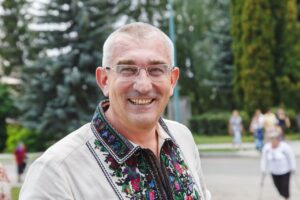
Ivan Tchaikovsky, a Member of the Ukrainian Parliament and founder of the company “Agroprodservice,” was named the winner of the “Agribusiness Leader of the Year” category as part of the 30th anniversary nationwide “Person of the Year 2025” program.
Chaikovsky was born on May 29, 1972, in the village of Nastasov in the Ternopil region. He began his entrepreneurial career after serving in the Armed Forces of Ukraine. In 1998, he became head of the “Kolos” owners’ association in Nastasov, and in 1999, he founded the leasing company “Agroprodservice,” which subsequently became one of the leading agricultural producers in western Ukraine.
The company is involved in crop production, livestock farming, agricultural processing, and energy projects. According to information provided by the organizers of the “Person of the Year” program, “Agroprodservice” currently processes more than 63% of its own crop production, ranks among Ukraine’s leading enterprises in dairy and swine farming, and is also developing projects in the clean energy sector.
Tourism has become a separate area of diversification. The company is developing “Agroland,” a family-oriented ethno-park that combines agritourism with the promotion of Ukrainian crafts, traditions, and the rural way of life.
In 2009, Tchaikovsky earned a master’s degree in economics and investment management from Ternopil National Economic University, now known as the Western Ukrainian National University. In 2015, he graduated from the Lviv Regional Institute of Public Administration of the National Academy of Public Administration under the President of Ukraine with a degree in “Public Administration.”
From 2002 to 2015, he was elected three times as a deputy to the Ternopil District Council. In 2018, he stepped down from the day-to-day management of “Agroprodservice” to focus on political and civic activities.
In 2019, Tchaikovsky was elected a People’s Deputy of Ukraine of the IX convocation as an independent candidate in electoral district No. 165 in the Ternopil region. He serves as secretary of the parliamentary Committee on Agrarian and Land Policy and is a member of the “For the Future” parliamentary group.
As part of his parliamentary work, Tchaikovsky participates in drafting legislation on agricultural and land policy, as well as in interparliamentary and European integration initiatives.
In addition to his business and political activities, he is involved in charitable projects. In 2012, Tchaikovsky founded the “Pokrova” Charitable Foundation, which implemented social, educational, cultural, sports, and environmental programs. After the outbreak of full-scale war, a significant portion of the foundation’s aid was redirected to support the Ukrainian military, particularly units of the 12th Special Forces Brigade “Azov” of the 1st Corps of the National Guard of Ukraine “Azov.”
Ivan Tchaikovsky has been awarded the “For Labor and Valor” Medal, the Order “For Merit” (3rd Class), and a number of professional and industry awards.
“Agroprodservice” was founded in 1999 in the Ternopil region. The company operates in the fields of crop production, livestock farming, seed production, and agricultural processing, and is developing energy and tourism sectors.
Open4Business is an information partner of the nationwide “Person of the Year 2025” program.
AGRIBUSINESS, agricultural sector, BUSINESS, Tchaikovsky, UKRAINE

The 2026 fire season in Europe has become one of the most difficult in terms of the geographical spread of fires and the scale of their consequences, with Ukraine ranking among the continent’s most affected countries, the Experts Club information and analytical center reports, citing data from the Global Wildfire Information System (GWIS), the European Forest Fire Information System (EFFIS) and other European bodies.
As of August 31, the area affected by fire in Ukraine was estimated by GWIS at 413.1 thousand hectares, or about 0.69% of the country’s territory. If the Russian Federation is not included in the direct comparison, as the system also takes into account the vast territories of Siberia and the Far East, Ukraine ranks first among the countries of geographical Europe in terms of the absolute area affected by fires.
It is followed by Spain — 242.1 thousand hectares, Italy — 118.3 thousand hectares, France — 105.1 thousand hectares, and Portugal — 60.5 thousand hectares.
In Ukraine, fire statistics have an additional specific feature due to the war. Satellite systems record the territory affected by fire but do not determine its cause. Therefore, alongside heat, drought, careless handling of fire and arson, shelling, explosions and fires along the front line may also play a significant role.
The greatest burden relative to the size of the territory is recorded in the Balkans. In Montenegro, about 1.7% of the country’s territory has been affected by fire, in Bosnia and Herzegovina — more than 1%, and in North Macedonia — about 0.75%. Altogether, Montenegro, Bosnia and Herzegovina, North Macedonia, Albania and Serbia have about 142 thousand hectares of burned areas.
A separate feature of the season has been a sharp increase in fire activity in countries where large fires are traditionally less common. In Belgium, the area affected by fires has already exceeded the average for 2012–2025 by more than ten times, in the Netherlands — by approximately three times, in Austria — by 2.5 times, and in France — by almost 2.5 times.
In the EU itself, by August 30, 636.1 thousand hectares of burned areas had been recorded within 1,861 major fires. This is 36% less than in the record year of 2025, but more than twice the long-term average for the same period.

On September 8, the 17th International Conference “Effective Management of Agribusiness Companies” (LFM) will be held. The event will be attended by CEOs of leading agribusiness companies, investors, government officials, experts, innovators, and business owners.
This was reported by Interfax-Ukraine, citing the press service of the organizers—the “Ukrainian Agribusiness Club” and the UCABevent agency.
This year’s conference offers a fresh perspective on agribusiness: how to restructure business models, maintain efficiency amid global changes, adapt to European integration, and prepare for a world where artificial intelligence and autonomous technologies are becoming part of everyday operations.
The organizers promise participants over 8 hours of management training and networking, a format designed for maximum interaction, practical insights, and discussions on key issues. Traditional panel discussions will give way to open dialogue, where participants can ask questions, defend their positions, and influence the direction of the conversation.
Conference Program
The conference will be opened by Taras Vysotsky, Minister of Economy, Environment, and Agriculture of Ukraine, and Mykola Mazany, CEO of CNH Industrial in Ukraine.
This year’s program consists of four thematic blocks, each of which explores a distinct aspect of agribusiness transformation:
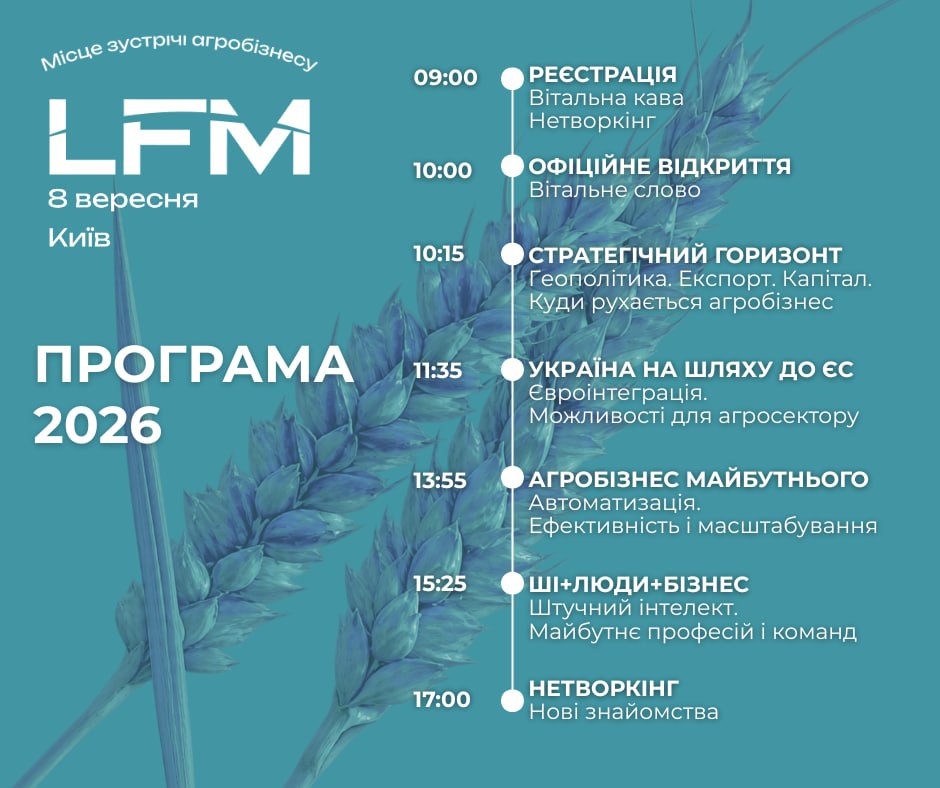
1. The Strategic Horizon of Ukrainian Agribusiness.
Traditional business models no longer guarantee results, and external factors—from logistical constraints and climate risks to shifts in global markets—are forcing companies to rethink their approaches to scaling and management. In this session, we will discuss where the tipping point lies and how businesses can remain resilient in this new reality.
Attendees can expect:
2. Win-win or shock therapy? How Ukraine’s membership will change the EU’s stability.
European integration is creating new rules, standards, and opportunities for the Ukrainian agribusiness sector. What impact will enlargement have on the European economy, and how can the agribusiness sector adapt to the requirements of the Green Deal without losing efficiency?
You’ll find answers to these questions during:
3. Dismantling the Architecture. Is the business community ready to trust processes that humans cannot fully understand?
Agribusiness is entering a period where automation, artificial intelligence, and autonomous technologies are transforming the very logic of production organization. This section focuses on figures, productivity, labor shortages, and the future of the autonomous enterprise:
4. The Last Recruiter. When Will AI Stop Playing the Role of an Assistant?
Artificial intelligence is already transforming not only individual processes but also the labor market itself. The final session of the conference will focus on the professions of the future, the transformation of education, and how businesses can prepare for this new reality.
This part of the conference will cover:
Terms of Participation and Registration
For security reasons, the exact venue will be communicated to registered participants.
Details and registration are available at the following link: https://cutt.ly/7yarHYei
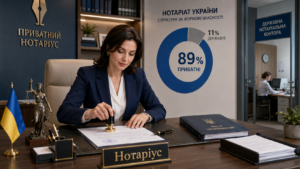
Ukraine continues to see a structural shift of notarial services toward the private sector: as of the end of August 2026, 5,484 out of 6,156 notaries included in the Unified Register of Notaries were working privately.
Thus, the share of private notaries reached about 89%, or almost nine out of ten professionals, according to an Experts Club analysis based on Opendatabot data.
There were 652 notaries working in state notary offices, accounting for about 10.6% of the total number, while another 20 professionals worked in state notarial archives.
Over the past year, the number of private notaries increased by 345 people. At the same time, the number of notaries in state institutions decreased by 34.
As a result, the entire net increase in the register was provided by the private sector. The total number of notaries increased by 311 people over the year, or by approximately 5%, to 6,156.
According to Experts Club, this dynamic indicates a further shift of the Ukrainian notarial services market toward the private model. The state segment is gradually shrinking both in absolute terms and as a share of the total number of professionals.
At the same time, the increase in the register does not mean a similar influx of new personnel. Of the total increase, only 40 notaries were new, while the majority were professionals who renewed their certificates. Another 104 notaries stopped working during the year.
A notable feature of the profession remains the significant predominance of women: they account for 82% of all notaries in Ukraine. Over the year, the number of women in the register increased by 250, while the number of men increased by 61.
Source: Opendatabot, data from the Unified Register of Notaries as of the end of August 2026.

Ukrainian President Volodymyr Zelenskyy has submitted two bills to the Verkhovna Rada for consideration aimed at tightening penalties for organizing fraudulent call centers and participating in their activities, as well as providing additional, substantial protection for people against illegal actions involving payment instruments and bank accounts.
“Penalties for fraudulent call centers must be clear and severe—not only for those who carry out the work at these call centers, but also for those who organize them, profit from them, and own them. The first bill provides for exactly that,” Zelenskyy emphasized, commenting on the bills on his Telegram channel.
According to the president, the bills also provide for the introduction of stricter liability for organizing fraudulent schemes involving banking instruments, in particular so-called “drops.”
“At the level of internal regulation of the banking system, there must be appropriate steps and changes to algorithms that will give banks more opportunities to protect the rights and legitimate interests of individuals and businesses and prevent the use of accounts for tax evasion or the laundering of funds from illegal activities. At the legislative level, we will create the necessary framework to counter the organizers of fraudulent schemes involving bank accounts and payment instruments,” Zelenskyy explained.
He added that this same bill aims to implement European Union legal standards in Ukraine, as provided for in agreements with partners.
BANK, BILL, call center, fraud, UKRAINE



