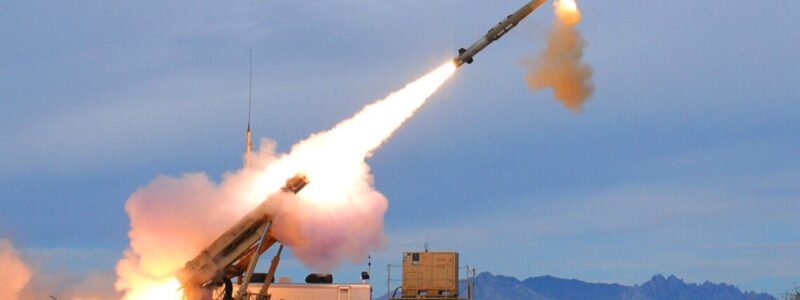
Stocks of Patriot interceptor missiles held by U.S. forces in Europe have plummeted following large-scale deliveries to Ukraine and particularly heavy ammunition consumption during the war with Iran, raising concerns about NATO’s ability to repel sustained ballistic missile attacks.
The Associated Press reported this on August 27, citing a U.S. military official in Europe and a NATO spokesperson, both of whom spoke on condition of anonymity.
According to the U.S. official, the most serious problem concerns the Patriot missiles specifically designed to intercept high-speed ballistic missiles.
He described inventory levels as “below critical” and stated that U.S. forces in Europe currently “definitely” do not have enough interceptors to repel a sustained series of ballistic missile strikes.
The official described the ability to defend against even a single ballistic strike or an errant Russian missile that has veered off course and is heading toward NATO territory as “very limited.”
A NATO spokesperson who spoke with the AP also confirmed the low level of Patriot stockpiles among U.S. and NATO forces in Europe.
However, both the Pentagon and NATO officially reject assessments of a critical shortage.
NATO’s senior military representative, U.S. Army Colonel Martin O’Donnell, told the AP that the claim that the number of Patriot missiles in Europe is “below critical levels” is not true. According to him, NATO has sufficient air defense capabilities both for its own protection and to continue assisting Ukraine.
Pentagon spokesperson Sean Parnell also dismissed reports of a shortage of U.S. ammunition as false and stated that the U.S. military has the necessary stockpiles to conduct operations.
Nevertheless, independent assessments show a significant reduction in U.S. reserves.
According to Mark Kansian, a senior advisor at the Center for Strategic and International Studies (CSIS), Ukraine has received more than 600 Patriot missiles from U.S. and allied stocks since the start of the full-scale war.
However, the main factor behind the sharp decline in reserves was the U.S. war with Iran.
According to CSIS estimates, approximately 65% of U.S. Patriot stockpiles—roughly 1,500 out of 2,330 interceptors—were expended during the campaign against Iran. By the end of July, CSIS analysts estimated that the remaining U.S. Patriot stockpiles stood at fewer than 1,000 missiles.
Ed Arnold, an expert at the British Royal United Services Institute, noted that deliveries to Ukraine had been planned in advance and were relatively manageable, whereas the need for massive deployment of interceptors in the Middle East arose much sooner than expected, exposing the limitations of the production chain.
The shortage is particularly acute for Europe, as there are currently few alternatives to the Patriot system for intercepting modern ballistic missiles.
France and Italy are developing a new version of the SAMP/T NG system, which is expected to have broader capabilities against ballistic targets; however, this new variant has not yet been tested in actual combat conditions. The current version of the SAMP/T has a shorter range than the Patriot.
A sharp increase in production capacity should partially resolve the problem.
In 2026, approximately 600–650 modern PAC-3 MSE missiles are expected to be produced, and the U.S. defense industry plans to increase production capacity to 2,000 interceptors per year by 2030. Lockheed Martin and the Pentagon have already signed agreements designed to significantly expand production.
Additional production capacity is being established directly in Europe.
In September 2026, the first European production center for Patriot missiles is scheduled to launch in Schrobenhausen, Germany. The facility is being established by COMLOG, a joint venture between MBDA Deutschland and the American company Raytheon.
The new facility will carry out final assembly and testing of PAC-2 GEM-T missiles. The first deliveries are expected in 2027. Among the countries that have already placed orders, AP lists Germany, the Netherlands, Romania, and Spain.
Raytheon received a separate $3.7 billion contract in April 2026 to produce GEM-T missiles for Ukraine. The company explicitly stated that the new plant in Germany is also expected to play a key role in replenishing Ukraine’s stockpile of interceptors.
For Ukraine, this situation means increased competition for the limited supply of missiles being produced. Kyiv needs the Patriot system primarily to intercept Russian ballistic missiles, which remain one of the most challenging targets for Ukraine’s air defense.
At the same time, U.S. manufacturers must replenish their own stockpiles, meet the needs of European NATO members, fulfill orders from Middle Eastern countries, and continue to support Ukraine.
CSIS warns that even with a significant ramp-up in production, it will take several years to fully replenish U.S. stockpiles. Until new production lines reach full capacity, the U.S. and its allies will have to prioritize the allocation of a limited number of interceptors among Europe, Ukraine, the Middle East, and the Indo-Pacific region.