
According to Experts Club, nearly half of Ukrainians—49.7%—had a positive view of Greece in August 2026, while only 3.9% of respondents expressed a negative view. At the same time, 44.2% of those surveyed held a neutral position. Compared to March, positive assessments have declined slightly, but the overall balance of attitudes remains distinctly positive, reports the Experts Club Information and Analytical Center.
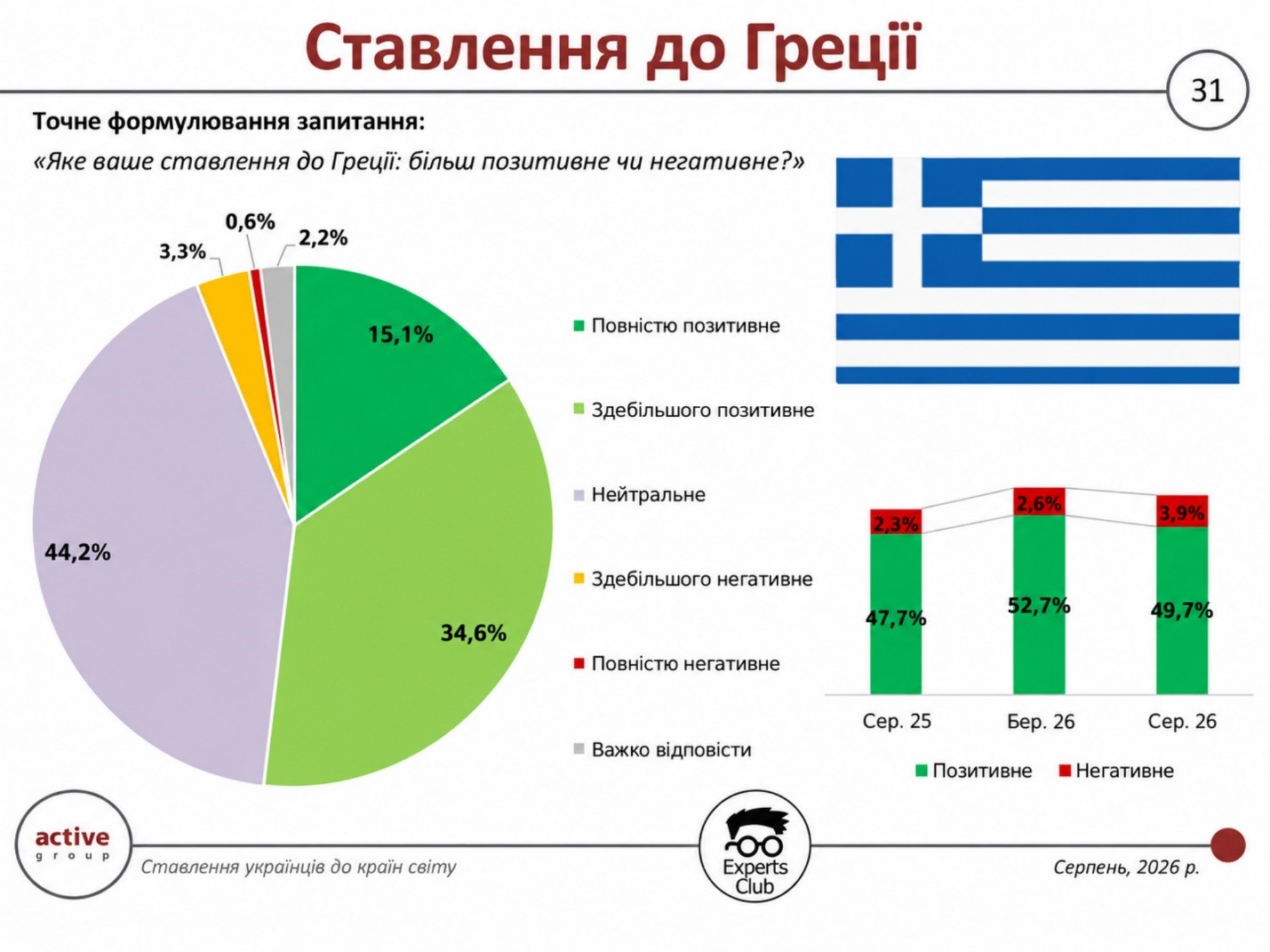
According to the results of the August survey, 15.1% of Ukrainians have a completely positive attitude toward Greece, and 34.6% have a mostly positive attitude. 44.2% of respondents have a neutral attitude. 3.3% view the country mostly negatively, 0.6% completely negatively, and another 2.2% were undecided.
The balance between positive and negative assessments stands at plus 45.8 percentage points. Thus, positive attitudes toward Greece outnumber negative ones by nearly 13 to 1; however, a large proportion of neutral responses remains a distinctive feature of public perception of the country.
In March 2026, 52.7% of respondents had a positive attitude toward Greece: 16.8% were completely positive and 35.9% were mostly positive. A neutral stance was held by 43.1% of those surveyed, while negative assessments accounted for about 2.6%.
Thus, over the course of five months, the share of positive assessments decreased by 3 percentage points—from 52.7% to 49.7%. Negative attitudes increased by approximately 1.3 percentage points—to 3.9%—while neutral attitudes rose by 1.1 percentage points. The balance between positive and negative attitudes, respectively, narrowed from approximately plus 50.1 to plus 45.8 percentage points.
Despite this trend, there has been no sharp shift in attitudes toward Greece. More than nine out of ten respondents view the country positively or neutrally, while the share of unequivocally negative responses remains negligible.
Oleksandr Pozniy, director of the research firm Active Group, commented on the results of the previous wave, drawing attention specifically to the significant proportion of neutral assessments regarding Greece.
“The results regarding Greece show that Ukrainians do not form strong opinions where interaction is less intense. In such cases, we see a combination of a moderately positive attitude with a large proportion of neutral responses. This means that the country’s image is still in the process of forming,” Pozniy noted.
The new wave of the survey generally confirms this pattern: the neutral group not only remains very large but has also increased slightly. At the same time, negative attitudes account for less than 4% of respondents, suggesting that Ukrainian society continues to hold a predominantly positive-neutral perception of Greece.
The survey was conducted in August 2026 using self-administered online questionnaires in the SunFlowerSociology panel among 800 Ukrainian citizens aged 18 and older. In the previous survey wave in March, 800 respondents were also surveyed; the sample was representative by age, gender, and region, with a maximum theoretical margin of error of ±3.5 percentage points for indicators at the 50% confidence level.
ACTIVE GROUP, EXPERTS CLUB, GREECE, international relations, PUBLIC OPINION, SOCIOLOGY, SOUTHERN EUROPE, UKRAINE
According to Experts Club, the United Kingdom continues to enjoy one of the highest levels of positive perception among Ukrainians: in August 2026, 72.6% of respondents viewed the country positively, while 7.1% viewed it negatively. Compared to March, the share of positive assessments has decreased slightly, but the overall attitude remains consistently favorable, reports the Experts Club Information and Analytical Center.
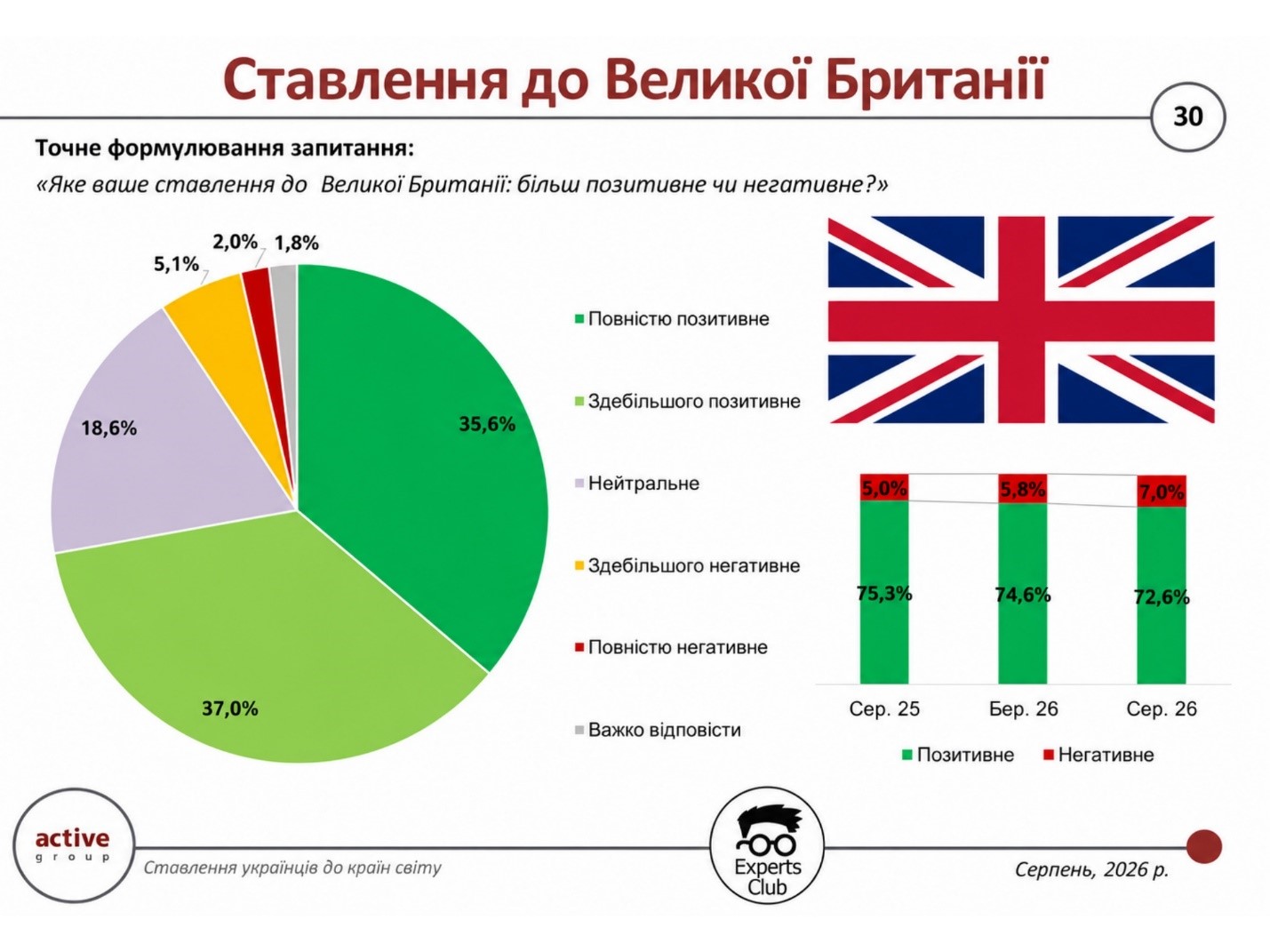
According to the results of the August survey, 35.6% of Ukrainians have a completely positive view of the United Kingdom, and 37% have a mostly positive view. 18.6% of respondents hold a neutral position. 5.1% view the country mostly negatively, 2% view it entirely negatively, and another 1.8% were undecided.
Based on the rounded figures in the table, the balance between positive and negative assessments stands at approximately plus 65.5 percentage points. Thus, positive attitudes outweigh negative ones by more than ten times, and the United Kingdom remains among the countries with the highest level of public favor among Ukrainians.
In March 2026, the overall share of positive assessments of the United Kingdom stood at 74.6%. At that time, 40.3% of respondents described their attitude as entirely positive, while another 34.3% described it as mostly positive. A neutral response was chosen by 18.2% of those surveyed, and negative assessments accounted for about 5.8%.
Thus, over the course of five months, the share of positive responses decreased by approximately 2 percentage points—from 74.6% to 72.6%—while negative responses increased by approximately 1.3 percentage points. The share of neutral responses remained virtually unchanged—18.2% in March versus 18.6% in August.
At the same time, a noticeable shift has occurred in the structure of the positive segment. The share of entirely positive assessments fell from 40.3% to 35.6%, while the share of mostly positive assessments rose from 34.3% to 37%. This suggests a certain softening in the intensity of positive attitudes rather than a fundamental change.
Oleksandr Pozniy, director of the research firm Active Group, had previously linked the high ratings for the United Kingdom to the nature of its relationship with Ukraine.
“Support from London during the war—both political and military—was highly valued by Ukrainian society. The United Kingdom is perceived as a reliable ally,” Pozniy noted.
At the same time, commenting on the trends in subsequent waves of the survey, he emphasized that the ratings for certain countries had deteriorated somewhat compared to the previous survey.
The current results confirm that a high level of positive attitude toward the United Kingdom remains, although it has weakened somewhat compared to March. At the same time, the country remains in the top group of nations in terms of the balance of positive and negative assessments by Ukrainians.
The survey was conducted in August 2026 using self-administered online questionnaires in the SunFlowerSociology panel among 800 Ukrainian citizens aged 18 and older. In the previous survey wave in March, 800 respondents were also surveyed; the sample was representative by age, gender, and region, with a maximum theoretical margin of error of ±3.5 percentage points for indicators at the 50% confidence level.
ACTIVE GROUP, EUROPE, EXPERTS CLUB, international relations, PUBLIC OPINION, SOCIOLOGY, UKRAINE, UNITED KINGDOM

In August 2026, Ukrainians’ attitudes toward Uzbekistan remain predominantly neutral: 55.6% of respondents hold this view. Taking these categories together, 25.7% of those surveyed view the country positively, while 14.5% view it negatively, according to the Experts Club Information and Analytical Center. In the summary report, the positive figure is listed as 25.6%, which is due to the rounding of the raw data.
6.5% of Ukrainians have a completely positive attitude toward Uzbekistan, while 19.2% have a mostly positive attitude. 55.6% of respondents chose a neutral response. 13.1% view the country mostly negatively, 1.4% completely negatively, and another 4.3% were undecided.
When the categories are combined, the balance between positive and negative attitudes is +11.2 percentage points. Positive assessments thus outnumber negative ones by approximately 1.8 times. At the same time, more than half of those surveyed do not express a strong positive or negative stance toward the country.
In the overall regional picture, Uzbekistan has a less pronounced positive image than Georgia and Azerbaijan. In August, positive assessments stood at 57.3% for Georgia and 48.7% for Azerbaijan, while a high proportion of neutral responses remains the key feature of perceptions toward Uzbekistan.
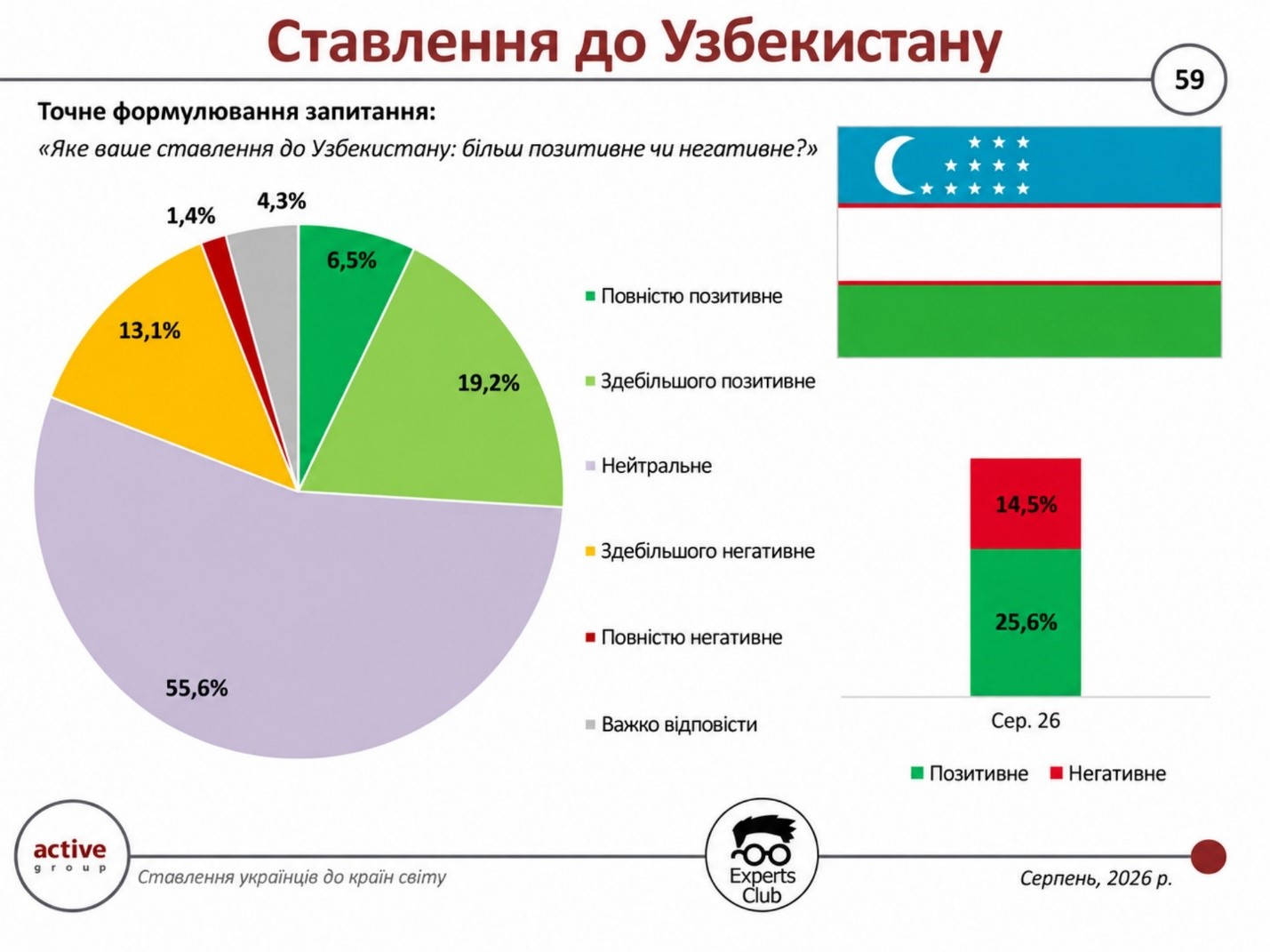
At the same time, compared to the April 2025 survey, attitudes have become more defined. At that time, 63.4% of Ukrainians held a neutral stance toward Uzbekistan, 21.7% had a positive view, 9.3% had a negative view, and 5.6% were undecided. Thus, the positive segment grew by approximately 4 percentage points, the negative segment by 5.2 percentage points, and the share of neutral responses decreased by 7.8 percentage points.
Maksym Urakin, founder of the Experts Club Information and Analytical Center and a candidate of economic sciences, believes that a key factor in how Uzbekistan is perceived remains Ukrainians’ lack of awareness about the country’s current role in Central Asia.
“For a significant portion of Ukrainian society, Uzbekistan remains a rather distant country. People are exposed to far less information about its economy, business, politics, or humanitarian ties than they are about EU countries, the Caucasus, or Ukraine’s immediate neighbors. That is precisely why the neutral group still accounts for more than half of the respondents,” Urakin noted.
At the same time, he said, the decline in the share of neutral responses—from 63.4% in April 2025 to 55.6% in August 2026—is a more significant signal than the individual increase in positive or negative assessments.
“We are seeing the gradual formation of a more defined image of Uzbekistan. Some respondents are shifting from a neutral stance to a specific assessment of the country. At the same time, positive attitudes still significantly outweigh negative ones. This means that there is a sufficiently favorable foundation for the development of economic, educational, cultural, and humanitarian ties, but the image of Uzbekistan in Ukraine still requires a greater informational presence,” Urakin added.
The current results partially confirm this assessment: the neutral group remains the largest, but it has shrunk significantly compared to 2025. The simultaneous increase in both positive and negative responses indicates, above all, the gradual formation of a more defined attitude toward Uzbekistan.
The survey was conducted in August 2026 using an online self-administered questionnaire via the SunFlowerSociology panel among 800 Ukrainian citizens aged 18 and older. The sample is representative by age, gender, and region; the maximum theoretical margin of error for indicators at the 50% confidence level is ±3.5 percentage points.
ACTIVE GROUP, Central Asia, EXPERTS CLUB, international relations, PUBLIC OPINION, SOCIOLOGY, UKRAINE, URAKIN, UZBEKISTAN
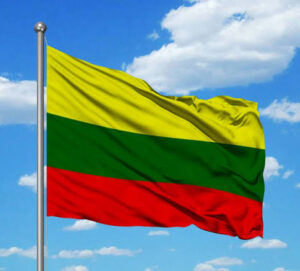
According to Experts Club, Lithuania continues to enjoy one of the highest levels of positive perception among Ukrainians: in August 2026, 69.9% of respondents viewed the country positively, while only 3.9% viewed it negatively. At the same time, compared to the previous wave of the survey, the share of positive assessments has decreased, while the share of neutral assessments has increased, reports the Experts Club Information and Analytical Center.
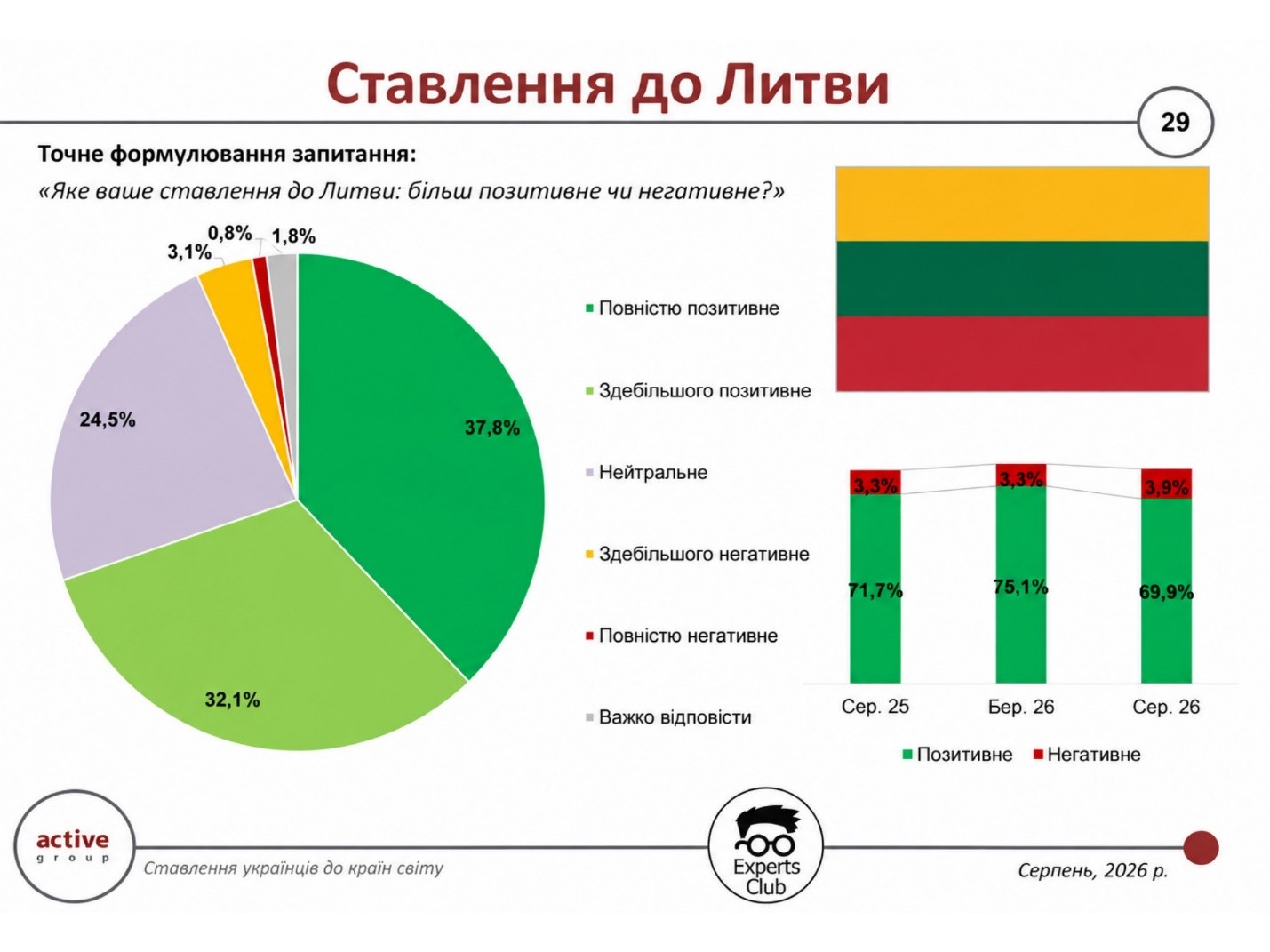
According to the results of the August survey, 37.8% of Ukrainians view Lithuania entirely positively, and 32.1% view it mostly positively. A neutral stance is held by 24.5% of respondents. 3.1% view the country mostly negatively, 0.8% view it entirely negatively, and another 1.8% were undecided.
Based on the rounded figures in the table, the balance between positive and negative assessments is approximately plus 66 percentage points. This means that positive assessments of Lithuania outnumber negative ones by nearly 18 times. The country remains among those with the most favorable public perception among Ukrainians.
Compared to March 2026, the positive attitude has weakened somewhat. At that time, 44.1% of respondents rated Lithuania entirely positively, and another 31% rated it mostly positively, meaning the combined positive rating stood at 75.1%. Twenty-one percent of respondents had a neutral attitude toward the country, while about 3.3% had a negative one.
Thus, over the course of five months, the share of positive assessments decreased by 5.2 percentage points—from 75.1% to 69.9%. The share of neutral responses increased by 3.5 percentage points—from 21% to 24.5%—while the negative segment grew by only about 0.6 percentage points. Consequently, the decline in the positive rating was primarily due to some respondents shifting to a neutral position, rather than a sharp rise in negative attitudes.
The change in the intensity of positive assessments is also significant. The share of respondents with a completely positive attitude fell from 44.1% in March to 37.8% in August, while the share of mostly positive responses actually rose slightly—from 31% to 32.1%. This indicates a certain softening of assessments while maintaining an overall favorable image of Lithuania.
Oleksandr Pozniy, director of the research company Active Group, previously linked the high ratings of European countries to how Ukrainians perceive their support.
“This study confirms the general trend in public sentiment in Ukraine, which has intensified since the start of the full-scale war. Ukrainians clearly associate the support received primarily from European Union countries and the United Kingdom with a positive attitude toward them,” Pozniy noted.
At the same time, commenting on the structure of the responses in the survey, he emphasized: “For Ukrainians, the world is not ‘black and white,’ and the large proportion of neutral assessments regarding a number of countries indicates caution and a desire for balanced judgment rather than indifference.”
The latest round of the survey shows that, in the case of Lithuania, this trend is reflected in an increase in the neutral segment, while negative assessments remain at a very low level. Despite a decline compared to March, approximately seven out of ten Ukrainians continue to view the country positively.
The survey was conducted in August 2026 using self-administered online questionnaires in the SunFlowerSociology panel among 800 Ukrainian citizens aged 18 and older. The previous survey in March also included 800 respondents; the sample was representative by age, gender, and region, and the maximum theoretical margin of error for indicators at the 50% confidence level was ±3.5 percentage points.
ACTIVE GROUP, EUROPEAN UNION, EXPERTS CLUB, international relations, LITHUANIA, PUBLIC OPINION, SOCIOLOGY, THE BALTIC STATES, UKRAINE
According to Experts Club, France continues to enjoy one of the highest levels of positive perception among Ukrainians: in August 2026, 72.8% of respondents viewed the country positively, while only 3.7% viewed it negatively. Compared to March, the share of positive assessments has decreased slightly, but at the same time, the share of negative responses has also decreased, reports the Experts Club Information and Analytical Center.
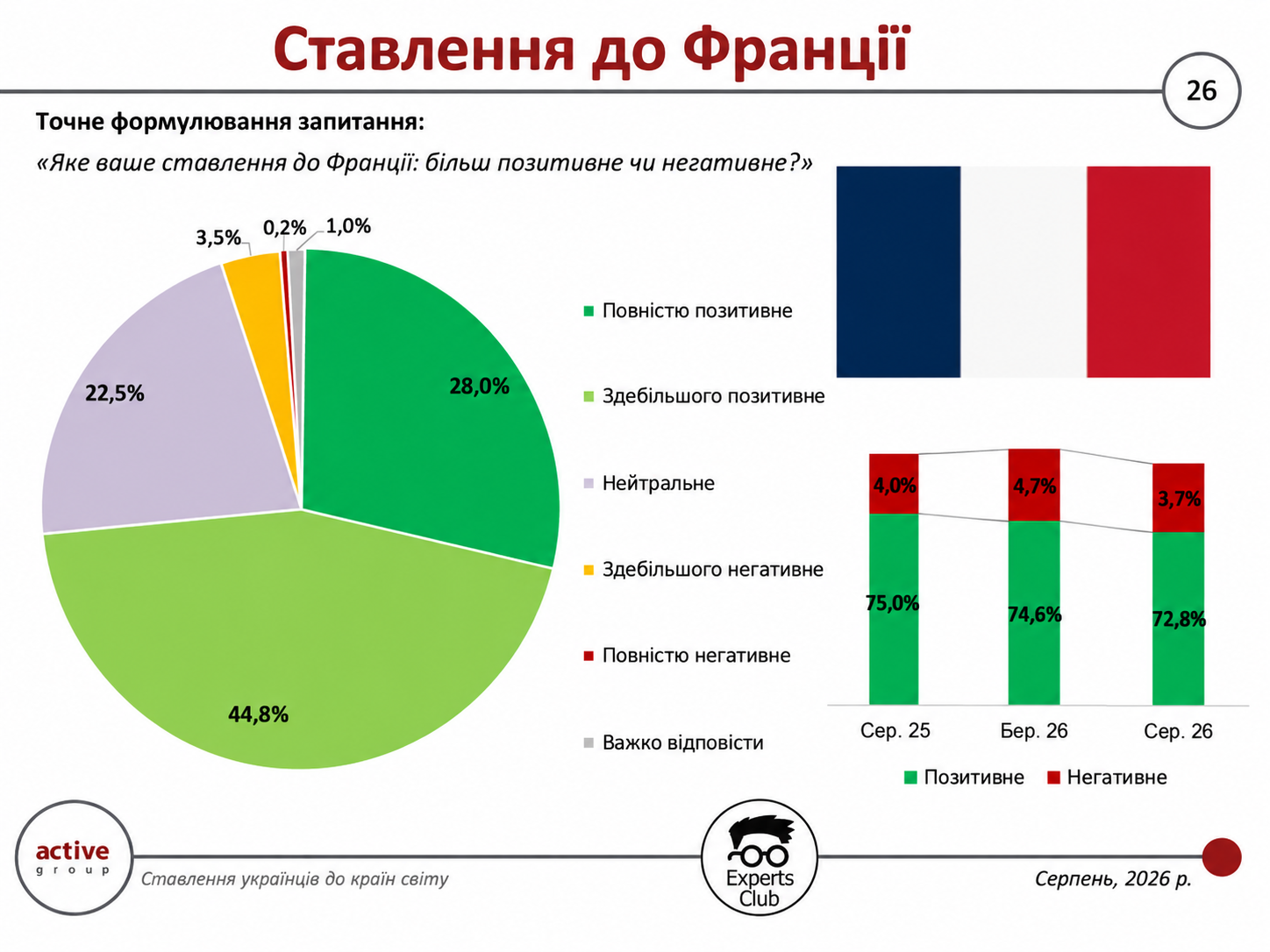
According to the results of the August survey, 28% of Ukrainians view France entirely positively, and 44.8% view it mostly positively. 22.5% of respondents hold a neutral position. 3.5% view the country mostly negatively, only 0.2% view it entirely negatively, and another 1% were undecided.
The balance of positive and negative assessments stands at plus 69.1 percentage points. Thus, positive attitudes toward France outnumber negative ones by nearly 20 to 1. Based on this balance, the country remains among the leaders in the overall ranking of Ukraine’s trading partners.
Compared to the previous survey wave, the changes are relatively minor. In March 2026, 30.3% of respondents had a completely positive attitude toward France, and 44.3% had a mostly positive attitude—meaning the overall positive rating stood at 74.6%. At that time, 20.3% held a neutral position, while 4.7% of respondents expressed a negative attitude.
Thus, over the course of five months, the share of positive assessments decreased by 1.8 percentage points—from 74.6% to 72.8%—but the share of negative assessments also fell—from 4.7% to 3.7%. At the same time, the share of neutral responses increased by 2.2 percentage points—to 22.5%. The balance between positive and negative attitudes changed only slightly—from plus 69.9 to plus 69.1 percentage points.
The internal structure of positive responses is also revealing. The share of those who view France entirely positively decreased from 30.3% to 28%, while the share of mostly positive responses remained virtually unchanged—44.3% in March and 44.8% in August. This indicates that a stable, positive core of public opinion regarding France remains intact.
Oleksandr Pozniy, director of the research firm Active Group, previously attributed France’s high ratings to its established image among the Ukrainian public.
“For many Ukrainians, France is a symbol of support in difficult times, as well as a cultural and political reference point in Europe. These figures demonstrate a high level of trust and respect, which is largely explained by Paris’s active role in European policy toward Ukraine,” Pozniy noted.
According to him, when analyzing these results, it is important to consider more than just current emotional assessments: attitudes toward other countries are shaped by experiences of interaction, the informational context, and Ukrainians’ expectations regarding the future role of a partner country.
The latest wave of the survey shows that attitudes toward France remain consistently positive: a slight decrease in the overall share of favorable assessments is accompanied by a reduction in the negative segment and an increase in the share of neutral responses. In other words, there has been no noticeable shift from a positive to a negative perception.
The survey was conducted in August 2026 using self-administered online questionnaires in the SunFlowerSociology panel among 800 Ukrainian citizens aged 18 and older. In the previous survey wave in March, 800 respondents were also surveyed; the sample was representative by age, gender, and region, with a maximum theoretical margin of error of ±3.5 percentage points for indicators at the 50% confidence level.
ACTIVE GROUP, EUROPEAN UNION, EXPERTS CLUB, FRANCE, international relations, PUBLIC OPINION, SOCIOLOGY, UKRAINE
According to Experts Club, Ukrainians’ attitudes toward Romania remain predominantly positive or neutral; however, in August 2026, the share of positive assessments declined slightly compared to the previous survey wave. 45.2% of respondents view the country positively, 9.8% negatively, while 42.3% hold a neutral stance, reports the Experts Club Information and Analytical Center.
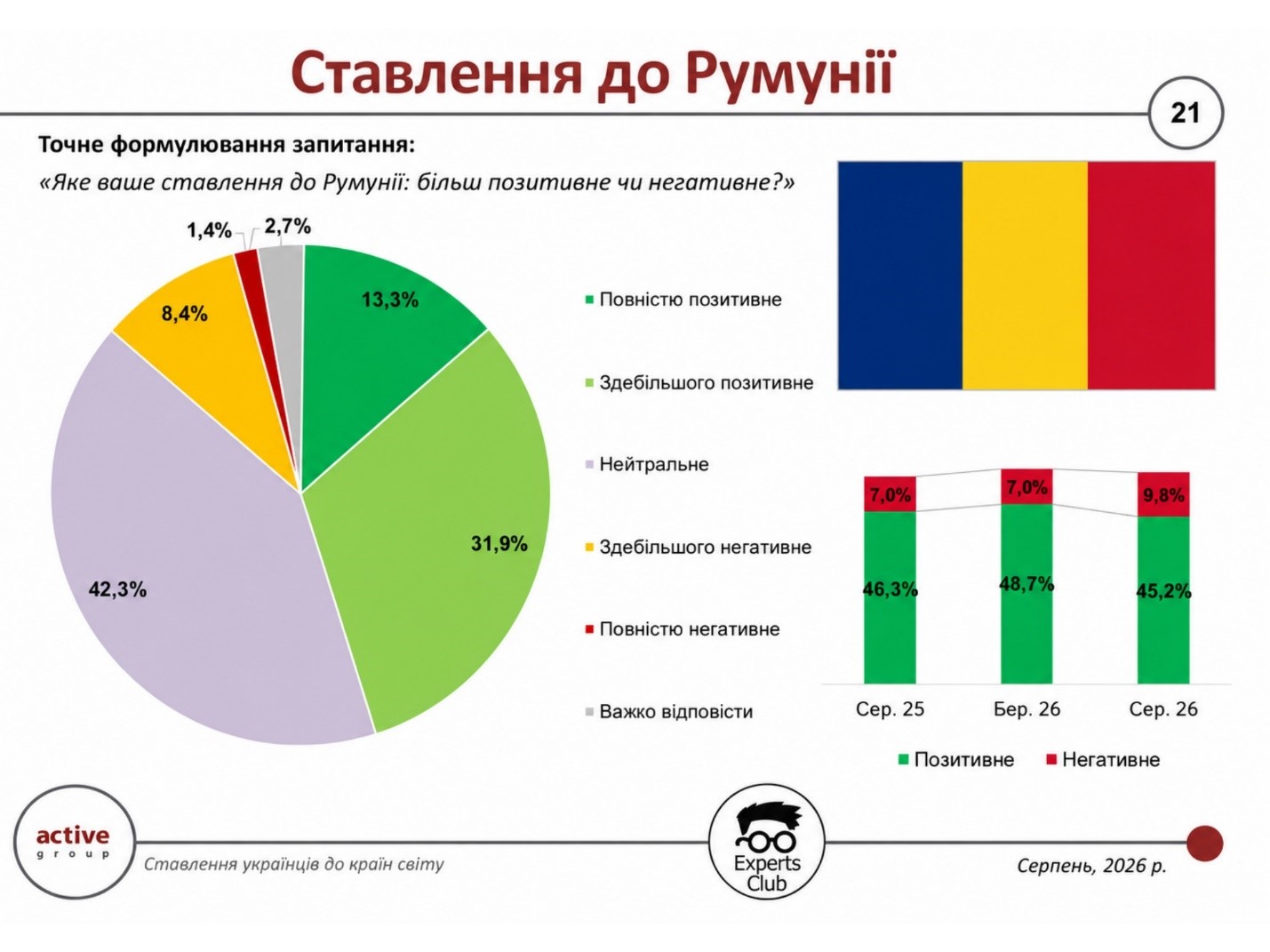
According to the results of the August survey, 13.3% of Ukrainians view Romania entirely positively, and 31.9% view it mostly positively. A neutral attitude was expressed by 42.3% of respondents. 8.4% view the country mostly negatively, 1.4% view it entirely negatively, and another 2.7% were undecided.
The balance of positive and negative assessments stands at plus 35.4 percentage points. Thus, positive responses outnumber negative ones by more than four to one, although respondents with a neutral attitude remain the largest single group.
Compared to March 2026, public perception of Romania has deteriorated slightly. In the previous survey wave, 14.9% of respondents rated the country entirely positively, and 33.8% rated it mostly positively—meaning the total share of positive responses was 48.7%. Seven percent of respondents had a negative view of Romania, and 42.2% were neutral.
Thus, over the course of five months, the positive attitude decreased by 3.5 percentage points—from 48.7% to 45.2%—while the negative attitude increased by 2.8 percentage points—to 9.8%. The share of neutral responses remained virtually unchanged: 42.2% in March and 42.3% in August. The balance between positive and negative assessments decreased from +41.7 to +35.4 percentage points, or by 6.3 percentage points.
These results indicate a moderate weakening of positive perceptions rather than a fundamental shift in attitude. The neutral group remains stable, and negative assessments, despite their increase, still lag significantly behind the positive ones.
Maksym Urakin, founder of the Experts Club information and analytical center and a candidate of economic sciences, commenting on the need to compare public assessments with the actual economic role of international partners, emphasized the deterioration of Ukraine’s overall foreign trade balance.
“For Ukraine, Romania is not an abstract foreign policy partner, but a neighboring country with which logistics, trade, the movement of people, the transit of Ukrainian goods, and humanitarian contacts are intertwined on a daily basis. Therefore, public perception here is shaped not only by political statements but also by concrete experiences of interaction. I would not yet interpret the current decline in positive assessments as a fundamental shift in attitude—the positive balance remains very significant,” Urakin noted.
In the case of Romania, the new wave of the survey shows that the country maintains a positive balance in public opinion, but this margin has narrowed compared to March. At the same time, the virtually unchanged proportion of neutral responses indicates that the main changes occurred specifically between the positive and negative segments.
The survey was conducted in August 2026 using an online self-administered questionnaire via the SunFlowerSociology panel among 800 Ukrainian citizens aged 18 and older. The previous wave also included 800 respondents, and the sample was representative by age, gender, and region.
ACTIVE GROUP, CENTRAL AND EASTERN EUROPE, EXPERTS CLUB, international relations, PUBLIC OPINION, ROMANIA, SOCIOLOGY, UKRAINE



