
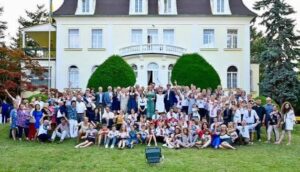
More than 400 Ukrainian children, mostly from Ukraine’s frontline regions, had the opportunity to participate in a health and summer vacation program in Austria with the support of the Embassy of Ukraine and Austrian partners.
This was reported by the Embassy of Ukraine in the Republic of Austria.
The programs for children were organized in cooperation with the federal states of Austria and with the direct participation of Austrian civil society organizations.
“One of the Embassy’s key priorities is to create opportunities for Ukrainian children to receive health treatment and enjoy a vacation,” the diplomatic mission noted.
In total, more than 400 Ukrainian children took advantage of the opportunity to vacation in Austria during the summer. The organizers focused primarily on children from regions located near the front lines that are regularly subjected to Russian shelling.
The embassy expressed gratitude to the federal states, civil society organizations, and other Austrian partners who contributed to the implementation of the programs.
“We thank everyone who participated and gave our children the opportunity to experience the joy of childhood. We hope for continued support in the future,” the statement reads.
Organizing recreational and health programs for Ukrainian children abroad has become one of the areas of Ukraine’s humanitarian cooperation with European countries since the start of the full-scale war. Such programs are primarily aimed at children from frontline regions and areas affected by hostilities.
Original source: Embassy of Ukraine in the Republic of Austria.
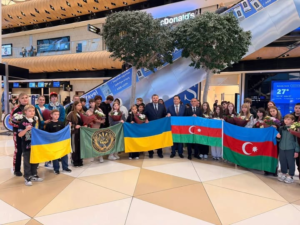
A group of 30 Ukrainian children from the Kharkiv and Kherson regions has arrived in Azerbaijan for psychological and health rehabilitation and recreation, the Embassy of Ukraine in the Republic of Azerbaijan reported.
The group includes children living under constant Russian shelling, as well as children of active Ukrainian servicemen, prisoners of war, and wounded defenders of Ukraine.
The rehabilitation and recreation program has been organized in the city of Gabala, one of Azerbaijan’s main mountain resort centers.
At Heydar Aliyev International Airport, the children were welcomed by Ukraine’s Ambassador to Azerbaijan Yurii Husiev, head of the Azerbaijan-Ukraine Interparliamentary Relations Working Group and member of the Milli Majlis Alibala Maharramzade, and Deputy Chairman of the Board of the Social Services Agency under Azerbaijan’s Ministry of Labour and Social Protection of the Population Vugar Mammadov.
Since the beginning of the full-scale war, 692 Ukrainian children have already undergone recreation, health improvement and rehabilitation in Azerbaijan, the embassy reported.
Thus, taking into account the current group, Azerbaijan continues to implement humanitarian programs aimed at supporting Ukrainian children affected by the war.
“We highly appreciate this assistance, the strong strategic partnership and friendship that unite the Ukrainian and Azerbaijani peoples,” Husiev said.
The ambassador also thanked Azerbaijan for its support for Ukraine and assistance to children who, because of the war, are forced to live under conditions of constant danger and shelling.
The European Union did not support Ukraine’s request for early disbursement of additional funding in 2026 and emphasized that the allocation of funds will depend directly on Kyiv’s implementation of agreed-upon reforms, according to the Financial Times, citing a letter from European Commissioners Valdis Dombrovskis and Marta Kos to Verkhovna Rada Chairman Ruslan Stefanchuk.
This summer, Ukraine estimated its additional defense needs at approximately $27 billion and approached the European Commission with a proposal to advance a portion of the funds from the two-year €90 billion Ukraine Support Loan program (€60 billion earmarked for defense, €30 billion for direct budget support). According to the program’s terms, up to €45 billion is to be made available to Ukraine in 2026, with the remaining €45 billion to follow in 2027.
According to the FT, European Commissioners have made it clear that access to funding is contingent upon fulfilling an agreed-upon list of commitments. Specifically, this involves the elimination of VAT exemptions for small international parcels, the introduction of taxation rules for digital platforms, and proper financial monitoring of politically exposed persons (PEPs)—changes to which have raised concerns in Brussels as a deviation from the anti-corruption agenda. According to the publication’s assessment, meeting these requirements will pave the way for Kyiv to receive approximately 34 billion euros in support as early as 2026.
At the same time, the European Commission emphasized that the rejection of the request for an early advance payment does not mean a curtailment of financial assistance. On October 1, the parties announced that they had agreed on sources of funding for budgetary and defense needs through the end of 2026, noting that there is no unfunded financial gap for the current year.
In addition, on October 2, the European Commission transferred another tranche of 2.9 billion euros to Ukraine as part of the Ukraine Facility program. The total amount of aid to Kyiv from the EU and its member states since the start of Russia’s full-scale invasion has reached 227.4 billion euros.

Germany has provided 5 pickup trucks and 5 cargo vans for track workers, communications specialists, and power engineers to help restore damaged infrastructure and resume train service as quickly as possible following Russian attacks on the railway, according to a statement by Ukraine’s Ministry of Recovery, Infrastructure, and Transport on its Telegram channel.
“After every strike, repair crews must be dispatched to the site as quickly as possible to restore infrastructure and train service. This requires people, equipment, and, of course, transportation.
We thank the railroad workers for their 24/7 efforts. And we thank Germany for its consistent support and practical assistance. It is important to us that this support continues and intensifies,” said Deputy Minister Volodymyr Shemaev.
The equipment was handed over by Boris Ruge, Ambassador Extraordinary and Plenipotentiary of the Federal Republic of Germany to Ukraine.
Italian Foreign Minister Antonio Tajani confirmed that a new aid package for Ukraine is being prepared, as well as the continuation of the Italian government’s commitments regarding Ukraine’s security, recovery, and defense.
According to the website of the Italian Ministry of Foreign Affairs and International Cooperation, Tajani made these remarks during a phone call with Ukrainian Foreign Minister Andriy Sybiga on the occasion of the 35th anniversary of Ukraine’s restoration of independence.
During the conversation, Tajani condemned the ongoing Russian attacks on Ukrainian territory and reaffirmed the Italian government’s full support for the Ukrainian people.
“The minister reaffirmed the government’s commitment to maintaining maximum pressure on Moscow, as demonstrated by Prime Minister Giorgia Meloni’s participation today in the Coalition of the Willing. Tajani confirmed that the government’s commitment to Ukraine’s security, reconstruction, and defense remains firm, in particular thanks to a new Italian aid package currently being prepared, as well as support through EU sanctions,” the statement reads.
Separately, the parties discussed food security and maritime safety. Tajani emphasized the importance of the Black Sea and the entire Mediterranean for global food security and ensuring the continuity of Ukrainian grain exports.
He reaffirmed Italy’s readiness to cooperate with Kyiv, in particular by exploring avenues for collaboration with MED9+ initiatives regarding the Strait of Hormuz, underscoring the interconnection between maritime security, economic stability, energy flows, and food security.
The conversation also touched on Ukraine’s recovery. According to the Italian Ministry of Foreign Affairs, Italy has already allocated approximately 3.2 billion euros to support Ukraine’s recovery and reconstruction, in part through contributions from Italian companies.
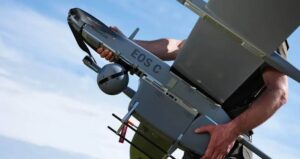
Estonian Defense Minister Hanno Pevkur stated that the republic provided Ukraine with military aid totaling over EUR50 million in 2026, of which over EUR40 million consisted of products from the Estonian defense industry.
“This year’s contribution of at least 0.28% of GDP and the growing share of Estonian defense products in our aid to Ukraine demonstrate the consistency of our support. Ukraine can count on both us and its other allies,” said Pevkur, as quoted by the ministry’s press service.
He noted that in 2023, the Estonian government set a goal of providing support to Ukraine at a level of at least 0.25% of GDP per year. In 2025, this aid reached 0.35% of GDP.
The bulk of Estonia’s military aid is provided in the form of products from Estonian companies. Part of the aid package for 2026 has already been delivered: Estonia has purchased drones and related equipment for Ukraine. Aid measures for 2027 will be announced shortly.
As part of the NATO PURL (Prioritized Ukraine Requirement List) initiative, products from the U.S. defense industry are also being procured for Ukraine. Estonia has contributed EUR 21 million to the initiative.
In total, since the start of the war in Ukraine in 2022, Estonia has provided over EUR 850 million in support to the country through various military aid initiatives, according to the Ministry of Defense.



