
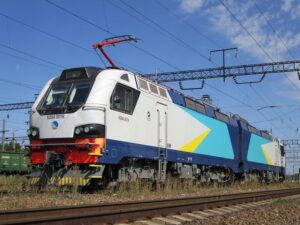
Ukrzaliznytsia plans to receive its first Alstom UA8AC electric locomotive in the first quarter of 2027, and by the end of 2029, the company expects to receive a total of 55 such locomotives, said Volodymyr Shemaiev, director of the international projects office at Ukrzaliznytsia.
“This will be a modest overhaul of the freight electric locomotive fleet, which will serve as a foundation for the fleet in the coming years,” Shemaev noted during the 8th International Conference “Railways of Ukraine: Development and Investment” in Kyiv.
Oleksiy Balesta, Deputy Minister of Community and Territorial Development, reported at the conference that since the start of Russia’s full-scale invasion, more than 300 locomotives have been damaged, with about 50 destroyed beyond repair.
According to Ukrzaliznytsia, 9 diesel locomotives were damaged in the first half of 2025, 119 in the second half, and 81 in the first quarter of 2026.
As previously reported, Ukrzaliznytsia signed a EUR473 million contract with Alstom Transport following an international tender organized by the World Bank. The European Bank for Reconstruction and Development subsequently joined the project.
Among other international projects that Ukrzaliznytsia plans to implement, he mentioned the cooperation agreement signed between the governments of Ukraine and Spain regarding the creation of a gauge-changing bogie capable of changing track gauge without stopping. According to him, the first stage involves developing design documentation for such a bogie.
“In about two years, such a bogie will be manufactured in Ukraine, after which testing will begin. If the results of these tests are positive, we can then discuss the commercial production of such bogies and, accordingly, railcars, both for the Ukrainian market and for European markets,” noted the director of Ukrzaliznytsia’s International Projects Office.
Shemaev also reported that a meeting was recently held with Korean partners, with whom Ukrzaliznytsia plans to prepare a feasibility study over the next three years for a high-speed railway from Kyiv to Lviv and onward to the Polish border.
Separately, the director of Ukrzaliznytsia’s International Projects Office told Interfax-Ukraine that Ukrzaliznytsia has joined a project to build decentralized gas-fired power generation facilities at the government’s request. Specifically, 40 MW of equipment has already been delivered, and preparatory work for its installation is currently underway.
In addition, a tender under the rules of the European Bank for Reconstruction and Development (EBRD) for an additional 160 MW has been completed; its results are in the process of being signed, and equipment delivery is expected within 8 months.
Shemaev noted that Ukrzaliznytsia is implementing this project in partnership with the EBRD and the European Commission; it is supported by a EUR41 million grant, with an additional 20 million pounds worth of equipment provided by the United Kingdom.
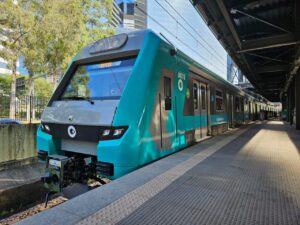
According to Serbian Economist, the French company Alstom has been awarded a €915 million contract to supply a comprehensive turnkey solution for Belgrade’s first metro line—Serbia’s first fully automated metro system. The company announced this on March 27, and the news portal Parametar (https://www.parametar.rs/) described the deal as one of the largest infrastructure projects in the region in recent years.
The first phase of Line 1 will connect Makishko Pole and Karaburma. The 15-kilometer section will include 15 stations, with approximately 11 kilometers running through tunnels in the city center.
The contract calls for the delivery of 32 driverless three-car Metropolis trains, as well as signaling and telecommunications systems, power supply, track infrastructure, platform doors, depot equipment, a centralized control center, and cybersecurity systems. The trains will operate using Urbalis CBTC technology, which will enable fully automated service with intervals of up to 90 seconds.
Alstom has already entered the design phase for Line 1. The company emphasizes that the project is being implemented with the support of French government funding, and the agreement itself will be reflected in the financial statements after the finalization of the financial agreement.
The Belgrade metro project is estimated at €4–7 billion in total, and the financing needs for the first line alone could reach €2.5 billion. Construction work on the project is being carried out separately, notably with the participation of Chinese contractors, making the construction model Franco-Chinese in terms of supply and execution.
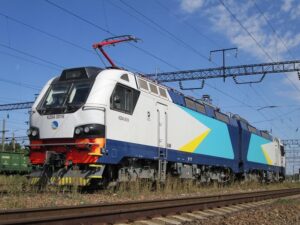
The fleet of electric locomotives of JSC Ukrzaliznytsia is five times larger than the fleet of diesel locomotives, which makes them critically important and necessitates the purchase of electric locomotives, said the company’s CEO Oleksandr Pertsovskyi in a comment to journalists in connection with the purchase of 55 electric locomotives from French manufacturer Alstom.
“The basis of Ukrainian logistics, Ukrainian railways, as well as European railways, is electric traction. It is more efficient, it accounts for 80% of our volume, it is five times more than their fleet, and there is a critical need in this segment,” Pertsovsky emphasized, according to an Interfax-Ukraine correspondent.
According to him, the ratio of electrified and non-electrified networks of Ukrainian Railways is “about 50-50,” but 80% of cargo and passenger traffic passes through electrified sections.
Pertsovsky clarified that the cost of electric traction transportation is 4-5 times lower.
“It is absolutely critical for us to have a reliable fleet of electric locomotives in order to transport our cargo economically,” the head of the UZ board concluded.
It is noted that at the beginning of the project, the possibility of purchasing diesel locomotives was considered, but the international community and Ukraine, as part of it, decided to adhere to the principles of the Paris Declaration, avoiding new capital investments with a high environmental impact.
The chairman of the board acknowledged that in the current conditions, when there are risks of power outages, diesel locomotives are relevant, but for this purpose, the company is urgently restoring the diesel locomotives that it inherited in large numbers.
Separately, Pertsovsky reported that a group of engineers and machinists visited Azerbaijan, where similar locomotives from the French concern Alstom are in operation, to familiarize themselves with their operation and technical features.
As reported, the French company Alstom and Ukraine’s Ukrzaliznytsia signed a contract to supply 55 electric locomotives to Ukraine worth EUR473 million in 2027-2029. The first electric locomotive will arrive in Ukraine in the first quarter of 2027. This will be followed by certification and the necessary tests.
Ukrzaliznytsia emphasized that 37% of the project’s funding is non-repayable grant aid of approximately EUR 173 million from the URTF fund managed by the World Bank, while the rest is a preferential long-term loan from the EBRD for EUR 300 million.
CEO of Ukrzaliznytsia JSC Oleksandr Kamyshin and CEO of Alstom Henri Poupart-Lafarge have signed a memorandum of understanding.
The signing took place at a press conference of Presidents of Ukraine and France Volodymyr Zelensky and Emmanuel Macron in Kyiv on Tuesday.
Earlier, at this press conference, Zelensky said that on February 8, Ukraine and France finalized the agreements and switched to the practical stage the implementation of the project on the supply of 130 ALSTOM locomotives worth EUR 900 million.
As reported, in May, Ukraine and France signed a framework intergovernmental agreement on financing the supply of 130 heavy-duty electric locomotives worth EUR 900 million for Ukrzaliznytsia by Alstom. The document was ratified by the Verkhovna Rada on July 1, 2021.
Alstom welcomed the ratification of the intergovernmental agreement and said that “the next important step is the signing of commercial agreements in the second half of 2021.” This will allow Alstom to start supplying locomotives to the Ukrainian market, which will also include 35% local content associated with the production and maintenance of electric locomotives.
Alstom is one of the world leaders (along with Siemens and Bombardier) in the production of power equipment and railway transport. It operates in more than 70 countries.
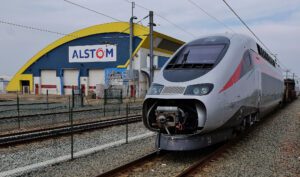
The French concern Alstom welcomes the ratification of an intergovernmental agreement between France and Ukraine on financing the supply of 130 heavy-duty electric locomotives for Ukrzaliznytsia, the company’s press service has said.
“The next important step is the signing of commercial agreements in the second half of 2021,” the company said.
According to the press release, this will allow Alstom to begin supplying locomotives to the Ukrainian market, which will also provide for 35% localization associated with the production and maintenance of electric locomotives.
As reported, Ukraine and France in May signed an intergovernmental agreement on financing the supply by Alstom of 130 heavy-duty electric locomotives for Ukrzaliznytsia for up to EUR 900 million.
This agreement was ratified by the Verkhovna Rada of Ukraine on July 1, 2021.
Alstom is one of the world leaders (along with Siemens and Bombardier) in the production of power equipment and railway transport. It operates in more than 70 countries and employs about 70,000 people.
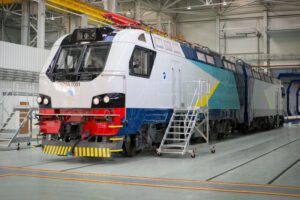
The launch of a project for the supply of electric locomotives to Ukraine can create more than 7,000 jobs in the country in the long term, the French concern Alstom has said.
“The creation of new jobs will be one of the main positive consequences of the contract, which will be signed in the near future. According to our estimates, more than 7,000 jobs will be created or retained in Ukraine thanks to the electric locomotive business in the long term,” the company told Interfax -Ukraine.
Asked about the delivery times and conditions of locomotive maintenance, Alstom said that this issue is currently being resolved with customers and cannot yet be brought up for discussion.
According to representatives of Alstom, the company is looking for local clients in Ukraine, including among private businesses.



