
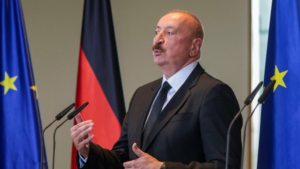
President of Azerbaijan Ilham Aliyev on September 15 sharply criticized the European Parliament, calling it “a den of corrupt officials.” He made the statement in Baku during a meeting with participants of international conferences. The quote is confirmed by the official transcript on the website of the President of Azerbaijan.
Aliyev referred to the Qatargate corruption scandal, which erupted in the European Parliament at the end of 2022 and was linked to former EP Vice-President, Greek politician Eva Kaili. According to him, “suitcases containing millions of dollars were seized from the home of its vice-president,” after which, Aliyev claims, the case was allegedly “hushed up.” He also accused the European Parliament of bias against Azerbaijan and Islamophobia.
At the same time, the factual circumstances of the case differ somewhat from the wording used by the Azerbaijani president. In December 2022, Belgian investigators did indeed discover about EUR1.5 million in cash as part of Qatargate, but the money was seized in several locations: about EUR150,000 in Kaili’s apartment, around EUR750,000 in a suitcase that was with her father, and another approximately EUR600,000 in the home of another person involved in the investigation.
Kaili was arrested in December 2022, lost her position as Vice-President of the European Parliament and spent some time in custody. Therefore, Aliyev’s claim that “no measures were taken” against her does not correspond to the full chronology of the case. Kaili herself denies committing any crimes.
It is also not yet possible to say that the case was closed or officially “hushed up.” As of the end of June 2026, the Belgian Qatargate investigation was continuing and had not yet reached trial. In February 2026, the Brussels Chamber of Appeal rejected procedural objections from the main suspects and allowed the investigation to continue. At the same time, the investigation has been criticized because of its duration and a number of procedural problems.
AZERBAIJAN, CORRUPTION, EUROPEAN PARLIAMENT, QATARGATE, Алієв

Turkey intends to participate in the Caspian Sea–Black Sea–Europe energy corridor (Black Sea Energy) project, which is designed to ensure the supply of “green” electricity from the South Caucasus to the European Union market, said Turkish Minister of Energy and Natural Resources Alparslan Bayraktar.
According to him, the project involves connecting the power grids of Azerbaijan and Georgia, followed by the transmission of electricity via an undersea cable across the Black Sea to Romania and on to Hungary. At the invitation of the Azerbaijani side, Turkey expressed its intention to join the initiative and supported its implementation.
Ankara’s interest in the project is also confirmed by preliminary negotiations with Baku. On August 1, Azerbaijan’s Minister of Energy Parviz Shahbazov reported following a meeting with Bayraktar in Istanbul that the parties had discussed Turkey’s potential cooperation within the framework of the “Caspian–Black Sea–Europe” energy corridor and had also agreed to accelerate the implementation of other joint energy projects.
According to Bayraktar, cooperation between Turkey and Azerbaijan in the electricity sector is currently developing along three fronts.
The first involves integrating Nakhchivan’s power grid with Turkey’s and organizing electricity exchanges. In the future, this route could be connected to the main territory of Azerbaijan via the Zangezur Corridor.
The second direction is the “green” energy corridor connecting Azerbaijan, Georgia, Turkey, and Bulgaria. It is intended to facilitate the export of renewable electricity generated in Azerbaijan through Georgia and Turkey to Bulgaria and onward to EU markets. In August 2026, Baku and Ankara separately agreed to accelerate the implementation of this project.
The third initiative is Black Sea Energy itself. The main participants in the project remain Azerbaijan, Georgia, Romania, and Hungary. The four countries signed an agreement on strategic partnership in the development and transmission of “green” energy in Bucharest on December 17, 2022. The European Union supports the project, viewing it as a new supply route for renewable electricity from the South Caucasus to the EU.
In July 2026, the project moved to the next phase of implementation following the completion and approval of feasibility studies. The project operator, Green Energy Corridor Power Company, has begun developing the conceptual design, engineering solutions, and procurement strategy.
According to recent statements by the Azerbaijani side, the plan is to gradually export up to 3.9–4 GW of green electricity through the corridor, starting in 2032. The project has also been included in the TYNDP 2026 portfolio of the European Network of Transmission System Operators for Electricity (ENTSO-E).
A key infrastructure element will be a high-voltage subsea direct-current cable between Georgia and Romania. The preliminary construction cost is estimated at approximately 3.5 billion euros, with a construction period of three to four years. It was previously reported that up to 2.3 billion euros in European funding could be secured. However, in the latest Global Gateway documents, 2.3 billion euros is also cited as the indicative investment amount for the strategic Black Sea electricity interconnector, so the final financing structure for the project is still to be finalized.
The European Commission views Black Sea Energy as one of the tools for diversifying the EU’s energy supply and integrating renewable generation from the South Caucasus. The project is intended to connect the Caspian Sea region to the European power grid via Georgia and Romania, while also strengthening the energy resilience of the participating countries.
If Turkey joins, the project will take on additional significance, as Ankara will be able to participate in several parallel transmission routes for Azerbaijani “green” electricity to Europe—via the Black Sea and via the Turkey–Bulgaria overland corridor.
Ukrainian Minister of Internal Affairs Ivan Vygivsky held a telephone conversation with Azerbaijani Minister of Internal Affairs Vilayat Eyvazov, according to the press service of the Ukrainian Ministry of Internal Affairs.
“We discussed our partnership in the field of law enforcement. The key areas of cooperation are combating organized and transnational crime, cybersecurity, and the fight against fraud, as well as strengthening practical cooperation,” Vygivsky said following the conversation.
During the talks, the head of the Ukrainian ministry also briefed his counterpart on the current situation in the country, particularly regarding the latest Russian shelling of civilian infrastructure and attacks on the civilian population.
The parties paid special attention to joint humanitarian initiatives, particularly in the areas of healthcare, rehabilitation, and social support for the families of Ukrainian defenders.
“In the past year alone, the Republic of Azerbaijan has hosted two groups of high school students from the Ministry of Internal Affairs. The students had the opportunity to learn about the country’s culture and history and broaden their horizons. In recent years, our units have also received humanitarian demining equipment and technology from Azerbaijan that ensures uninterrupted operations during power outages. We are grateful to the Government of the Republic of Azerbaijan for its support of Ukraine and assistance to the Ministry of Internal Affairs. We agreed to strengthen our partnership,” Vygivsky concluded.
AZERBAIJAN, COOPERATION, Ministry of Internal Affairs, SECURITY, UKRAINE
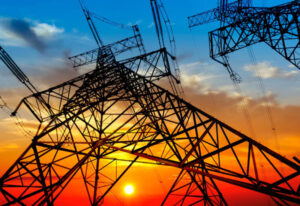
Azerbaijan intends to increase electricity exports to neighboring countries and enter the European energy market, said the country’s president, Ilham Aliyev.
“By expanding our export capabilities to neighboring countries, we will also enter the European market. After all, we have already entered the European market with our oil and gas, but we want to enter it with electricity as well,” Aliyev said in an interview with the Azerbaijani state television channel AzTV.
According to him, the only route for supplying electricity to Europe currently runs through Georgia and Turkey, but Azerbaijan intends to expand the number of export routes. In this regard, a feasibility study for the Black Sea Energy project has already been prepared.
In addition, in November 2024, as part of COP29, Azerbaijan, Kazakhstan, and Uzbekistan signed an agreement to lay an electrical cable along the bottom of the Caspian Sea.
“Azerbaijan will establish itself as a country that generates, receives, transmits, and exports electricity,” Aliyev said.
He also noted that the capacity of solar power plants in the Nakhchivan Autonomous Republic (NAR) could reach 500 MW, and up to 1 GW in the future.
“The main issue here is export capacity. To achieve this, of course, negotiations must be held with the relevant authorities in the respective countries, and these are already underway,” the president said.
At the same time, Aliyev noted that the existing power transmission lines from the NAR to Iran and Turkey have limited capacity, which needs to be increased.
“That is, for exporting 500 megawatts—or even 1,000 megawatts—of electricity, there are currently two routes: one to Turkey and the other to Iran. But in the future, this could also include Europe,” he said.
The head of state added that Azerbaijan’s plans to export electricity are in line with the interests of the countries “surrounding us.”
“It’s just that coordination efforts here must be carried out properly, at the necessary level, and negotiations must be accelerated. I can say that negotiations on this matter are currently underway with both Turkey and Iran. It’s too early to say anything for sure,” the president said.
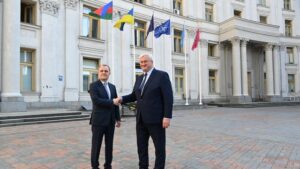
Ukrainian Foreign Minister Andriy Sibiga stated that Kyiv wants to restore pre-war levels of bilateral trade with Azerbaijan, which currently stands at about $600 million.
According to a correspondent for “Interfax-Ukraine,” Sibiga made this remark at a joint press conference with his Azerbaijani counterpart, Jeyhun Bayramov
“We have set ourselves the goal of returning to pre-war levels in terms of trade. We have now reached about $600 million,” said the minister.
In this context, the foreign ministers agreed to work toward holding the next meeting of the Ukrainian-Azerbaijani Intergovernmental Commission on Economic Cooperation in Ukraine.
The parties held detailed talks on the bilateral and international agenda, Ukraine’s preparations for the winter season, and strengthening energy security in the region.
“Over the past year and this year, we have seen a new dynamic in the strategic partnership between Ukraine and Azerbaijan, with increased contacts at all levels. We view your visit as yet another element of this new and positive dynamic,” noted the Ukrainian diplomat.
The parties paid particular attention to the development of mutually beneficial economic, investment, and humanitarian cooperation. Sibiga stated that Ukraine values investments by Azerbaijani companies and looks forward to expanding their presence and implementing new joint projects.
The diplomats also discussed regional security issues in the South Caucasus and the Middle East. Andriy Sibiga briefed his Azerbaijani counterpart on Ukraine’s peace efforts and highlighted Azerbaijan’s important role in promoting peace and ensuring regional stability.
“We appreciate Azerbaijan’s principled stance in support of Ukraine’s territorial integrity and sovereignty. Ukraine has also always supported and continues to support Azerbaijan’s sovereignty and territorial integrity. This is a constant in our relations,” emphasized the head of Ukraine’s Ministry of Foreign Affairs.
Sybiga expressed gratitude to Azerbaijan, President Ilham Aliyev, and the entire Azerbaijani people for their assistance to Ukraine from the very first days of the full-scale invasion.
“The restoration of civilian infrastructure in Irpin, humanitarian aid, equipment for energy facilities, and much more. We will always remember this,” he assured.
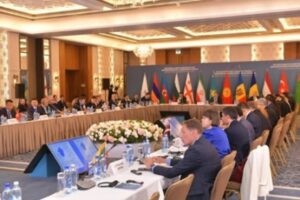
Uzbekistan, Kazakhstan, Kyrgyzstan, Azerbaijan, and Ukraine have agreed to introduce unified transit permits for freight transport. This was reported by the press service of the Ministry of Transport.
The relevant intergovernmental agreement was signed on May 15 of this year at a meeting of the TRACECA Intergovernmental Commission in Astana. It provides for the introduction of a single transit permit form in all five countries.
The document will allow carriers to cross the territories of several participating states using a single form without additional documents. The decision aims to eliminate administrative barriers and speed up transit.
AZERBAIJAN, KAZAKHSTAN, KYRGYZSTAN, transit permits, UKRAINE, UZBEKISTAN



