
According to Serbian Economist, the Serbian government has approved a shareholders’ agreement between the state-owned companies Elektroprivreda Srbije (EPS), Srbijagas, and Azerbaijan’s SOCAR.
The new joint venture will be responsible for financing, constructing, and operating a gas-fired power plant in Niš.
The government’s decision on this matter was published in the official gazette, “Službeni Glasnik.”
The plant’s planned capacity is up to 500 MW. The facility will use combined heat and power (CHP) technology.
This approach allows for more efficient use of natural gas, as the heat generated during electricity production is also used for heating or other utility needs.
The project will mark a continuation of energy cooperation between Serbia and Azerbaijan. SOCAR is Azerbaijan’s state-owned oil and gas company and participates in international projects involving the extraction, transportation, and supply of energy resources.
The establishment of the joint venture paves the way for further preparation of the investment project; however, construction has not yet begun, and the final cost of the power plant has not been announced.
https://t.me/relocationrs/3902
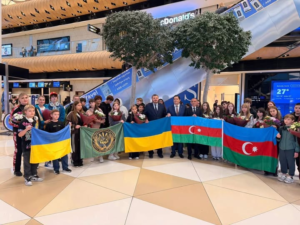
Another 30 Ukrainian children have arrived in Azerbaijan for rest, health improvement, and psychological rehabilitation, according to the Embassy of Ukraine in the Republic of Azerbaijan.
The new group includes children from the Dnipropetrovsk region and the city of Boyarka in the Kyiv region.
The program will take place in Gabala, one of Azerbaijan’s largest tourist and resort centers. The children will participate in recreational activities, health-improvement programs, and receive psychological support.
Since the start of the full-scale war, 722 Ukrainian children have already had the opportunity to rest and undergo rehabilitation in Azerbaijan.
Yuriy Gusev, Ukraine’s Ambassador to Azerbaijan, thanked the country’s leadership and the Azerbaijani people for their support of Ukrainian children.
“We are sincerely grateful to the leadership of the Republic of Azerbaijan and the Azerbaijani people for their solidarity, care, hospitality, and support for Ukrainian children. This is yet another demonstration of the genuine friendship between our peoples and the Ukrainian-Azerbaijani strategic partnership,” the ambassador noted.
Recreation and rehabilitation programs for Ukrainian children in Azerbaijan have been implemented since the start of the full-scale war and have become one of the areas of humanitarian cooperation between the two countries.
AZERBAIJAN, child, HUMANITARIAN AID, REHABILITATION, UKRAINE
Georgia has the highest balance of positive and negative attitudes among Ukrainians among the countries of the Caucasus and Central Asia included in the study—48.5 percentage points. Azerbaijan scored 40.1 percentage points, while Uzbekistan’s score was 11.1 percentage points. These findings come from the third wave of the study “Ukrainians’ Attitudes Toward Countries Around the World,” conducted by Active Group in collaboration with Experts Club, according to the Experts Club Information and Analytical Center.
57.3% of Ukrainians surveyed view Georgia positively, 32.1% neutrally, 8.8% negatively, and another 1.8% were undecided. The balance of positive and negative assessments stands at 48.5 percentage points and has gradually increased over the three waves of the survey: from 45.6 percentage points in August 2025 to 47.5 percentage points in March 2026 and 48.5 percentage points in August of this year. The current figures for positive attitudes and the balance are confirmed by the published survey data.
A positive attitude toward Azerbaijan was expressed by 48.7% of respondents, a neutral one by 39.5%, a negative one by 8.6%, and another 3.1% chose the “difficult to answer” option. The balance stands at 40.1 percentage points. Compared to March 2026, it has risen from 37.8 percentage points, but remains lower than the August 2025 level of 51 percentage points. In terms of the share of positive assessments, Azerbaijan ranks second in this regional group after Georgia.
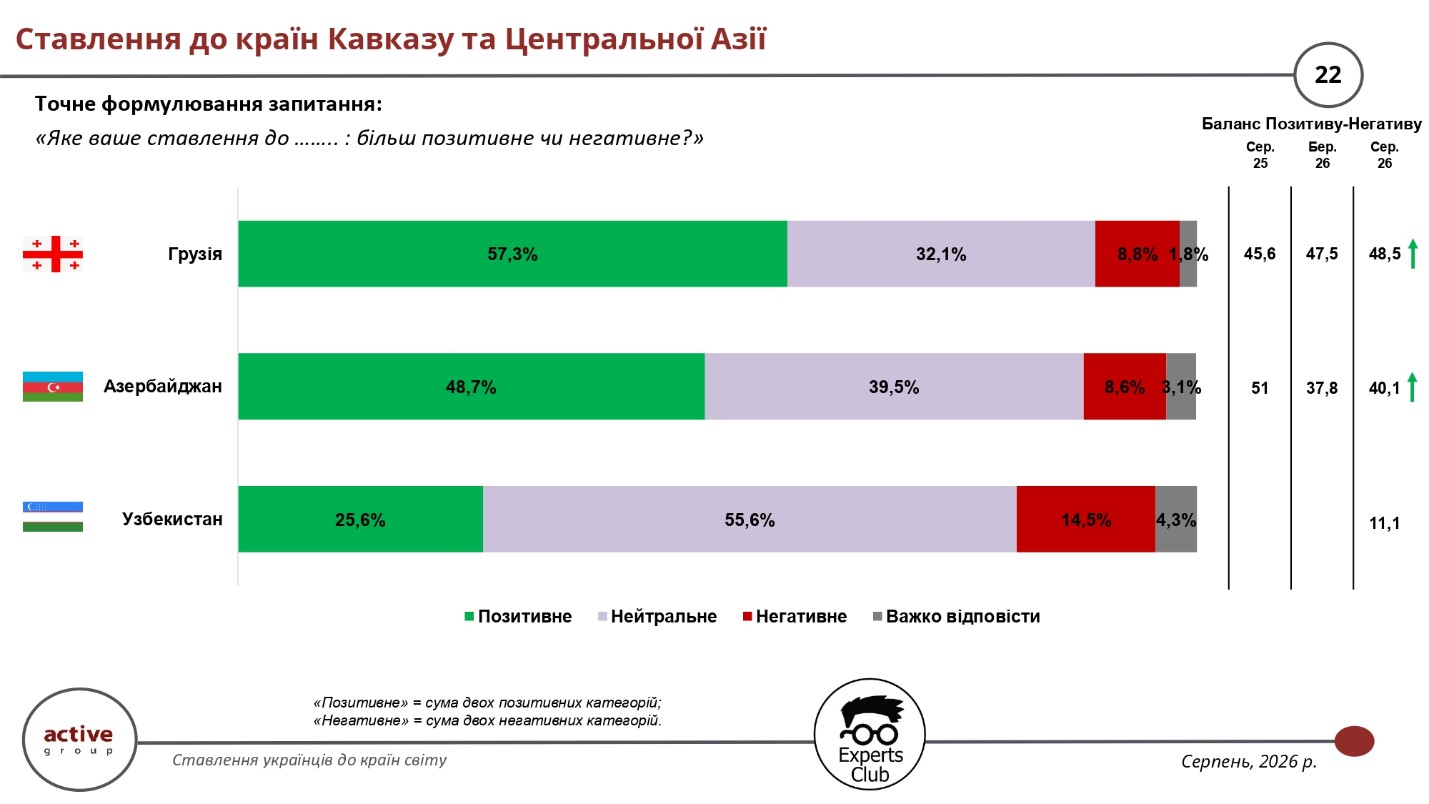
Attitudes toward Uzbekistan are characterized primarily by a high proportion of neutral assessments. 25.6% of respondents view the country positively, 55.6% neutrally, 14.5% negatively, and another 4.3% are undecided. The balance between positive and negative responses is 11.1 percentage points. In the study’s analytical materials, the high proportion of neutral responses is noted as a characteristic feature of perceptions of countries in the region that receive less media attention from the Ukrainian audience.
Thus, the balance remains positive for all three countries surveyed, but the structure of the assessments differs significantly. In the case of Georgia, the overwhelming majority of respondents express a positive attitude; positive assessments also prevail regarding Azerbaijan, while a neutral stance dominates in assessments of Uzbekistan.
Maksym Urakin, founder of the Experts Club Information and Analytical Center, deputy director of the Interfax-Ukraine news agency, and candidate of economic sciences, emphasized the importance of systematic communication between foreign partners and Ukrainian society.
“Second, we must be open to questions and inquiries from the media and the public. We also need to make use of our sociological data,” Urakin noted. According to him, it is important for embassies to regularly inform the Ukrainian audience about specific results of cooperation and to maintain full-fledged communication in the Ukrainian language.
Oleksandr Pozniy, director of the research company Active Group, drew attention to the need to develop the practical component of international economic cooperation.
“We should focus not only on raising general awareness. We need to expand cooperation with countries where we can achieve a positive trade balance,” Pozniy noted. He also highlighted the role of business associations, the Ministry of Economy, and the Ministry of Foreign Affairs in developing bilateral relations.
The survey was conducted in August 2026 using self-administered online questionnaires via the SunFlowerSociology panel. A total of 800 Ukrainian citizens aged 18 and older were surveyed. According to the organizers, the sample is representative in terms of age, gender, and region, and the maximum theoretical margin of error for indicators at the 50% confidence level is ±3.5 percentage points. This is the third wave of the survey, following surveys conducted in August 2025 and March 2026.
ACTIVE GROUP, AZERBAIJAN, Central Asia, EXPERTS CLUB, GEORGIA, international relations, Pozniy, SOCIOLOGY, the Caucasus, UKRAINE, URAKIN, UZBEKISTAN
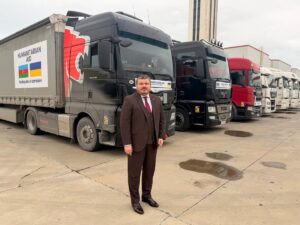
Azerbaijan has sent Ukraine another shipment of humanitarian aid in the form of energy equipment needed to restore and maintain the power grid during the heating season, according to the Embassy of Ukraine in the Republic of Azerbaijan.
The shipment includes high-capacity transformers, 186 km of electrical cables, and other equipment for restoring the energy infrastructure.
In total, the cargo will be delivered to Ukraine by ten heavy-duty trucks.
Yuriy Gusev, Ukraine’s Ambassador to Azerbaijan, thanked Azerbaijani President Ilham Aliyev, the country’s government, and the Azerbaijani people for their support of Ukraine.
“This aid is a practical demonstration of solidarity and the Ukrainian-Azerbaijani strategic partnership, as well as a significant contribution to strengthening the resilience of our power grid amid ongoing full-scale Russian aggression,” Gusev stated.
According to him, the equipment is particularly important for Ukraine in the run-up to and during the heating season.
Azerbaijan has previously sent humanitarian aid to Ukraine on multiple occasions, including equipment to restore energy infrastructure damaged as a result of hostilities.
AZERBAIJAN, ENERGY, HEATING SEASON, HUMANITARIAN AID, UKRAINE
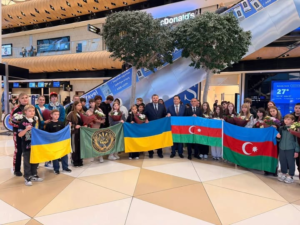
A group of 30 Ukrainian children from the Kharkiv and Kherson regions has arrived in Azerbaijan for psychological and health rehabilitation and recreation, the Embassy of Ukraine in the Republic of Azerbaijan reported.
The group includes children living under constant Russian shelling, as well as children of active Ukrainian servicemen, prisoners of war, and wounded defenders of Ukraine.
The rehabilitation and recreation program has been organized in the city of Gabala, one of Azerbaijan’s main mountain resort centers.
At Heydar Aliyev International Airport, the children were welcomed by Ukraine’s Ambassador to Azerbaijan Yurii Husiev, head of the Azerbaijan-Ukraine Interparliamentary Relations Working Group and member of the Milli Majlis Alibala Maharramzade, and Deputy Chairman of the Board of the Social Services Agency under Azerbaijan’s Ministry of Labour and Social Protection of the Population Vugar Mammadov.
Since the beginning of the full-scale war, 692 Ukrainian children have already undergone recreation, health improvement and rehabilitation in Azerbaijan, the embassy reported.
Thus, taking into account the current group, Azerbaijan continues to implement humanitarian programs aimed at supporting Ukrainian children affected by the war.
“We highly appreciate this assistance, the strong strategic partnership and friendship that unite the Ukrainian and Azerbaijani peoples,” Husiev said.
The ambassador also thanked Azerbaijan for its support for Ukraine and assistance to children who, because of the war, are forced to live under conditions of constant danger and shelling.
Andriy Butenko, Ukraine’s Minister of Education and Science, discussed with Seymur Mardaliyev, the Ambassador of the Republic of Azerbaijan to Ukraine, the recognition of higher education documents, the expansion of cooperation between universities, and the preparation of bilateral events in the field of education and science.
“As of early 2026, more than 5,400 Azerbaijani citizens were studying in Ukraine—about one-third of all international students. The Ukrainian side reaffirmed its interest in maintaining this cooperation and creating appropriate conditions for pursuing an education,” according to a statement from the Ministry of Education.
It is noted that special attention was given to the recognition of diplomas from Ukrainian higher education institutions in Azerbaijan.
In particular, the Ukrainian side proposed to thoroughly examine the relevant issues within the framework of a specialized working group.
The meeting also addressed the issue of documentation required for the admission and arrival of Azerbaijani students coming to study in Ukraine.
In addition, the meeting participants discussed preparations for a visit to Azerbaijan by a delegation from the Ministry of Education led by Deputy Minister Mykola Trofimenko.
“The proposed program includes a working group meeting on the recognition of educational documents, as well as meetings with the leadership of the relevant ministry and university rectors. The visit is intended to facilitate the development of joint decisions and the establishment of direct partnerships between higher education institutions in both countries. The possibility of organizing a meeting between the education ministers of Ukraine and Azerbaijan by the end of this year was also discussed,” the statement reads.
The parties also discussed preparations for the 14th meeting of the Joint Intergovernmental Commission on Economic Cooperation and the signing of an intergovernmental agreement on scientific and technical cooperation.



