
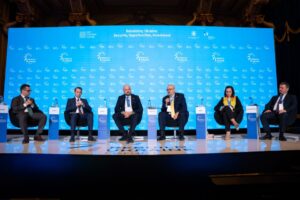
At the Rebuilding Ukraine: Security, Opportunities, Investments forum in Bucharest, during one of the panel discussions, representatives of Romania, the Republic of Moldova, and Ukraine announced their intention to deepen regional cooperation in infrastructure within the “strategic transport triangle” to support Ukraine’s reconstruction and strengthen the region’s resilience.
The panel was moderated by George Scutaru, CEO of the New Strategy Center think tank. Participants included Vladimir Bolea, Deputy Prime Minister and Minister of Infrastructure and Regional Development of the Republic of Moldova; Mihai Iurca, Special Envoy for the Reconstruction of Ukraine and Head of the Office of the Prime Minister of Romania; First Deputy Chair of the Verkhovna Rada Committee on Transport and Infrastructure Yulia Sirko, State Secretary of the Ministry of Infrastructure of Romania Ionel Scrieşteanu, Deputy Minister of Communities, Territories and Infrastructure of Ukraine Serhiy Derkach (via videoconference), and CEO of Leviatan Group Cătălin Podaru.
The discussion focused on the strategic importance of regionalizing infrastructure projects between the three countries and developing logistics corridors that ensure not only economic and demographic mobility, but also military mobility in the context of the ongoing war. The participants emphasized that transport and energy connectivity is seen as a tool for coordinating government policies, as well as a platform for involving the private sector in the reconstruction of Ukraine.
“Logistics is becoming a key element of security and development: from ports and railways to border infrastructure, all of this must function as a single network between Romania, Moldova, and Ukraine,” Skutaru noted during the discussion. He stressed that coordinating investments and projects within the “strategic transport triangle” is a necessary condition for increasing the capacity of corridors used for trade, transit, and military aid.
Representatives of the Ukrainian and Moldovan sides stressed that the reconstruction of Ukraine is impossible without the active participation of private business and the involvement of international companies in joint projects. “Ukraine is open to partnership, and we need both financial resources and technological solutions that can be provided by regional and global partners. Joint infrastructure projects strengthen not only the economy but also the stability of the entire region,” emphasized Deputy Minister Serhiy Derkach.
Following the discussion, participants noted positive dynamics in strengthening connectivity between the three countries, particularly with regard to the modernization of transport corridors, port, and border infrastructure. They concluded that further progress will depend on coordinated government action, effective use of financial instruments, and close cooperation with international partners to enhance the collective resilience and prosperity of the region.
The forum “Rebuilding Ukraine: Security, Opportunities, Investments” is being held on December 11-12 in Bucharest under the auspices of the Romanian Ministry of Foreign Affairs and the Ukrainian Ministry of Foreign Affairs and organized by the New Strategy Center. According to the organizers, more than 30 panel discussions and parallel sessions are planned over two days with the participation of representatives of governments, international organizations, the private sector, financial institutions, and experts from Europe, North America, and Asia. The topics of the panels cover security and defense, infrastructure, financing and investment, green energy, digitalization, human capital, and cross-border cooperation.

Participants in the panel discussion “Challenges of the Ukrainian Labor Market. Mobilizing Human Capital for Sustainable Reconstruction” at the forum on Ukraine’s reconstruction in Bucharest concluded that the country needs a two-pronged policy for sustainable economic recovery: creating conditions for the return of those who wish to do so, while simultaneously supporting the active diaspora as a resource for investment and knowledge transfer.
The panel was moderated by Adam Eberhart, Deputy Director of the Center for East European Studies at the University of Warsaw (SEW UW). The discussion was joined by Svitlana Kovalchuk, Executive Director of the Yalta European Strategy (YES) Bogdan Zavadetchik, President of the Charitable Foundation “Resources and Public Initiatives” in the Chernivtsi region Olena Tanasychuk, representative of the Ukrainian diaspora in the UK at Ealing Community & Voluntary Service (ECVS) Ania Abdulah, and Osamu Hattori, Head of the Japan International Cooperation Agency (JICA) office in Ukraine.
According to surveys cited by participants, most Ukrainian refugees would only consider returning if there were reliable guarantees of security and a stable economic situation. At the same time, statistics show that after two to three years abroad, the likelihood of returning decreases sharply due to deeper integration of people into their host countries, particularly through employment, children’s education, and access to social services. “The longer people stay abroad, the more their lives shift—and the harder it is to convince them to start from scratch at home,” Ebergart noted.
Separately, experts noted that the potential opening of borders could trigger a new wave of emigration, particularly among men of conscription age, who are currently restricted from leaving due to mobilization rules. Against this backdrop, participants emphasized the need for policies that, on the one hand, create the conditions for return—through security, jobs, housing, and access to services—and, on the other hand, support a strong and organized diaspora.
The discussion concluded that the Ukrainian diaspora can remain an important resource for the country’s development even without physical return, through investment, professional networks, educational and expert projects. “The question is not only how many people will return, but also how many of them, wherever they live, will remain actors in Ukraine’s development,” Kovalchuk concluded. Participants agreed that a coordinated human capital policy should be one of the key elements of Ukraine’s post-war reconstruction strategy.
The forum “Rebuilding Ukraine: Security, Opportunities, Investments” is being held on December 11-12 in Bucharest under the auspices of the Romanian Ministry of Foreign Affairs and the Ukrainian Ministry of Foreign Affairs and is organized by the New Strategy Center. According to the organizers, more than 30 panel discussions and parallel sessions are planned over two days with the participation of representatives of governments, international organizations, the private sector, financial institutions, and experts from Europe, North America, and Asia. The topics of the panels cover security and defense, infrastructure, financing and investment, green energy, digitalization, human capital, and cross-border cooperation.
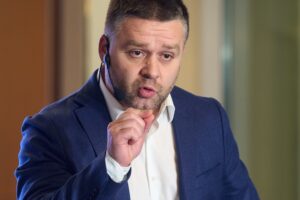
The Serbian Economist reports that the candidate of the National Liberal Party of Romania (PNL), backed by Prime Minister Ilie Bolojan, Ciprian Ciuc won the early election for mayor of Bucharest with about 36% of the votes after almost all ballots were counted.
According to Romanian and international media, Ciuc beat far-right Alliance for the Unification of Romanians (AUR) candidate Anca Alexandrescu, who received about 22% of the vote, as well as Social Democratic Party (PSD) nominee Daniel Belutse, who came in third. The election was seen as a test of the influence of AUR, which is leading in part of the nationwide polls.
The post of mayor of the Romanian capital became vacant after the former mayor Nicusor Dan was elected president of the country in 2025, necessitating an extraordinary vote. The victory of the EU-oriented liberal candidate is seen by observers as an important political success for incumbent Prime Minister Bolojan and his pro-European ruling coalition amid the growing popularity of right-wing and far-right forces in the region.
Analysts note that the outcome of the Bucharest election reduces the risk that one of the first capitals of an EU member state could become a city governed by a radical right-wing party, while strengthening the government’s position ahead of further political battles at the national level.
https://t.me/relocationrs/1901

On December 11–12, Bucharest will host the forum “Rebuilding Ukraine: Security, Opportunities, Investments,” organized by the Center for New Strategies under the patronage of the Romanian Ministry of Foreign Affairs and the Ukrainian Ministry of Foreign Affairs. This event, which is being held for the second time, brings together officials, representatives of international organizations, the private sector, international financial institutions, and experts from various fields, such as defense, finance and banking, energy, infrastructure, digitalization, cybersecurity, and agriculture. The conference will be attended by numerous representatives of Ukrainian regional authorities who are directly involved in the planning and implementation of recovery projects.
Participants will gain a deeper understanding of Romania’s role in the recovery process in Ukraine, especially in the southern regions of the country located near Romania, as well as in issues related to connectivity, energy, and cross-border cooperation projects that have a positive economic impact on communities in both Romania and Ukraine. Over the course of two days, the event will feature more than 30 panel discussions and parallel sessions with guests from Europe, North America, and Asia. The discussions will address key elements of Ukraine’s reconstruction: security and defense, infrastructure, communications, financing and investment, green transition, energy security, digitalization, human capital, agriculture, and cross-border cooperation.
The panel discussions will address important topics such as:
● Regional security architecture and possible diplomatic developments;
● Lessons learned from the war in Ukraine and how they can be applied by Ukraine’s allies;
● Cooperation for the development of projects in the defense industry;
● Connectivity projects between Romania, Ukraine, and the Republic of Moldova;
● Financial instruments, guarantees, investments, and the role of the private sector;
● The strategic role of the Danube in Ukraine’s reconstruction;
● Black Sea ports;
● Energy sustainability, rare minerals, and the future of the green transition;
● Cloud infrastructure, advanced digitalization, and cybersecurity;
● Reintegration of displaced persons, veterans, and community recovery;
● Ukraine’s integration into the EU and necessary reforms;
● The role of local communities and minorities in cross-border cooperation.
The conference provides a unique platform for establishing links between decision-makers and the business community, financial institutions, local authorities, and experts from various fields, facilitating the creation of concrete partnerships and sustainable solutions for Ukraine’s recovery. Simultaneous interpretation in Romanian, Ukrainian, and English will be provided during the conference, as well as online streaming.
Media partner of the forum: Interfax-Ukraine news agency
Event website: https://reconstruct-ukraine.ro/
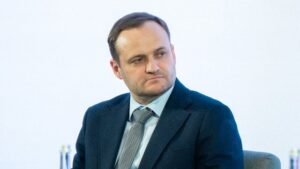
Train #99/100 Kyiv-Bucharest, despite massive attacks on Ukrainian critical and civilian infrastructure, has set off on its maiden voyage together with a hundred passengers, Deputy Prime Minister for Reconstruction – Minister of Community and Territory Development Oleksiy Kuleba said.
“Despite massive attacks on Ukrainian critical and civilian infrastructure by Russia, Ukrzaliznytsia trains are departing on schedule. Thus, train No. 99/100 Kiev-Bucharest departed on its first trip clearly on schedule,” Kuleba wrote in his Telegram channel on Friday.
According to him, the new train will run daily on the route Kiev-Bucharest through Vinnitsa, Zhmerinka, Mogilev-Podilskyi. Border control will take place in the towns of Velchinets and Ungheni.
It is noted that the train arrives at the main station of the capital of Romania – Gara de Nord.
Separately, Kuleba specified that from Kiev the train will depart from the Central Station at 06:30 and arrive in Bucharest at 06:47 the next day.
In the opposite direction, according to the schedule, it will depart from Gara de Nord station at 19:10 and arrive in Kiev at 19:34 the next day.
“Even during the war, Ukraine continues to move forward – literally and symbolically”, – added the Deputy Prime Minister for recovery.
As previously reported, “Ukrzaliznytsia” from October 10 launches a daily train on the route Kiev-Bucharest. The cost of a ticket in a compartment car is approximately UAH 3,800. You can already buy tickets in the application or on the website of “Ukrzaliznytsia”.

A direct railway service between Kyiv and Bucharest will be launched in test mode on Thursday, Ukrainian Foreign Minister Andriy Sybiga said.
“Direct rail service between Kyiv and Bucharest is launching today in test mode. Two special cars are leaving today for the Romanian capital via Chisinau and will return to Kyiv tomorrow,” he said during a statement to the media together with Romanian Foreign Minister Oana-Silvia Cioa.



