

According to the Serbian business publication Parametar, the Adriatic Sea is warming not only near the surface—scientists have recorded an unprecedented rise in temperature in the deep layers of the Southern Adriatic, including at depths of about 1,000 meters.
A study by an international team of oceanographers showed that over the past decade, the temperature of the bottom waters of the South Adriatic Basin has risen by 0.8 °C. At the same time, salinity has increased significantly.
For the study, scientists combined observational data collected since 1957, measurements from deep-sea stations, and data from 15 autonomous buoys of the international Argo system.
Over the long-term period from 1957 to 2024, the temperature at a depth of 1,000 meters increased by an average of 0.088 °C per decade.
However, this process has accelerated sharply in recent years.
According to Argo data, between individual deep-water renewal cycles, the rate of temperature increase at a depth of 1,000 meters was approximately 0.40°C per decade in 2012–2016, 0.67 °C in 2018–2021, and 0.64 °C in 2022–2024.
Another clear indicator of the scale of these changes is the penetration of warm water to greater depths. In the early 2010s, the 14 °C isotherm was located at a depth of approximately 100 meters, but by 2024, water at that temperature had spread nearly to the bottom of the South Adriatic Basin.
Changes were even recorded at a depth of 1,200 meters. During the deep-water turnover in 2022, the temperature there rose by approximately 0.4°C, while salinity increased significantly.
Researchers describe what is happening as an unprecedented warming and salinization of the Adriatic’s deep waters. The observed changes are occurring much faster than predicted by regional climate models with high emissions scenarios.
The Southern Adriatic is of particular importance to the entire sea. It is home to a deep basin reaching 1,200 meters, where the deep water masses of the Adriatic are formed and redistributed.
Therefore, the changes taking place there may affect more than just water temperature. Scientists warn of potential consequences for marine biogeochemistry, water circulation, and living organisms.
For countries along the Adriatic coast—specifically Montenegro, Croatia, Albania, and Italy—this means that climate change in the sea can no longer be assessed solely by the water temperature at beaches in the summer. The transformation affects virtually the entire water column and represents a long-term change in the marine system itself.
A separate study of temperature trends in the Mediterranean Sea also showed that the Southern Adriatic stands out among deep-water regions. In the 700–2,000-meter depth layer, warming of 0.058 °C per year was recorded here between 2013 and 2020—one of the most pronounced rates in the deep layers of the Mediterranean.
Source: Limnology and Oceanography Letters
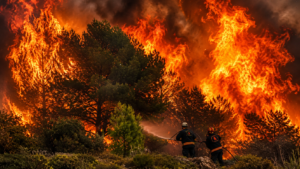
The 2026 fire season in Europe has become one of the most difficult in terms of the geographical spread of fires and the scale of their consequences, with Ukraine ranking among the continent’s most affected countries, the Experts Club information and analytical center reports, citing data from the Global Wildfire Information System (GWIS), the European Forest Fire Information System (EFFIS) and other European bodies.
As of August 31, the area affected by fire in Ukraine was estimated by GWIS at 413.1 thousand hectares, or about 0.69% of the country’s territory. If the Russian Federation is not included in the direct comparison, as the system also takes into account the vast territories of Siberia and the Far East, Ukraine ranks first among the countries of geographical Europe in terms of the absolute area affected by fires.
It is followed by Spain — 242.1 thousand hectares, Italy — 118.3 thousand hectares, France — 105.1 thousand hectares, and Portugal — 60.5 thousand hectares.
In Ukraine, fire statistics have an additional specific feature due to the war. Satellite systems record the territory affected by fire but do not determine its cause. Therefore, alongside heat, drought, careless handling of fire and arson, shelling, explosions and fires along the front line may also play a significant role.
The greatest burden relative to the size of the territory is recorded in the Balkans. In Montenegro, about 1.7% of the country’s territory has been affected by fire, in Bosnia and Herzegovina — more than 1%, and in North Macedonia — about 0.75%. Altogether, Montenegro, Bosnia and Herzegovina, North Macedonia, Albania and Serbia have about 142 thousand hectares of burned areas.
A separate feature of the season has been a sharp increase in fire activity in countries where large fires are traditionally less common. In Belgium, the area affected by fires has already exceeded the average for 2012–2025 by more than ten times, in the Netherlands — by approximately three times, in Austria — by 2.5 times, and in France — by almost 2.5 times.
In the EU itself, by August 30, 636.1 thousand hectares of burned areas had been recorded within 1,861 major fires. This is 36% less than in the record year of 2025, but more than twice the long-term average for the same period.
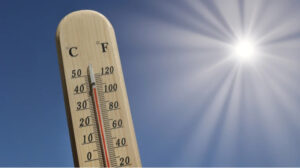
A number of countries in Southern and Western Europe have seen a sharp rise in temperatures to nearly 40 degrees, leading to widespread warnings, transportation disruptions, and strain on infrastructure and ecosystems, according to Reuters.
Spain, France, and Italy have been the hardest-hit countries due to the heat wave in Europe, where air temperatures are approaching 40 degrees. The extreme weather conditions have led to the issuance of elevated danger alerts, disruptions to transportation—particularly rail service—and increased strain on infrastructure and emergency services.
“The heat surge on June 21—the day of the summer solstice in the Northern Hemisphere and typically the start of the three hottest months of the year—has raised concerns about the early and prolonged onset of extreme conditions,” the report states.
In Spain, the AEMET weather service issued red and orange warnings, forecasting temperatures of 39–40 degrees across most of the Iberian Peninsula and Mallorca. The heat is expected to last at least until midweek.
In France, due to overheating of the infrastructure, the railway operator SNCF canceled 71 intercity trains. A total of 3,500 employees have been deployed for monitoring and emergency response, with an additional 2,000 staff members on standby.
“The spike in temperatures is caused by a mass of hot air moving northward from the Sahara, intensified by a strong anticyclonic system known as the ‘African anticyclone.’ Meteorologists note that this system creates a so-called ‘heat dome,’ which traps hot air over Western and Central Europe and allows temperatures to rise day after day,” the agency’s report states.
In Germany, where temperatures reached 38 degrees, thunderstorms and power outages were reported during mass events in Berlin.
Meanwhile, in Belgium, wildlife centers are reporting an overload of injured animals, mainly young birds, with about 150 having been brought in over the past few days.
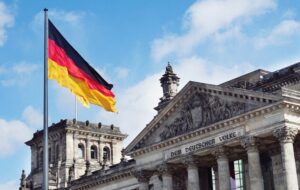
The total budget of technical assistance projects to be implemented in Ukraine within the framework of the International Climate Initiative will amount to EUR 44.5 million, including both new projects and those planned to be launched before the war or whose work was temporarily suspended with the outbreak of hostilities.
According to the website of the Ministry of Environmental Protection and Natural Resources of Ukraine on Tuesday, such initiatives were discussed in Berlin during the meeting of the Ukrainian delegation headed by Deputy Minister Alexander Krasnolutsky with representatives of the Federal Ministry of Economics and Climate Protection of Germany, the Federal Ministry for the Environment, Nature Conservation, Nuclear Safety and Consumer Protection of Germany, the German Society for International Cooperation (GIZ) and the Secretariat of the German Institute for International Cooperation.
German projects, in particular, will cover support for Ukraine in implementing the Paris Agreement and adaptation to the consequences of climate change in the Black Sea region, establishing an emissions trading system, forming a low emission policy, preserving forests in the Carpathians, and increasing Ukraine’s ability to overcome the consequences of war and integrate into the EU. In addition, they talked about Ukraine’s accession to the climate club, which is now being formed by the European Union.
In addition, the German government is ready to help Ukraine with the construction of rehabilitation centers for animals affected by war, which are envisaged in the plan for the post-war reconstruction of Ukraine.
According to Krasnolutsky, Ukraine is striving to apply the best practices that exist today in Europe for its reconstruction and development.

Climate change in Spain is threatening a key ingredient in the diet of pigs, acorns from oak forests, which could affect the production of premium Iberico Beyota jamón in the country.
Iberico Beyota jamón is a premium Spanish jamón that can sell for more than 100 euros per kilogram. It is made from black-legged pigs that must spend their last month of life eating acorns in oak forests.
In recent years, however, due to unusually hot and dry summers, fewer acorns have grown on the oaks. This fact, as well as a drop in the market value of the product, has led to a 20% reduction in jamón production in the autonomous region of Extremadura.
The summer of 2022 was the hottest in Spain’s history and also the third driest. In 50 years, rainfall in Extremadura decreased by 35%. That said, even if next summer isn’t as hot, it won’t guarantee plenty of acorns in the future.
“I expect that this year, after last summer’s drought and winter with little rain, could be the worst in the 40 years I’ve been working here,” said Francisco Esparrago, president of jam producer Señorio de Montanera.
Jamon producers could import acorns, but Esparrago does not approve of the idea. Imported acorns could bring new diseases, he said.
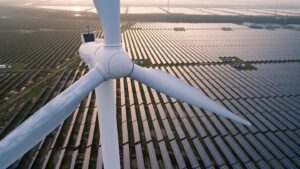
Energy Minister of Ukraine Herman Halushchenko and U.S. Secretary of Energy Jennifer Granholm have signed a joint statement on strategic dialogue in the field of energy and climate, Ukrainian President Volodymyr Zelensky said.
“A strategic dialogue in the field of energy and climate has been initiated between Ukraine and the United States. The corresponding joint statement was signed by Ukraine’s Minister of Energy Herman Halushchenko and U.S. Secretary of Energy Jennifer Granholm,” Zelensky wrote on Twitter on Tuesday.



