
Due to problems with storing and exporting the harvest caused by the closure of Black Sea ports, there is a risk that the planted area for the upcoming harvest could be reduced by 5–7 million hectares, said Taras Vysotsky, Minister of Agrarian Policy and Food.
“The biggest challenge today is compensating for interest rates on loans. If we do not support the financial stability of farmers, there is a risk that the area sown for the upcoming harvest will be reduced by 5–7 million hectares,” the Ministry of Agrarian Policy’s press service quoted Vysotsky as saying during his meeting with the UN System Coordinator in Ukraine, Matthias Schmale, and the leadership of the Food and Agriculture Organization of the United Nations (FAO) and the World Food Programme (WFP).
The minister emphasized that Ukraine currently faces two key challenges: preventing the spoilage of the harvest that has already been gathered, ensuring storage capacity, and providing farmers with working capital.
“According to our estimates, the storage capacity deficit could reach 11 million metric tons as early as this fall, and the funding requirement for this area is $44 million,” he noted.
According to Vysotsky, Ukraine has sent an official request to the European Union for the allocation of EUR220 million to compensate for interest rates on bank loans for farmers.
Another important topic of the talks, he said, was the willingness of UN agencies to become more actively involved in resolving systemic problems caused by the war and overcoming its consequences, the statement noted.
UN representatives confirmed their readiness to respond promptly to Ukraine’s urgent requests, mobilize resources from the international community, expand operational assistance, and support Ukraine in overcoming humanitarian and economic challenges.
Following the meeting, the parties agreed on a joint action plan to attract additional donor funding from international financial institutions, including the World Bank, as well as private humanitarian foundations.
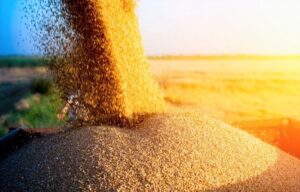
As of July 21, Ukrainian farmers had threshed 1.34 million hectares—or 11% of the projected area—and harvested 5.47 million metric tons of grain from the new crop, according to the press service of the Ministry of Agrarian Policy and Food.
Wheat production totaled 2.6 million metric tons from an area of 633,200 hectares, with an average yield of 41.1 centners per hectare.
Barley production totaled 2.56 million metric tons from an area of 580,500 hectares, with a yield of 44.1 centners per hectare.
Peas yielded 301,400 metric tons from an area of 121,600 hectares, with a yield of 24.8 centners per hectare.
The Odesa region currently leads in terms of the volume of early grain and legume crops harvested, with 1.597 million metric tons harvested from an area of 385,000 hectares. In the Mykolaiv region, 1.303 million metric tons were harvested from an area of 365.5 thousand hectares. In the Dnipropetrovsk region, 1.005 million metric tons were harvested from an area of 256.5 thousand hectares.
Winter and spring rapeseed have already been threshed across an area of 216,200 hectares, yielding 429,600 metric tons with an average yield of 19.9 centners per hectare.
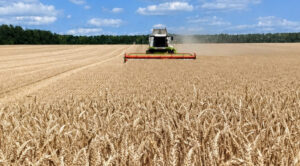
As of July 7, Ukrainian farmers had harvested 1.022 million metric tons of early-season grains and legumes from the new crop, according to the press service of the Ministry of Economy, Environment, and Agriculture.
“This year, due to weather conditions, the harvest began somewhat later. But farmers are working as hard as they can, and we’ve already reached the first million metric tons of grain—that’s a good result for this time of year. It was made possible by the coordinated efforts of producers and the efficient organization of fieldwork, even amid security and logistical challenges,” the press service quoted Deputy Minister Taras Vysotsky as saying.
According to the ministry, the harvest of early grain and legume crops is underway in 15 regions. Grain has already been threshed on an area of 251,400 hectares, which accounts for 3% of the projected area, with an average yield of 40.7 centners per hectare.
Farmers have already harvested 719.4 thousand metric tons of barley, 264.6 thousand metric tons of wheat, and 35.1 thousand metric tons of peas.
In the Kherson and Ivano-Frankivsk regions, the rapeseed harvest has begun, with 2.68 thousand metric tons harvested so far.
The largest volumes of grain from the new harvest were harvested by farmers in the Odesa (389 thousand metric tons) and Mykolaiv (347.2 thousand metric tons) regions.
According to the Ministry of Economy, Ukrainian farmers planted over 20 million hectares with winter and spring grains and oilseeds in 2026. Specifically, 5.88 million hectares were planted with spring grains and legumes, and 7 million hectares with industrial crops.

Agrotrade Agroholding has completed harvesting industrial hemp, which it grew on an area of about 230 hectares in Chernihiv region, the company’s press service reported on its Facebook page.
According to the report, 2024 was the final year of the agricultural holding’s hemp cultivation trials. The company has determined the best technologies and herbicide plant protection products, and understood the technical features of working with this crop.
“By changing approaches to seed harvesting and processing, we have obtained very good quality grain indicators: the oil content is high, and the acidity and peroxide values are low. The yields were slightly lower than we expected. The hemp was dry and the fiber was easily separated from the bast, so technical support during harvesting was the biggest challenge. The reason is that you can’t just pick up any harvester at any time: you need to know exactly what kind of hemp is best for what time and what kind of harvester will be optimal. These are the technical features of hemp that we have figured out,” says Oleksandr Ovsyanyk, Director of Agrotrade’s Agricultural Department.
“This year, we started harvesting later to get higher quality seeds. Due to the peculiarities of the variety and the year in general, threshing took longer than expected.
The agricultural holding emphasized that the Ukrainian market is not yet ready to consume large quantities of hemp grain, so this year’s harvest will be exported. If it can be sold profitably and in large volumes, the company will consider expanding the area.
Agrotrade Group is a vertically integrated holding company with a full agro-industrial cycle (production, processing, storage and trade of agricultural products). The company cultivates over 70 thousand hectares of land in Chernihiv, Sumy, Poltava and Kharkiv regions. Its main crops are sunflower, corn, winter wheat, soybeans and rapeseed. It has its own network of elevators with a one-time storage capacity of 570 thousand tons.
The group also produces hybrid seeds of corn and sunflower, barley, and winter wheat. In 2014, a seed plant with a capacity of 20 thousand tons of seeds per year was built on the basis of Kolos seed farm (Kharkiv region). In 2018, Agrotrade launched its own brand Agroseeds on the market.
Vsevolod Kozhemiako is the founder and CEO of Agrotrade.
Ukraine in the 2022-2023 marketing year (MY) harvested 70 million tons of grain and managed to export two-thirds of the harvest planned for export even taking into account the record high transitional residues, Minister of Agrarian Policy and Food Mykola Solskiy said on air of the marathon “United News”.
“Last year we harvested only about 70 million tons. All that we planned to take out, we took out. This is about two-thirds. We have transitional residues by the beginning of July – several million tons. If we compare it with the transitional residues last year, it is several times less – it was 22 million tons then. This is due to the fact that we were not traveling for a couple of months and had a huge harvest in 2021,” he explained.
Solsky recalled that in May in the Ministry of Agrarian Policy predicted that this year’s grain harvest will be 10% lower than last year. However, now the expectations have changed and the Ministry expects that the grain harvest will be less by about 6% due to favorable weather conditions.
“Agrarians have decided to sow corn not in the same volume (as before – IF-U), but to sow more sunflower and soybeans. It can be the same income in money, but the logistics costs are less and it is necessary to deal with it less, because conditionally the yield of corn per hectare is two to three times higher than that of soybeans and sunflowers,” the minister explained.
Solsky noted that farmers are not accustomed to difficulties and expressed confidence that Ukrainian farmers will cope with the challenges that constantly arise before them.
The minister called the main problem of Ukrainian farmers not difficulties with the realization of the produced products, but with the price for them.
“In the coming months, the work of everyone related to the state authorities will be related to the fact that they (agrarians – IF-U) will be able to sell expensively. This has to do with reducing logistics costs, with expanding opportunities, where it can go, to which countries to sell,” he summarized.

An aerospace study of winter crops in Ukraine revealed their reduction from 9.14 million hectares to 8.38 million hectares (by 0.75 million hectares, or 8.3%), mainly due to the economic consequences of a full-scale invasion of the Russian Federation to Ukraine.
As reported on the website of the Ministry of Agrarian Policy and Food on Wednesday, a decrease in this indicator means a drop in yields from these areas by 15%, which is equivalent to the loss of 4.2 million tons of grain (20% of the crop).
The relevant data was provided by a team of experts from the National Technical University. I. Sikorsky, Space Research Institute of the National Academy of Sciences of Ukraine, Joint Research Center of the European Commission and the World Bank (WB) at a meeting of the coordination meeting of international donors.
The research group is collecting data on direct and indirect damage caused to the Ukrainian agro-industrial complex for possible further recovery of compensation from the Russian Federation. The group continues to monitor crops and yields, and will present an updated forecast for the loss of winter and spring crops in September.
It is clarified that a 20% loss of winter crops will occur provided that they can be harvested in the current volume, without taking into account the ongoing war. Otherwise, crop losses may be higher.
“If it weren’t for the perseverance and sacrifice of our farmers, the losses for the agricultural sector would have been much greater,” Denis Bashlyk, Deputy Minister of Agrarian Policy for Digital Development, Digital Transformations and Digitalization, stated during the meeting.
He added that thanks to cooperation with international partners and the use of modern digital technologies, all losses of Ukrainian agricultural producers are recorded.
“A systematic analysis of crop losses will help attract more support from international partners in the agricultural sector to help agricultural producers survive these difficult times and subsequently revive production,” Klaus Deininger, a leading economist at the World Bank, was quoted by the Ministry of Agrarian Policy as participating in the meeting.
As reported with reference to a study by the KSE Institute, the total amount of direct losses caused to the agricultural industry of Ukraine as a result of the full-scale invasion of the Russian Federation amounted to $4.3 billion by mid-June. military operations – $ 2.14 billion.
In addition, 22% of the total damage to the Ukrainian agro-industrial complex fell on the loss of agricultural equipment ($926 million), 14% – on already manufactured products ($613 million), 6% – on granaries ($272 million), 3% – on livestock breeding ($136 million). ) and inventory items, including fuel and fertilizers ($120 million), 2% for perennial plantings ($89 million).
The total amount of indirect losses of the agricultural industry of Ukraine from the invasion of the Russian Federation for the period from February 24 to mid-June amounted to $23.3 billion. At the same time, the country suffered the largest losses (51%) due to the reduction in the cost of agricultural products caused by the blockade of its seaports – $11.9 billion.



