
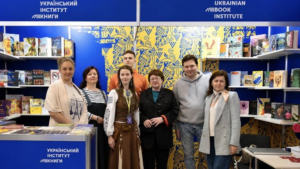
Approximately 7 million hryvnias per year are currently allocated for programs to promote reading and support related projects in Ukraine, which does not meet the industry’s actual needs, said Oleksandra Koval, acting director of the Ukrainian Book Institute, in an interview with the Interfax-Ukraine news agency.
“As for the activities of the Ukrainian Book Institute specifically, the main problem remains insufficient funding. We have about 7 million hryvnias per year for programs to promote reading and support related projects. This allows us to support only 15–20 projects across the country. For a country the size of Ukraine, this is extremely little,” Koval said.
According to her, real change in the field of reading requires not dozens, but thousands of events each year, which should be held in libraries, schools, communities, at festivals, and book fairs.
Koval emphasized that one of the key challenges remains Ukrainians’ access to books, especially in small towns and villages.

She also noted that the systematic updating of library collections should become an important focus of state policy.
“We are convinced that new books are the strongest draw for libraries. That is precisely why Ukraine needs a systematic update of its library collections. In my opinion, libraries should receive at least one million new books each year, and ideally—around three million copies,” said the head of the UIC.
According to her, only under such conditions will the changes be noticeable to readers across the country, particularly in small towns and villages.
As reported, Ukrainians have spent over 3.5 billion hryvnias on book purchases under state support programs since late 2021, and in 2026, the Translate Ukraine program plans to publish about 100 translations of Ukrainian books in 33 countries worldwide. Book piracy causes losses to the Ukrainian market amounting to hundreds of millions of hryvnias.
BOOKS, CULTURE, OLEXANDRA_KOVAL, READING, UKRAINIAN_INSTITUTE_OF_BOOKS
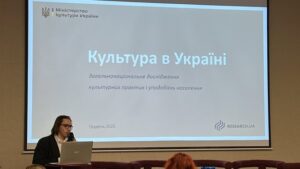
According to the Interfax-Ukraine Culture project, nearly 40% of Ukrainians attend cultural events once every six months or less, most often at movie theaters, according to the “Culture in Ukraine” study by Research.ua, which was presented by the Ministry of Culture of Ukraine on Thursday in Kyiv.
Specifically, when asked about the frequency of attending cultural events, 37% of respondents said they attend such events once every six months or less, 26%—once every few months, 30%—once a month or more often, and 7% noted that they do not attend cultural events.
Among the main sources of cultural news in 2025 were social media (75%) and messaging apps (65%), specifically: Telegram is a source of cultural news for 58% of respondents, Facebook – 51%, Instagram – 46%, and YouTube – 42%.
Among the most popular formats for cultural events are movie theaters (66% of respondents), music concerts (42%), and theater performances (40%).
Regarding barriers to attending cultural events: lack of funds (54% of respondents), lack of time (42%), lack of events nearby (26%), and lack of company (17%).
The survey was conducted December 22–30, 2025, via online interviews; the sample consisted of 2,000 respondents; the survey covered the adult urban population of Ukraine in all regions, excluding temporarily occupied territories.
https://interfax.com.ua/news/culture/1171698.html
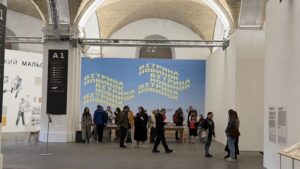
According to the Interfax-Ukraine Culture project, the 14th international “Book Arsenal” festival began in Kyiv on Thursday, bringing together over 150 participants from the book market, authors, publishers, artists, and intellectuals from Ukraine and abroad, reports a journalist from the “Culture” department of Interfax-Ukraine.
Over the course of four days, more than 240 events—including discussions, public talks, lectures, readings, workshops, presentations of new books, and meetings with authors—will take place at the Art Arsenal. In addition to the literary program, the organizers have also prepared musical and performance components for the festival.
This year’s artistic component of the “Book Arsenal” features 15 exhibition projects that combine contemporary art, documentary film, archival practices, and reflections on the Ukrainian experience of war.
The focus theme of this year’s festival, “Carry Your Freedom,” is curated by Ukrainian journalist, human rights activist, military serviceman, and former prisoner of war Maksym Butkevych.
Also returning to the festival this year is the “Writer’s Program,” curated by Andriy Lyubka, a Ukrainian Armed Forces servicemember, volunteer, poet, prose writer, and translator.
In an exclusive comment to the Interfax-Ukraine news agency, Ukraine’s Deputy Prime Minister for Humanitarian Policy and Minister of Culture Tetyana Berezhna said that despite the heavy workload associated with her government duties, she continues to read fiction regularly, as she considers it essential for strategic thinking.
“I am absolutely convinced that in order to develop visionary skills and think strategically, we need to read a great deal of both fiction and other literature,” Berezhna said.
According to her, among the books that have made the greatest impression on her recently are “Against Cultural Amnesia” by Vira Ageyeva and the essays of Yuri Shevelov, edited by Yevgen Stasinevich.
The minister also mentioned that she is currently reading children’s books with her five-month-old daughter. Separately, she advised Ukrainians to pay attention to the poetry of Bohdan-Ihor Antonych to support their morale and mental health.
“Book Arsenal” is one of the largest international literary and arts festivals in Eastern Europe, bringing together Ukrainian and foreign authors, publishers, intellectuals, artists, and public figures every year. The festival was founded in 2011.
After the start of Russia’s full-scale invasion, “Book Arsenal” became one of the key platforms for discussions on culture, memory, war, and Ukrainian identity.
https://interfax.com.ua/news/culture/1171814.html

According to the Interfax-Ukraine Culture project, in honor of International Museum Day, the Ivan Honchar Museum opened part of its collection and shared the stories of five exhibits that have survived the disappearance of villages, the changing of eras, the loss of traditions, and even the memory of themselves, the museum’s press service told the agency.
“Each of these items is not just an object, but an experience that cannot be contained within a single human biography. They preserve the memory of an environment that has already disappeared and give us a chance to experience it,” says Oleksandra Storchai, a researcher at the Ivan Honchar Museum.
These are items created decades and centuries ago, which today have become not just museum exhibits, but tangible witnesses to vanished worlds.
Among the main exhibits are two embroidered shirts from Bakota—a village in Podillia that was flooded in 1981 during the construction of the Novodnistrovsk Hydroelectric Power Plant. Today, this place is called the “Ukrainian Atlantis.”
The museum emphasizes that these shirts serve as a memory of the lives of people who were forced to leave their homes along with the village, which disappeared forever under the water.
The collection also features balamuty—traditional necklaces made of fossilized mother-of-pearl. According to legend, deposits of this material in Ukraine were exhausted by the end of the 19th century, so today it is virtually impossible to recreate such jewelry.
Another exhibit is a salba, a chest ornament covered with coins from various countries and eras. It combines coins from the Austro-Hungarian Empire, the United States, and Canada, some of which date back to the 18th century.
Separately, the museum displayed a Volyn shirt with a restrained aesthetic and complex embroidery techniques, as well as one of the oldest shirts in the collection—featuring a slanted sleeve. Such a cut was already considered outdated by the early 20th century.
The museum notes that all these items have one thing in common—they have outlived their owners, the eras, and the environments in which they were created, yet they continue to preserve the memory of them.
The Ivan Honchar Museum is one of Ukraine’s key museums dedicated to the preservation and study of Ukraine’s traditional culture and ethnographic heritage.
https://interfax.com.ua/news/culture/1168579.html

According to the Interfax-Ukraine Culture project, the 10th Italian Design Day took place in the capital, dedicated to the theme “Re-Design: Regenerating spaces, objects, ideas, and relationships,” regenerating spaces, objects, ideas, and relationships“), the Italian Embassy in Ukraine reported on its Facebook page.
”Design is a distinctive expression of Italian quality and an effective tool for meeting the growing demand of the Ukrainian market,” said Carlo Formosa, Italy’s Ambassador to Ukraine.
The event took place at Taryan Towers. It was attended by over 150 representatives of Ukrainian and Italian institutions, businesses, and creative industries.
Among the participants were Ukraine’s Minister of Economy, Environment, and Agriculture Oleksiy Sobolev and representatives of leading Ukrainian institutions.
The event focused primarily on issues of architecture, design, and post-war reconstruction. The Italian side was represented by “Design Ambassador” Luca Tripetti, who presented a vision for cooperation in the woodworking and furniture sectors in Ukraine. Designer Carlo Colombo also joined the event online.
As part of the event, the exhibition “Città in scena” was presented, dedicated to urban regeneration and sustainable development projects.
The embassy noted that the event took place against the backdrop of growing interest in “Made in Italy,” particularly in the fields of design and furniture.
Italian Design Day is an international initiative aimed at fostering cooperation in the fields of design, architecture, and the creative industries.
https://interfax.com.ua/news/culture/1165047.html

According to the Interfax-Ukraine Culture project, as part of the 17th Odessa International Film Festival, a 24-hour challenge for young filmmakers will be held in the capital, during which participants will create short films under time constraints, the festival’s press service reports.
“The format involves a full production cycle in 24 hours—from concept to final edit,” the initiative’s organizers note.
The challenge will be part of the festival’s industry track and is primarily aimed at young directors, actors, and creative teams working with video content. Participants will form groups and shoot short films lasting up to several minutes, using available tools, including mobile devices.
The organizers expect that this format will allow participants to test their skills in rapid storytelling, teamwork, and decision-making under pressure—all of which are critically important for the modern film and creative industries.
Special attention will be given to practical experience: participants will not only create content but also present their work to the festival’s professional audience.
The event will take place in late August in Kyiv as part of the film festival program, which has been held in the capital for several years.
The Odessa International Film Festival is one of the key film forums in Eastern Europe. Following the outbreak of full-scale war, the event temporarily changed its location and is now held in Kyiv, maintaining its focus on the development of the Ukrainian film industry and support for young filmmakers.
https://interfax.com.ua/news/culture/1164937.html



