

Latvia announced a contribution of 50,000 EUR to the Ukrainian Cultural Heritage Fund (UCHF), according to Ukraine’s Deputy Prime Minister for Humanitarian Policy and Minister of Culture Tetiana Berezhna.
“This is the eleventh country to support the Fund,” she wrote on Facebook on Tuesday.
The Ukrainian Cultural Heritage Fund was established as an international mechanism to mobilize resources for the protection and restoration of Ukrainian cultural heritage. To date, the Fund has already raised over EUR4.3 million, Berezhna noted.
“Funds from the Ukrainian Cultural Heritage Fund are directed toward specific projects—the protection, restoration, and preservation of Ukrainian cultural heritage. The first project to receive support is ‘Mystetskyi Arsenal,’” the post states.
Berezhna thanked Latvia for its support of Ukraine, its solidarity with Ukrainian culture, and its willingness to invest resources in its preservation.
As previously reported, in July 2025, the Ministry of Culture, together with its partners, presented new international instruments to support Ukrainian culture at the Recovery Conference in Rome (Italy): the Alliance for Cultural Resilience, the Ukrainian Cultural Heritage Fund, and Team Europe Ukraine.
In early November 2025, the second international conference, “Cooperation for Resilience,” took place in Copenhagen, Denmark, where the operational framework of the Ukrainian Cultural Heritage Fund was presented. Following the conference, Denmark, the Netherlands, Poland, and the United Kingdom announced that they would invest EUR 3 million in the newly established Ukrainian Cultural Heritage Fund.
In late January 2026, Berezhna stated that launching the UCHF’s operations would require an initial budget of EUR10–15 million. In June, she confirmed that EUR15 million would need to be raised by the end of 2026 for the UCHF to fully launch.
The following countries have announced their contributions: the Kingdom of Denmark—10 million Danish kroner; the Kingdom of the Netherlands—1 million euros; the United Kingdom—200,000 pounds sterling; the Republic of Poland and the Kingdom of Spain—0.5 million euros each; the Republic of Estonia—20,000 euros; the Republic of Latvia – 50,000 euros
It has been reported that the first site to be restored under the auspices of the Ukrainian Cultural Heritage Fund will be the History and Local Lore Museum in Ivankiv (Kyiv Oblast), which was destroyed by the occupiers and once housed paintings by Ukrainian artist Maria Pryimachenko.

The Second Ukrainian Film Festival in Thailand, organized by the Embassy of Ukraine to mark the 35th anniversary of the country’s independence, will take place in Bangkok on August 5–6.
The screenings will take place at the Bangkok Art and Culture Centre. The program includes four Ukrainian films of various genres—a biographical drama, a documentary, a family adventure film, and an anthology of short stories.
The festival will open on August 5 at 4:00 p.m. with a screening of the 2025 film “Malevich,” dedicated to the life and work of Ukrainian avant-garde artist Kazimir Malevich.
At 6:00 p.m., audiences will be treated to the 2026 documentary “The Underground Garden.” The film tells the story of a children’s art studio operating in a Kharkiv bomb shelter as it prepares for its first international exhibition.
On the second day, August 6, at 3:00 p.m., there will be a screening of the family adventure film “The Guard Post,” based on the legends and imagery of the Kievan Rus’ era.
The festival will conclude at 6:00 p.m. with the 2025 anthology of short films *War Through the Eyes of Animals*. It features stories based on real events about animals during a full-scale war. Oscar-winning American actor and director Sean Penn participated in the creation of the project.
The embassy noted that the festival program aims to introduce Thai audiences to the culture and history of Ukraine, the resilience of Ukrainian society, and the lives of people living under wartime conditions.
Admission to all screenings is free, but advance registration is required—https://forms.gle/CkNvc5TjmUdvDmV6A.

Ukrainian libraries are experiencing a systemic crisis that encompasses four dimensions: salaries at subsistence levels, a rapidly aging workforce, chronic underfunding of collections and facilities, and an outdated evaluation system, according to the analytical report “The Systemic Crisis in the Ukrainian Library Sector and Ways to Overcome It” by the Network for the Protection of National Interests “ANTS.”
“Ukraine’s libraries are now on the brink of survival. Librarians’ salaries in 2026 range from 5,691 to 7,356 UAH; young people are hardly entering the profession, and nearly half of the staff are already in the 45–60 age group. If the situation does not change, many libraries risk being left without the staff needed to keep them running. But the problem goes far beyond low salaries. It concerns the loss of institutions that preserve our memory, support education, digital literacy, and community resilience,” the ANTS statement reads.
According to the analytical report, Ukrainian libraries are experiencing a systemic crisis that encompasses four dimensions: salaries at the subsistence level (in 2026, salaries range from 5,691 UAH to 7,356 UAH); the rapid aging of the workforce (as of the end of 2025, approximately 46.7% of library staff were in the 45–60 age group, while young people accounted for 9.3%); chronic underfunding of collections and facilities; and an outdated evaluation system that fails to recognize libraries’ real contribution to societal development.
The report also proposes a three-stage action plan, the first stage of which calls for reviewing librarians’ salary scales, conducting an audit of the staffing situation, and identifying a list of frontline libraries for priority support within the first 6 months.
In the second phase—from 6 to 18 months—the plan is to launch pilot projects for new funding models that grant institutions greater autonomy, update collections and equipment, and shift to evaluating libraries based on indicators of social and educational impact—rather than solely on the number of visits and books checked out.
In the final stage, over a 3-year horizon, the proposal is to scale up successful models and integrate libraries into broader programs for reading, digital literacy, and adult education.
“Raising salaries is a necessary first step, but it is not enough. Without institutional reform, greater financial autonomy for libraries, and new performance criteria, the system will remain stagnant. Ukraine can develop a modern library network. Implementing this strategy will transform libraries from loss-making budgetary institutions into an effective public service and infrastructure for the development of the entire country,” the ANTS emphasized.
As previously reported, in late May, Deputy Prime Minister for Humanitarian Policy and Minister of Culture of Ukraine Tetiana Berezhna stated that the replenishment of library collections through co-financing with local communities could begin on July 1.
On June 22, Deputy Minister of Culture of Ukraine Bohdana Laiuk stated that she does not like the idea of transforming libraries into cultural hubs or cultural centers, and that she is also opposed to simply talking about closing libraries. At the same time, the deputy minister noted that there is currently no final decision on what the model for co-financing the replenishment of library collections with local communities will look like.
According to a study by the Ukrainian Book Institute (UBI), only 47% of local communities purchased books to replenish the collections of public libraries in 2025.
In April, a petition on the Cabinet of Ministers’ website calling for a review of librarians’ salaries did not receive the number of votes required for consideration.

The State Film Agency of Ukraine has selected 404 out of 449 submissions for feature films and TV series to advance to the next stage of the “Tysyachovesna” cultural support program competition.
The application period for the “Tysyachovesna” program ended on June 4. A total of 449 applications were submitted in the “Feature Films and TV Series” category.
Following a technical screening, the State Film Agency published a list of 404 participants admitted to the second stage of the artistic competition.
“In addition, in accordance with the requirements of the Regulations, a random draw was conducted to assign projects to the experts on the competition commission for expert evaluation during the second stage of the artistic competition,” the Agency’s statement reads.
The expert evaluation will continue until July 28. It is at this stage that a comprehensive professional evaluation of the submitted projects will be conducted by more than 180 experts, whose list has been approved by the government.
Each project will be evaluated by five independent experts based on ten criteria, including: the project’s relevance to the competition’s theme; the budget’s alignment with the creative concept; the professionalism of the team; the potential to engage the audience; artistic and content value; originality of the idea; social significance and potential impact; inclusivity, accessibility, and diversity; feasibility of implementation; and the team’s experience in implementing similar projects.
Based on the evaluation results, a list of participants will be compiled who will proceed to the next stage of the competition—the pitching session. The final pitching sessions, held in a festival format, will take place from August 12 to 16. Participants will present their projects to experts and competition committees, who will determine the program’s winners.
Estimated funding by category: feature films and series—1.9 billion UAH; non-fiction (documentary) films and series—240 million UAH; animated films and series, as well as films and series for children—490 million UAH; contemporary music – 300 million UAH; performing arts – 400 million UAH; visual arts – 300 million UAH; audiovisual shows and videos for social media – 260 million UAH.
As previously reported, on April 3, the Ministry of Culture launched the call for proposals under the initiative to create Ukrainian cultural products (formerly “1,000 Hours of Ukrainian Content,” now “Tysiachovesna”). The application period ran through June 4, and the final project pitching will take place August 12–16.
The 2026 state budget allocates 4 billion hryvnias for the implementation of this program. According to Deputy Prime Minister for Humanitarian Policy and Minister of Culture of Ukraine Tetiana Berezhna, this year a maximum of 80% of the 4 billion hryvnias—that is, 3.2 billion hryvnias—will be allocated to the “Tysyachovesna” program.
Berezhna also reported that the ministry will propose allocating funds for the “Tysyachovesna” program in the 2027 state budget. She added that next year, the project is planned to be expanded to include books and online games.

On June 17, the “Sens” bookstore on Khreshchatyk hosted the presentation of the first Ukrainian translation of Agatha Christie’s autobiography—a book the author worked on for 15 years and which literary scholars consider one of the most important works in her body of work.
According to a reporter from the culture desk of the “Interfax-Ukraine” news agency reporting from the scene, the event was attended by Svitlana Stretovych, founder and editor-in-chief of Stretovych Publishing House; literary scholar and publisher Rostyslav Semkiv; and translator Roksana Shevchuk, who spoke about the work involved in producing the first Ukrainian edition of Agatha Christie’s autobiography, the nuances of the translation, and the book’s significance for today’s readers.
“Mystery fans often say that Agatha Christie was the queen of the genre, but many consider her autobiography to be her strongest work. It offers insight into her perspective on life, people, and the era in which she lived,” Stretovych emphasized during the presentation.
The idea to publish Agatha Christie’s autobiography in Ukrainian came from Svitlana Stretovych, founder and editor-in-chief of Stretovych Publishing. According to her, the idea came to her unexpectedly after one of the book presentations.
“It just occurred to me one evening: has Agatha Christie’s autobiography been translated into Ukrainian? I was convinced it had. But the next day we started checking and it turned out there was no Ukrainian translation. So we immediately began searching for the rights holders,” Stretovych told the agency.
According to the publisher, negotiations to acquire the rights lasted several weeks. The process was complicated by the fact that Agatha Christie’s detective novels have been published in Ukraine by KSD for many years, so the rights holders first had to determine whether the author’s current Ukrainian publisher planned to release the autobiography.
Stretovich noted that the publishing house deliberately chose the autobiography, as biographies and memoirs are one of the key areas of its work.
“We were specifically interested in the autobiography. We didn’t plan to publish the detective novels, since another Ukrainian publisher handles that. Biographical literature, on the other hand, is one of our publishing house’s main areas of focus, so this book fits perfectly into our concept,” she said.
The book’s initial print run was 3,000 copies. The publication is nearly 800 pages long, and its current price is 750 UAH. However, according to Stretovich, the actual cost of the project is significantly higher due to the large volume of translation and preparatory work.
Finding a translator was a story in itself. According to the publisher, the team was looking not only for a professional specialist but also for someone who shared their values. An unexpected turn of events proved decisive when translator Roksana Shevchuk mentioned one of the publishing house’s books on social media almost at the same time.
“I took it as a sign and immediately wrote to Roksana with an offer to translate Agatha Christie. She agreed,” Stretovich said.
Translator Roksana Shevchuk told the agency that work on the Ukrainian edition took five months. According to her, the translation proved to be much more complex than usual work with a literary text, since it involved not only conveying the content but also recreating Agatha Christie’s own voice.
“Technically, it took five months. The war was constantly echoing both in the book and in my personal life. While I was working on it, my godson was killed in the Sumy region, and I was in the middle of translating the chapters about World War II. At a certain point, I had to take a break,” the translator said.
According to her, what impressed her most was the author’s ability to remain optimistic even after the most difficult trials in life.
“At a certain point in Agatha Christie’s life, she had suffered a tremendous number of losses. But even during the darkest times, she never lost her faith in people, her sense of humor, or her love of life. That’s what impressed me the most,” Shevchuk noted.
The translator is convinced that the autobiography is relevant to modern Ukrainian readers as well, since it speaks to a person’s ability to weather crises and start over.
“This book makes you want to be a better person. It teaches you not to be afraid to dream, not to set limits for yourself, and to keep searching for who you are, regardless of your age,” she said.
Literary scholar and publisher Rostyslav Semkiv called the book one of the most fascinating autobiographies in world literature.
“This is not just the life story of a famous writer. It is the success story of a person who is now ranked alongside Shakespeare in terms of popularity and print runs. Here you can see how she worked on her texts, communicated with publishers, overcame creative crises, and learned to write,” said Semkiv.
According to him, this very book served as one of the sources for his work on the craft of writing.
“When I was working on the book *How the Classics Wrote*, Agatha Christie’s autobiography formed the basis for the chapter about her. It contains a lot of practical advice for authors and, at the same time, is a very captivating human story,” he noted.
Semkiv expressed his conviction that the Ukrainian edition will be a success among readers.
“There are many fans of the mystery genre and of Agatha Christie herself in Ukraine. I think readers have been waiting for this book for a long time,” he said.
During the presentation, it was also emphasized that the team worked to preserve the atmosphere of the British era while making the text feel natural to Ukrainian readers. Significant attention was paid to historical explanations, footnotes, and cultural context.
Participants at the event described the autobiography as a book about the courage to live, to make mistakes, to lose, and to start over. That is why, nearly half a century after the author’s death, her personal story continues to find new readers around the world.
https://interfax.com.ua/news/culture/1177587.html
Agatha_Christie, Agatha_Christie_in_Ukrainian, CULTURE, роксана_шевчук, ростислав_семків, світлана_стретович
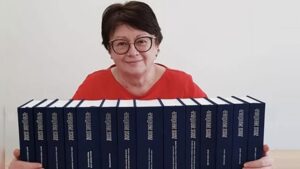
According to the Interfax-Ukraine Culture project, about 100 translations of Ukrainian books will be published in 2026 in 33 countries around the world under the Translate Ukraine translation support program, said Oleksandra Koval, acting director of the Ukrainian Book Institute, in an interview with Interfax-Ukraine.
“This year, under the Translate Ukraine program alone, about 100 translations of Ukrainian books will be published in 33 countries around the world. And in total, since the program’s inception in 2020, we have supported about 300 translations,” Koval said.
According to her, the sale of translation rights for Ukrainian books is currently one of the most successful avenues for Ukrainian literature to enter the international market.
Koval noted that Ukraine remains a key topic for the international cultural community, which contributes to growing interest in Ukrainian authors and their works abroad.
She emphasized that one of the most significant changes in recent years has been the perception of Ukraine as a distinct and independent participant in the international book market.
“Ukraine has finally become a distinct and independent entity in the international book market. It is no longer perceived as part of the Russian-speaking sphere and is increasingly associated with its own language, literature, and culture,” Koval emphasized.
According to the Ukrainian Book Institute, the database of translations of Ukrainian literature already includes over 1,500 titles in various languages of the world. The works of Andriy Kurkov, Serhiy Zhadan, Yuriy Andrukhovych, Oksana Zabuzhko, and the “Agrafka” creative workshop have the most translations. Among the new wave of authors who are actively attracting the attention of foreign publishers and readers, Koval highlighted Artem Chapay, Oleksandr Mykhed, Yevheniia Kuznetsova, Sofiia Andrukhovych, and Yuliia Ilyukha. At the same time, she recalled the significant contribution to the promotion of Ukrainian literature abroad made by the writers Viktoria Amelina and Volodymyr Vakulenko, who died during the war.
At the same time, one of the main challenges for the further promotion of Ukrainian literature abroad remains the shortage of translators from the Ukrainian language. According to Koval, demand for Ukrainian books is growing faster than the number of specialists capable of providing high-quality translations, and many translators already have orders booked several years in advance.
The head of the UIC also noted that international book fairs play an important role in promoting Ukrainian authors, where Ukrainian publishers negotiate new translations, contracts, and partnerships.
As reported, book piracy remains one of the biggest problems facing the Ukrainian publishing market and costs the industry hundreds of millions of hryvnias in losses every year.



