

As of July 1, 2026, the Poltava region ranked first in Ukraine in terms of the average amount of tax debt per debtor company.
According to data from the State Tax Service cited by Opendatabot, the average tax debt per company in Poltava Oblast is approximately 2.78 million UAH.
Kirovohrad Oblast ranks second in this metric, with an average of about 2.2 million UAH per company in debt.
These figures significantly exceed the national average. In total, 218,731 companies owe the state 263.32 billion UAH, meaning the average debt is approximately 1.2 million UAH per company.
However, the largest number of debtors and the largest absolute amount of debt are concentrated not in the Poltava region, but in Kyiv. There are 58,056 debtor companies registered in the capital, with a combined debt of 96.06 billion UAH.
Thus, regional statistics reveal a significant difference between the number of debtors and the size of the debt: Kyiv dominates in terms of absolute figures, while Poltava Oblast leads in terms of the average debt per company.
Source: Opendatabot

As of July 1, 2026, 218,700 Ukrainian companies had tax debt totaling 263.32 billion UAH, according to data from the State Tax Service analyzed by Opendatabot.
On average, each debtor company owes about 1.2 million UAH in tax debt.
Since the beginning of 2026, the number of companies with tax debts has increased by approximately 3%, while the total amount of debt has risen by 4%.
At the same time, tax debt grew much more sharply in 2025. Over the past year, the number of companies in debt increased by only 4%, but the total amount of debt rose by approximately 1.6 times—nearly 100 billion UAH.
Overall, since the start of the full-scale war, the aggregate tax debt of Ukrainian companies has increased by 2.5 times. Based on current figures, it stood at approximately 105 billion UAH at the start of the full-scale invasion, meaning it has increased by roughly 158 billion UAH during this period.
Information on individual companies with the largest tax debts is currently unavailable. Since the start of the full-scale war, the State Tax Service has restricted access to some open data and has been publishing mainly aggregated statistics.
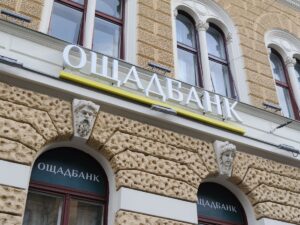
State-owned Oschadbank has put up for auction on the “Prozorro.Sales” platform a claim against ESU LLC, which owns 92.79% of the shares in JSC “Ukrtelecom,” with a starting price of 2.65 billion hryvnia, the bank announced on Friday.
The claim arose under a securities purchase agreement dated April 25, 2013, under which Oschadbank acquired 2 million bonds of ESU LLC with a total par value of 2 billion UAH.
The auction is scheduled for October 6 at 12:55 p.m., and the submission of bids will close on October 5 at 8:00 p.m. Bidding will follow the English-style ascending-bid model.
The starting price of the lot is 2.65 billion UAH excluding VAT; the minimum bid increment is 1%, or 26.45 million UAH; and the security deposit is 5%, or 132.27 million UAH.
Banks and other financial institutions that are legally authorized to provide funds and bank metals on credit are eligible to participate in the auction.
If the English-style auction does not take place, Oschadbank may subsequently offer the claim rights in a Dutch-style auction with a reduced starting price.
As previously reported, in November 2022, Oschadbank had already put the claim against “ESU” up for sale via OpenMarket (the State Enterprise “SETAM” of the Ministry of Justice) with a starting price of 1.82 billion UAH; however, the auction did not take place due to a lack of eligible bidders.
Following a tender announced in the fall of 2010, the State Property Fund of Ukraine sold 92.79% of Ukrtelecom’s shares in early 2011 to the Ukrainian subsidiary of the Austrian company EPIC—ESU LLC—for 10.58 billion hryvnias. The SCM Group, owned by Ukrainian businessman Rinat Akhmetov, acquired ESU in 2013.
In 2024, the Kyiv Commercial Court opened bankruptcy proceedings against ESU LLC.

Metinvest B.V. (Netherlands), the parent company of an international vertically integrated mining and metallurgical group, made a scheduled coupon payment on its 2027 Eurobonds.
As the group’s press service reported on Wednesday in response to a request from the “Interfax-Ukraine” agency, the payment was made on time, despite unprecedented challenges that have pushed the steel industry to the brink of survival.
“The aggressor’s blockade of Black Sea ports is limiting the volume of raw material and finished product shipments. At the same time, Ukrzaliznytsia has raised freight rates by 30%, which has increased the share of rail costs in the cost of metallurgical products by 2–3 times. And all of this is taking place against the backdrop of European restrictions, such as the introduction of CBAM and import quotas on Ukrainian steel into the EU, which have significantly reduced the group’s export opportunities,” the statement notes.
At the same time, it is noted that despite these critical obstacles, the group continues to diligently service its debt portfolio to preserve the ability to finance the restoration of its assets after the war and help the country recover more quickly from its aftermath. Since the start of the full-scale invasion, Metinvest has reduced its debt burden by $1 billion, the press service’s response emphasizes.
The current coupon payment dates for the 2027 Eurobonds are September 1. “Coupon payment dates are March 1 and September 1 of each year,” states the information regarding the 2027 bonds. The coupon rate is 7.650% per annum.
Metinvest is a vertically integrated group of mining and metallurgical enterprises. Its facilities are located in Ukraine—in the Donetsk, Luhansk, Zaporizhzhia, and Dnipropetrovsk regions—as well as in the European Union, the United Kingdom, and the United States.
The holding company’s main shareholders are the SCM Group (71.24%) and Smart Holding (23.76%). Metinvest Holding LLC is the management company of the Metinvest Group.

Agricultural holding company Astarta reported a net loss of EUR14.07 million in the first half of 2026, compared to a net profit of EUR42.27 million for the same period last year, according to a report filed by the company with the Warsaw Stock Exchange on Thursday.
According to the report, while all segments generated net profit in January–June of last year, each segment recorded a loss this year: in sugar production, a loss of EUR3.83 million replaced a profit of EUR8.35 million; in crop production, a profit of EUR20.07 million turned into a loss of EUR3.76 million; in cattle farming, a loss of EUR2.41 million was recorded instead of a profit of EUR10.68 million; and in soybean processing, a loss of EUR2.27 million was recorded instead of a profit of EUR5.84 million.
Crop production and soybean processing reported operating profits, while sugar production and livestock farming posted operating losses. Furthermore, livestock farming also reported a gross loss.
According to the report, Astarta’s consolidated revenue for the first half of the year decreased by only 0.1% to EUR 226.47 million, with export sales accounting for 62% compared to 61% in the first half of last year.
The agriculture sector led the way, with sales growing by 27% to EUR78 million, or 34% of total revenue. In sugar production, sales fell by 10% to EUR72 million, or 32% of total revenue; in soybean processing, by 7% to EUR51 million; and in livestock farming, by 15% to EUR25 million.
Gross profit for January–June of this year fell by half—to EUR46.01 million—as the cost of goods sold rose by 10% compared to the same period last year, and the estimated value of crops and livestock was reduced due to falling agricultural prices and rising costs.
Consolidated EBITDA fell 2.4-fold compared to the same period last year, to EUR34.32 million.
It is noted that net investments decreased by 41% to EUR27 million following the completion of investments in a protein concentrate production plant and ongoing planned capital expenditures in other segments.
According to the report, in the first half of 2026, net financial debt (excluding lease obligations) amounted to EUR81 million, compared to EUR28 million in the first half of 2025. Total net debt (including leases) increased by 44% to EUR220 million.
“Astarta” is a vertically integrated agro-industrial holding operating in eight regions of Ukraine and is the largest sugar producer in Ukraine. It comprises six sugar plants, agricultural enterprises with a land bank of 220,000 hectares, dairy farms with 22,000 head of cattle, an oil extraction plant in Hlobine (Poltava Oblast), seven grain elevators, and a biogas complex.
Astarta’s net profit for 2025 fell 4.2 times—to $19.94 million—while consolidated revenue decreased by 23%—to $472 million.

As of July 2026, sole proprietors registered in Kyiv owed the state 2.61 billion UAH in taxes, the highest figure among Ukraine’s regions, according to data from the State Tax Service analyzed by Opendatabot.
The capital accounts for about 16% of the country’s total tax arrears owed by sole proprietors, which amount to 16.6 billion hryvnias.
In second place is the Odesa region, with entrepreneurs owing about 1.6 billion hryvnias; in third place is the Kyiv region, with 1.37 billion hryvnias.
Collectively, Kyiv, Odesa, and Kyiv regions account for approximately one-third of all tax debts owed by Ukrainian sole proprietors.
At the same time, Kyiv region leads in the number of debtors, with 182,640 sole proprietors owing tax debt. Over the past year, their number has increased by approximately 1.5 times.
The Odesa Oblast has 119,470 individual entrepreneurs in debt, while the Kharkiv Oblast has 101,500.
In total, approximately 1.5 million individual entrepreneurs in Ukraine owe taxes, amounting to a total of 16.6 billion hryvnias.
Source: Opendatabot, data from the State Tax Service of Ukraine as of July 2026.



