
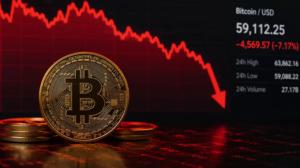
According to Fixygen, the cryptocurrency market is ending the week on a down note: Bitcoin has once again fallen below the psychological $60,000 level, Ether has approached $1,550, and most major altcoins are trading under pressure amid capital outflows from crypto ETFs, harsher expectations regarding Fed interest rates, and a strengthening dollar.
As of Thursday and Friday, Bitcoin was trading around $59,200, down approximately 3% over the past 24 hours.
The intraday low was around $58,200. Ether fell to $1,550, losing about 5.5% over the day, while Solana held steady around $68–69.
The week marked a continuation of June’s weak performance. Earlier this month, Bitcoin was trading above $70,000, but the market then faced a series of negative factors: record or near-record outflows from U.S. spot Bitcoin ETFs, growing investor interest in stocks of companies related to artificial intelligence, a strengthening U.S. dollar, and deteriorating sentiment surrounding major corporate Bitcoin holders.
This week, the pressure intensified after Bitcoin once again fell below $60,000. CoinDesk noted that the cryptocurrency’s decline is occurring even amid periodic gains in other risky assets, as capital continues to flow into the technology and AI segments of the stock market. According to CoinDesk, Deutsche Bank attributed Bitcoin’s drop below $60,000 to the Fed’s hawkish rhetoric, outflows from ETFs, and concerns surrounding companies with high Bitcoin exposure.
Ethereum has also failed to serve as a safe-haven asset within the crypto market. Trading at around $1,550, the second-largest cryptocurrency by market capitalization remains under pressure alongside the broader market. The decline in ether indicates that investors are currently reducing their exposure to crypto assets in general, not just bitcoin.
Solana appeared slightly more resilient intraday, but the overall sentiment for altcoins remains weak. When Bitcoin falls below key levels, investors typically reduce their positions in riskier tokens faster than in the market’s core assets.
The dynamics of spot Bitcoin ETFs in the U.S. remain a separate factor. In June, the market already experienced several waves of outflows from funds that had previously been one of the main sources of demand for Bitcoin. When ETFs stop supporting the market with inflows, Bitcoin becomes more sensitive to macroeconomic data, yields, the dollar, and overall risk appetite.
Globally, cryptocurrencies are now competing for capital not only with traditional assets but also with the AI sector. Reuters previously noted that investors are increasingly shifting funds toward AI-related stocks and anticipated major IPOs, while bitcoin is experiencing one of its weakest starts to the year in the past decade.
Through the end of the week, the key technical level for Bitcoin remains the $58,000–$60,000 range. Holding this range could give the market a chance to stabilize, but a sustained move below $58,000 would reinforce expectations of a further decline. In this case, the next area of focus could be $55,000, which some analysts view as a potential level for a local bottom to form.
The base case scenario for the coming days is heightened volatility and cautious attempts at stabilization following the sharp decline. For a sustained recovery, the market will need a combination of several factors: an end to outflows from ETFs, a weaker dollar, softer expectations regarding Fed interest rates, and a return of risk appetite for crypto assets.
For now, the crypto market remains in defensive trade mode: investors prefer to reduce their exposure, cut their losses, or wait for new signals from ETF flows and the U.S. macroeconomy.

The U.S. dollar is rising modestly against the euro, the pound sterling, and the yen on Tuesday morning amid increased demand for safe-haven assets.
The ICE DXY index, which tracks the dollar’s performance against six currencies (the euro, Swiss franc, yen, Canadian dollar, pound sterling, and Swedish krona), is up 0.1%, while the broader WSJ Dollar Index is up 0.09%.
The U.S. military struck two boats belonging to the Islamic Revolutionary Guard Corps (IRGC) and an anti-aircraft missile system position in Bandar Abbas in southern Iran, Fox News reporter Jennifer Griffin reported.
Meanwhile, U.S. Secretary of State Marco Rubio stated that negotiations with Iran in Qatar are ongoing, though finalizing the wording of the agreement between Washington and Tehran could take several days.
Meanwhile, European Central Bank (ECB) Executive Board member Isabel Schnabel said in an interview with Reuters that the regulator will likely have to raise key interest rates in June, even if the U.S. and Iran manage to sign a peace agreement by then.
“Given the scale and duration of the shock we are seeing, it can no longer be ignored,” she said. “Based on the information available at this time, I believe a rate hike will be necessary in June.”
French Central Bank Governor François Villeroy de Galhau, who will step down at the end of May, told Le Figaro in an interview that the regulator will not hesitate to take measures to curb inflation and bring it back to the 2% target.
As of 9:19 a.m., the euro/dollar pair is trading at $1.1631, compared to $1.1643 at the close of the previous session; the single European currency is down about 0.1%.
The pound fell 0.2% against the dollar to $1.3474, compared to $1.3505 at the close of trading on Monday.
The U.S. dollar rose 0.1% against the yen to 159.06 yen, compared to 158.91 yen at the close of the previous session.
The dollar is stable against the offshore yuan at 6.7875 yuan.

Silver prices on Monday are showing a sharp decline amid a strengthening U.S. dollar and a general deterioration in sentiment in the precious metals market. As of 9:25 a.m., silver futures on Comex fell 10.5% to $62.345 per ounce.
The rise in the DXY dollar index is weighing on prices, as are expectations that the U.S. Federal Reserve may maintain a tight monetary policy for longer than the market had previously anticipated. An additional factor is demand for the dollar as a safe-haven asset amid the ongoing conflict in the Middle East.
Like other precious metals, silver becomes less attractive to investors when the dollar is strong, especially as yields on dollar-denominated instruments rise.
Silver is important not only as an investment and monetary metal but also as an industrial raw material. It is widely used in solar energy, electronics, electrical engineering, medicine, and battery production, so its market depends on both financial and industrial factors.
Reference: The Experts Club analytical center previously released a video analysis of the twenty largest silver-producing countries and their competition for leadership from 1971 to 2024 – https://www.youtube.com/shorts/HvKK-YET8vs

Gold prices are falling sharply on Monday amid the strengthening of the U.S. dollar against major global currencies and a shift in expectations regarding the Federal Reserve’s monetary policy. As of 9:25 a.m., April gold futures on the Comex exchange fell 9.7% to $4,131 per ounce. This is the lowest level since November 2026.
Pressure on the market is coming from the dollar’s rise, as well as growing fears that the Fed may abandon plans to cut rates or even raise them by year-end if inflation accelerates. According to CME FedWatch, traders estimate the probability of a 25-basis-point rate hike at nearly 36%.
A strong dollar traditionally reduces gold’s appeal to investors using other currencies, as it makes the metal more expensive when purchased outside the U.S.
Gold is important to the global financial system as a safe-haven asset, a savings instrument, and a component of central banks’ international reserves. It is also significant for industry due to its use in electronics, medicine, and high-precision technologies.
Earlier, the Experts Club analytical center presented an analysis of the world’s leading gold-producing countries in a video on its YouTube channel — https://youtube.com/shorts/DWbzJ1e2tJc?si=BywddHO-JFWFqUFA

The spot price of gold exceeded $5,000 per troy ounce for the first time on Monday amid growing demand for safe-haven assets. As of 8:02 a.m., the spot price of gold rose 1.8% to $5,078.54 per ounce, reaching $5,093.05 per ounce during the session.
The price is supported by fears of another US government shutdown and the weakening of the dollar: the DXY index, which reflects the dynamics of the US currency against six major world currencies, is down 0.5%.
Since the beginning of the year, gold has risen in price by 15.5%.
Earlier, the Experts Club analytical center presented an analysis of the world’s leading gold-producing countries in its video on YouTube channel — https://youtube.com/shorts/DWbzJ1e2tJc?si=BywddHO-JFWFqUFA

The National Bank of Ukraine (NBU) increased dollar sales on the interbank market by $79.0 million, or 12.5%, to $712.1 million last week, according to statistics on the regulator’s website.
According to the NBU, during the first four days of last week, the average daily negative balance of currency purchases and sales by legal entities decreased to $67.3 million from $69.3 million during the same period a week earlier, totaling $269.3 million.
On the currency exchange market for the population, on the contrary, the negative balance increased to $46.5 million from $21.9 million the week before last, and on all days, the purchase of non-cash currency exceeded its sale.
The official hryvnia-to-dollar exchange rate, which started last week at 42.2942 UAH/USD, weakened daily to a new historic low, broke through the 43 UAH/USD level, and ended the week at 43.0757 UAH/USD.
The hryvnia’s exchange rate against the euro also fell by 1.1% over the week, from 49.5794 UAH/EUR1 to 50.1444 UAH/EUR1. During these days, it also broke through the important level of 50 UAH/EUR1 for the first time and reached a historic low of 50.1762/EUR1.
On the cash market, the dollar exchange rate over the past week followed the official trajectory, with the dollar rising by approximately 77 kopecks over the week: purchase – to 42.84 UAH/$1, sale – to 43.26 UAH/$1, while on the black market on Monday it reached 43.4-43.5 UAH/$1, with the euro also rising in price by 80 kopecks and currently trading at: purchase – 50 UAH/EUR11, sale – 50.73 UAH/EUR1.



