

According to the Serbian business media outlet Parametar, housing prices in the European Union rose by 4.7% in the second quarter of 2026 compared to the same period last year, and by 4.0% in the eurozone, according to Eurostat data published on October 1.
Compared to the first quarter of this year, housing prices in the EU rose by another 1.2%, and in the eurozone by 1.1%.
Year-over-year price increases were recorded in 23 EU countries for which data is available. Prices fell in only three countries: Finland (by 2.7%), Luxembourg (by 2.2%), and France (by 0.8%).
Portugal led the EU in housing price growth, with prices rising 16.5% over the year. Bulgaria ranked second with a 15.5% increase, and Lithuania third with 14.3%.
High growth rates also persisted in Slovakia, where housing prices rose by 13.6%, Croatia—by 12.7%, and Spain and Romania—by 12.1% each.
In Latvia, the increase was 11.4%; in Hungary, 10.2%; in Denmark, 9.4%; in Slovenia, 9.1%; in the Czech Republic, 8.6%; and in Cyprus, 7.9%.
More moderate price growth was observed in Malta—6.9%, in Poland—6.3%, Ireland—6%, Estonia—5.8%, Austria—5.1%, Sweden—4.8%, the Netherlands—4.3%, and Italy—4%.
Some of the lowest positive figures were recorded in Belgium—2.1%—and Germany—just 0.6%.
Compared to housing prices in the first quarter of 2026, prices rose the fastest in Lithuania—by 5%, Bulgaria—by 4.5%, and Romania—by 4.4%. Quarterly declines were observed only in Hungary—by 1.4%—and France—by 0.8%.
Eurostat calculates the House Price Index based on the cost of residential real estate purchased by households, including both new construction and existing homes.

According to Experts Club, EU countries issued approximately 3.9 million first-time residence permits to third-country nationals in 2025, which is 10.1%, or 355,350, more than in 2024.
This was the highest figure since Eurostat began compiling comparative statistics in 2008.
Labor migration was the main driver of this growth. The number of first-time work-related permits increased by 179,700, or 16.1%, over the year, reaching approximately 1.3 million. Work-related permits accounted for 33.6% of all first-time residence permits issued.
The number of permits issued for family reasons rose by 14.1%—to approximately 1.1 million, or 28.1% of the total.
Another 600,000 residence permits, or 15.5%, were issued for educational purposes. Their number increased by 9%.
About 22.8% of permits were issued on other grounds, including international protection. In this category, the number of residence permits decreased by 0.9%.
Ukrainian citizens constituted the largest group of first-time permit recipients—335,100—followed by India with 227,600 and Morocco with 202,100.
Spain led all EU countries in the total number of new permits, issuing 635,400 residence permits.
The data does not include individuals under temporary protection, including the millions of Ukrainians who fled the country after the start of the full-scale war.

According to Experts Club, Ukrainian citizens received 335,100 first-time residence permits in European Union countries in 2025, ranking first among citizens of all non-EU countries, according to Eurostat data.
Ukrainians accounted for 8.7% of all first-time residence permits issued in the EU to third-country nationals. Citizens of India ranked second with 227,600 permits, or 5.9%, while Morocco ranked third with 202,100 permits, or 5.2%.
Compared to 2024, the number of first-time residence permits issued to Ukrainians increased by 13.6%. A year earlier, there were about 295,000. Thus, despite the continuation of the temporary protection mechanism, the flow of Ukrainians who are transitioning to or initially applying for other grounds for legal residence in the EU remains significant.
The main reason Ukrainians obtained their first residence permit was employment. According to Eurostat, approximately two-thirds of the permits issued to Ukrainian citizens in 2025 were related to employment.
Poland remained the primary destination: it accounted for 72% of all first residence permits issued to Ukrainians in the EU.
At the same time, Eurostat specifically notes that these figures do not include individuals benefiting from temporary protection in connection with Russia’s full-scale invasion of Ukraine. Temporary protection is accounted for in separate statistics; therefore, the 335,100 permits reflect other grounds for residence—primarily work, family, education, and other categories.
In total, EU countries issued approximately 3.9 million first-time residence permits to third-country nationals in 2025.
EU, Eurostat, EXPERTS CLUB, MIGRATION, RESIDENCE PERMIT, UKRAINE

Verifying a foreign investor helps Ukrainian businesses establish the origin of capital, the ownership structure and the partner’s ability to fulfil its obligations.
When raising foreign financing, the main attention is usually paid to verifying the Ukrainian company. A potential investor analyses financial statements, corporate documents, taxes, litigation, assets and the business model.
However, Ukrainian owners should also verify the party offering the capital. The name of a well-known fund in a presentation or claimed access to significant financial resources does not yet confirm that the negotiations are being conducted by an authorised person or that the money actually belongs to the declared investor.
Before signing an agreement, it is worth verifying the legal entity, the date of its establishment, its executives, owners, corporate group, previous investments and possible sanctions or reputational risks.
Particular caution is required if the investor demands payment of an upfront fee, uses unofficial email addresses, avoids providing corporate documents or proposes making payments through a company that is not a party to the agreement.
D&B third-party verification solutions make it possible to identify a company, analyse its corporate relationships, establish its owners and conduct checks against sanctions lists and other risk sources. D&B Investigate is also used to visualise business relationships and support enhanced due diligence.
“When raising capital, it is not only the Ukrainian company that undergoes verification. Business owners also need to understand who is offering the financing, where this capital comes from and whether the potential investor is capable of fulfilling its obligations,” emphasised Maksym Urakin, Director of Development and Marketing at Interfax-Ukraine, Head of the D&B-Interfax-Ukraine Business Unit and PhD in Economics.
According to him, verification is particularly important for small and medium-sized businesses that do not have their own large legal or compliance department and may perceive the very fact of a foreign investor’s interest as confirmation of its reliability.
The verification result does not replace legal and financial due diligence, but it helps determine whether it is worth proceeding to the costly stage of negotiations, disclosing confidential data and providing access to internal documentation.
Before signing an agreement, it is also necessary to make sure that the representative is authorised to act on behalf of the investor and that the bank account used for the transaction belongs to a party to the agreement or to a duly authorised entity.
Dun & Bradstreet is an international business data and analytics company founded in 1841. Its solutions are used for company verification, corporate ownership analysis, compliance, credit risk assessment and business decision support.
In Ukraine, Dun & Bradstreet is represented by the Interfax-Ukraine News Agency. The D&B-Interfax-Ukraine unit helps Ukrainian enterprises verify potential investors, partners, buyers and suppliers. The agency has operated in the political and economic information market since 1992.
Enquiries can be submitted via D&B’s specialised resource — dnb.ua, by email at Urakin@interfax.kyiv.ua or by telephone at +38 (044) 270-65-74.
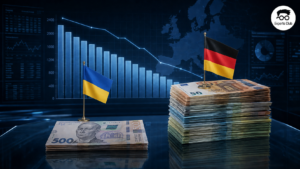
Ukraine continues to have the lowest minimum wage among European countries with a statutory minimum wage included in Eurostat statistics.
As of 1 July 2026, Ukraine’s minimum wage amounts to EUR 169 gross per month when converted into euros, according to Eurostat data.
Moldova ranks second from the bottom with a minimum wage of EUR 313, while in all other countries covered by the survey, the figure exceeds EUR 500.
For comparison, the minimum wage is approximately EUR 517 in Albania, EUR 620 in Bulgaria, EUR 621 in Türkiye, EUR 624 in North Macedonia, EUR 670 in Montenegro and EUR 743 in Serbia.
At the opposite end of the European ranking is Luxembourg, with a minimum wage of EUR 2,771 per month. It is followed by Ireland, Germany, the Netherlands, Belgium and France, where the minimum wage exceeds EUR 1,800 in all cases.
When making comparisons, it should be taken into account that Eurostat presents the figures in euros and as gross monthly equivalents. For countries that do not use the euro, the amounts are converted using the exchange rate at the end of the previous month. Therefore, changes in the national currency’s exchange rate may also affect a country’s position in the ranking.
In total, Eurostat covers 22 EU member states with a national minimum wage and seven candidate and potential candidate countries where such a wage is established at the national level. At the same time, Denmark, Italy, Austria, Finland and Sweden do not have a single statutory national minimum wage.
Below is the full ranking of minimum wages in Europe as of 1 July 2026, from highest to lowest, gross per month converted into euros according to Eurostat’s methodology.
Luxembourg — €2,771
Ireland — €2,391
Germany — €2,343
Netherlands — €2,338
Belgium — €2,234
France — €1,867
Slovenia — €1,482
Spain — €1,425
Lithuania — €1,153
Poland — €1,119
Cyprus — €1,088
Greece — €1,073
Portugal — €1,073
Croatia — €1,050
Malta — €994
Estonia — €946
Czechia — €923
Slovakia — €915
Hungary — €906
Romania — €825
Latvia — €780
Serbia — €743
Montenegro — €670
North Macedonia — €624
Türkiye — €621
Bulgaria — €620
Albania — €517
Moldova — €313
Ukraine — €169

Only eight of the 29 European countries that have a national minimum wage raised it in their national currency between January and July 2026, according to Eurostat data.
The largest increase over the six-month period was recorded in North Macedonia—6.9%.
Next were Romania and Estonia—both at 6.8%—followed by Belgium at 5.8%, Greece at 4.5%, Luxembourg at 2.5%, France at 2.4%, and the Netherlands at 1.9%.
In the remaining 21 countries, the minimum wage in national currency remained unchanged between January 1 and July 1. This group includes, in particular, Serbia, Croatia, Slovenia, Poland, Germany, Spain, Portugal, Bulgaria, Hungary, and Ukraine.
At the same time, the absence of an increase in the nominal minimum wage effectively means a decline in its purchasing power in countries where consumer prices continued to rise during this period.
Eurostat publishes comparative data on minimum wages twice a year—as of January 1 and July 1. Changes that occur between these dates are reflected in the next semi-annual update of the statistics.
As of July 1, 2026, the minimum wage among EU countries ranged from 620 euros in Bulgaria to 2,771 euros in Luxembourg. When candidate countries are included, the lowest figure was recorded in Ukraine—169 euros.



