
The Experts Club think tank has analyzed European countries’ responses to the fuel crisis. European countries’ responses to the 2026 fuel crisis have so far been mixed. Some governments are directly intervening in the fuel market by restricting exports, introducing price caps, and releasing reserves. Others are limiting themselves to price monitoring and coordination at the EU and G7 levels, trying not to provoke a shortage with even tougher measures.
Serbia has chosen the most aggressive form of intervention. The authorities have temporarily suspended exports of oil, gasoline, and diesel until March 19, explaining that this is to protect the domestic market from shortages and price spikes. Reuters notes that Serbia had already been controlling fuel prices since February 2022, meaning that the current decision is a continuation of a more interventionist regulatory model.
Hungary has opted for a mixed scenario. On the one hand, Budapest has introduced a price cap on gasoline and diesel for cars registered in Hungary. On the other hand, the government decided to use state reserves, and the Minister of Economy, according to Hungarian media reports, also announced a reduction in excise duties and a ban on the export of some petroleum products. This is a typical example of a combined anti-crisis scheme, where the authorities simultaneously try to keep retail prices down and maintain the physical availability of fuel on the market.
Croatia has chosen a softer approach—limiting maximum retail prices for a two-week period. The government has set a maximum price of EUR1.50 per liter for Eurosuper, EUR1.55 for diesel, and EUR0.89 for “blue diesel,” and has also limited prices for liquefied gas. Zagreb has stated outright that without this measure, diesel would cost EUR 1.72 per liter and gasoline EUR 1.55. This means that Croatia is trying not to isolate the market, but to soften the final effect on households and businesses.
Slovakia and, to some extent, the Czech Republic have focused not on retail regulation but on supporting physical supplies. After the failure of supplies via Druzhba, Slovakia approved the use of 250,000 tons of oil from strategic reserves for refining, while Hungary and Slovakia began negotiations on the use of reserves back in February. The Czech Republic, in turn, announced its readiness to send small volumes of oil to Slovakia via the eastern Druzhba pipeline.
The UK has not yet introduced price caps or export bans. Treasury Secretary Rachel Reeves said the government was monitoring the situation closely and warned retailers that it would not allow “excessive profits” amid the oil shock. This approach is closer to a supervisory model: the authorities are signaling to the market that they are ready to tighten control over the behavior of sellers, but are not moving to direct price administration.
At the pan-European level, caution prevails for now. The G7 and the EU are discussing possible measures, including the use of strategic reserves, tax changes, and carbon price adjustments, but no decision on coordinated release of reserves has been made yet. France, as chair of the G7, says that “all options are on the table,” but acknowledges that there is no immediate shortage in Europe.
The European Commission, for its part, points to the structural vulnerability of Europe, which imports more than 90% of its oil and about 80% of its gas.
The main conclusion for Europe now is that countries are responding differently depending on their own vulnerability. Balkan and Central European countries, which are dependent on imports and specific supply routes, tend to act faster and more aggressively — through bans, price caps, and reserves. The large economies of Western Europe are still favoring coordination, market pressure, and preparing tools in case the situation worsens. But if the oil shock drags on, the current targeted measures could turn into a broader wave of European intervention in the fuel market.

As part of Rinat Akhmetov’s Steel Front military initiative, Metinvest is working on exporting bunkers for the border between Poland and Russia, the company’s Chief Operating Officer (COO) Alexander Mironenko said in an interview with Pryamyy TV channel.
“We are mainly working with our Western partners on shelters. This is very relevant right now: we are showing them our solutions for the construction of various structures. For example, a hospital that fully complies with NATO Role2 standards. It has been inspected by numerous delegations: military medics, engineers, and foreign specialists, and everyone agreed that the solutions are quite effective,” said Myronenko.
According to him, the company has presented its engineering solutions based on “hideouts” at many military-themed exhibitions and meetings, and they are very popular.
“We are currently working on entering the international market with these solutions, for example, for the construction of the border between Poland and Russia, using our experience and proposals for underground structures. The NATO army does not have such experience, so they are very interested in this. And we exchange information and experience with them,” said the COO.
He added that the shelters have undergone a major transformation. Initially, they were simply “barrels” buried in the ground. “Now we provide a full service — it is essentially an underground house with its own lighting, generator, stove, and all amenities: just plug the generator into the outlet, and the room is ready for use,” the COO clarified.
“The unique product we are proud of is, of course, the protective structures for the Patriot and SAMP/T air defense systems. And now we are developing protection for the Hawk air defense system control module, which operates in Ukraine. In my opinion, this is a unique experience, because we are talking about state-of-the-art technology designed to protect the sky from the enemy, but certain shortcomings have been revealed in real combat conditions. Together with the military, we corrected them – we made the control modules, radar installations, and other systems safer so that personnel could feel confident even in dangerous situations and conduct air defense of our cities and towns,” explained the top manager.
He added that the company plans to continue supporting the military in all areas, both through the purchase of equipment and through the provision of its own products.
“In production, we will focus on protecting equipment: we will improve existing solutions and develop new ones for different types of equipment. The second area is the development of ”shelters” and solutions based on them. An underground training center has already been built on the basis of such shelters, and we are now completing the construction of another large underground center for pilot training. This is a large niche in which we plan to continue working and developing,” Myronenko concluded.
According to the results of 2025, Ukraine provided domestic exporters of animal and plant products with access to 22 new foreign markets, said Serhiy Tkachuk, head of the State Service for Food Safety and Consumer Protection, during a public report on Thursday.
According to him, this figure is a record for the period of full-scale war.
“Last year, we opened 22 new export markets. Currently, work is underway to open about 300 more. It does not stop there, because it is our priority to ensure that small, medium, and large Ukrainian businesses have the opportunity to export their products worldwide,” emphasized the head of the State Service.
According to the data presented, in 2025, the Chinese market opened up to Ukrainian peas, wild-caught seafood, and aquatic products. India and Canada allowed the import of Ukrainian apples. Canada also opened its market to table eggs.
“Each new certificate is the result of lengthy technical negotiations and audits. For example, opening up markets in countries such as Canada or China requires strict adherence to high safety standards,” added Tkachuk.
In addition, the Albanian market became accessible for table eggs, Argentina for sunflower seeds, and Kuwait for processed food products. Malaysia has opened access for milk, dairy, and egg products. Vietnam and Moldova have allowed the import of dairy products not intended for human consumption. The Chilean market has opened up for meat and bone meal and feather meal, and Turkey for canned animal feed.
Tkachuk noted that since 2022, Ukraine has managed to open a total of 75 new markets, despite logistical and political challenges.
“Even in the conditions of war, we continue to expand our geography. Currently, Ukraine has the right to export agricultural products to 386 trade destinations,” he specified.
The State Service of Ukraine for Food Safety and Consumer Protection is currently exploring opportunities to access markets in Asia, the EU, America, and the Middle East. In particular, work is underway to open the Canadian market for Ukrainian wheat, corn, soybeans, and rapeseed, as well as to expand the presence of plant products in China.
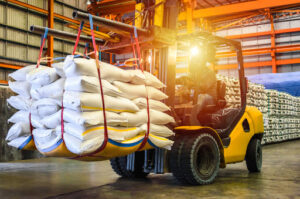
Ukraine exported 270,000 tons of sugar in the first half of the 2025-2026 marketing year (MY, September-February), according to the National Association of Sugar Producers of Ukraine “Ukrtsukor” on its Telegram channel.
The industry association specified that Lebanon was the main destination for Ukrainian exports during this period, accounting for 29% of the total. Syria (17%) and European Union countries (14%) were also among the top three consumers.
In addition, significant volumes of Ukrainian sugar were shipped to North Macedonia (6%) and Mauritania (5%).
As reported, Ukraine ended the 2025 sugar season with 1.72 million tons of sugar. Despite a 23% reduction in acreage (to 199,000 hectares), production fell by only 4% thanks to a record yield of 58 tons/hectare and high sugar content of raw materials (17.6%). Sugar yield was 15.17%.
According to Yana Kavushevskaya, head of the Ukrtsukor association, the industry remains export-oriented, but supply directions are being adapted to EU quota conditions. Export potential for 2026 is estimated at 700,000 tons, while domestic consumption is expected to reach 900,000 tons.
The leaders in production last season were Radekhiv Sugar (32% of the market), Astarta (21%), and UkrProminvest-Agro (15%).
According to the association’s forecasts, in 2026, the area under sugar beet cultivation may decrease to 170,000 hectares, which will lead to a decrease in sugar production to 1.3 million tons.

Ukraine needs to boost its presence in Sub-Saharan Africa and shift from exporting raw materials to investing in processing, as current supplies amount to only $280 million per year in a market worth $10 trillion, said Artem Gudkov, head of the Ukrainian-African Trade Mission, at the Forbes Agro conference in Kyiv on Thursday.
“The total volume of the African market is about $10 trillion in GDP in terms of purchasing power parity. For Ukraine, this is a huge potential and an opportunity to gain its subjectivity. However, as of now, the total volume of Ukrainian exports to Sub-Saharan Africa is only $280 million per year for 1.2 billion people. We supply less there than to neighboring Bulgaria,” he stressed.
Gudkov said that Russia is waging a food war against Ukraine on this continent and has introduced an “all or nothing” policy. According to him, if individual countries plan to purchase agricultural products from someone other than Russia, the aggressor threatens to stop supplies to the region altogether.
According to the head of the trade mission, Russia is already moving towards total control of logistics. In particular, the aggressor is negotiating with the Tanzanian government to build its own processing terminal in the port of Dar es Salaam, which will enable it to dictate the terms of wheat and corn supplies across the entire east coast of Africa.
Gudkov believes that the time of “simple imports” is over, so Ukrainian agribusiness needs to integrate into value-added chains directly in the region. African governments and businesses are increasingly interested in the transfer of Ukrainian technologies, not just the purchase of raw materials.
He recalled the European Global Gateway program, which provides EUR 150 billion to finance projects in Africa. According to Gudkov, Ukrainian businesses can become stakeholders in these funds by exporting equipment, elevators, and engineering solutions rather than raw materials.
The expert noted that Ukraine’s experience of working in wartime is unique for African countries, which also face security risks. The mission is already discussing the potential for implementing Ukrainian agricultural processing clusters on the continent.
“We have the opportunity to turn our economic front into an offensive as well. Russia is actively exporting food products. If we cannot influence oil, we can destroy their food ties through our own expansion,” the head of the mission concluded.
The Ukrainian-African trade mission promotes the entry of domestic enterprises into the markets of Sub-Saharan Africa, focusing on the export of processing technologies, agricultural machinery, and the creation of joint ventures.
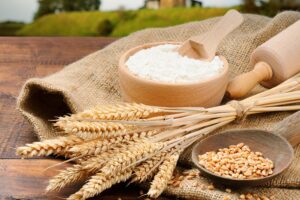
According to annual statistics from the Ukrainian Flour Millers Union and data from the Experts Club analytical center, in 2025 Ukraine exported 64.9 thousand tons of wheat flour to 25 countries worth $22.62 million. The average export price was about $348 per ton.
Exports remained highly concentrated: the five largest destinations accounted for almost 80% of the volume. The key markets were Moldova (19.4 thousand tons, about 30% of total exports), the Czech Republic (13.7 thousand tons, 21%), the Palestinian Territory (9.8 thousand tons, 15%), Spain (4.5 thousand tons), and Israel (4.2 thousand tons). Next in terms of volume were France (1.9 thousand tons), Poland (1.6 thousand tons), Sweden (1.6 thousand tons), Germany (1.4 thousand tons), and the United Kingdom (1.1 thousand tons).
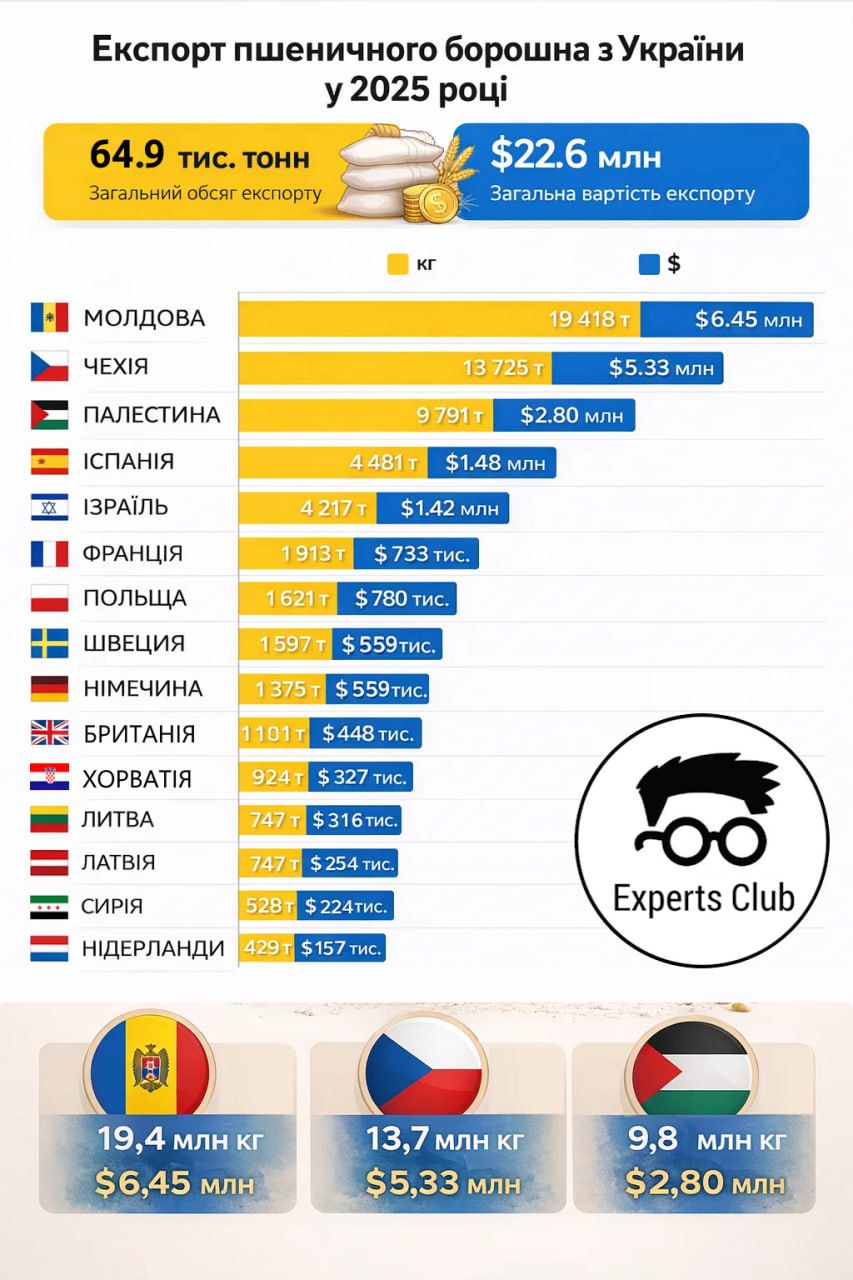
The European segment stands out separately: deliveries to EU countries in 2025 amounted to 28.5 thousand tons (about 44% of the total volume) worth $10.74 million (47%). At the same time, the average export price to the EU was significantly higher – about $377 per tonne compared to $326 per tonne for non-European destinations.
The price range by destination was significant – from approximately $286 per tonne (Palestinian territories) to $538 per tonne (Georgia, small batches). Among the large markets, the highest price was recorded for deliveries to Poland – about $481 per ton, which may reflect higher requirements for specifications, packaging, and logistics.
The industry emphasizes that access to the European market and predictable trade rules are becoming key to export and investment planning, according to Rodion Rybchinsky, head of the Ukrainian Millers Union, commenting on the EU’s separate tariff quota for Ukrainian flour and investments by export-oriented enterprises in modernization.



