
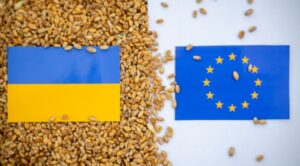
Wheat trade in Ukraine remains sluggish, while the corn market continues to see some activity, primarily along the western border, consulting firm Barva Invest reported on its Telegram channel.
According to the firm, prices for Ukrainian wheat with an 11.5% protein content on a DAP-Danube basis stand at $166–168 per metric ton.
“An imbalance between supply and demand persists in the Ukrainian wheat market. A shortage of EU quotas, logistics at the western border booked months in advance, and the absence of panic among importers are holding back trading activity and putting downward pressure on prices,” the report states.
Quotes for Ukrainian corn on a DAP Izov basis stand at $173 per metric ton.
“The Ukrainian corn market is in the off-season and awaiting the resumption of deep-water exports. Some activity continues along the western border for both the old crop and forward contracts,” analysts note.

According to Experts.news, the United Kingdom could come close to the entire European Union market in terms of Ukrainian chicken meat purchases by 2027, while the importance of Middle Eastern countries for Ukrainian exporters will decline, according to a forecast by the Kyiv office of the U.S. Department of Agriculture (USDA FAS).
In the “Poultry and Products Annual” report, published on August 19, 2026, the United Kingdom is identified as one of the key drivers of growth in Ukrainian chicken meat production and exports in 2026–2027.
On January 16, 2026, Ukraine and the United Kingdom agreed to extend the duty-free trade regime for chicken meat and a number of other agricultural products until March 31, 2028. The United Kingdom will not impose a tariff quota on Ukrainian chicken until that date.
According to USDA estimates, this effectively provides Ukrainian producers with nearly two additional years of unrestricted access to one of the world’s most price-competitive markets. In some months, retail prices for Ukrainian chicken in the United Kingdom have even been higher than in the EU.
As a result, FAS/Kyiv expects a further sharp increase in shipments to the United Kingdom. By 2027, their volume could become comparable to Ukraine’s total chicken exports to the EU.
At the same time, the European Union remains the industry’s largest premium market; however, shipments are limited by a new permanent duty-free quota of 120,000 metric tons per year.
The new quota was agreed upon by Ukraine and the EU in October 2025. It replaced the pre-war permanent quota of 90,000 metric tons and the temporary regime of autonomous trade measures, which allowed for significantly larger volumes to be exported. The USDA expects that in 2026–2027, actual exports to the EU will remain at the established limit of 120,000 metric tons.
The expansion of shipments to the UK and the EU is already changing the geography of Ukrainian exports.
The shift is particularly noticeable in the Middle East. The USDA reports that in 2026, Ukrainian chicken exports to Saudi Arabia—which had previously been Ukraine’s largest single export market for this product—ceased entirely.
This occurred despite MHP’s long-standing relationship with Saudi Arabia and the Saudi Agricultural and Livestock Investment Company (SALIC), which owns 13% of MHP. At the same time, the USDA anticipates that Ukrainian products may return to the Saudi market in the coming years.
Exports to Iraq, on the other hand, continue. The USDA specifically notes that Ukraine was not included in Iraq’s ban on chicken imports from 39 major supplier countries due to risks associated with highly pathogenic avian influenza.
Ukrainian producers also maintain a presence in the markets of Africa and the former Soviet Union countries; however, the most profitable European markets are gradually drawing a portion of the production toward them.
Exports via Turkey are primarily of a transit nature: according to USDA industry sources, most of the Ukrainian poultry arriving there is subsequently re-exported to Asia or Africa. At the same time, the free trade agreement between Ukraine and Turkey, which will take effect in 2026, provides for a separate duty-free quota of 2,000 metric tons for raw and processed poultry products.
Overall, according to the latest estimate by FAS/Kyiv, chicken meat exports from Ukraine will increase from about 450,000 metric tons in 2025 to 490,000 metric tons in 2026 and 530,000 metric tons in 2027.
Thus, one of the key changes over the next two years will be the further reorientation of the Ukrainian poultry industry toward the United Kingdom and the EU, at the expense of some of its traditional markets in the Middle East and Asia.
Source: USDA Foreign Agricultural Service, Ukraine: Poultry and Products Annual, UP2026-0022, August 19, 2026.

Prices for food and feed wheat in Ukraine remained unchanged over the week—$195 and $185 per metric ton, respectively, on a CPT Odessa basis, according to the brokerage firm Spike Brokers.
“Ukrainian wheat exports in August are estimated at 500,000 metric tons, compared to the usual 2 million metric tons for this month. Russian wheat exports in August are expected to reach 2 million metric tons, compared to 4.5 million metric tons last year. The flow of Ukrainian wheat to Constanta has begun to increase but remains limited for now. Efforts are being made to compensate for the shortage of Ukrainian wheat on the global market through other exporters,” the report states.
The price of corn also remained unchanged at $190 per metric ton on a CPT Odessa basis and $220 per metric ton on an FCA Chop basis.
According to brokers, the price of sunflower seeds also remained unchanged at $440 per metric ton (including VAT) on a CPT mill basis.
At the same time, rapeseed prices at the western border rose by $5—to $550 per metric ton on an FCA Chop basis. The price of rapeseed on a CPT port basis was $500 per metric ton, and on a CPT mill basis—$485 per metric ton.
Soybean prices also remained unchanged: GMO soybeans were priced at $420 per metric ton on a CPT port basis, $435 on an FCA Chop basis, and $425 on a CPT plant basis, while non-GMO soybeans were priced at $440 per metric ton on a CPT port basis and $470 on an FCA Chop basis.
According to Spike Brokers, global corn prices rose over the week, but Ukrainian prices remained unchanged due to physical export constraints. At the same time, the highest premium in the soybean market remains in the non-GMO segment along the western border.

In January–July 2026, Ukraine exported tractors worth $5.97 million, which is approximately 71% more than during the same period last year, when exports totaled $3.49 million, according to data from the State Customs Service.
Thus, tractor exports are growing significantly faster than imports, although in absolute terms, the volume of Ukrainian exports remains relatively small.
Belgium became the main market for Ukrainian tractors in January–July, accounting for 24.8% of total exports. Based on the total volume of shipments, the value of exports to this country amounted to approximately $1.48 million.
Over the course of the year, the geography of exports changed noticeably. In January–July 2025, Romania was the largest destination, accounting for 38% of Ukrainian tractor exports.
For the full year 2025, Ukraine exported $6.6 million worth of tractors, compared to $5.4 million in 2024. The main export destinations at that time were Romania, Belgium, and Germany.
It is noteworthy that in just the first seven months of 2026, exports nearly matched the total for the entire previous year: $5.97 million compared to $6.6 million for the full year of 2025.
If the current trend continues, the final figure for 2026 could exceed last year’s level; however, the data provided by the State Customs Service does not allow for a prediction of future monthly trends or the year-end total.
At the same time, Ukraine remains a major net importer of tractors. From January through July, imports totaled $507.5 million, which is approximately 85 times the value of exports.

Ukraine’s foreign exchange earnings from ferrous metal exports in July 2026 totaled $199.9 million, which is nearly 32% less than in June, when exports brought in $293.6 million, according to data from the State Customs Service.
Thus, July was noticeably weaker than the previous month for Ukrainian steel exports.
Overall, from January through July, companies in the sector earned $1.678 billion from ferrous metal exports, which is 7.6% less than during the same period last year.
At the same time, imports of ferrous metals in July totaled $176.4 million. The difference between exports and imports thus narrowed to approximately $23.5 million for the month.
Over the seven-month period, metal imports rose by 7.2% to $1.023 billion.
The decline in July’s export revenue comes after two years of recovery in metallurgical exports. In 2024, their value rose by 16.9%, and in 2025, by another 7.85%.

Ukraine’s positive foreign trade balance in ferrous metals decreased by approximately 24% in January–July 2026, to $655 million, according to Open4Business calculations based on data from the State Customs Service.
Over the seven months, Ukraine exported $1.678 billion worth of ferrous metals, while imports amounted to $1.023 billion.
During the same period of 2025, exports reached $1.816 billion, while imports, based on their current growth of 7.2%, amounted to approximately $954 million. Thus, the trade surplus at that time stood at approximately $862 million.
The reduction in the positive balance is associated with two trends: the export revenue of Ukrainian steelmakers decreased by 7.6%, while the value of products imported into the country increased by 7.2%.
In July, the gap between exports and imports narrowed even further: ferrous metal exports amounted to $199.9 million, while imports totalled $176.4 million.
Despite the deterioration in dynamics, Ukraine’s trade in ferrous metals remains in surplus. However, the margin of exports over imports is becoming significantly smaller.
Source: State Customs Service of Ukraine, Open4Business calculations.



