
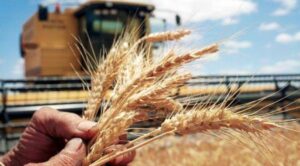
As of August 25, Ukrainian farmers had threshed 6.76 million hectares, or 58% of the projected area, and harvested 31.73 million metric tons of grain from the new crop, according to the press service of the Ministry of Agrarian Policy and Food.
Wheat was harvested from 5 million hectares, yielding 24.61 million metric tons, with an average yield of 49.2 centners per hectare; barley was harvested from 1.46 million hectares, yielding 6.33 million metric tons, with an average yield of 43.4 centners per hectare. Peas were harvested from 297,000 hectares, yielding 786,900 metric tons, with a yield of 26.5 ts/ha.
Farmers in the Odesa, Kirovohrad, and Dnipropetrovsk regions currently lead in terms of the gross harvest volume of grain and legume crops.
In the Odesa region, 4.82 million metric tons were harvested from an area of 1.19 million hectares, specifically: 3.22 million metric tons of wheat, 1.31 million metric tons of barley, and 285,000 metric tons of peas.
In the Kirovohrad region, 2.42 million metric tons have been harvested from an area of 556,000 hectares: 1.92 million metric tons of wheat, 412,000 metric tons of barley, and 82,000 metric tons of peas.
In Dnipropetrovsk Oblast—2.63 million metric tons from an area of 634,000 hectares: wheat—2.02 million metric tons, barley—568,000 metric tons, and peas—37,000 metric tons.
The highest grain yields are currently recorded in the Khmelnytskyi (70.8 ts/ha), Sumy (60.1 ts/ha), and Vinnytsia (59.7 ts/ha) regions.
The rapeseed harvest is nearly complete—1.32 million hectares have been threshed, or 99% of the projected area, yielding 3.79 million metric tons of seed with an average yield of 28.6 centners per hectare.
In some regions, the harvest of buckwheat and millet has begun. For buckwheat, 0.65 thousand hectares have been threshed, yielding 0.9 thousand metric tons at a yield of 13.8 centners per hectare; for millet, 3.6 thousand hectares have been harvested, yielding 7.84 thousand metric tons at a yield of 21.8 centners per hectare.
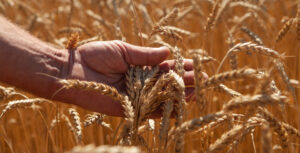
As of August 4, Ukrainian farmers had threshed 4.01 million hectares—or 34% of the projected area—and harvested 17.59 million metric tons of grain from the new crop, according to the press service of the Ministry of Agrarian Policy and Food.
Wheat was harvested from 2,736.5 thousand hectares (53% of the area), yielding 12.51 million metric tons with an average yield of 45.7 centners per hectare.
Barley was harvested from 1,015.0 thousand hectares (68%), yielding 4.42 million metric tons at a yield of 43.5 centners per hectare.
Peas: 261,700 hectares (88%) have been harvested, yielding 669,500 metric tons at a yield of 25.6 centners per hectare.
The Odesa region currently leads in terms of the volume of early grain and legume crops harvested, with 3.593 million metric tons harvested from an area of 857 thousand hectares (wheat—2.108 million metric tons, barley—1.252 million metric tons, peas – 232,5 thousand metric tons).
In the Mykolaiv region, 2.125 million metric tons have been harvested from an area of 606,2 thousand hectares (wheat – 1.440 million metric tons, barley – 577,9 thousand metric tons, peas – 106,8 thousand metric tons).
In the Dnipropetrovsk region, 1.911 million metric tons were harvested from an area of 475,400 hectares (wheat – 1.421 million metric tons, barley – 455,600 metric tons, peas – 34,000 metric tons).
Winter rapeseed has already been harvested from 910,600 hectares (68% of the total area), yielding 2.39 million metric tons.
As of July 28, Ukrainian farmers had threshed 2.6 million hectares—or 22% of the projected area—and harvested 10.65 million metric tons of grain from the new crop, according to the press service of the Ministry of Agrarian Policy and Food.
Wheat was harvested from 1,531.7 thousand hectares (30% of the area), yielding 6.61 million metric tons with an average yield of 43.2 centners per hectare.
Barley was harvested from 790,000 hectares (53%), yielding 3.49 million metric tons at a yield of 44.2 centners per hectare. Peas were harvested from 279,500 hectares (94.6%), yielding 549,500 metric tons at a yield of 19.7 centners per hectare.
The Odesa region currently leads in terms of the volume of early grain and legume crops harvested, with 2,425.7 thousand metric tons harvested from an area of 586.7 thousand hectares (wheat—1,252.1 thousand metric tons, barley—988.9 thousand metric tons, peas—184.7 thousand metric tons).
In the Mykolaiv region, 1,797.8 thousand metric tons have been harvested from an area of 514.1 thousand hectares (wheat – 1,152.0 thousand metric tons, barley – 539.0 thousand metric tons, peas – 106.8 thousand metric tons). In the Dnipropetrovsk region—1,493.0 thousand metric tons from an area of 376.4 thousand hectares (wheat—1,087.2 thousand metric tons, barley—379.0 thousand metric tons, peas—26.8 thousand metric tons).
Winter rapeseed has already been harvested from 539,600 hectares (41% of the total area), yielding 1.31 million metric tons.

Ukrainian farmers received over 137 million UAH in government aid for maintaining breeding herds of goats and sheep as part of the second phase of the first stage of the program to support the development of livestock farming and agricultural processing, according to a press release from the Ministry of Agrarian Policy and Food.
According to the report, in July, 536 farms and other agricultural producers received funds through the Ukrainian State Fund for Support of Farming Enterprises.
Support is provided to producers who maintain between 5 and 500 breeding goats and/or sheep. The budget subsidy amounts to 2,000 UAH per head.
The Ministry noted that the funds are intended to help agricultural producers maintain their herds, support economic activity in rural communities, and contribute to the recovery of sheep and goat farming, whose herds, according to the Ministry, have declined by nearly 30% compared to the pre-war period.
The program is funded as part of the World Bank’s ARISE project, aimed at revitalizing Ukraine’s agricultural sector.
Applications can be submitted through the State Agrarian Register (DAR).
As previously reported, in February, agricultural producers submitted 1,621 applications through the State Agrarian Register (DAR) within two days to receive subsidies for maintaining goats and sheep, totaling 203.6 million UAH.
In June, as part of the first phase of the program for the development of livestock farming and agricultural processing, farmers received over 93 million UAH in state support for maintaining breeding herds of goats and sheep.

Over the two years of the updated state support program, Ukrainian agricultural producers have purchased domestic agricultural machinery and equipment totaling over 10.5 billion UAH (including VAT), according to the press service of the Ministry of Economy, Environment, and Agriculture.
According to the ministry’s report, between April 2024 and February 2026, 8,982 enterprises took advantage of the opportunity for partial reimbursement of costs (25%). During this period, farmers purchased 14,611 units of equipment, and the total amount of funds disbursed by the state reached $2.2 billion.
“For farmers, this is a beneficial tool for modernizing their equipment fleet, and for manufacturers, it means an increase in orders. Since April 2024, the list of equipment eligible for state compensation has grown more than 14-fold. Funding for the program has already been allocated for 2026,” noted Minister of Economy, Environment, and Agriculture Oleksiy Sobolev.
The 2026 budget allocates $1.8 billion for the implementation of the state program. The first $126.1 million has already been disbursed to 382 manufacturers who submitted applications this winter. Farms in the Ternopil, Poltava, Cherkasy, Kirovohrad, and Vinnytsia regions were the most active buyers of equipment.
The official list of eligible equipment currently includes 14,425 items from 166 Ukrainian manufacturers. The ministry also noted that, starting in April 2026, the compensation rate for farmers in frontline areas has been increased to 40%.

The Cabinet of Ministers has introduced a military risk insurance mechanism for farmers, which provides for reimbursement from the budget of up to 60% of the insurance premium paid, according to Taras Vysotsky, First Deputy Minister of Economy, Environment, and Agriculture.
“Access to agricultural insurance in wartime is becoming not just a financial tool, but a key condition for economic stability. That is why the government has introduced a new mechanism: the state reimburses up to 60% of the insurance premium for farmers in frontline communities and up to 45% for other producers,” he wrote on his Facebook page following a meeting with representatives of the agricultural sector.
The Deputy Minister noted that agricultural processing companies are currently facing not only military threats but also challenging weather conditions, such as drought or spring frosts. Due to this combination of factors, the cost of insurance services in the sector remains high.
Vysotsky noted that the Ministry of Economy’s strategic goal is to create a market-oriented system that will combine private insurance, reinsurance, and state support. The ministry is currently consulting with businesses to determine acceptable insurance rates, remove barriers to access to financing, and compile a list of risks that remain uninsured.
“We are ready to carefully consider and gradually implement the solutions and proposals developed by the business community. It is precisely this kind of dialogue that allows us to shape state policy based on the real needs of the economy,” the deputy minister concluded.
As reported, in March 2026, the Cabinet of Ministers adopted Resolution No. 1541, which expanded the military risk insurance program. The maximum amount of insurance premium compensation for businesses was increased from UAH 1 million to UAH 3 million, and the deadline for submitting a claim for payment was reduced to 31 days after the contract is signed. For enterprises operating in frontline regions, compensation for damaged property is available up to UAH 30 million.
The 2026 state budget allocates over UAH 2 billion to support the agricultural sector and related insurance programs, of which UAH 1.8 billion is earmarked to compensate for the cost of Ukrainian-made agricultural machinery under the “Made in Ukraine” policy, as well as separate allocations for partial compensation of insurance premiums for winter crop producers and agricultural processors.



