
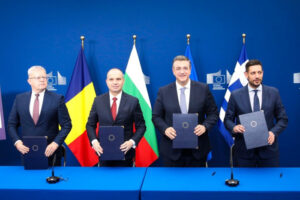
Bulgaria, Greece, and Romania have agreed to prepare a joint application for European funding for a high-speed railway line along the “Western Axis” Athens-Thessaloniki-Sofia-Bucharest, according to the Bulgarian publication Sega.
According to the publication, the initiative was discussed at a meeting between representatives of the three countries and the European Commission in the context of the development of the North-South transport corridor, which is intended to connect the Baltic, Black and Aegean Seas. The meeting was hosted by Bulgarian Deputy Prime Minister and Minister of Transport Grozdan Karadzhov.
Greek Transport Minister Konstantinos Kiranakis said that by 2027, it is planned to provide high-quality passenger rail service between Thessaloniki and Sofia, while the Bulgarian side recalled that rail service on this route was interrupted in 2017.
Karadzhov also noted that the countries intend to synchronize planning, design, and permitting procedures to avoid delays and bureaucratic obstacles. Among Bulgaria’s priorities, he highlighted the acceleration of the project for a new bridge across the Danube between Ruse and Giurgiu, as well as the preparation of projects for new bridges in the Nikopol-Turnu Măgurele and Silistra-Kelerashi areas; the restoration of ferry connections on the Danube, including the Ruse-Giurgiu line, was also mentioned.
According to Sega, Romanian Transport Ministry representative Ionut Cristian Savoiu named among Romania’s priorities the modernization of the existing Giurgiu-Ruse bridge, the construction of a new Danube bridge, and the development of road and rail lines, as well as improvements on the Vidin – Calafat – Craiova section for better connectivity with Ukraine and Moldova.
The European Bank for Reconstruction and Development (EBRD) is providing OTP Leasing with an unsecured loan in local currency equivalent to up to EUR 20 million to support micro, small and medium-sized enterprises (MSMEs) affected by the Russian Federation’s war against Ukraine.
“The financing will help strengthen the competitiveness, resilience, and inclusiveness of Ukrainian MSMEs by expanding access to leasing products in conditions of liquidity shortages and heightened economic uncertainty,” the bank said in a statement on Wednesday following the signing of the necessary documents.
It is noted that 50% of the loan funds are planned to be directed to MSMEs for long-term investments in technologies that meet European Union (EU) standards, in particular “green” technologies, and the financing should enable enterprises to obtain transport, equipment, and machinery without significant initial capital expenditures at a time when liquidity remains limited due to war factors.
Upon completion of the investment projects, borrowers who meet the program criteria will receive EU-funded technical assistance and US-funded investment incentives under the EU4Business initiative.
Additional grants are available for businesses that have suffered destruction, loss of assets, or forced displacement, as well as for companies that promote the reintegration of veterans, persons with disabilities, and IDPs, and for MSMEs that have relocated or operate in affected regions, with support also extending to businesses led by women and young people.
The loan will be supported by an interest rate subsidy of up to 10% from the US through the EBRD’s SME Special Fund.
According to the EBRD, the company is its current client and a leading leasing company in Ukraine, providing financial leasing and fleet management services to corporate clients and MSMEs throughout the country.
Since the start of Russia’s full-scale war against Ukraine, the EBRD has raised more than EUR 9.1 billion for Ukraine, including EUR 3.3 billion through partner financial institutions.
OTP Leasing is a non-bank financial institution subsidiary of Hungary’s OTP Bank, which has been working with the EBRD for many years.
In the third quarter of 2025, the company’s revenue increased by 7.3% compared to the third quarter of 2024, to UAH 1 billion 242.3 million, while net profit almost doubled, to UAH 808.0 million.
EBRD, FINANCING, LOAN, OTP LEASING, SMES
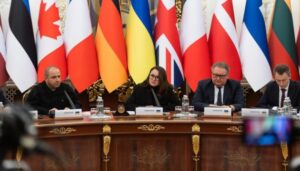
Over the next two weeks, Ukraine and its partners will work out in detail what sources of funding can be allocated for the implementation of the Ukraine prosperity plan, which is being developed as part of the peace agreement, how much of this funding can come from public sources, and how much can be financed by the private sector, said Minister of Economy, Environment, and Agriculture Oleksiy Sobolev.
“The $800 billion (total amount of the Ukraine Prosperity Plan – IF-U) comes from both private and public sources. According to our estimates, about $500 billion should come primarily from public sources: in the form of grants, some concessionary loans – that is, both what needs to be repaid and what does not need to be repaid,” Sobolev said at a briefing following the results of the economic block of consultations held in Kyiv on January 3 with national security advisers from 15 partner countries, the European Council, the European Commission, and NATO.
The minister added that at the same time, work will be done to determine which sectors of the economy have enough projects for the next 10 years to attract the private sector, and through which instruments this capital can flow into Ukraine.
According to him, this work has been going on for a long time, with the involvement of the World Bank and the European Union, so preliminary calculations already exist.
“Now we need to agree with all countries on the figures for each sector and overall needs, as well as the sources that can be found over these 10 years,” Sobolev explained.
He noted that there is a desire to attract more funding from the private sector, as this provides additional investment in Ukraine and improves reforms.
“But the private sector comes after there is a security framework, a security guarantee, and macro-financial stability, which requires institutional funds, funds from countries. And when there are reforms, and when there is concession capital, which reduces the risks of working in Ukraine,” the Minister of Economy also noted.
He specified that the next meetings will be held in Paris on January 5 in order to develop a joint plan with the US, European countries, as well as Canada and Norway.

Housing supply in Ukraine remains limited due to a lack of funding sources for developers and the effects of shelling, according to the NBU’s financial stability report for December 2025.
According to the regulator, the area of housing commissioned in the first half of 2025 corresponds to the figure for the same period last year, but the share of apartments in this structure has decreased. According to the NBU, the supply is mainly replenished by the completion of long-started residential complexes, while new projects are launched extremely rarely and mainly in the western regions.
Separately, the NBU emphasizes the impact of air strikes: in the first nine months of 2025, more than twice as many homes were damaged by shelling than in the same period last year.

The European Investment Bank is considering a EUR70 million project to supply Mykolaiv with drinking water.
“The sub-project aims to restore Mykolaiv’s access to drinking water after serious damage to its water supply infrastructure as a result of the destruction of the Kakhovka hydroelectric power plant by Russian troops in 2023. The implementation of the sub-project will bring significant environmental and social benefits, including improved water quality, reduced pollution, and increased energy efficiency,” the project description states.
In addition, temporary jobs will be created during the construction of infrastructure elements, the document notes.
According to information on the bank’s website, the beneficiaries of the financing are state bodies and companies. The project is part of the Ukraine Municipal Infrastructure Development Program, launched in 2015 with financing in the form of a EUR400 million framework loan.
As reported, in September 2024, the government reached preliminary agreements with the EIB to attract donor funds for the construction of a water intake from the Southern Bug River and a main water pipeline in Mykolaiv.
The EIB has been operating in Ukraine since 2007. Following Russia’s full-scale invasion in 2022, the Bank stepped up its financial support to help strengthen the country’s resilience and rebuild its infrastructure. Since then, the EIB has provided Ukraine with EUR 4 billion in financing.

Finnish Finance Minister Riitta Puurta has presented a draft budget for 2026 that proposes abolishing integration compensation paid to municipalities and social services for accepting asylum seekers and refugees, Yle reports.
It is noted that as part of the integration compensation, the state compensates municipalities for expenses related to the integration of immigrants. The most important of these services are language training and employment assistance, but they also include, for example, training courses that introduce people to Finnish society and customs.
The abolition of integration benefits will particularly affect those who have fled the war in Ukraine, said Sonya Hämäläinen, Director of Immigration at the Ministry of Employment and the Economy.
According to her, most users of integration services are asylum seekers and refugees.
Currently, most of them are Ukrainians who have applied for temporary protection. Their number is estimated at around 46,000. This year, about two-thirds of the funds spent on integration services will go to services for people arriving from Ukraine, and next year, according to estimates, three-quarters.
The amount of compensation paid by the state for the integration of refugees has increased dramatically. Before the Russian invasion in 2022, compensation payments amounted to $50-60 million per year, and now they exceed $150 million.
At the same time, municipalities have a legal responsibility for the integration of immigrants. This responsibility does not end even after compensation payments cease, according to Mikko Harkonen, Director of Viability at the Association of Finnish Local and Regional Authorities.
“Someone has to take care of integration, and then the municipality will have to use other means to provide these services.
Therefore, services must be financed, for example, by increasing municipal taxes or reducing other services. It may also be necessary to reduce the scope of integration services. Even now, compensation is insufficient to fully finance these services,” he stressed.
The draft budget will be discussed at government budget talks in the fall, after which the government will present its draft budget for next year. The final decision on the budget will be made by parliament.



