

The International Finance Corporation (IFC) is implementing the “Digital Finance Future Ukraine” advisory project in Ukraine with an estimated total budget of $2.83 million, aimed at developing digital financial services and attracting private capital, according to the corporation’s website.
According to the IFC, the project aims to expand access to financing for the general public and small and medium-sized businesses by promoting digital financial services as part of Ukraine’s recovery efforts.
The project involves collaboration with government agencies, financial institutions, fintech companies, as well as participants in the venture capital and private equity markets.
It is noted that the project, approved by the IFC on May 6, 2026, consists of three components.
The first component aims to align Ukrainian legislation and the regulatory environment in the field of digital financial services with European Union standards.
The second component is aimed at modernizing financial infrastructure and attracting private capital to the fintech sector, in particular through the development of open banking, venture capital, and direct investments.
The third component is designed to promote cooperation, innovation, and regional integration of the fintech market, as well as to provide its participants with the tools and knowledge needed to expand digital financial services and broaden access to capital.
The project is expected to be completed by March 31, 2030.
According to data on the IFC website, since the start of the full-scale invasion, the amount of financing provided by the corporation in Ukraine had reached $2.8 billion as of February 2026; in particular, over $1 billion was mobilized from partners and donors.

The European Bank for Reconstruction and Development (EBRD) and the European Union (EU) are launching the “Ukrainian SME Recovery” program, which is expected to provide approximately EUR135 million in financing and advisory support for small and medium-sized enterprises, larger companies, and startups in Ukraine, the financial institution announced on its website.
EU support under the program is being implemented through the Ukraine Investment Framework (UIF) and amounts to EUR46 million, including EUR41 million in guarantees and approximately EUR5 million in technical assistance.
According to the announcement, the program provides for financing at least 15 investment projects by Ukrainian companies, as well as advisory support for up to 34 startups.
The first component of the program will be implemented through the EBRD’s Risk Sharing Framework (RSF) in collaboration with partner banks. EU guarantees will be used to cover the first-loss risks of the EBRD and partner banks on a parity basis.
According to the bank’s assessment, this will expand Ukrainian companies’ access to long-term financing, particularly for the restoration and expansion of production assets and capacity.
The second component involves expanding the EBRD’s Star Venture program in Ukraine, aimed at supporting high-potential startups and developing an innovative ecosystem.
Under this initiative, selected startups, accelerators, and venture capital firms will receive advisory support. The funding is intended to help early-stage companies cover operational and market development costs and enhance their readiness to attract commercial investment.
The EBRD is the largest institutional investor in Ukraine. Since the start of Russia’s full-scale invasion in February 2022, the bank has allocated nearly EUR10 billion to Ukraine.

Ukrsibbank (Kyiv) plans to increase its loan portfolio in the small and medium-sized business (SME) segment by more than 2.5 times in 2026, according to Vladimir Shevchenko, head of the retail sales department.
“Last year, we increased our loan portfolio in the SME segment by almost 3 times,” Shevchenko said during the presentation of the results of the European Business Association (EBA) study “Small Business Sentiment Index” 2026.
Commenting on the study data, according to which only 12% of entrepreneurs consider lending as a source of financing, Shevchenko noted that this figure is low compared to developed countries, but at the same time indicates the potential for growth after the end of the war.
“For me, this 12% is like a glass that is half full and half empty.
On the one hand, it is very little, but on the other, it is the potential that awaits us after victory,” he added.
The main barrier to more active lending to small businesses remains entrepreneurs’ uncertainty about the future, while banks do not have a shortage of liquidity or credit appetite.
Shevchenko added that banks are adapting their processes to SME requests for quick access to financing, in particular by reducing decision-making time and trying to use information from open sources to offer customers almost ready-made solutions.
The greatest demand for lending in the SME segment comes from the retail trade (financing of working capital and covering cash gaps), while enterprises in the agricultural sector, manufacturing, and logistics also actively need loans.
“Among the key requirements of small businesses for banks, in addition to the cost of lending, the speed and convenience of financing approval are becoming increasingly important, as customers are not willing to wait one or two months for a loan decision,” Shevchenko emphasized.
At the same time, he noted that a significant increase in the share of entrepreneurs who consider loans as a source of financing should not be expected before the end of the war.
Ukrsibbank is owned by BNP Paribas (France) — 60% and the European Bank for Reconstruction and Development (EBRD) — 40%.
According to the regulator, as of January 1, 2026, the bank ranked 8th (UAH 186.48 billion) among 60 banks in Ukraine in terms of net assets, with a net profit of UAH 5.8 billion for 2025.
The bank’s net loan portfolio in 2025 increased by 73.9% to UAH 17.29 billion.
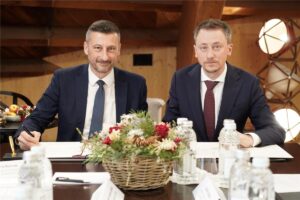
On January 21, Ukraine and Switzerland signed a Memorandum of Understanding in Davos on the sidelines of the World Economic Forum, launching a new large-scale economic sustainability program called “Competitiveness for Ukraine’s Recovery 2026-2030.”
“The total budget of the program is CHF 30 million. It is a long-term support tool for small and medium-sized enterprises (SMEs), which is particularly important for supporting SMEs in the current difficult conditions,” said Serhiy Sobolev, Minister of Economy, Environment, and Agriculture, on Facebook.
According to him, the priority areas include agribusiness and food processing, sustainable construction, woodworking, mechanical engineering, and IT.
As specified by the Ministry of Economy, the memorandum defines four strategic areas of work, including simplifying the conditions for doing business (improving the regulatory framework, digitizing public services, and reducing regulatory pressure on entrepreneurs) and strengthening institutions (supporting business associations and regional development agencies that will help SMEs enter new markets).
This list also includes the modernization of enterprises (direct technical assistance to businesses for the introduction of green technologies, automation, and EU quality standards) and the development of human capital (joint work with the International Labor Organization to involve veterans, women, and internally displaced persons in economic processes).
The program will cover 10 regions of Ukraine where Regional Development Agencies (RDAs) are already actively working, as well as those regions covered by other Swiss-funded projects. It is expected that this approach will ensure the even recovery of communities and the creation of jobs directly in the regions.
The program is fully synchronized with state strategies and the Ukraine Facility plan, the Ministry of Economy added.

The European Bank for Reconstruction and Development (EBRD) is providing OTP Leasing with an unsecured loan in local currency equivalent to up to EUR 20 million to support micro, small and medium-sized enterprises (MSMEs) affected by the Russian Federation’s war against Ukraine.
“The financing will help strengthen the competitiveness, resilience, and inclusiveness of Ukrainian MSMEs by expanding access to leasing products in conditions of liquidity shortages and heightened economic uncertainty,” the bank said in a statement on Wednesday following the signing of the necessary documents.
It is noted that 50% of the loan funds are planned to be directed to MSMEs for long-term investments in technologies that meet European Union (EU) standards, in particular “green” technologies, and the financing should enable enterprises to obtain transport, equipment, and machinery without significant initial capital expenditures at a time when liquidity remains limited due to war factors.
Upon completion of the investment projects, borrowers who meet the program criteria will receive EU-funded technical assistance and US-funded investment incentives under the EU4Business initiative.
Additional grants are available for businesses that have suffered destruction, loss of assets, or forced displacement, as well as for companies that promote the reintegration of veterans, persons with disabilities, and IDPs, and for MSMEs that have relocated or operate in affected regions, with support also extending to businesses led by women and young people.
The loan will be supported by an interest rate subsidy of up to 10% from the US through the EBRD’s SME Special Fund.
According to the EBRD, the company is its current client and a leading leasing company in Ukraine, providing financial leasing and fleet management services to corporate clients and MSMEs throughout the country.
Since the start of Russia’s full-scale war against Ukraine, the EBRD has raised more than EUR 9.1 billion for Ukraine, including EUR 3.3 billion through partner financial institutions.
OTP Leasing is a non-bank financial institution subsidiary of Hungary’s OTP Bank, which has been working with the EBRD for many years.
In the third quarter of 2025, the company’s revenue increased by 7.3% compared to the third quarter of 2024, to UAH 1 billion 242.3 million, while net profit almost doubled, to UAH 808.0 million.
EBRD, FINANCING, LOAN, OTP LEASING, SMES
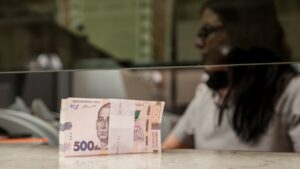
As of August 1, 2021, ten banks issued 1,917 loans to small, medium and micro-businesses (SME) through portfolio government guarantees totaling UAH 5.007 billion, the Ministry of Finance reported.
“Liabilities on the principal debt, which are partially secured by state guarantees on a portfolio basis, amounted to UAH 2.316 billion. This is about 59% of the total limit of guarantees provided in 2020 (UAH 3.93 billion),” the Ministry of Finance said on its website.
According to it, in July this year, banks provided 122 such loans for a total of UAH 735 million with a share of the state’s liabilities of UAH 306 million.
In terms of the number of loans issued, PrivatBank is in the lead – 945 loans for UAH 859 million in total, which is 100% of the limit of such guarantees provided to the bank in 2020. The second largest bank is Oschadbank – 680 loans for UAH 2.036 billion, according to the data of the Ministry of Finance.
“The program is in the greatest demand in Kyiv, where, in total, 151 loans were issued for UAH 542 million. In Lviv and Dnipropetrovsk regions, which are among the top three, these figures are 136 loans (UAH 340 million) and 129 (UAH 300 million),” the ministry said.
By type of economic activity, most of the loans, partially secured by state guarantees on a portfolio basis, were issued in the areas of wholesale and retail trade (675), agriculture (558) and processing industry (277).



