
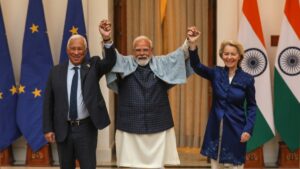
India and the European Union announced the conclusion of negotiations on a free trade agreement (FTA) following the summit in New Delhi.
According to the European Commission, trade liberalization will cover 99.3% for the EU and 96.6% for India (taking into account the partial liberalization of a number of items), with the EU eliminating tariffs on more than 90% of tariff lines and India on 86%.
The Indian side stated that the agreement provides access to the EU market for more than 99% of Indian exports in value terms, noting that the document will undergo legal review and final approval procedures.
According to EU profile materials, European agri-food exports will see a reduction in current high tariffs, including on alcoholic beverages—up to 30% for most wines, 40% for spirits, and 50% for beer. A number of Indian and industry sources also indicate that for certain categories, including passenger cars, tariffs may be reduced from 110% to 10% within an annual quota of up to 250,000 cars, and for premium wines – up to 20%.
EU-India trade in goods in 2024 amounted to around EUR 120 billion, with India being the EU’s ninth largest trading partner; for India, the EU is the largest trading partner in goods. The Indian Ministry of Commerce and Industry estimated bilateral trade in goods with the EU in the 2024-2025 financial year at $136.54 billion.
Source: https://expertsclub.eu/indiya-ta-yes-zavershyly-peregovory-shhodo-ugody-pro-zvt/
EU, FTA, INDIA, NEGOTIATIONS
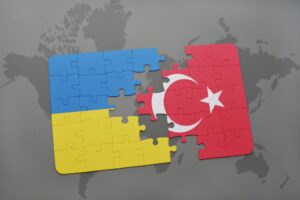
A free trade agreement with Turkey may make some types of Ukrainian agricultural products uncompetitive in Ukraine and in foreign markets, since Turkish food products have already taken a strong position around the world, and similar Ukrainian products may not find markets there.
Head of the Ukrainian Agricultural Export Association (UAEA) Dmytro Kroshka told Interfax-Ukraine on Monday about the impact of the FTA agreement with Turkey signed on February 3 on the export of Ukrainian agricultural products.
“Competition between Ukraine and Turkey is most visible on the markets of third countries. We have already determined that Turkish tomato on the Ukrainian market will be cheaper than domestic. Our producer understands that if he cannot make money on the Ukrainian market, he will seek sales in Europe or somewhere else, where it turns out that Turkey is exactly the same in those markets. And sooner or later, a manufacturer that cannot reorient itself will have to reduce production or abandon it, this is very likely,” the head of the association said.
He said that the key risk for the Ukrainian agribusiness from the zeroing of customs duties is the export orientation of Turkish producers, supported and controlled by the state.
“In Turkey, there is a huge infrastructural and financial support for exporters. The state establishes KPI there, and a manufacturer is supported, whose products are not just produced, but exported. And for a manufacturer to export, its products must meet the quality requirements that the market requires, and not only increase the volume. The effect of Turkish policy has become actively noticeable to us in recent years, when the active expansion of Ukrainian products to world markets began,” Kroshka said.
The head of the UAAE said that Ukrainian producers of apples, nuts and other products of the fruit and nut group will definitely benefit from the actions of the FTA, which Turkey will be able to re-export to the countries of the Middle East and Africa, taking advantage of its favorable geographical location. However, this is guaranteed to have a negative impact on vegetable and egg producers.
“We just need to look at the news about the FTA between Ukraine and Turkey as news that we will sell more there and the trade turnover will certainly increase. But at the same time, I believe that this agreement will reveal a wave of internal Ukrainian economic problems in agriculture, which are linked to the production of agricultural goods common with key Turkish products,” the expert said.
He also said that in 2022, Ukrainian agricultural producers were faced with an increase in energy costs, a review of existing taxes and the introduction of new ones, fiscalization of business, which, along with an increase in Turkish food imports, will lead to a wave of bankruptcies of small agricultural enterprises if the latter do not receive proper support from the state.
He said that the agreement on the main terms of trade in food products between Ukraine and Turkey took place simultaneously with the approval of the Export Strategy of Ukraine and the sectoral export strategy for food products, the implementation plans of which were provided, including reducing the tax burden on producers. However, this decision was never implemented, which will affect the state of the market in the near future.
“It seems to me that many manufacturers simply will not survive this stage of development of Ukraine. 2022, taking into account these factors, will be the beginning of a wave of bankruptcies, especially for small enterprises,” the head of the UAEA said.
AGRICULTURAL PRODUCTS, FOREIGN MARKETS, FTA, TURKEY, UNCOMPETITIVE
Ukraine and Turkey will reach an agreement on signing an agreement on a free trade area (FTA) in the next two days, President Volodymyr Zelensky has said.
“We are getting ready to give a powerful economic signal, to sign an FTA agreement with Turkey already within these two days. Our groups are working. I am sure that we will agree,” he said, speaking at the Verkhovna Rada on Tuesday.
Ukraine and Turkey are considering the meeting of the Strategic Council between Ukraine and Turkey co-chaired by both presidents in February 2022 as an opportunity to sign a free trade agreement (FTA), Ukrainian Foreign Minister Dmytro Kuleba has said.
“Next year, Ukraine and Turkey will celebrate 30 years since the establishment of diplomatic relations between the two countries. To mark this occasion, we plan to hold the next session of the Strategic Council between Ukraine and Turkey under the co-chairmanship of both presidents. A number of agreements and documents are currently being prepared ahead of next year’s Strategic Council. Both sides see the February 2022 meeting as an opportunity to finally sign a long-awaited Turkish-Ukrainian free trade agreement following years of negotiations,” Kuleba wrote in an article for the Atlantic Council released on Thursday.
Once in force, he said, this free trade deal will significantly boost already strong trade ties between the two Black Sea countries and facilitate the establishment of new business links.
“With bilateral trade steadily growing, we also plan to hold a joint intergovernmental trade and economic commission in the near future,” Kuleba said.
The Ukrainian Foreign Minister also said that Ukraine and Turkey are developing plans to unite forces in the production of Ukrainian Antonov aircraft.
“Our Turkish friends were very impressed with the capabilities of Ukrainian Antonov aircraft for extinguishing fires. During the last meeting with my Turkish counterpart Mevlut Cavusoglu in Lviv in October 2021, he expressed Turkey’s interest in Antonov aircraft. Ukraine welcomes this interest and is ready to explore the possibilities of joint aircraft production Antonov and international exports,” the minister said.
Kuleba said that with the climate crisis escalating, the threat of wildfires in Turkey and dozens of other countries around the globe looks like it is here to stay, along with increased demand for firefighting aviation.
“This makes the proposed aviation industry cooperation between Turkey and Ukraine strategically appealing. We plan to discuss this topic in more depth during our next Quadriga meeting of foreign and defense ministers, which will take place in December 2021 in Ankara,” he said.
Ukraine and Turkey are at the final stage of negotiations on a free trade area (FTA) after large moves made in the negotiation process, First Deputy Prime Minister, Minister of Economy Oleksiy Liubchenko said in an exclusive interview with Interfax-Ukraine.
“By the way, negotiations on an agreement on FTA with Turkey are now almost on completing. There have been significant positive moves in the negotiations,” he said.
Liubchenko also said that Ukraine had carried out preparatory work for negotiations with Tunisia, Egypt and Jordan.
Speaking about other areas of work of the Ministry of Economy in terms of international trade, he noted the unblocking of the work of the interdepartmental commission with Kazakhstan, following the meeting of which the ministry receives feedback from the parties.
“We are also systematically working with China, coordinated by Deputy Prime Minister Olha Stefanishyna. We have begun a joint study of the possibility of a free trade area agreement. The results will be known next year. On this basis, a political decision will be made whether to start negotiations. We are also actively working on preparations for negotiations with Indonesia and Vietnam,” he said.
Next week Turkey is ready to receive a Ukrainian delegation to finalize the technical aspects of the draft agreement on a free trade area (FTA) between the countries, Turkish Trade Minister Mehmet Muş said.
“Our delegations have already fruitfully worked on the agreement. And next week we are ready to host a delegation from Ukraine to finalize the technical aspects of the draft agreement,” the press service of the Economy Ministry of Ukraine said, citing Muş, following his videoconference with First Deputy Prime Minister Oleksiy Liubchenko on Monday.
The Turkish minister said the delegations should intensify their work and in the near future submit a draft agreement on an FTA between the two countries.
“We have several positions left where we must find a balance in our trade relations. It should be noted that during the negotiations with our Turkish colleagues we came to constructive and progressive solutions that will allow us to protect domestic markets where necessary and prepare an agreement, which will contribute to the deepening of trade relations and the development of the economies of our countries,” Liubchenko said.
According to the Economy Ministry, the videoconference was held following a phone conversation between President of Ukraine Volodymyr Zelensky and President of Turkey Recep Tayyip Erdoğan.



