
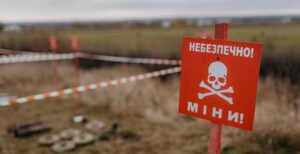
“Nibulon” Joint Venture LLC is preparing to begin work on its second humanitarian demining contract in Kharkiv Oblast, which involves clearing 64 hectares of agricultural land in the Izyum District, the company’s press service reported.
“The terrain is challenging, but we make timely decisions tailored to each specific challenge—to ensure effective work and achieve our main goal: that farmers in the Kharkiv region harvest grain, not the remnants of explosive ordnance,” the press service quoted Vsevolod Petrovsky, head of the “Demining” division, as saying.
According to the report, the work will be carried out under a subcontract on land owned by Landex-Agro LLC.
At the same time, Nibulon is completing its first government contract in the Kharkiv region, which it is carrying out jointly with Ukrainian Demining Services LLC. As part of this project, the company’s specialists have already surveyed more than 30 hectares of land across seven cadastral numbers on the territory of “Agrofirma Yug-M” LLC.
The work has passed an internal inspection and is currently undergoing an external audit conducted by the Mine Action Center of the Ministry of Defense of Ukraine, the statement said.
In addition, the company has completed a non-technical survey of 24 hectares of land in the Dnipropetrovsk region. The results have been validated by the Center for Mine Action in the IMSMA system.
The company noted that the development of its humanitarian demining operations is supported by DEG Impulse gGmbH, which has enabled it to strengthen its technical capabilities, particularly through the use of modern clearance equipment.
The statement noted that “Nibulon” has already completed its first commercial humanitarian demining contract in the Mykolaiv region. Since the start of operations, the company has returned more than 7,500 hectares of agricultural land to productive use and confirmed the certification of five mine action processes. Certification of three additional processes is currently underway.
As previously reported, in May 2025, Nibulon confirmed its certification in demining and expanded the list of mine action processes to eight areas.
Before the war, Nibulon LLC cultivated 82,000 hectares of land across 12 regions of Ukraine and exported agricultural products to more than 70 countries worldwide. In 2021, the grain trader exported 5.64 million metric tons of agricultural products—the highest volume in its history. After the war began, the company was forced to relocate its headquarters from Mykolaiv to Kyiv. In addition to 23 grain elevator complexes, “Nibulon” has its own trucking and rail transport capabilities, as well as a fleet built at its own shipyard. During wartime, this fleet continues to provide river transport services.
The company is also actively developing its own humanitarian demining division to restore safety on leased lands and assist Ukraine’s agricultural sector. Nibulon is a certified mine action operator.
DEG Impulse gGmbH is a nonprofit subsidiary of the German financial institution DEG that implements private-sector support programs funded by the German Federal Ministry for Economic Cooperation and Development (BMZ).
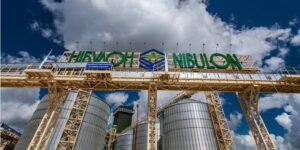
One of Ukraine’s largest grain market operators, Nibulon JV LLC (Mykolaiv), has been certified and granted the right to conduct humanitarian demining in the areas of Technical Survey, Manual Demining and War Zone Clearance, the grain trader’s press service reports.
“These certificates allow Nibulon sappers to carry out demining of Ukrainian land. At the same time, we continue to be certified in the process of “demining with the use of machines and mechanisms” to start clearing the land with the help of GCS-200 demining machines, obtained with the assistance of the German development bank DEG Impulse gGmbH, a subsidiary of DEG,” the agricultural holding said in a statement.
According to the report, Nibulon’s specialists have undergone a multi-level certification procedure at the Mine Action Center (MAC) under the Ministry of Defense of Ukraine. During the visit, representatives of the MAC checked the compliance of Nibulon sappers with the national legislation regarding the availability of the necessary documentation, equipment, including the equipment of an emergency medical vehicle, compliance with mine action processes and the competence of specialists.
“This is a very important moment for us, as certification required significant efforts from the entire team. Now, thanks to the hard work and help of our partners, Nibulon is ready to provide demining services to everyone at cost,” said Maksym Sovetkin, Head of Nibulon’s demining department.
At the same time, he noted that farmers are not ready to pay for demining services. Mr. Sovetkin pointed out the need for the government to enlist the support of donors and develop a transparent mechanism for compensating commercial players from the state to help farmers resume cultivating land and, accordingly, supply grain to world markets.
JV Nibulon LLC was established in 1991. Prior to the Russian military invasion, the grain trader had 27 transshipment terminals and crop reception complexes, capacity for simultaneous storage of 2.25 million tons of agricultural products, a fleet of 83 vessels (including 23 tugs), and owned the Mykolaiv Shipyard.
“Before the war, Nibulon cultivated 82 thousand hectares of land in 12 regions of Ukraine and exported agricultural products to more than 70 countries. In 2021, the grain trader exported the highest ever 5.64 million tons of agricultural products, reaching record volumes of supplies to foreign markets in August – 0.7 million tons, in the fourth quarter – 1.88 million tons, and in the second half of the year – 3.71 million tons.
Nibulon’s losses due to Russia’s full-scale military invasion in 2022 exceeded $416 million.
Currently, the grain trader is operating at 32% of capacity, has created a special unit to clear agricultural land of mines, and was forced to move its headquarters from Mykolaiv to Kyiv.
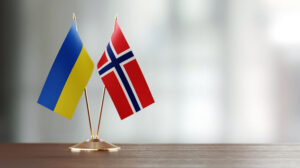
The Norwegian government is allocating an additional 200 million Norwegian kroner (about $18.5 million at the current exchange rate) for humanitarian demining in Ukraine, Norwegian Foreign Ministry State Secretary Eivind Vad Petersson has said.
“Since 2015, Norway has provided EUR 15 million in assistance through non-governmental organizations. Today, we are increasing our contribution by another 200 million kroner in additional demining assistance,” he said at the High Level International Donor Conference on Humanitarian Demining in Ukraine in Zagreb on Wednesday.
Vad Petersson also called for compliance with the Anti-Personnel Mine Ban Convention, adopted 25 years ago, expressing hope that Croatia would join it.
A statement on the Norwegian government’s website on Wednesday said that the widespread use of mines and cluster munitions in Ukraine has made it the most mined country in the world today, and that Norway will more than double its support for efforts to clear mines laid in Ukraine since the beginning of Russia’s brutal aggressive war.
It is noted that about 30% of Ukraine’s territory is currently littered with mines and unexploded ordnance, and demining is vital for Ukrainian farmers to grow crops.
“Russia’s military aggression on the territory of Ukraine affects not only Ukraine. It threatens food security around the world,” Foreign Minister Anniken Huitfeldt said in the release.
It is specified that Norway has previously provided NOK 164 million for demining activities since Russia launched a full-scale war against Ukraine in February 2022. The additional funds allocated under the Nansen Support Program for Ukraine will be channelled through existing demining organizations, including Norwegian People’s Aid, HALO Trust and the UN system.
Norway recalls that it has already provided more than NOK 4.5 billion in humanitarian aid to Ukraine and assistance to refugees in neighboring countries.
Earlier at the conference, Croatia, which organized the donor conference, announced the allocation of additional funding of EUR 5 million for humanitarian demining in Ukraine. Several other countries, including Spain, Slovakia, and Slovenia, announced at the conference that they would allocate additional funds for this purpose, but in these cases, the amounts were in the range of EUR0.5 million to EUR1.5 million.
According to a study conducted by the World Bank, the Ukrainian government, the European Commission, and the UN, the cost of humanitarian demining in the year after the start of Russia’s full-scale invasion was estimated at more than EUR34 billion out of the total cost of reconstruction and recovery of EUR383 billion. At the same time, the full extent of the contamination remains unclear due to the ongoing hostilities and occupation of the territory.
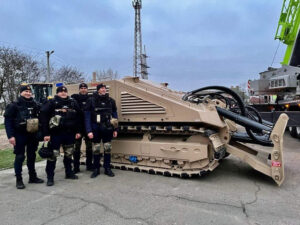
Ukraine to receive USD244m from donor countries to purchase special equipment for humanitarian demining, Ukraine’s first deputy prime minister and economy minister Yuliya Sviridenko has said.
A number of donor countries will provide Ukraine with USD244m to purchase special equipment for humanitarian demining, Ukraine’s First Deputy Prime Minister and Economy Minister Yuliya Sviridenko has said.
“Our donors, including the United States, the European Union, Japan, Germany, the United Kingdom, Norway, Sweden, Italy, Lithuania, the Netherlands, Denmark, Canada, Austria, Switzerland, Korea and the Howard Buffett Foundation will total more than USD244 million to Ukraine for humanitarian demining,” she wrote on Facebook.
According to the First Deputy Prime Minister, by the end of the year Ukraine should receive equipment from foreign partners, in particular, 10 demining vehicles from the Croatian company DOK-ING and another 10 vehicles from Global Clearance Solutions. It is expected to receive about 200 pyrotechnic machines, more than 600 metal detectors, 50 explosive machines, as well as individual demining kits, explosion-proof suits, quadrocopters, robotic systems for munitions clearance.
As reported, more than one third of agricultural land identified for priority demining has been surveyed in Ukraine. According to the State Emergency Situations Service, more than 411,000 explosive objects, including more than 3,000 aircraft bombs, have been neutralized on the territory of Ukraine since the beginning of Russia’s large-scale military invasion.



