
Concorde Capital, an investment firm that has been operating in the Ukrainian market since 2004, plans to lower the entry threshold for investors in its projects and launch retail investment products, according to Ihor Sotnyk, managing director of Concorde Capital’s investment banking department.
“We have already prepared this infrastructure and plan to launch products—including government bonds and other products that will be available to retail investors—and to develop this segment,” he said during a discussion on the prospects of the Ukrainian stock market organized by the Kyiv International Economic Forum last week.
Sotnik noted that the investment group began with joint investment initiatives, “investing in infrastructure, in the app, and in an asset management company.”
“The numbers show that there is money in the domestic market and people are still investing,” he explained, referring to Concorde Capital’s plans to develop such investment products.
The department director added that a successful example was the Encraft project for joint investments in distributed generation and energy storage systems, which managed to attract investors and launch the first phase.
In addition, the investment group launched a mobile app and digital investment platform called “Statock,” which currently lists three projects with a minimum investment threshold of $9,000.
At the same time, the Statock website states that in the third quarter of this year, the company plans to launch an investment module with a minimum investment threshold of just 1,000 UAH for government bonds, stocks, and bonds, as well as ETF funds, featuring savings accounts, automatic reinvestment, and portfolio management.
In addition, the launch of an AI-powered robo-advisor for selecting investment instruments and a PFM (personal financial manager) is scheduled for this quarter, while brokerage services are set to launch in the fourth quarter of this year.
It is noted that Statock is a fintech product of Concorde Capital’s subsidiary IT company, Concorde Fintech LLC, which, together with its partners, develops software for automating the retail investment business in Ukraine.
The investment firm Concorde Capital, founded and led by Ihor Mazepa, states on its website that in more than 20 years of operating in the market, it has secured $4 billion in investments for clients, executed more than 100 deals, and has more than 1,000 corporate clients and more than 100,000 investors involved in investments in real businesses.

At the “Carpathian Eight” summit in Bukovel, JSC “Ukrzaliznytsia” proposed a project to establish, in partnership with investors, a low-cost passenger carrier on routes between Ukraine and the EU using European-standard tracks, with investments in share capital totaling approximately $441 million.
According to the project description posted on the summit’s website, the carrier’s routes will run from western Ukrainian railway hubs—including Uzhhorod, Lviv, and Kovel—to markets in Central and Eastern Europe, specifically Budapest, Bratislava, Warsaw, Vienna, and Berlin.
As part of the project, there are plans to purchase modern trains for European-standard tracks.
It is noted that the project is in the advanced planning stage, and its implementation is expected to take approximately four years.
Ukrzaliznytsia hopes that this project will attract interest from rail and road carriers in Poland, Slovakia, Hungary, and Romania.
As previously reported, in late 2018 and in June 2019, trains operated by the state-owned railway companies MÁV-START of Hungary and ZSSK of Slovakia began running on routes from Mukachevo—where the European gauge track ends—to Budapest and Košice, respectively.
On the same route, starting in March 2024, the Czech private carrier RegioJet has been operating services from Chop to Prague; it also cooperates with Ukrzaliznytsia on services to the Polish city of Przemyśl, which borders Ukraine.
In addition, in October 2023, the Polish company SKPL (Stowarzyszenie Kolejowych Przewozów Lokalnych) became the first to launch passenger service on the standard-gauge route between Warsaw and Rava-Ruska, where passengers transferred to Ukrzaliznytsia trains bound for Lviv or Kolomyia. Starting in December 2024, the state-owned operator PKP Intercity also began operating on this route, and SKPL withdrew from it in September 2025.
Ukrzaliznytsia also has plans to extend the European-gauge track to Chernivtsi and Lviv; prior to the full-scale Russian invasion, the possibility of building a new high-speed rail line between Warsaw and Kyiv was also being considered.
As reported, Ukrainian President Volodymyr Zelenskyy noted that agreements on $1 billion in investments had already been reached during the first Carpathian Economic Forum.
The C8 Summit website lists about 90 projects across eight sectors. The energy sector has the most—33—followed by transportation and logistics with 11, industry and manufacturing with 17, and infrastructure and real estate with 12.
In terms of regions, the largest number of projects is listed in Lviv Oblast—30—followed by 14 in Zakarpattia, 13 in Chernihiv Oblast, 11 in Poltava Oblast, and 3 in Bukovina.
The first inaugural summit of the “Carpathian 8” (Carpathian 8 Summit) is taking place at the Bukovel ski resort in Ivano-Frankivsk Oblast from September 18 to 20.
European gauge, INVESTMENT, TRANSPORTATION, UKRAINE, UKRZALIZNYTSIA
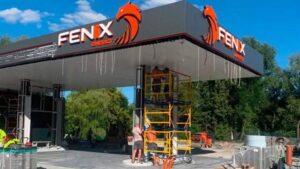
Western Fuel and Energy Company (ZTEK) plans to unveil its own network of FENIX energy gas stations by the end of 2026, which is expected to consist of approximately 20 locations in the initial phase.
Oleg Chykida, CEO and co-owner of ZTEK, announced this in an exclusive interview with the news agency “Interfax-Ukraine.”
“Our initial target is up to 20 gas stations by the end of 2026. Of course, we have to take military realities into account—a shortage of contractors and personnel, as well as disruptions in the supply of materials (…) Therefore, our plan is for up to 20 stations, but the timeline also depends on external factors,” he said.
According to Chikida, less than a year ago, FENIX energy practically didn’t exist, and he, along with his business partner and ZTEK co-owner Kostyantyn Gavrilenko, worked independently on the concept, name, color scheme, and positioning of the network.
“I’m cautious about chasing quantity. We’re entering a highly competitive and long-established market, so first we need to offer a high-quality product (…), build a strong team, refine the model, and only then scale it up,” the CEO noted.
The network’s primary geographic focus will be western and central Ukraine. ZPEK does not plan to operate in Kyiv during the initial phase.
FENIX energy will be financed from several sources: its own funds, profits from the group’s operations, and bank loans.
“Our key banking partner is Ukrgasbank. Over the past three years, we’ve gone from an initial financing round of approximately $110,000 to a credit line of about $17 million. At the same time, we’re in talks with other banks regarding the FENIX energy project,” Chikida said.
As he explained, ZTEK distinguishes three main formats for gas stations. The estimated budget, depending on the facility, can range from $700,000 to $2.5 million, while certain flagship complexes will require even greater investments.
For the urban format, the company is targeting approximately $1–1.2 million. There will also be regional highway stations and complexes along major national highways.
“We don’t want to build a network that differs only in the color of the ceiling. The foundation of FENIX energy is fuel quality control from import to the pump, a uniform standard for all facilities, and comprehensive roadside service,” added the CEO.
ZTEK plans to present some of its solutions, particularly those related to self-service, separately.

For the construction of underground fuel storage facilities to become possible in Ukraine, a compromise must be reached between the government and the private sector regarding the streamlining of permitting procedures and the provision of affordable long-term financing.
Oleg Chikida, CEO and co-owner of the Western Fuel and Energy Company (ZTEK), expressed this view in an exclusive interview with the “Interfax-Ukraine” news agency.
“We need to bring the government and the business community to the negotiating table and find a compromise: to safeguard the country’s strategic interests and create realistic economic conditions for private companies to build up reserves. As of now, I don’t see such a compromise yet,” he said.
According to the CEO, from the government’s perspective, reserves of oil and petroleum products are clearly necessary, but the conditions for businesses to build the required storage facilities have not yet been established.
“The first problem is financial. Building reserves means that a company must effectively freeze a significant amount of working capital. For ZTEK, this could potentially amount to more than one million dollars,” Chikida noted.
As he explained, an underground storage facility with a capacity of approximately 10,000 metric tons could require an investment of 10 million dollars, and for a private company, this is a very significant amount; therefore, affordable long-term financing is necessary to implement such projects.
“Programs are being discussed through state-owned banks at an interest rate of approximately 12% per year in hryvnia for five years. This is a step in the right direction, but it will not meet the industry’s needs,” the CEO believes.
The second problem, he says, is infrastructure-related. Since a significant portion of the storage facility network was destroyed or damaged during the war, the question arises: where should this resource be stored, and who will bear the risk if the storage site becomes a target of attack again?
“Specifically, we have a site where we could build an underground storage facility. But obtaining all the permits could take about a year and a half, and the construction itself, according to our estimates, is roughly three times more expensive than an above-ground facility,” Chikida noted.
He added, however, that ZTEK is ready to invest even under such conditions.
“But if we start the permitting process in September 2026, we’ll be lucky to get the documents in 2027, and construction won’t be completed until 2028. How will market demand change by then, and how will we recoup these investments?” the CEO asked.
As previously reported, Ukraine is set to launch a pilot project for the underground storage of petroleum products from the minimum reserves of oil and petroleum products (MZNN) starting in early 2027, in accordance with Cabinet of Ministers Resolution No. 1037 dated August 13, 2026.
The full text of the interview with Oleg Chikida, CEO and co-owner of ZTEK, will be published on the websites of the agency “Interfax-Ukraine” and its energy project “Energoreforma.”

Perfect Group plans to expand its rental real estate business in Kyiv and transfer some of the apartments in its complexes to professional management by hotel operators.
As the company’s CEO, Oleksiy Koval, stated in an interview with Interfax-Ukraine on September 1, 2026, the first such project is being developed in the LA MANCHE residential complex at 46 Shchekavitska Street in Podil. Forty apartments have been allocated for this income-generating real estate project.
The operator will focus primarily on long-term rentals.
Another project is being developed as part of the Stanford residential complex at 35 Predslavinskaya Street. Here, a separate section is planned for short-term rentals, and Perfect Group is in negotiations with a major professional operator.
The developer also plans to extend some hotel services to the other residents of the residential complexes. These include concierge services, babysitting, children’s playrooms, dog-walking, and other additional services.
According to Koval, after a period of competition among developers based on price, architectural concept, and infrastructure, the next key factor in market competition will be service quality.
For comfort-class housing, the company intends to develop a similar approach through digitalization. Perfect Group is developing an app to facilitate communication between residents and the management company, process requests, and vote on additional services. Its launch is planned for before the end of 2026.
In addition to income-generating real estate projects in Kyiv, Perfect Group is building the VELMY aparthotel in Polyanytsia near Bukovel.

On September 10, 2026, the Switzerland-Ukraine Municipal Cooperation Forum was held in Basel, focusing on the development of partnerships between Ukrainian and Swiss cities and the implementation of joint projects to rebuild and strengthen the resilience of communities, according to the Embassy of Ukraine to the Swiss Confederation and the Principality of Liechtenstein.
The forum brought together representatives of central and local authorities from Ukraine and Switzerland, as well as relevant organizations from both countries. It was jointly organized by the Swiss government, the cities of Basel, Bern, and Zurich, the Verkhovna Rada of Ukraine, the Embassy of Ukraine in Switzerland, the Ukrainian Association of Switzerland, and the Support and Recovery Platform.
Konradin Kramer, President of the Government of the Canton of Basel-Stadt; Iryna Venediktova, Ambassador of Ukraine to Switzerland; Vitaliy Bezgin, Minister of Community and Territorial Development of Ukraine; and Jacques Herber, the Swiss Federal Council’s delegate for Ukraine, delivered welcoming remarks to the participants.
Under the slogan “Building Partnerships. Achieving Results,” participants discussed the transition from inter-municipal contacts to specific investment and infrastructure projects. The main areas of cooperation identified were energy supply and energy efficiency, water infrastructure, local governance, and the development of public services.
The forum’s program included two panel discussions—one on the political foundations of municipal partnerships in reconstruction and the other on practical models for implementing such projects. Separate City Labs working sessions were held, during which representatives of Ukrainian and Swiss cities jointly developed specific proposals for further cooperation.
Municipal partnerships are one of the areas of Switzerland’s long-term support for Ukraine. The Swiss cooperation program with Ukraine for 2025–2028 specifically provides for support to local and regional authorities in the reconstruction and modernization of urban infrastructure and the provision of basic services, particularly in the areas of transportation, energy, water supply, healthcare, and education.
Swiss cities are already participating in practical projects in Ukraine. In particular, Basel is transferring up to 25 trams to Lviv as part of a program that Switzerland is funding with CHF 2.5 million from 2024 to 2028. Previously, Bern also donated trams to Ukraine.
Switzerland views the development of direct ties between cities as one of the mechanisms for Ukraine’s reconstruction. The country’s national program notes that Vinnytsia, Odesa, Sumy, and Kharkiv, among others, have previously expressed interest in partnerships with Swiss cities.
Holding the forum in Basel is intended to facilitate the transition from general agreements between communities to specific joint projects that can leverage Swiss technology, municipal expertise, and funding for the reconstruction of Ukraine’s infrastructure.



