

“Nova Poshta,” Ukraine’s leading express delivery service, has about 2,000 open positions, including 1,000 branch operators, 600 installers, 300 couriers and drivers, and another 100 in the support office, according to Anna-Maria Sabov, the company’s HR director.
“If we gain an additional platform as another recruitment channel, especially given that it will allow us to select candidates not only based on resumes but also on skills… I am confident that we will speed up the time it takes to fill vacancies,“ Sabov noted during the presentation of the launch of the first phase of the ”Obriy” digital labor market ecosystem in Kyiv earlier this week.
According to Nova Poshta’s management report, the total number of its employees in 2025 was 33,640, compared to 34,110 the previous year, while the average number of employees in 2025 was 27,570.
According to the director, the company’s current total time from the actual search to a trained candidate is about 30–35 calendar days, which includes a training phase lasting from three days to two weeks. Excluding this phase, the process would take 15–20 days.
“That’s a decent pace, but I want us to be even more productive,” Sabov emphasized.
She added that “Obriy” would provide additional value to employers if it allowed for the automation of paperwork when hiring employees, as this still requires a significant amount of time and resources.
The HR Director clarified that, overall, the recruitment department at Nova Poshta fills more than 1,000 vacancies each month, with 55 recruiters working to recruit employees for operational positions in the regions. According to her, the company plans to ensure staffing levels of about 95% during the summer to prepare for the seasonal increase in workload in September.
Sabov also reported that the company is launching a project to attract young specialists who will work on the architecture and modeling of Nova Poshta’s logistics. According to her, the company aims to make shipping cheaper and faster without compromising reliability and quality. To find such specialists, Nova Poshta plans to announce a separate campaign targeting a young audience in the near future.
“We will announce a major campaign to find such people. We want to start with five people first, so if “Obriy” can also provide, for example, a graduate’s GPA and their participation in extracurricular activities, such as academic competitions, this would be very valuable to us at “Nova Poshta” because we want to work with young people,” the director noted.
As reported, the Ministry of Economy, Environment, and Agriculture of Ukraine, in collaboration with the Ministry of Digital Transformation, has launched a closed registration for beta testing of the first tools of the new digital labor market ecosystem “Obriy,” the development and integration of which is estimated at $5–10 million for the current and next years.
The “Obriy” system will integrate information from existing job portals such as Work.ua, Robota.ua, Jooble, and others.
During the beta testing phase, “Diya” is launching its first two services: grants for professional training (reskilling and certification) of up to 15,000 UAH, as well as the option to remotely terminate employment contracts for individuals who remain formally employed in temporarily occupied territories (TOT). The launch of services for all citizens on the “Dii” platform is scheduled for July 2026.
The main activity of “Nova Poshta” is express delivery of documents, parcels, and palletized oversized cargo. Its ultimate beneficial owners are Volodymyr Poperechnyuk and Vyacheslav Klimov.

According to Eurostat, as of the end of July 2025 there are 4,373,455 citizens of Ukraine under temporary protection in EU countries. Over the month their number increased by 30,980 people, that is approximately by 0.71% compared to the June level — the dynamics are moderate but stable, indicating a continuing, though not surging, movement of people in search of safety. The overwhelming majority of beneficiaries of this regime — about 98.4% — are Ukrainians, which makes the group of aid recipients extremely homogeneous and requires focused integration measures.
The distribution by countries remains concentrated: the key burden is borne by Germany, Poland, and the Czech Republic. In Germany there are about 1,196,645 people — roughly 27.8% of the total; in Poland — about 992,505 people (around 23%); in the Czech Republic — about 378,420 people (about 8.8%). Taken together this is almost three-fifths of all recipients of protection, therefore it is precisely these economies and their social systems that first react to any changes in inflow: in large agglomerations the issues of housing affordability become acute, the need for school places and language courses grows, and municipal budgets face continuous obligations.
In such conditions, reception policy inevitably shifts to an integration agenda. Coming to the fore are the accelerated recognition of qualifications, intensive language programs, access to kindergartens and schools, as well as reskilling instruments. The labor market becomes the main shock absorber: the faster people move into formal employment, the lower the budgetary burden and the more noticeable the multiplier effect for domestic demand. At the same time, the housing issue remains the key risk: concentration in capital and industrial regions pushes rental rates upward and increases social tension. Effective responses appear to be targeted rent subsidies, accelerated renovation and construction of social housing, as well as a more even distribution of placements among municipalities.
Finally, the predictability of financing and interagency coordination at the EU and national government levels becomes critically important. Even with the current “soft” monthly increase, unreliable sources of funds quickly turn a manageable situation into a problem for local budgets. On the horizon of the coming months, the key indicators of resilience will be the growth rates of protection beneficiaries, the share of those employed, indicators of school and preschool integration, the dynamics of rental rates in concentration regions, and the speed of transition from emergency measures to long-term programs. Overall, the picture of stable but continuing growth with high concentration in Germany, Poland, and the Czech Republic requires shifting efforts from short-term aid to systemic integration — precisely this will make it possible to reduce budgetary costs and turn the humanitarian response into a sustainable socio-economic result.
EU, GERMANY, HOUSING, Labor market, MIGRATION, POLAND, REFUGEES, SOCIAL POLICY, TEMPORARY PROTECTION, UKRAINIANS

At the beginning of 2025, the German labor market is showing resilience despite economic challenges, including slowing GDP growth and structural changes in industry. However, problems such as a shortage of skilled workers, demographic changes, and difficulties with integrating migrants remain.
Key indicators at the beginning of 2025
Total employment: According to the Federal Statistical Office of Germany, the number of people in employment in March 2025 was around 45.8 million, 0.1% less than in March 2024.
Unemployment rate: In March 2025, the unemployment rate was 3.7%, up 0.2 percentage points compared to the same month of the previous year.
Average working week: Despite high employment, the average number of hours worked per employee fell to a record low (excluding the pandemic year of 2020), raising concerns about labor productivity.
Professions in demand
In 2025, there will continue to be high demand in Germany for specialists in the following fields:
Medicine: doctors, nurses, pharmacists.
Information technology: software developers, cybersecurity specialists, data analysts.
Construction: engineers, architects, skilled workers.
Education: teachers, especially in primary schools and technical subjects.
Care sector: social workers, caregivers, especially in the context of an aging population.
The shortage of personnel in these sectors is due to both demographic changes and an insufficient influx of qualified specialists.
Migration plays a key role in maintaining Germany’s labor force:
Number of foreign workers: As of 2024, the number of foreign workers in Germany stood at 6.3 million, almost twice as many as ten years ago.
Main migrant groups:
Ukraine: Since the start of the conflict in 2022, Germany has taken in a significant number of Ukrainian refugees, many of whom are integrating into the labor market.
Syria, Turkey, Afghanistan: These migrant groups are actively participating in the economy, especially in sectors with labor shortages.
Integration challenges: Despite integration efforts, migrants face challenges including recognition of qualifications, language barriers, and limited access to educational programs.
Average wage
Average wage: In 2025, the average gross wage in Germany is around €4,200 per month.
Minimum wage: From 2025, the minimum hourly rate has been increased to €12.82.
Sectoral differences:
IT and technology: high wages reflecting a shortage of skilled workers.
Medicine: salaries vary depending on specialization and region.
Construction and care: salaries remain competitive, especially given the shortage of labor.
Forecasts and challenges
Germany faces a number of structural challenges in the labor market:
An aging population: According to forecasts, around 4.8 million baby boomers will retire by 2035, exacerbating the labor shortage.
Reduction in working hours: The average number of hours worked per employee is declining, which could have a negative impact on overall productivity.
Integration of migrants: Additional measures are needed to effectively integrate migrants into the labor market, including recognition of qualifications and language support.
In response to these challenges, the German government is implementing programs to attract skilled workers from abroad, improve working conditions, and promote employment among women and older workers.
Source: http://relocation.com.ua/analysis-of-the-german-labor-market-at-the-beginning-of-2025-by-relocation/

At the end of 2024, the Serbian labor market showed stability with a gradual increase in employment. The unemployment rate decreased to 9.2%, down from 10.1% in 2023. Economic recovery from the pandemic and the inflow of investments in key sectors are contributing to job creation, but the country still faces a shortage of skilled labor.
The key characteristics of the labor market in Serbia are:
1) The employed population is about 2.9 million.
2) The main employment sectors are:
3)Average salary level:
4) The most demanded professions are:
IT specialists;
Engineers;
Medical personnel;
Workers in the construction and agricultural sectors.
The role of migrants in the Serbian labor market
Migrants play an important role in the Serbian economy, especially in sectors where there is a labor shortage. In 2024, the number of registered foreign workers exceeded 120,000, including citizens of Ukraine, Bosnia and Herzegovina, North Macedonia, Russia and China.
Main migrant groups and their roles:
Regularities:
Challenges of the labor market with regard to migration
Experts predict that Serbia will maintain a high share of migrant workers in the labor market, especially in construction, agriculture, and IT. Key factors:
Serbia’s labor market in 2024 is developing against the backdrop of an influx of foreign workers, including a significant share of Ukrainians. This allows the country to address the problem of staff shortages in key sectors. However, Serbia’s further growth will require not only attracting migrants, but also improving working conditions and incentivizing local workers.

The year 2024 started dynamically: the labor market saw an increase in the number of job seekers, which led to increased competition. Employers responded by increasing salaries and requirements for candidates. Find out what else has changed in the labor market in the Work.ua study.
What the January statistics tell us
Starting a new life with the new year seems to be the strategy followed by job seekers in the labor market in January 2024. After all, competition for vacancies has increased significantly after the traditional New Year’s Eve drop. Employers, on the other hand, are not yet as active – the number of job offers on the market is lower than last month. However, both trends are normal seasonal phenomena.
In January, the upward trend in wages continued. The average salary in Ukraine is now UAH 19,500. However, along with remuneration, the requirements for job seekers are also growing – employers are increasingly mentioning expectations for English language skills in their job postings.
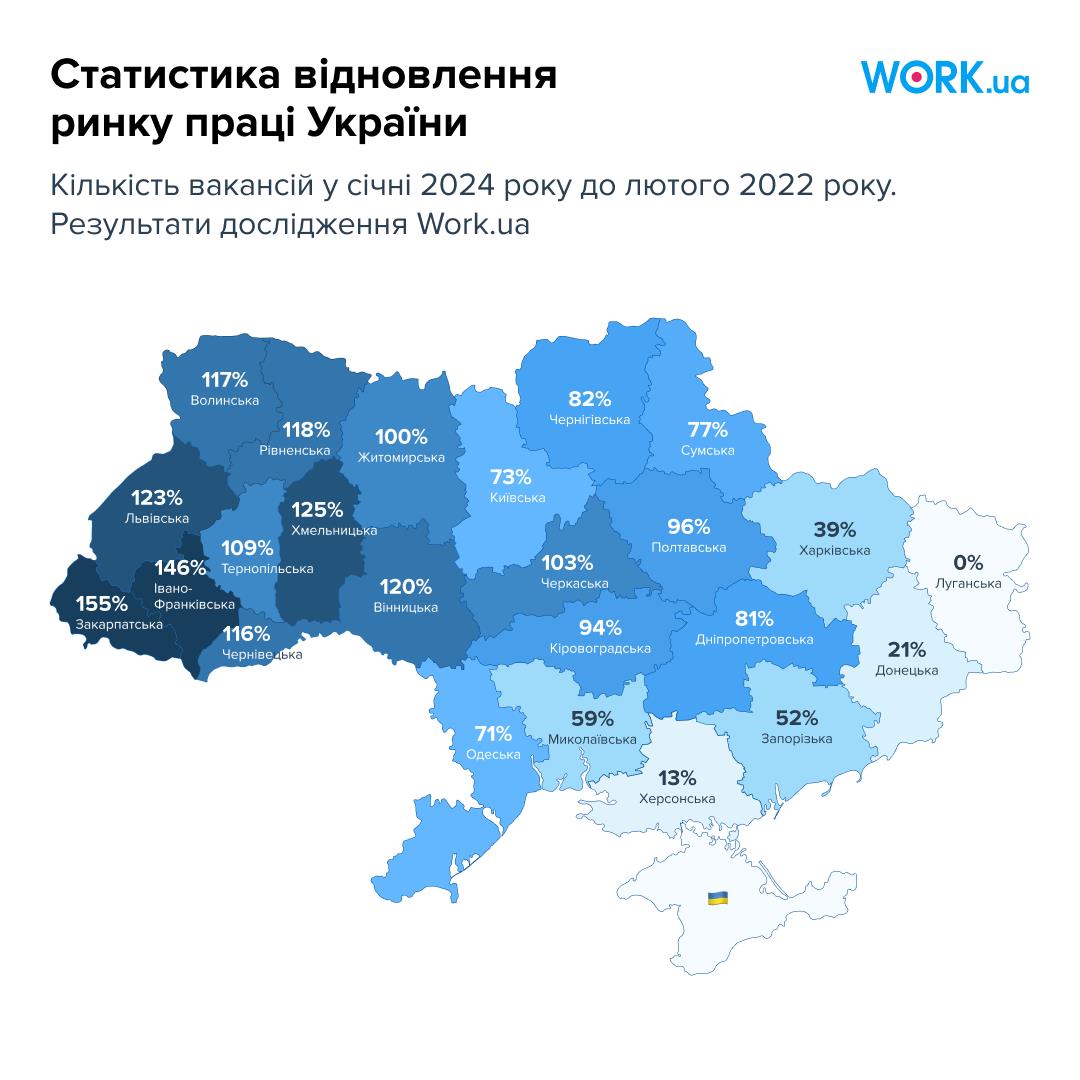
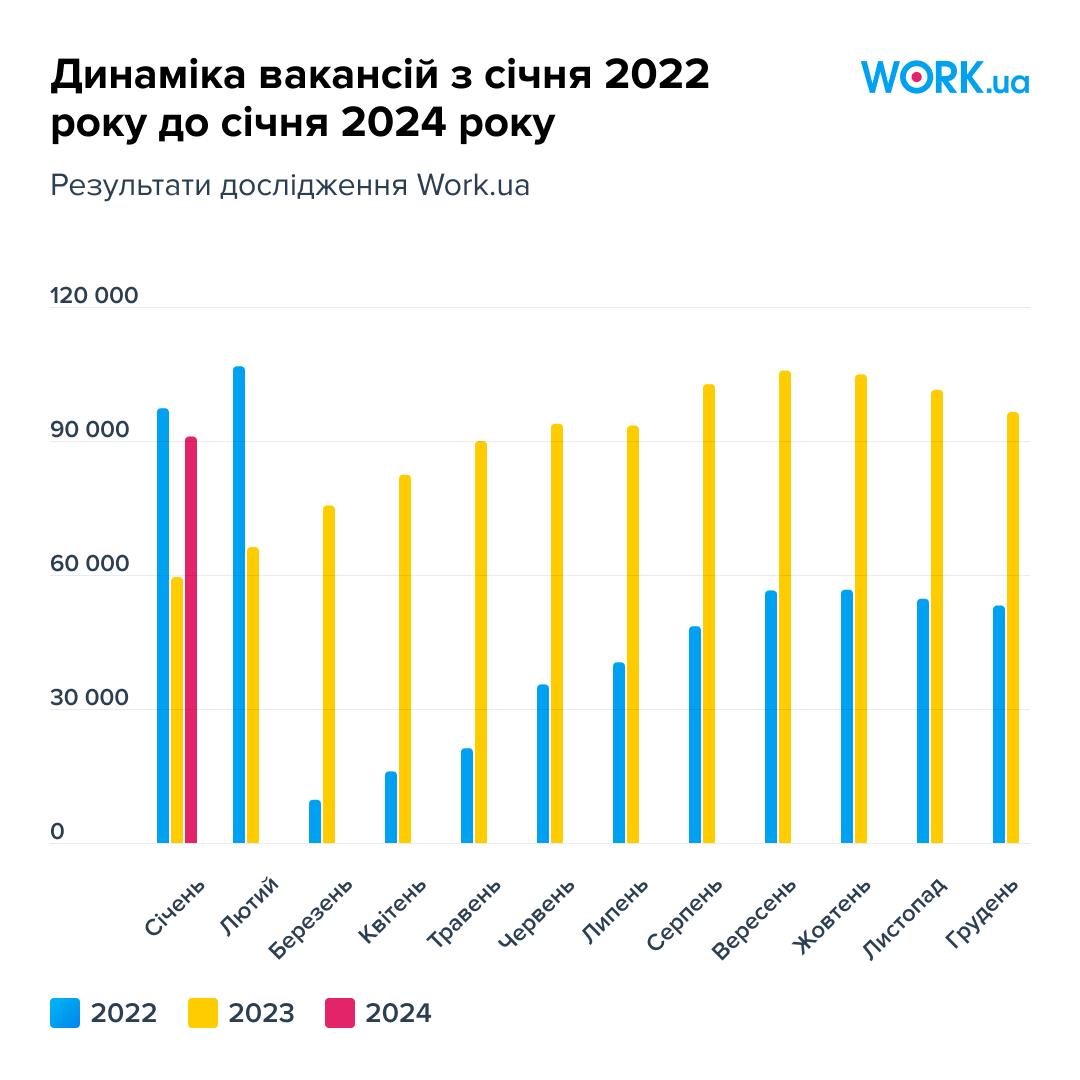
The labor market has recovered by 93%.
In January 2024, according to Work.ua, employers published 91,021 vacancies. This is 6% less than in December 2023 and 7% less than in January 2022. This means that the labor market has now recovered by 93% in terms of the number of job offers. But, as before, this recovery is uneven.
Compared to pre-war figures, the number of vacancies has increased the most in the following regions: Zakarpattia (155%), Ivano-Frankivsk (146%), Khmelnytsky (125%), Lviv (123%), Vinnytsia (120%), Rivne (118%), and Chernivtsi (116%).
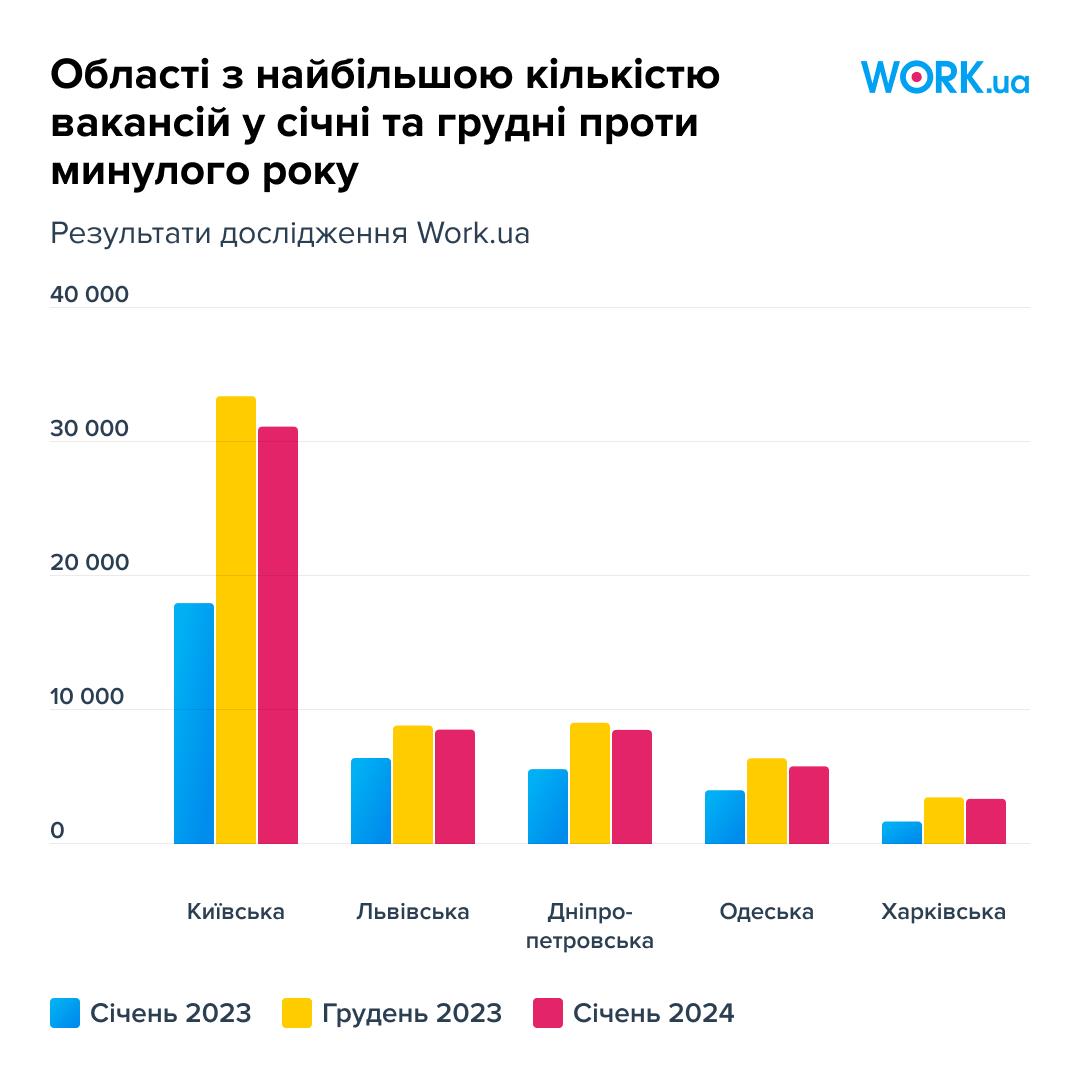
The leading regions in terms of the absolute number of job offers remain unchanged: Kyiv (30,913 vacancies), Lviv (8,473), Dnipropetrovs’k (8,452), Odesa (5,752), and Kharkiv (3,347). These regions account for 63% of all vacancies.
English language skills are required in almost every tenth vacancy
In December, the number of job offers decreased in all leading categories:
“Working specialties, production” – 14,923 vacancies, -14% compared to December;
“Service sector” – 14 674, -13%;
“Sales, purchasing” – 13,090, -1%;
“Retail trade – 10,809, -11%;
“Logistics, warehouse, foreign trade – 9,096, -10%;
“Administration, middle management – 8,340, -2%;
“Hotel and restaurant business, tourism” – 7,591, -16%;
“Transportation, automobile business – 7,214, -3%;
“Accounting, audit – 6,752, -2%;
“Medicine, pharmaceuticals – 6,326, -2%.
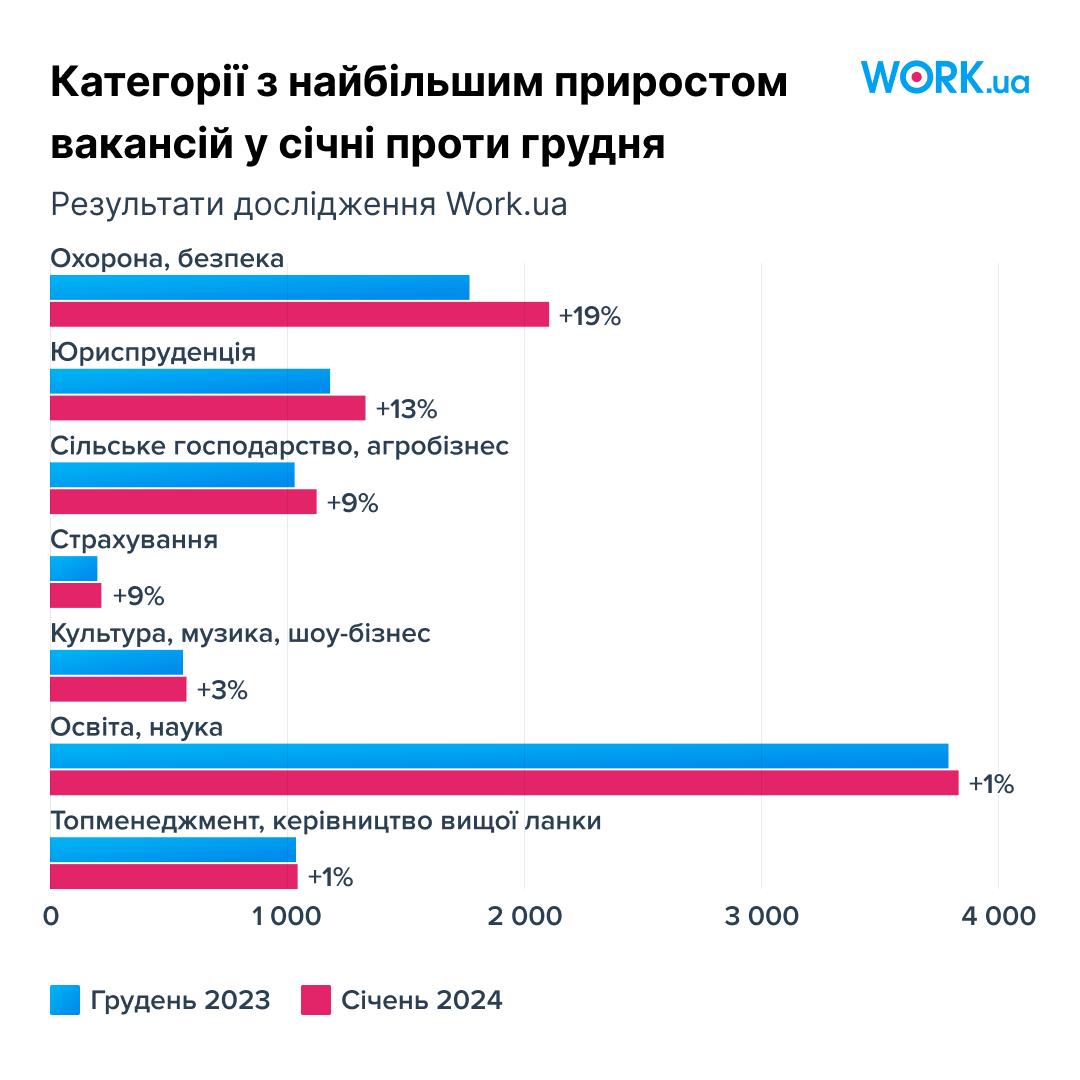
But in 7 categories, on the contrary, the number of jobs increased. The largest increase is seen in the category “Security, safety”, where vacancies are posted by the Defense Forces of Ukraine. You can learn more about them at work.ua/zsu/.
In terms of individual professions, the demand for the following specialists increased in January:
● Estimator (+21% compared to December, 138 vacancies)
● Correctional teacher (+20%, 147)
● Press secretary (+20%, 139)
● Service engineer (+20%, 324);
● massage therapist (+18%, 267)
● Financial analyst (+16%, 342);
● Turner (+16%, 200);
● graphic designer (+15%, 188);
● Florist (15%, 267);
● Project manager (+15%, 651).
In absolute terms, the labor market has the most job offers for sales consultants, sales managers, accountants, drivers, cashiers, cooks, loaders, account managers, administrators, sales representatives, and storekeepers.
The January drop in the number of vacancies affected almost all types of jobs. For example, the number of remote work offers decreased, and there were fewer vacancies for students and people without experience. Instead, employers are increasingly indicating that their vacancies are open to veterans (+6% compared to December, 6,194 job offers) and pensioners (+1%, 4,033).
Compared to December, the requirement for English language skills appears in job postings much more often. In January, this requirement was found in 7,990 vacancies, which is 19% more than in the previous month. In total, 9% of job offers require knowledge of English.
One third of job seekers want to work in Kyiv region or remotely
In January, job seekers updated or created 350,858 resumes on Work.ua. One third of all resumes indicated Kyiv region or remote employment as their preferred region of work.
Compared to December, the number of resumes increased by 24%. Obviously, job seekers have taken the idea of “new year, new job” seriously. So now employers have a better chance of finding qualified specialists. The increase in the number of candidates has also affected competition – it has increased by 42% compared to December.
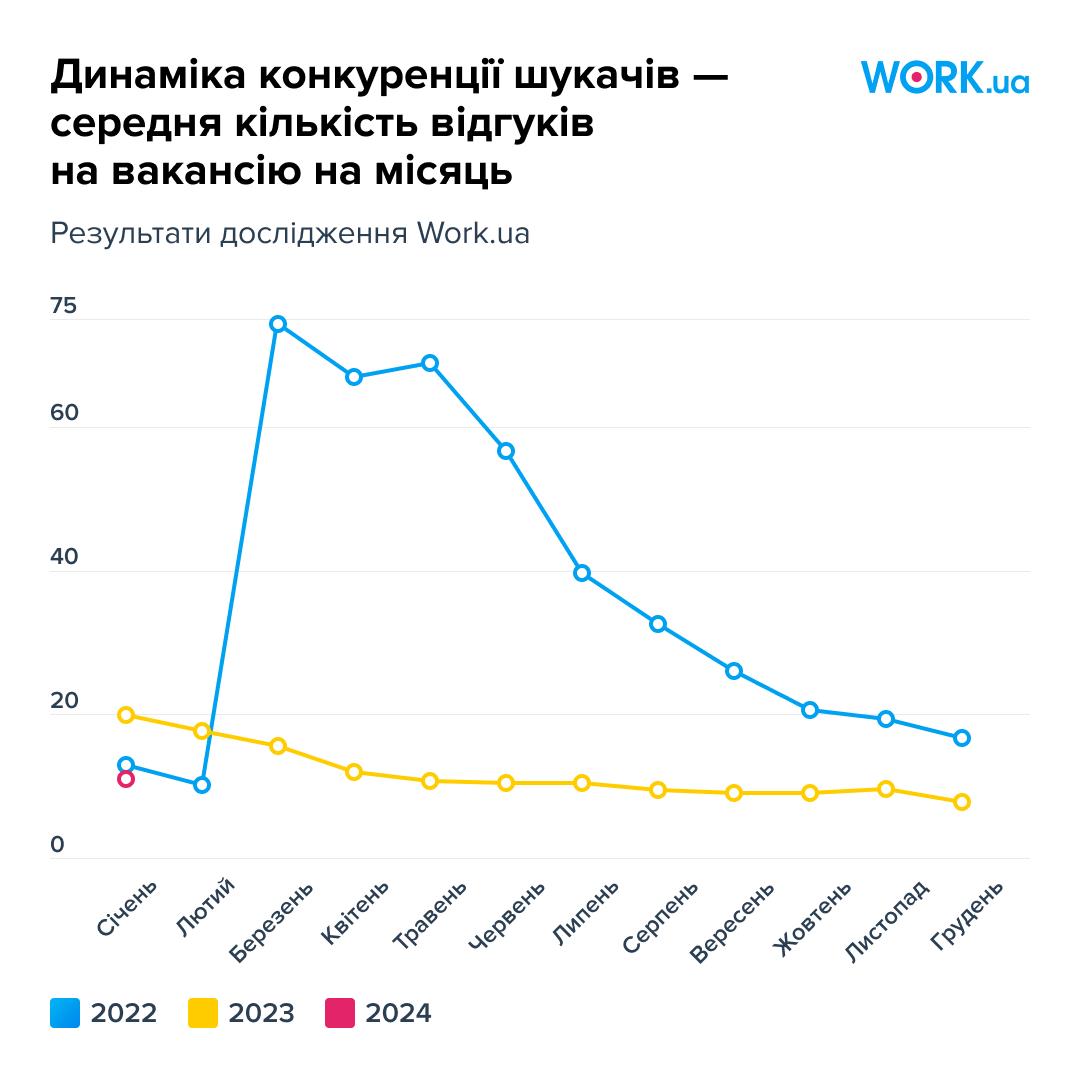
In December, employers in Kyiv, Vinnytsia, Volyn, Lviv, and Kharkiv regions received the largest number of responses to their vacancies. The most difficult situation with candidate responses was in Kherson, Zakarpattia, Chernivtsi, Cherkasy, Mykolaiv, and Chernihiv regions.
In January, the competition for remote work was 5 times higher than average: Ukrainians continue to want to work online the most. The number of responses from candidates for the most competitive remote positions increased several times more. These positions include front-end developer, coder, web designer, tester, Android programmer, video editor, Python programmer, and Java programmer.
The most difficult to find are blue-collar professionals and doctors. The list of positions with the lowest competition in January included a diesel locomotive driver, train assembler, stone processing specialist, miner, oncologist, endocrinologist, otorhinolaryngologist, gastroenterologist, and hirudotherapist.
On Work.ua, not only do candidates submit resumes, but employers can also offer job openings to job seekers. In terms of the ratio of the number of offers to the number of vacancies, the most active employers were those looking for housewives, realtors, police officers, contact center operators, development managers, sales managers, customer service managers, English teachers, sales consultants, and promoters.
The number of women in the labor market is growing
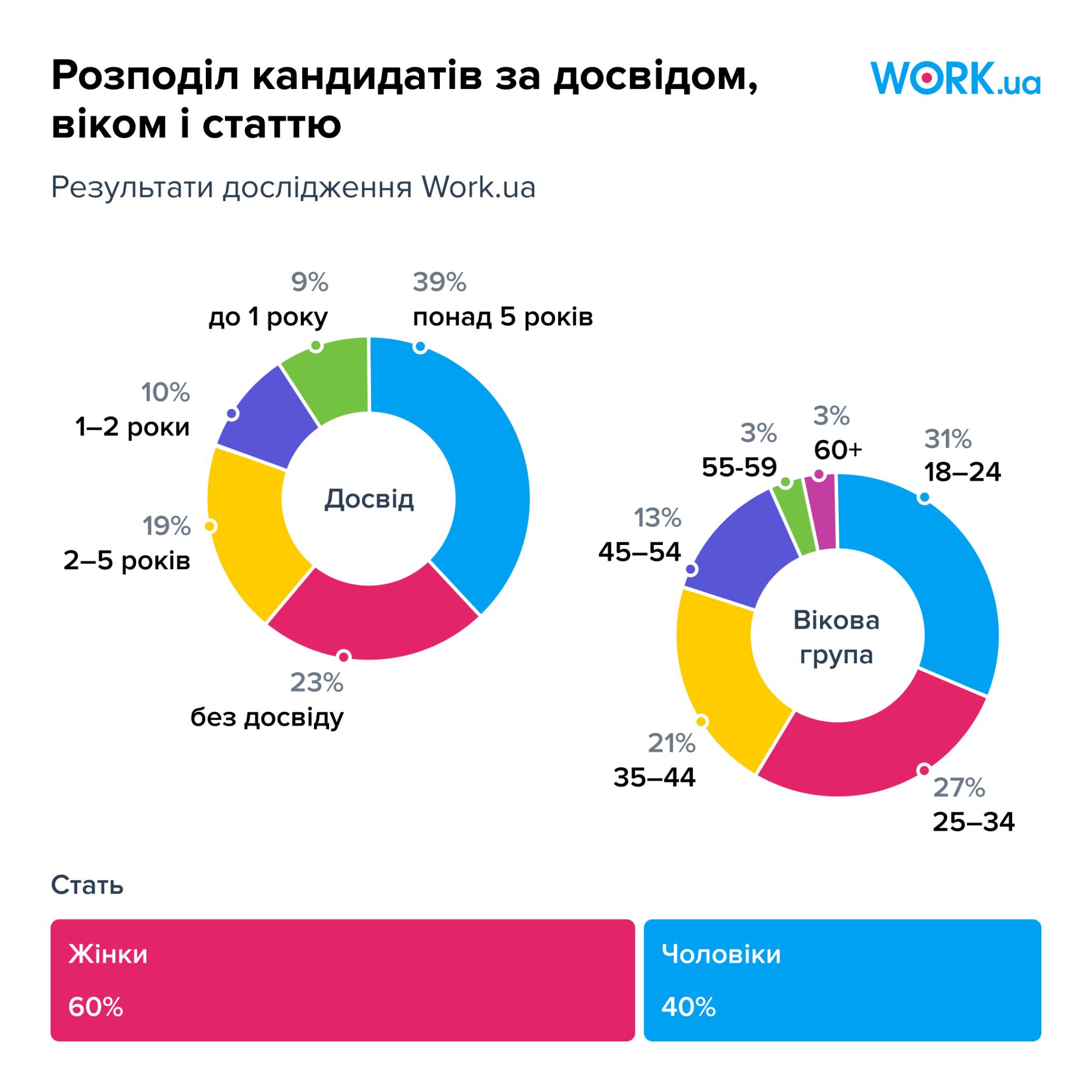
In January, job seekers updated or created 350,858 resumes on Work.ua. Among them, 60% are women and 40% are men. Compared to previous months, the share of women in the labor market has increased. However, there were no significant changes in the distribution of job seekers by age and work experience.
In January, the number of candidates for the following professions increased: embroiderer (+107% compared to December), SMM specialist (+99%), molder (+72%), insurance agent (+68%), office manager (+68%), nutritionist (+67%), tour guide (+67%), draftsman (+66%), psychiatrist (+66%), and event manager (+64%).
Vacancies in the Defense Forces are among the leaders in terms of salaries
The trend towards a gradual increase in wages, which began in 2023, continues. In January, the average salary increased by 3% to UAH 19,500. Among the leading regions, wages increased in Kyiv (+150 UAH to UAH 21,000), Lviv (+230 UAH to UAH 19,230), Odesa (+500 UAH to UAH 18,500), and Dnipro (+500 UAH to UAH 18,500). In Kharkiv region, however, the salary did not increase again and has remained at UAH 17,500 for the third month in a row.
In January, salaries of employees in some categories also increased:
● Insurance – UAH 22,000, +10% compared to December;
● Security and safety – UAH 17,500, +6%;
Agriculture, agribusiness – 21,000, +5%;
Real estate – 36,500, +4%;
Retail trade – 16,000, +3%.
In the ranking of positions with the highest salaries (except for executives and IT), we see positions of specialists for the Ukrainian Defense Forces: drone pilot, rifleman, grenade launcher, mortar operator (over UAH 70,000). To join the ranks of the Defense Forces of Ukraine, please apply for the vacancies posted at work.ua/zsu/.
Among civilian professions (except for executives and IT), the highest salaries in December were as follows:
● 47,500 UAH – media buyer
UAH 45,000 – international driver
UAH 42,500 – ceramist;
UAH 40,000 – a straightener;
● 37,500 UAH – endodontist, supermarket manager, realtor;
● UAH 36,250 – dental technician.

The labor market continues to develop according to an optimistic scenario: in April, as in previous months, the number of published vacancies increased and reached almost 82,500, which is 9% more than in March, according to the April labor market research from Work.ua.
“For the first time after the full-scale invasion, Kharkiv region broke into the top five in terms of the number of proposals and ranked fifth, overtaking Ivano-Frankivsk region. In turn, Dnipropetrovsk region overtook Lviv and ranked second,” the company said.
According to its data, now the labor market is almost at the level of April 2021, while in April 2022 there were only 16,050 vacancies.
The largest increase in vacancies in April was demonstrated mainly by the frontline regions: Kharkiv (up 26%, 2,795 vacancies), Sumy (up 17%, 735 vacancies), Chernihiv (up 16%, 883 vacancies), Kherson (up 14%, 136 vacancies), Zaporizhia (up 14%, 1,415 vacancies) and Kyiv region (up 13%, 25,717 vacancies).
As for the areas, the largest increase in vacancies compared to March was recorded in the areas of security and safety – 21%, hotel and restaurant business and tourism – 20%, services – 16%, construction and architecture – 15%.
The largest increase in employers’ demand occurred for the vacancies of a cleaner – 911 vacancies (up 33%), a security guard – 1,088 vacancies (up 32%), a bartender/barista – 1,768 vacancies (up 30%), a waiter – 1,382 vacancies (up 26%) and a picker – 1,549 vacancies (up 25%).
In April, applicants created and updated 18% fewer resumes than in March. In distribution by gender: 55% of candidates are women, 45% are men.
According to the resource, competition for jobs has continued to decline since March 2022 (69 responses per vacancy) and is now at the minimum – approximately 12 responses per vacancy in April against 15 in March 2023.



